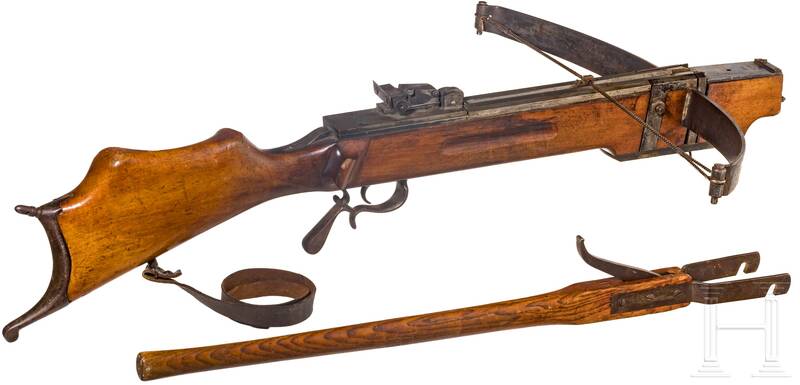
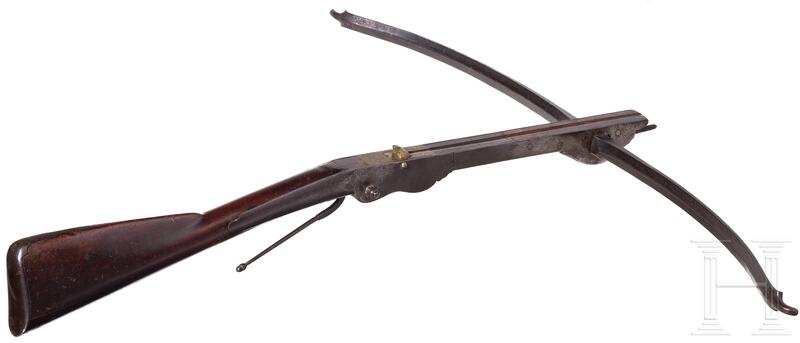
This ordinance crossbow features a steel prod in a screwed-in mount, strung with a solid steel wire string attached within the slide. The walnut stock features a thumb rest and capped off with an iron butt plate, serial number "EASV 644" on the front. A set of adjustable open sights (for elevation and windage) is present, right behind the intact claw lock, controlled by a single trigger within an iron trigger guard. Remnants of a sling is present around the butt. Also included is the 75 cm long cocking lever made of ash wood and iron.
Hermann Historica mentions that from the 1940s to the 1960s, the service crossbow was the official competition weapon of the Swiss Crossbow Shooting Association (EASV). It owes its name to its sights and trigger, which are similar to those of an army rifle. It formed the basis for the development of the modern match crossbow.
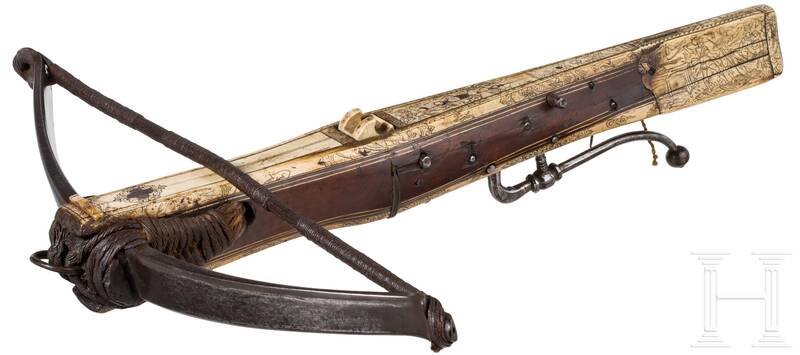
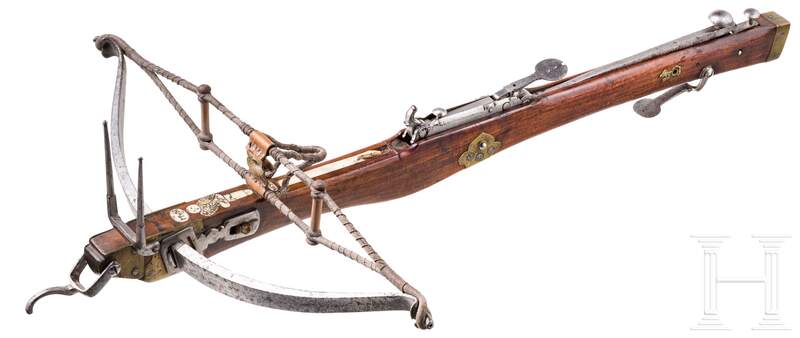
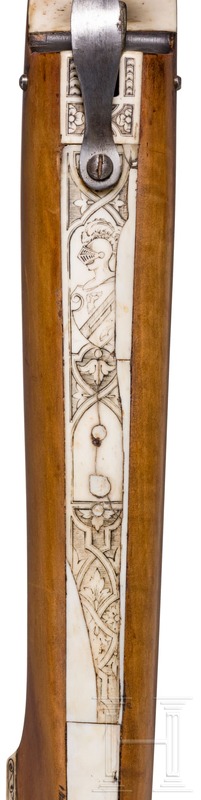
This bow features a set of heavy steel prod, with a circular mark with a sun burst struck on the inside on the right, the monogram "HF" stamped on the right, secured by thick blackened bridling. The finely grained, reddish-brown stock is rounded and covered with lavishly engraved bone inlays. The original nut is made of antler with iron securements in its chamber, secured with thread, or nussfaden. Operated by a multi-axle lock, the hair set trigger is accompanied with an iron trigger guard and transverse pin/lug, for a cranequin to engage with. The top of the tiller engraved with scenes of the Labours of Hercules amidst volutes and depictions of animals, an old inscription with the name "IACOB" behind the nut. The light-coloured side bands featuring antique heroes interspersed with leaping foxes, hounds, a hare and reclining deer. An antique scene with a dead king, killed by a shot, and three archers on the cheek rest. Fortuna floating above a globe is engraved on the bone butt cap. St Agnes holding a lamb and St Barbara with staff and chalice on the underside, engraved volutes and elaborately intertwined mythical creatures on the lower side bands.
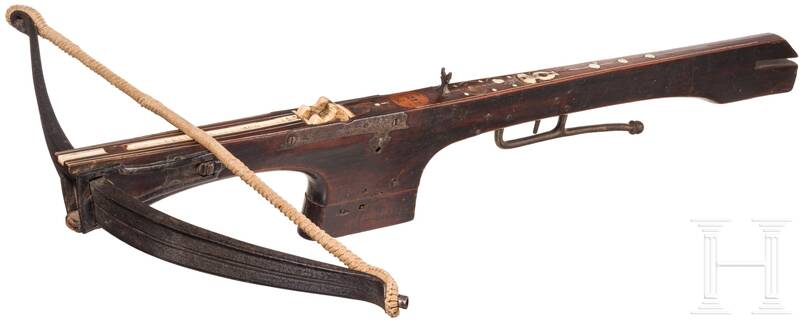
This crossbow features a set of heavy forged steel prod with a central rib on the back and the maker's mark "PM" (?) on the upper narrow side of each limb, and is anchored with laterally wedged iron prod reinforcements. The wooden stock includes a bracket attached at the bottom and iron lock plates. On the top of the stock is a bone bolt groove and fine bone carvings, behind the nut the incised number "III 1", and behind which is an iron sight. At the base of the stock, a slot is cut in for the cocking mechanism (possibly a windlass) and notches in the bow. The string engages with an iron-lined bone nut and is released with the spring-loaded trigger, long iron trigger guard with a ball end.
Hermann Historica notes that it is an early version of the Western European target crossbow, which still clearly shows its kinship with the Spanish crossbow.
This bolt or pellet crossbow features a set of blackened, slender steel prod, secured to the bow with tight bridling. The reddish-brown stained wood stock is covered with engraved bone inlays and iron fittings. On the top of the bone-lined guide rail, a bone inlay inscribed "LEHNHARD WIDENRODT"; on the sides of the stock, bone-inlaid mythical creatures. A teardrop-shaped iron ring is inserted at the front, and a front sight is inserted from the side. Aligning with that is an iron standing sight with an additional folding rear sight. A folding catch is controlled by the exposed hair trigger. To cap it all off, an iron butt cap, and a sliding butt plate on the right mirrored by the cheek rest on the left.
This elegant bolt crossbow features a curved steel prod with a burr on the inside and a blackened surface, and is secured by iron wedges in the iron-clad wooden stock with a bolt groove and flintlock-styled butt. The bow is operated with a single-axle brass nut with a long trigger lever, with iron inserts in the nut. Two rotating rollers on the sides serve as attachments for the cocking lever, and a square iron point is located at the front, possibly for cocking against a tree.
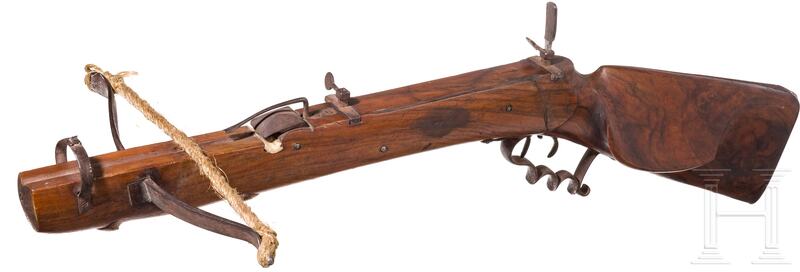
This bolt crossbow features a set of short steel prod, fixed into the bow with wooden wedges. The walnut stock has a ring or suspension ring screwed into the front, possibly for the sight alignment. A metal bolt clip and catch, with lining of bone in the cavity, is right behind it, operated by the set trigger and guarded by the iron trigger guard molded with finger holes. A diopter sight with adjusting screw is slided in from the side, and at the back, a moulded cheek rest.
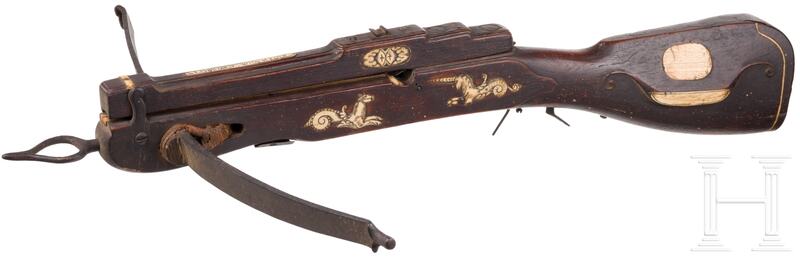
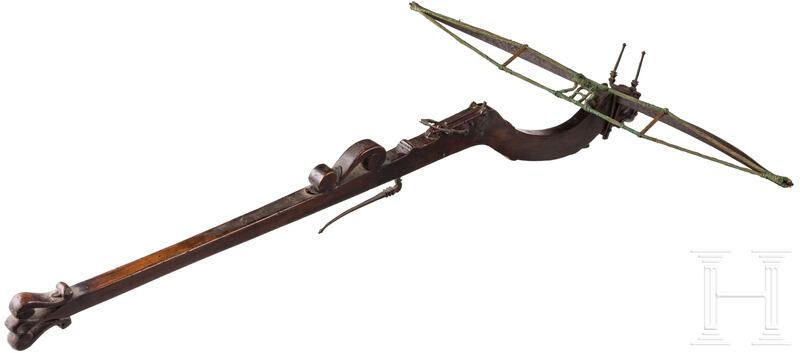
This pellet crossbow features a wedged narrow, slightly curved steel prod. The characteristically curved column is made of fine-grained wood, and subtly decorated with carvings (expressive leaf mask at the head, S-volute at the butt, and two small opposing S-volutes at the base). The bow has an intact iron lock and sight (rusty). The front is capped off with a monkey or idol-like figurehead rather than a spike, which is a unique feature.
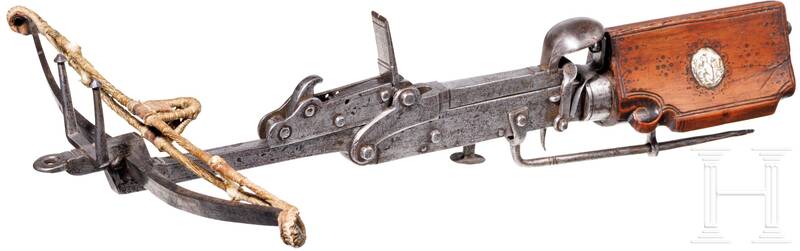
This crossbow is operated by a set of steel prods, markedwith "L W L" on the inside of both limbs and held to the stock in the center by two wedged iron clamps. Integrated into the stock is an iron cocking lever with a mushroom-shaped handle and cocking box, containing an intact lock with a single-finger nut and button release; a locking mechanism is located at the rear of the lever end. A set of high sight with rear sight and two diopter holes aligns with the folding iron sight fork. Built into the sturdy, fine-grained wooden stock is partially engraved bone inlays on the top, an owl motif, the monogram "MVM" and the year "1698" on the front. brass fittings, a downward-folding iron shoulder rest, and a swiveling suspension ring with a claw at the front.
Hermann Historica mentions that this bow is a very rare, beautifully preserved ball-barreled crossbow with an interesting mechanism. This type of ball-barreled crossbow originated in Spain and spread to the Netherlands and England following the Spanish fashion.
The bolt crossbow is supplemented with a steel prod, sturdy bridled and wedged with wooden pieces. The fine fruitwood stock is adorned with inlays of polished, finely engraved bone along the top, and capped off with the bone butt plate. A bone bolt saddle, suspension ring are all secured in the front. An intact catch with German set trigger and pivoting safety catch is seen on the underside.
This bolt crossbow features a sturdy steel bow secured with metal plates, with a cross-shaped mark on the left side of the coat of arms, secured by wooden wedges. The fine-grained stock has a continuous bolt groove and hunting-themed inlays of polished stag antler, a stag between two trees on the cheek rest, with a suspension ring attached at the front end. A polished catch is controlled by a long release lever, with a pivoting safety on the underside. The slide of the side butt compartment is securely closed.
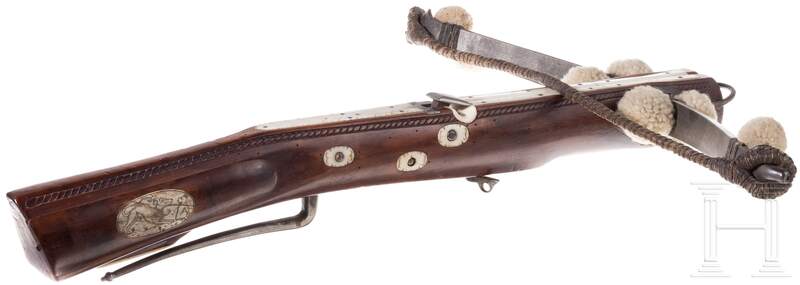
This crossbow features a wedged steel bow with very well replaced hemp string, with bone sticks as spacers. A set of inserted and riveted forked sight up in the front. The stock is entirely made out of metal, with a suspension ring forged right in the front. Operated with the case with one-finger nut, cranking lever, and aligning it with the vertical rectangular folding sight. A trigger with set button is protected with an iron trigger guard. At the back of the bow, a short wooden stock is decorated with incised lines around the edges and a pattern of dots, on the left side, an inlaid bone medallion engraved with a squirrel, at the rear end of the stock an iron pommel (with drilled hole underneath).
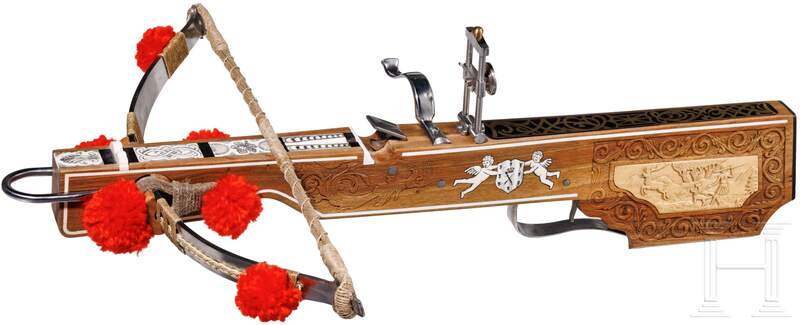
This bolt crossbow has a wedged in steel prod with red wool pom-poms sparsely decorated, secured in front is a metal suspension ring. The walnut stock is inlaid with many relief carvings, engraved white bone and intricately openwork brass along the relief-carved wood. Capped off with a dark wood butt cap, a bone medallion (monogram "UF") is embedded in the center of it. A single trigger, with a set of steel bolt clipped and steel catch, topped off with the large folding frame sight with adjustable diopter.
Hermann Historica notes that it is made with loving details in the style of the 17th/18th century, a cleanly crafted crossbow in beautiful, working condition.