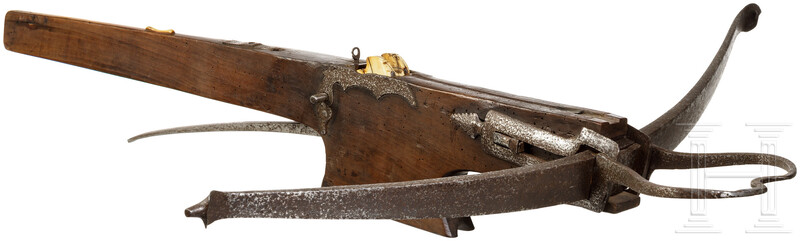
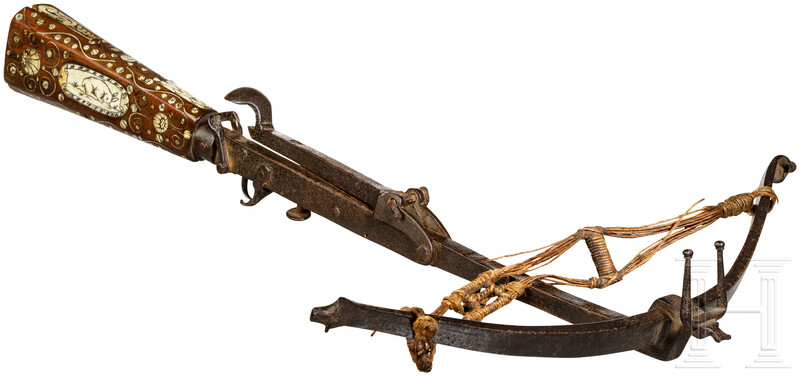
This large bolt crossbow features a set of sturdy steel prod with a biconvex cross-section and circular mark on it, secured by iron bow clamps alongside a metal stirrup in the front. The square wooden stock secured the nut with iron reinforcements, as well as a recessed iron bolt groove and pop-up sight, and a bone thumb rest at the rear. The bow is operated by a single-axis lock with a free-floating, bone nut and the large iron lever. Behind the lock is a transverse pin for cocking devices such as cranequin or cocking levers.
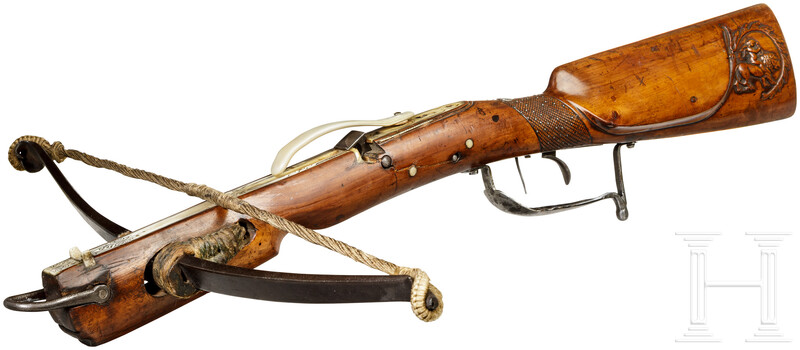
This crossbow features a blackened steel prod, stamped "R" (Johann Friedrich Rothe, Leipzig) on the right inner side, secured to the bow by thick bridling. Riveted in front is a suspension ring and a laterally inserted bolt bridge. The fruitwood stock is covered with engraved bone inlays and figurative carving on the butt, and a fish-scale pattern decorated with nails on the handle with a silver, and a rounded cheek rest elaborately decorated on the stock. The bow is operated with a folding catch with a large bolt clip is on top of the nut, and the hair and set triggers are located within the iron trigger guard.
Hermann Historica compares this to a similar piece signed "JFR" in the Hallwylska museet, Stockholm, and Richter, H., "Einmedenk der alten Zeit", exhibition catalog, Stadtmuseum Weimar, 2011, p. 51.
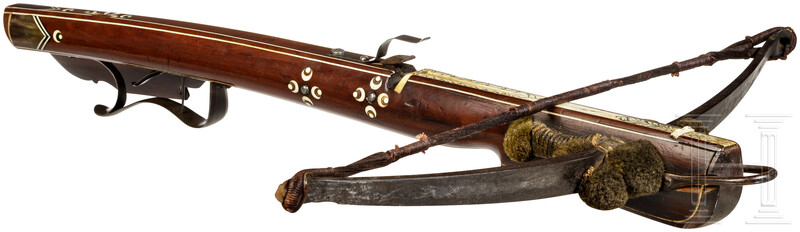
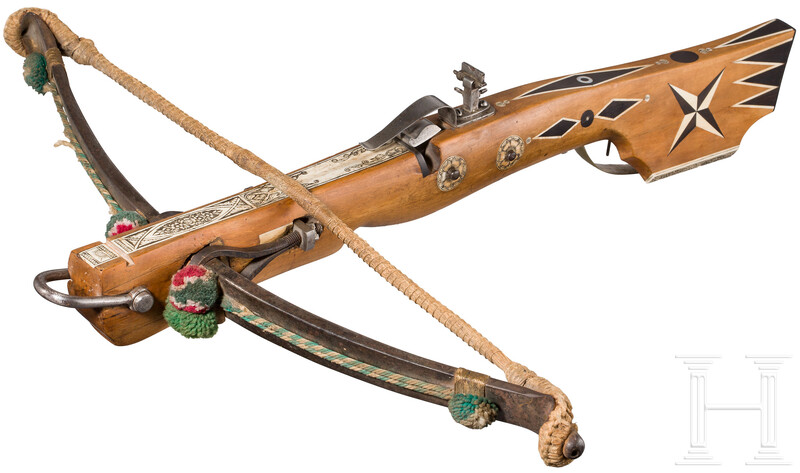
This crossbow has a blackened steel prod, decorated with a trefoil mark on the right inner side. Securing to the bow is a set of sturdy, old binding with traces of gilding, at the front, a riveted suspension ring as well as green wool pom-poms. The fruitwood stock is decorated with inlays of polished antler, dark horn, and ebony depicting circles, a palmette, and a compass rose (cheek end). Operated by a catch lock with a pin; the engraved year "1828" is inscribed in front of the latch. At the back, a polished antler butt cap bearing the engraved, blackened maker's mark "Haenisch in Dresden" can be seen.
The Hänisch family continued to produce bows in the 19th century, following a long-standing tradition. Crossbows almost identical to Baroque models, cf. H. Richter, Die Kunst der Armbrustmacher in Dresden (The Art of Crossbow Makers in Dresden), Beucha, 2008. Elegant, beautifully shaped disc crossbow, corresponding to the courtly weapons in the Dresden Armory. Comparable pieces with the cloverleaf mark on the bow are also stored there. Condition: II
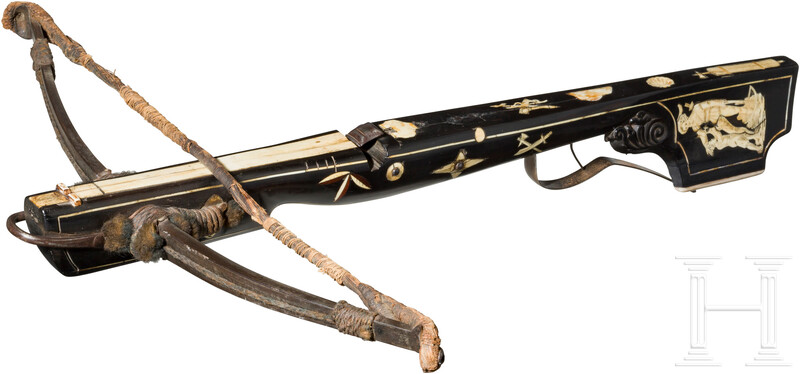
This crossbow features a forged, steel prod secured with braided safety string, and is strung with a braided hemp string, attached to the bow through cord bridling. The original greenish wool pompoms have faded in color. The rounded ebony stock is inlaid on the top and on the sides are engraved and blackened bone inlays in the form of trophy bundles, and the cheek rest is imbedded with a portrayal of Wilhelm Tell and his son. Operated by the iron flap lock, the set trigger is protected by the trigger guard. A missing hole in the shape of what may be a diopter sight is right behind the catch.
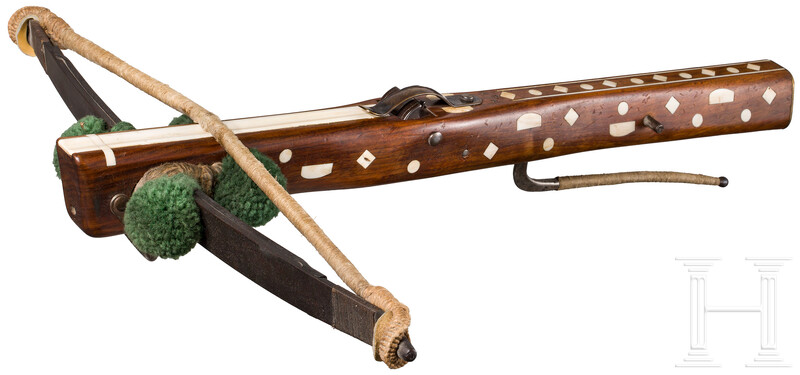
This bolt crossbow features a steel prod with a braided multicolored hemp safety crd and green wool pompoms on the prod. Riveted upfront is a suspension ring into the light walnut stock. It is lined with iron fittings and engraved bone inlays, as well as further geometric bone and wood inlays on both sides. A curved catch is behind the engraved bolt guide with a broken off sight. Right below that is the transverse pin, which is in place for the cocking lever or cranequin.
This bolt crossbow features a double-layered steel prod strung with braided hemp string and secured with bridling. The front is sparsely decorated with green wool pompoms. A rivet is present in the front into the walnut stock but nothing is attached onto it. The walnut stock is covered with simple leg inlays and iron fittings, with a transverse pin for the cocking lever or possibly cranequin. On the top of the bow, a bone bolt guide is reccessed into the bow, as well as a bone bolt rest, and the iron bolt clip and nut. The trigger is cord-wrapped and in a old-fashioned long lever style.
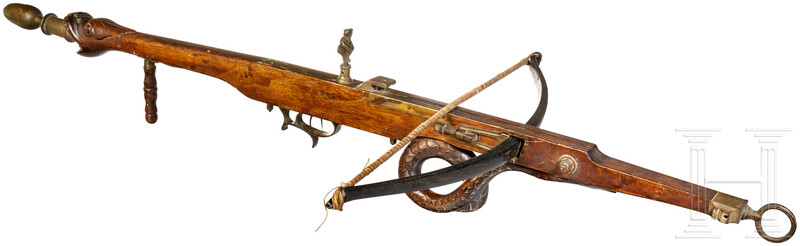
This heavy disc crossbow is fitted with a heavy steel prod strung with hemp string and secured with screwed in brass bow clamps. The square walnut stock features a serpentine butt carving at the end. On the top, it is lined with a recessed bolt groove, catch lock with hair trigger and set trigger. A diopter sight behind the catch is in the shape of a male figure. Length-adjustable shoulder rest on the underside, with an acorn-shaped brass balance weight at the end of the stock.
Hermann Historica mentions that it is an unusually large example of this type of target crossbow, which is still used in competitions in Belgium today. The crossbow is rested on the shoulder, and the counterweight ensures a steady aim.
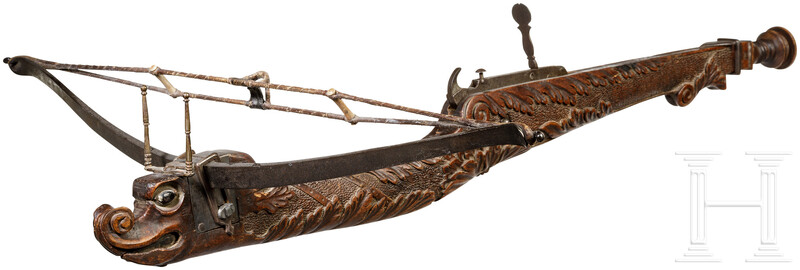
This gorgeously carved stonebow is fitted with a sturdy, slender steel prod with a rounded belly, held secure by two iron clamps wedged together. A set of iron sights is riveted to the front, possibly resembling something of horns. The string is weaved with two strands, and includes bone spacers and a leather bullet sack. The iron lockbox is integrated in the stock with a heart-shaped handle and case, containing a one-finger nut and push-button release. A high folding front sight at the back aligns with the front iron sights. The brown stained, wooden stock is lavishly carved with a dolphin's head, raised acanthus leaves, bands and volutes on a dotted, punched background, turned, contoured pommel.
Hermann Historica notes that less ostentatious, contemporary stonebows of this type from the Netherlands and England are known to exist. This elaborately carved version is absolutely one-of-a-kind.
This pellet bow is fitted with a set of slender, iron prod strung with a frayed string. A set of beaded iron sights is attached to the front with no spike. The stock of the bow is made out of iron, except for the symmetrical, wooden butt with richly engraved bone inlaid with two large replaced medallions with depictions of animals. The bow is missing it's cocking mechanism with only the cocking handle remaining, and everything else missing.
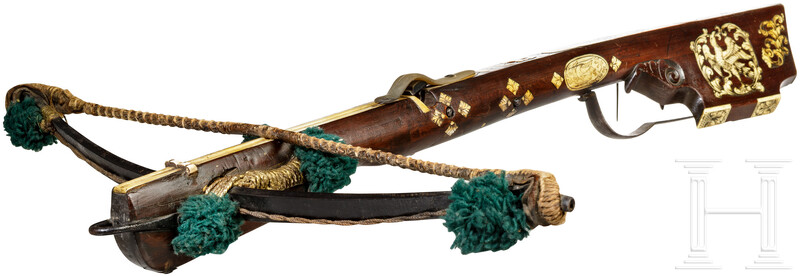
This bolt crossbow features a slender, blackened steel prod secured to the stock with gilt cord bridling. The front is sparsely decorated by green wool pompoms and a screwed in suspension ring. The fruitwood stock is covered with inlays of polished, delicately engraved antler (several replaced), depicting bird motifs, a satyr's head, a landscape and baroque acanthus tendrils. The bow is operated with a catch lock with a double set trigger protected by a shaped guard. The top of the stock is entirely lined with antler carvings and a bolt rail, and to cap it off, the butt cap made of dark horn, and a cheek rest is also potruded from the bow.
Hermann Historica mentions that this elegant, graceful crossbow is similar to the courtly weapons at the armoury in Dresden. The gilt bridle and the green pompons correspond to the colours of the Saxon state coat of arms and are found on crossbows of Saxon provenance. Weapons of this size are listed in the inventories of the armoury in Dresden as "Wandschnepper" (target crossbows) and were used for target shooting during the 18th century as entertainment for the nobility and wealthy citizens. See H. Richter, Die Kunst der Armbrustmacher in Dresden, Beucha, 2008, pp. 19, 40, 56, 80 and 84.
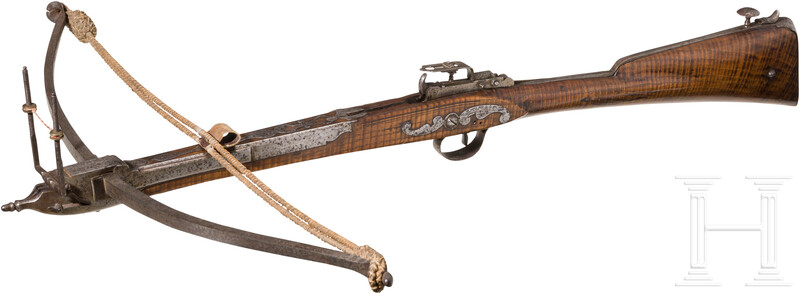
This large crossbow features a wide steel prod with convex inner face wedged in with metal, and strung with a pouched string without a point to catch on. Operated by a single-finger nut, it is controlled by a singular trigger protected by a round trigger guard. A finely adjustable folding sight sits right behind the nut, alinging with the folding sight fork. The elegant curly maple stock and the shotgun butt are all lined and decorated iron furniture.
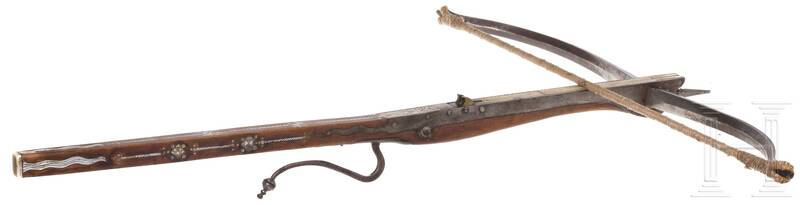
This long and wide crossbow is fitted with an elegantly curved steel prod with a burr on the inside, and secured with iron wedges. The slender wooden stock is lined with bolt groove and old iron fittings on both sides. Operated with a single-axle lock, it is controlled by a long trigger which releases the brass nut. Two rotating rollers on one side possibly originally both serve as attachments for the cocking lever, with a square iron point at the front for cocking.