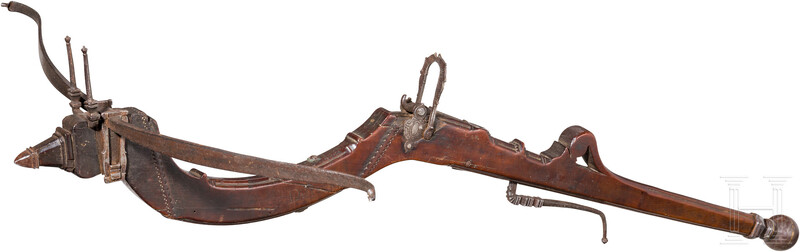
This bullet crossbow is operated with a narrow, slightly curved steel prod, which is secured to the front of the curved stock through wedges. A protruding spike is attached to the front, and a fork for a beaded sight is also raised up top. The typically curved, lightly carved walnut stock is covered with many iron fittings near the joints and edges, and the sights, nut and trigger are all iron too. Operated with a single fingered nut, it is released with the long and curved trigger with a ball at the end. At the rear end, an iron ball pommel is decorated with ornamental and figurative gold inlay, depicting a winged quadripedal creature perhaps from mythology.
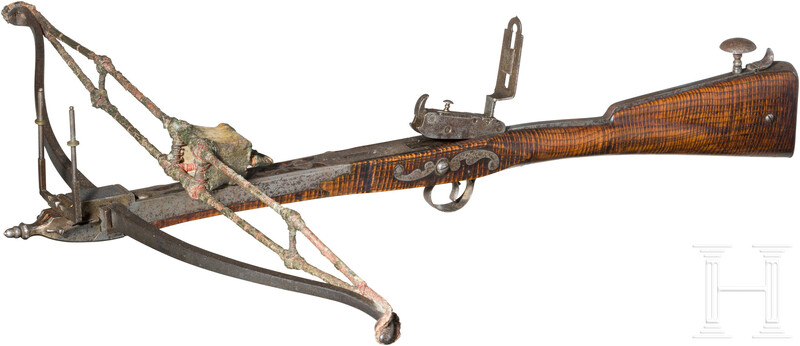
This bullet crossbow has an elegantly curved steel bow wedged into the stock, strung with a string and leather ball bag. Attached in front is a spike for cocking and a set of fork for a raised bead front sight. An integrated iron lock box locks the string with a single-finger nut, and behind that is a finely adjustable folding sight to align with the front bead sight. The detailed maple stock has many decorated iron installations, and vertical detailing, and at the end, the shotgun-styled butt has a raised mushroom-like metal part, possibly for resting on while aiming.
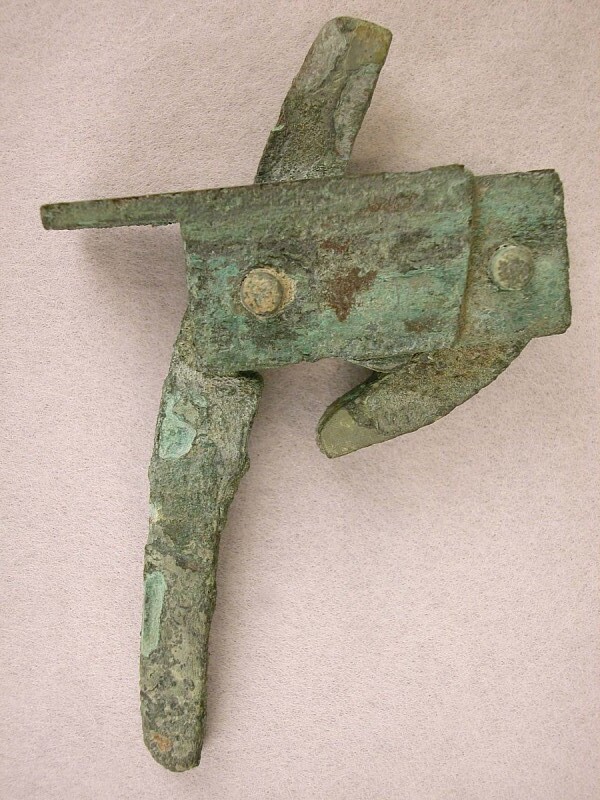
This bronze crossbow mechanism held by the Smithsonian Institution is dated to the Western Han dynasty. Its specific location of unearthing is not listed.
The mechanism is made of bronze and it comprises most of the typical parts of a Chinese crossbow mechanism. The long rectangular protrusion at the top of the mechanism is the sight, or wangshan (望山). The two small hooks sticking out in front of the sight are a part of the same component as the wangshan and serve as the nut, or ya (牙). The rectangular handle at the bottom of the mechanism is the trigger, or xuandao (悬刀), which in this specimen has been snapped, and within the bronze casing, or guo (郭) there is a sear, or gouxin (钩心) connecting the sight and nut and the trigger. The mechanism is held together by two bronze axle pins. The top surface of the bronze casing has a groove that goes down the middle which would continue onto the wooden stock of the crossbow. This groove would be where the arrow rests during drawing and aiming. The surface of the mechanism has been severely corroded and oxidised, so much so that the component parts likely do not move smoothly against each other.
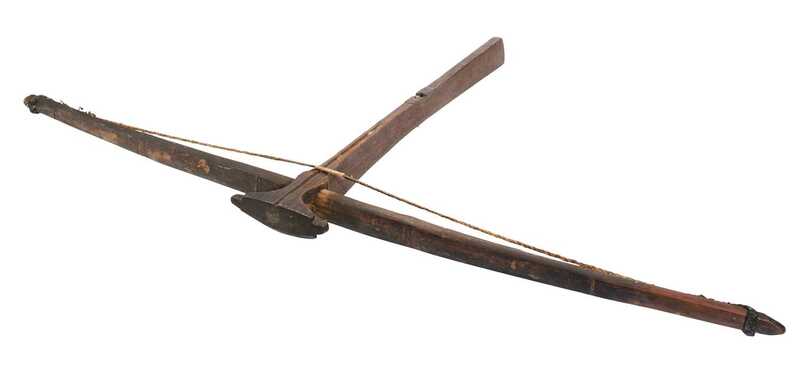
A crossbow from the late 1800s of Southeast Asian origin, likely used for hunting purposes. It is composed of a short wooden stock that is slender towards the main body and widens towards the front. The crossbow features a rectangular bolt groove carved into the stock. The prod of the crossbow is made from a piece of split bamboo and passes through the upper middle portion of the stock. The string attached to the prod is made of a twisted plant fiber. The nut mechanism, made of bone, is set deeply within the stock in a wooden bracket and protrudes through the other side of the stock, thus forming the trigger.
Measurements: 63.3 cm long, 116.0 cm bow
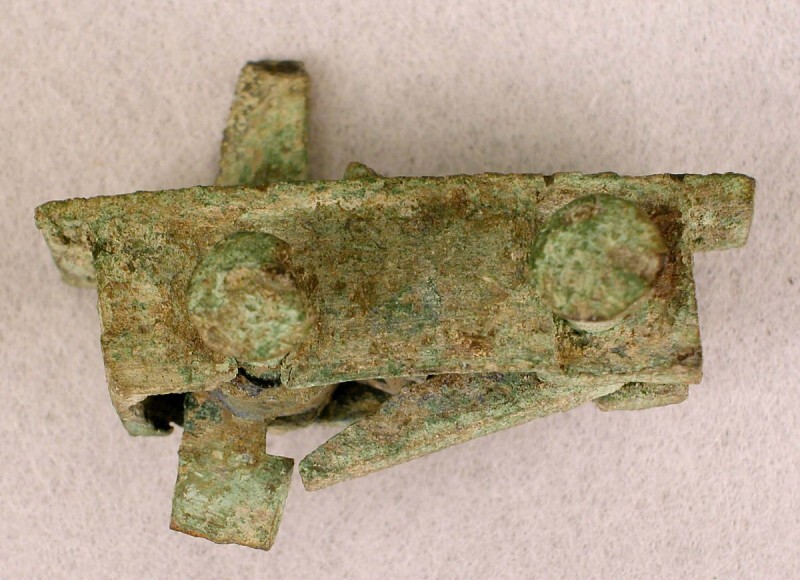
This bronze crossbow mechanism held by the Smithsonian Institution is dated to the Western Han dynasty. Its specific location of unearthing is not listed.
The mechanism is made of bronze and it comprises most of the typical parts of a Chinese crossbow mechanism. The long rectangular protrusion at the top of the mechanism is the sight, or wangshan (望山). Not visible in the photo, there are two small hooks that stick out in front of the sight which are a part of the same component as the wangshan and serve as the nut, or ya (牙). The rectangular handle at the bottom of the mechanism is the trigger, or xuandao (悬刀), and within the bronze casing, or guo (郭) there is a sear, or gouxin (钩心), which hangs out from under the casing in this photo, connecting the sight and nut and the trigger. The mechanism is held together by two bronze axle pins. The top surface of the bronze casing has a groove that goes down the middle which would continue onto the wooden stock of the crossbow. This groove would be where the arrow rests during drawing and aiming. The surface of the mechanism has been severely corroded and oxidised, so much so that the components of the mechanism appear to have joined together.
This bronze crossbow mechanism held by the Smithsonian Institution is dated to the Eastern Han dynasty. Its specific location of unearthing is not listed.
The mechanism is made of bronze and it comprises most of the typical parts of a Chinese crossbow mechanism. The long rectangular protrusion at the top of the mechanism is the sight, or wangshan (望山). The two small hooks sticking out in front of the sight are a part of the same component as the wangshan and serve as the nut, or ya (牙). The rectangular handle at the bottom of the mechanism is the trigger, or xuandao (悬刀), and within the bronze casing, or guo (郭) there is a sear, or gouxin (钩心) connecting the sight and nut and the trigger. The mechanism is held together by two bronze axle pins. The top surface of the bronze casing has a groove that goes down the middle which would continue onto the wooden stock of the crossbow. This groove would be where the arrow rests during drawing and aiming. The surface of the mechanism has been corroded and oxidised.
The description on the Smithsonian mentions that there are gold and silver inlays, but that is not visible in the photo from this angle. It is likely that the inlay would be located on the top surface of the mechanism’s bronze casing.
This bronze crossbow mechanism held by the Smithsonian Institution is dated to the Western Han dynasty. Its specific location of unearthing is not listed.
The mechanism is made of bronze and it comprises most of the typical parts of a Chinese crossbow mechanism. The long rectangular protrusion at the top of the mechanism is the sight, or wangshan (望山). The two small hooks sticking out in front of the sight are a part of the same component as the wangshan and serve as the nut, or ya (牙). The rectangular handle at the bottom of the mechanism is the trigger, or xuandao (悬刀), and within the bronze casing, or guo (郭) there is a sear, or gouxin (钩心) connecting the sight and nut and the trigger. The mechanism is held together by two bronze axle pins. The top surface of the bronze casing has a groove that goes down the middle which would continue onto the wooden stock of the crossbow. This groove would be where the arrow rests during drawing and aiming. The surface of the mechanism has been corroded and oxidised.
There are designs inlaid in silver on the top surface of the crossbow mechanism as well. These designs resemble cloud-like formations, arranged in a geometric fashion.
This bronze crossbow mechanism held by the Smithsonian Institution is dated to the Eastern Han dynasty. Its specific location of unearthing is not listed.
The mechanism is made of bronze and it comprises most of the typical parts of a Chinese crossbow mechanism. The long rectangular protrusion at the top of the mechanism is the sight, or wangshan (望山). The two small hooks sticking out in front of the sight are a part of the same component as the wangshan and serve as the nut, or ya (牙). The rectangular handle at the bottom of the mechanism is the trigger, or xuandao (悬刀), and within the bronze casing, or guo (郭) there is a sear, or gouxin (钩心) connecting the sight and nut and the trigger. The mechanism is held together by two bronze axle pins. The top surface of the bronze casing has a groove that goes down the middle which would continue onto the wooden stock of the crossbow. This groove would be where the arrow rests during drawing and aiming. The surface of the mechanism has been corroded and oxidised.
This bronze crossbow mechanism held by the Smithsonian Institution is dated to the Western Han dynasty. Its specific location of unearthing is not listed.
The mechanism is made of bronze and it comprises most of the typical parts of a Chinese crossbow mechanism. The long rectangular protrusion at the top of the mechanism is the sight, or wangshan (望山). The two small hooks sticking out in front of the sight are a part of the same component as the wangshan and serve as the nut, or ya (牙). The rectangular handle at the bottom of the mechanism is the trigger, or xuandao (悬刀), and within the bronze casing, or guo (郭) there is a sear, or gouxin (钩心) connecting the sight and nut and the trigger. The mechanism is held together by two bronze axle pins. The top surface of the bronze casing has a groove that goes down the middle which would continue onto the wooden stock of the crossbow. This groove would be where the arrow rests during drawing and aiming. The surface of the mechanism has been corroded and oxidised, but it appears that the mechanism might have once been gold plated.
This bronze crossbow mechanism held by the Smithsonian Institution is undated. Its specific location of unearthing is not listed.
The mechanism is made of bronze and it comprises most of the typical parts of a Chinese crossbow mechanism. The long protrusion at the top of the mechanism is the sight, or wangshan (望山). In this specimen, the sight is shaped like a beast, potentially a tiger or a mythical creature. The two small hooks sticking out in front of the sight are a part of the same component as the wangshan and serve as the nut, or ya (牙). This specimen is missing the trigger, or xuandao (悬刀), and it appears to also be missing the sear or gouxin (钩心) which would have connected the sight and nut to the trigger. Its bronze casing, or guo (郭) has a part of it broken off, and the mechanism is missing its two bronze axle pins which would have held it together. The top surface of the bronze casing has a groove that goes down the middle which would continue onto the wooden stock of the crossbow. This groove would be where the arrow rests during drawing and aiming. The surface of the mechanism has been corroded and oxidised.
This bolt crossbow is operated with a sturdy, bolted steel prod strung with braided hemp string. The prod is heavily wedged into the bow with metal securements alongside a front suspension ring screwed it. The rounded wooden stock is decorated with spiral bone linings, and has iron fittings screwed on the top, with a catch connected to the set trigger, protected with the long slightly curved guard trigger. The butt of the bow features an ornamentally engraved bone bolt rest; the inlays on the potruded cheek rest feature the words "A" and "C", with a circular face iconography and date "1691" on the buttstock.
This crossbow features a forged and wedged, heavy steel bow without string secured with metal reinforcements with screws, alongside a large stirrup. The rounded curved walnut stock features geometrical inlays and a bone bolt guide. Operated by an iron catch reinforced with ivory, it also has a large curved bolt clip with an opening in the middle, and in the back an adjustable rear sight, and a hair and set trigger guarded by a shaped finger guard.