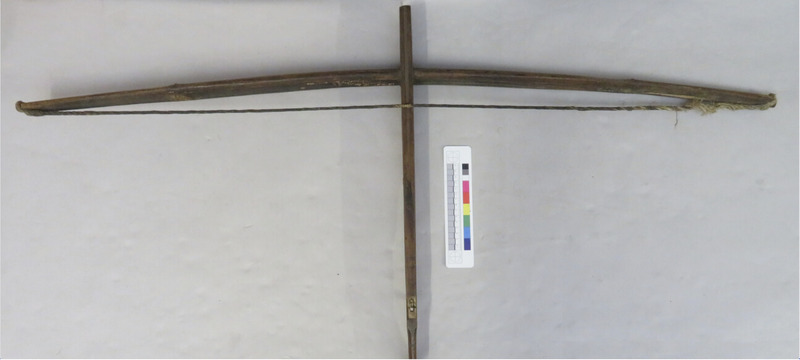
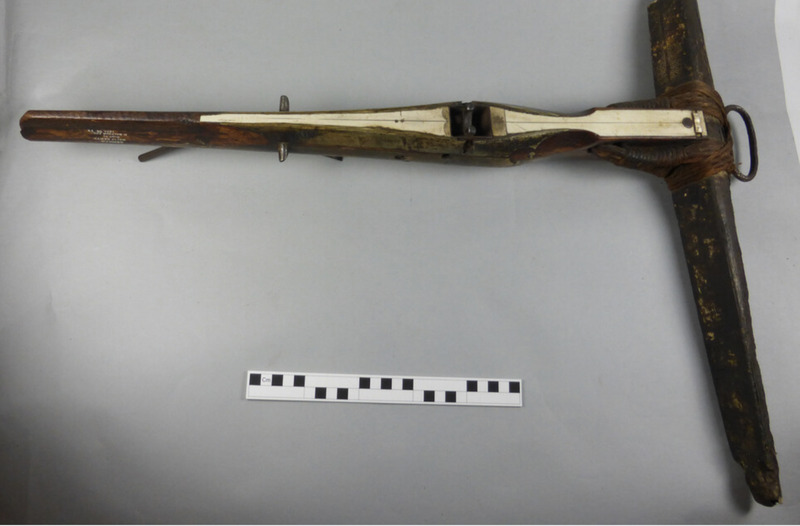
This crossbow, dated to before 1947, originates from the Arunachal Pradesh region of India and is used by the Nyishi ethnic group. It features a slender wooden stock that narrows and rounds at the butt end of the stock. The prod is slotted into the middle of the upper end of the stock and is made from a split bamboo material. The original bow string is intact and made of some kind of twisted plant fiber. At the butt of the stock is a trigger mechanism made of bone.
Dimensions Height: max 77 mm, Length: max 1280 mm, Width: max 620 mm
Materials and processes: Material Wood Plant, Material Cane Plant, Material Bone, Material Animal Sinew (uncertain), Material Plant Fibre (uncertain), Process Carved, Process Perforated, Process Wound, Process Twisted
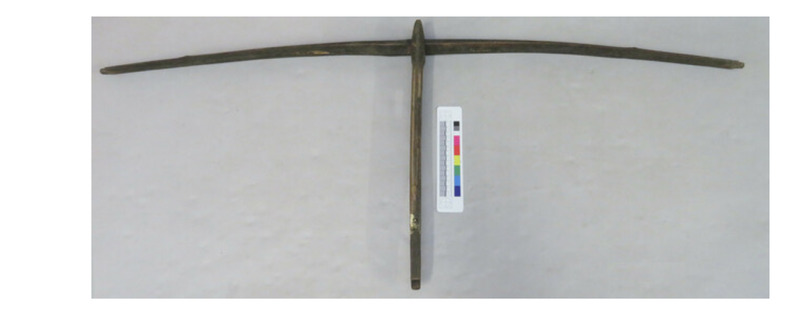
A wooden crossbow from Nagaland, India, dated to before 1897. It features a wooden stock that narrows toward the butt end of the stock with a small curve. The prod is made of a split cane plant fiber and passes through the upper portion of the stock that is fitted within a socket. The original string of the crossbow is missing, and the trigger is made of bone.
Measurements: Height: max 58 mm, Width: max 522 mm, Length: max 1278 mm
Materials: Material Wood Plant, Material Cane Plant, Material Bone, Process Carved, Process Perforated
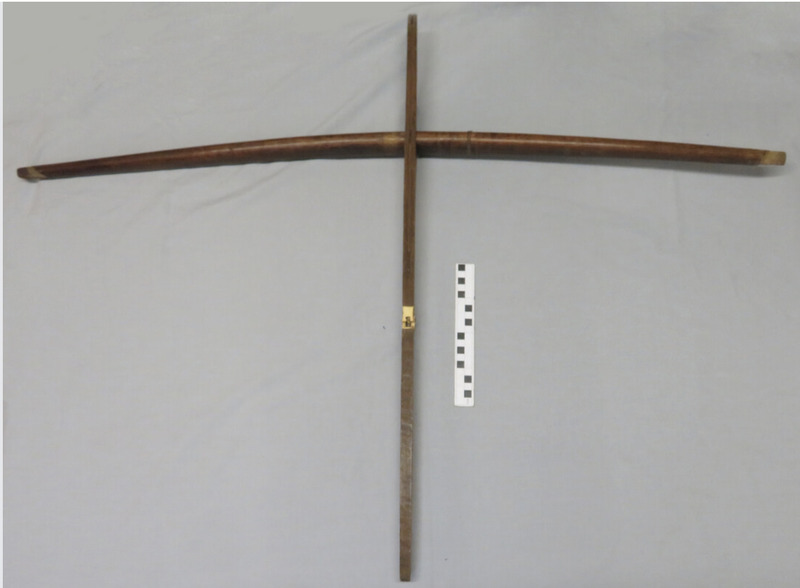
This crossbow originates from Nagaland, India, and its creation is dated to sometime before 1898. The crossbow’s rectangular stock is made entirely of wood and extends outward in a curved shape at the butt of the stock. The prod passes through the upper section of the stock and possesses a band on it made of plant fiber that is plaited. The trigger mechanism of the crossbow is made of bone and the string is missing.
Width: max 794 mm, Depth: max 63 mm, Length: max 1112 mm
Material Wood Plant, Material Bone, Material Plant Fibre, Process Carved, Process Plaited
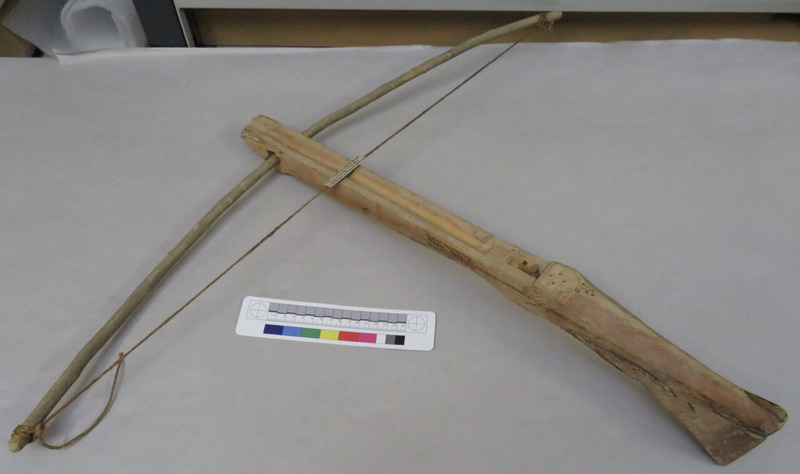
his toy crossbow is of North African origin from the Algeria Aurès Mountains and linked to the Chaouia Berbers ethnic group. It consists of a prod made from a curved wooden stick that passes through the stock, while the stock itself is made from carved wood. The top surface of the stock features a hollowed-out bolt channel made to hold the crossbow bolt in preparation for firing. The shape of the stock is slender toward the front and fans out at the butt of the stock. Carved into the surface of the stock is a small, dotted pattern. The trigger mechanism is made from carved wood.
Length: max 670 mm, Depth: max 100 mm, Width: max 843 mm
Materials: Material Wood Plant, Material Metal, Material String, Material Bamboo Plant, Process Carved, Process Perforated, Process Bound, Process Nailed
This crossbow originates from Germany and is dated to approximately 1480. It consists of a composite prod with remnants of birch bark that once entirely covered the prod, revealing the typical black and white dotted pattern that decorates it. The left side of the prod has been cut two times to be studied for research purposes, with the remaining pieces still with the crossbow. The stock is made from fruitwood and is inlaid with ivory. The sides of the stock feature a plated horn of a green colour and an ornate inlay decoration of a lily, while the top surface of the crossbow is entirely clad in polished antler plates. The cross section possesses a number of different coloured horn plates, including colours of brown, black, and green, all glued together. The sinew around the inner facing part of the prod is in an olive-green colour and has multiple layers. The lock mechanism has been reworked. The trigger lever of the crossbow and the transverse pin are made of metal, and the bridle cord, which binds the prod to the stock, is made of a plant fiber rope.
Measurements:
Overall cross section: 52 mm by 41 mm
Horn core: 42 mm by 20 mm
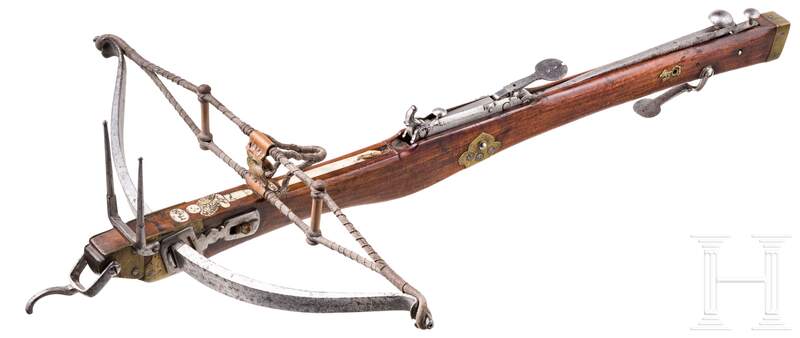
This crossbow featured a bare steel prod, marked "L W L" on the inside of both limbs, held to the stock in the center by two wedged iron clamps. The prod is strung with a string with spacers and a bullet pouch. Integrated into the fine grained wooden stock is an iron cocking lever with a mushroom-shaped handle and cocking box, containing ansingle-finger nut lock and a button release on the bottom; a locking mechanism is located at the rear of the lever end. A forked sight is aligned with the foldable rear sight and two diopter holes. The fine grained wooden stock is partially engraved bone inlays on the top, featuring an owl motif, the monogram "MVM" and the year "1698" on the front, as well as brass fittings that had a swiveling iron ring with a hook at the front.
Hermann Historica notes that this crossbow is a very rare, beautifully preserved ball-barreled crossbow with an interesting mechanism. This type of ball-barreled crossbow originated in Spain and spread to the Netherlands and England following the Spanish fashion.
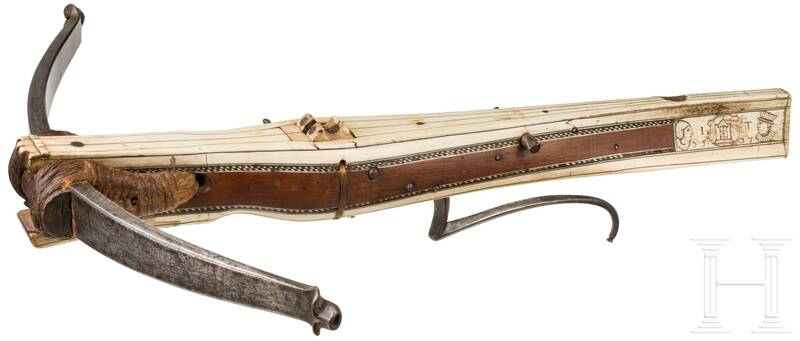
This bolt crossbow features a heavy steel prod, with a mark stamped on the inside (a wheel with a sun burst). Secured by hemp bridling, there is no string attached. The fruitwood stock is decorated in the bolt groove and the underside with bone inlays, the year "1562" engraved and blackened underneath, next to an old inventory label. A fine decorative frieze of bone and dark horn is inlaid on the sides. The bone inlay on the cheek rest is also engraved with a coat of arms, the portrait heads of a couple and the monogram "IT 1597". The original bone nut is secured with cord, also known as nussfaden. Operated with a multi-axle lock, the folding trigger with release is guarded with the curved iron trigger guard.
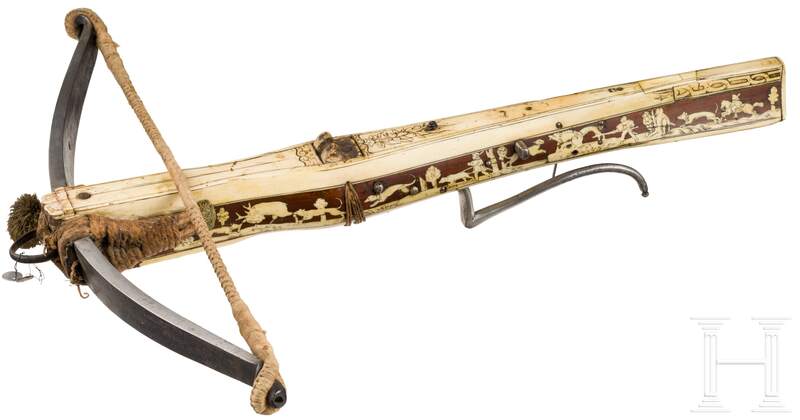
This crossbow features a heavy steel prod, with a mark stamped on the inside on the right (a wheel with a sun burst) and strung with a braided hemp bowstring. Brdled with hemp rope including a interlaced iron suspension ring, remnants of the green woollen pompoms can be seen in the bridles. Two old collection numbers are attached on the bow. This fruitwood crossbow has the top and bottom veneered with engraved bone inlays and the side with a multi-figured hunting scene, depicting hunters and hounds chasing a wild boar and a stag, inlaid in engraved, blackened bone. The bolt groove is lined with bone, and the original bone nut is secured with cord, or nussfaden. Controlled by a multi-axle lock, the folding set trigger is guarded with the ridged, iron trigger guard. The old monogram "MCVI" is also engraved on the underside.
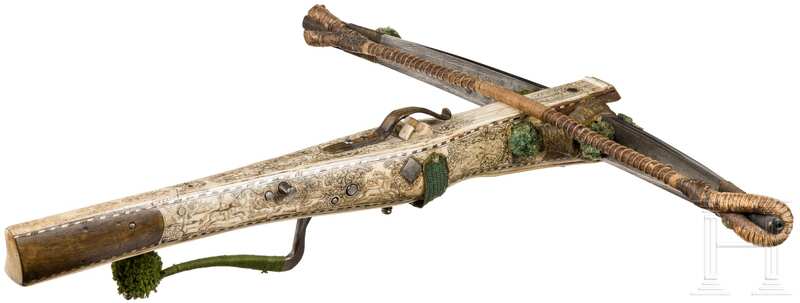
This bolt crossbow features a heavy, tapering steel prod, a wheel mark with a sun burst stamped onto the inside on the right. It is secured to the bow with gilt cord bridling, and green woollen pompoms decorate the front, strung with a green plait and braided hemp bowstring. The slender wooden stock is entirely covered in bone inlays, all surfaces lavishly engraved with tendrils and hunting scenes with horsemen, bears, a stag, a hare, a bird, dragons, set in landscapes with castles. Inlays of greyish-brown horn on both sides at the end of the tiller, bone butt cap. The manufacturer's signature "J. B. Senior f." (Johann Bensheimer Senior fecit) is imprinted on the underside, near the nut. The nut is made of antler, moving on the original cord pivot, or nussfaden, above which a nut band of green cloth, operated with a multi-axle lock controlled by the wrapped large trigger lever with a pompom on the end. The curved piece on the underside is stamped with a double cross pattée and the year "1569".
Hermann Historica notes that Johann Bensheimer the Elder (1st half of the 17th century – circa 1710) was a crossbow maker and engraver at the court of Johann Georg II, Elector of Saxony. His son of the same name can be documented in the service of the electors of Saxony and the Polish kings until 1747. See H. Richter, Die Kunst der Armbrustmacher in Dresden, pp. 16, 17. Two light crossbows signed by the same manufacturer can be found in the armoury in Dresden and in the art collections of Veste Coburg.
They also add that Bensheimer the Elder was long active in Gdansk, before returning to his home town of Dresden in the 1670s. He may have used older components from his reserves to make this crossbow, and is a fabulous crossbow of "Rüstung" type, produced by a crossbow maker of the court of Saxony.
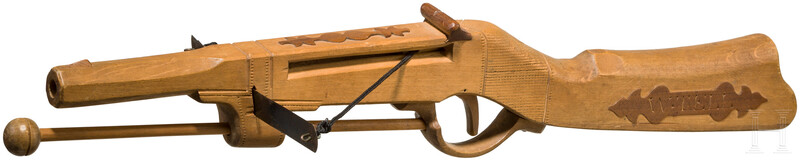
This lightly carved, wooden crossbow features a thin metal prod with an elastic band attached with a twisted metal wire. A set of iron sights are up top, with a ramrod on the underside, and wooden dowels as ammunition, housed in a compartment within the buttstock. The buttstock also features a carving with the words "W. TELL", suggesting it's maker. The profile of this crossbow resembles a rifle, with the trigger possibly releasing the projectile.
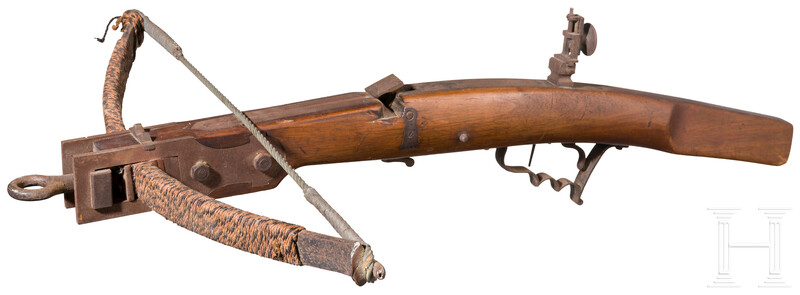
This disc crossbow features a screwed in steel prod with black and yellow string wrapping, alongside a metal suspension ring in the front. The walnut stock is covered with iron fixtures, such as the folding catch lock, controlled by the set trigger within the fingered trigger guard. A metal diopter sight is attached on the top, which can be laterally adjusted. The stock is shaped thinner, possibly for the positioning of the arm.
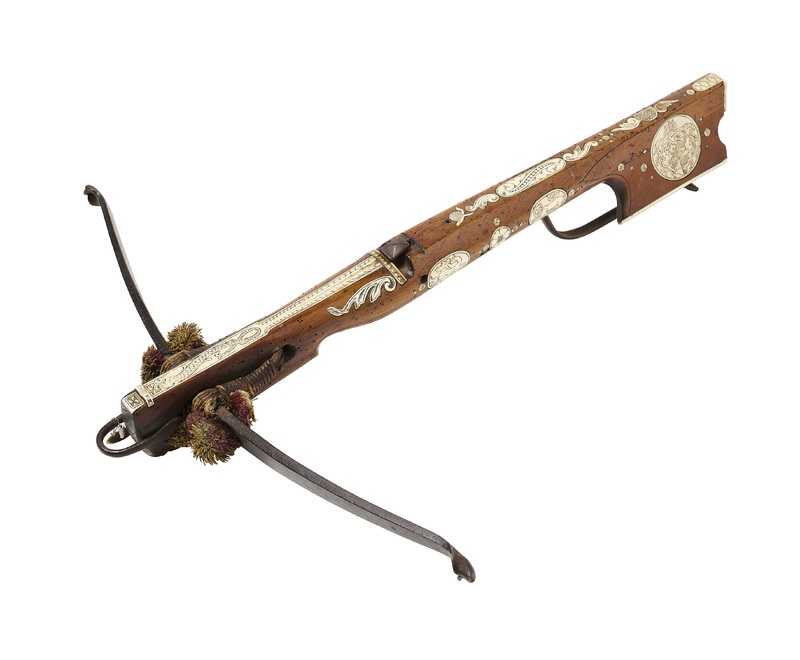
This German sporting crossbow, dated to around 1750, features a slim wooden stock and steel prod. The prod passes through the upper middle portion of the stock and is secured with a bridle cord, with two pompoms framing its sides. The fore of the stock is an iron stirrup, and the upper side of the stock features a staghorn inlay that spans from its top, and the bolt rest, to the iron string catch. The original string of the crossbow and the transverse pin are missing. The stock, previously repaired from worm damage, possesses an intricate design with staghorn inlays that depict decorated flowers, a deer, a lion, and foliage. At the butt of the stock is a concave cheek rest that features a staghorn inlay of a coat of arms. The trigger guard is made of iron, and the set trigger of the crossbow is incomplete.
Stock Measurement: 65.8 cm