A sporting crossbow used for hunting activities and classified as Halbe Rüstung, otherwise known as half-sized equipment used for hunting smaller game. It possesses a snap-lock release mechanism with a distinct cocking pin or pricker; the opening for the pin is encased with a decorative engraving on the top of the wooden stock in the rear of the crossbow’s backsight. It features common elements of sporting rifles with two triggers, a small trigger and its secondary set-trigger. At the fore of the trigger-guard is a pivot safety catch. It also features eight green woollen pompoms, likely for decoration. Additionally, both sides of the crossbow are made of palisander wood from East-Asia while the upper and bottom surfaces are veneered with white staghorn.
Materials: Steel, iron, fruitwood, palisander wood, staghorn, hemp fibre, textile.
Used for sporting. Stock made of wood with a curved fore-end. Upper surface carved with what is believed to be the arms of the Aldobrandini family. Thin metal prod. Folding sight in the form of an arch with ornamentation and a fork at the front to hold the front sight(string and bead are missing). Pyramidal spike at the front made of metal. Long, curved trigger ornamented with square mouldings(balusters). A carved seahorse in which the head is missing forms the decorative volute. Butt has circular mouldings. Bow irons are used to secure the bow to the stock. The nut is missing as well as the original string.
This crossbow was acquired by Vikingsword: Ethnographic Arms and Armour
forum user Matchlock’s private collection. Dated to be around circa 1500 to 1510s, the
composite crossbow is almost entirely veneered with white bone plagues, with a wooden core
and inlaid engravings along the center length of the crossbow itself. The crossbow features a
wide and thick composite prod, which is bent back from the release of constant tension and
rebounding of the composite materials, arching outwards without its string. A set of two
reinforcing rivets is put into the front plate, joining it together. It has around 3 axels inlaid near
the rolling nut, suggesting an old lever style trigger, a simpler mechanism. The crossbow seems
to just have axels holding the rolling nut in place and a lack of nut string to protect it. It also has
a transverse pin slightly behind the trigger, which serves as an anchor point for the cranequin to
interface with it. The arrow clip is swiveled back to the other end of it, possibly to prevent tension.
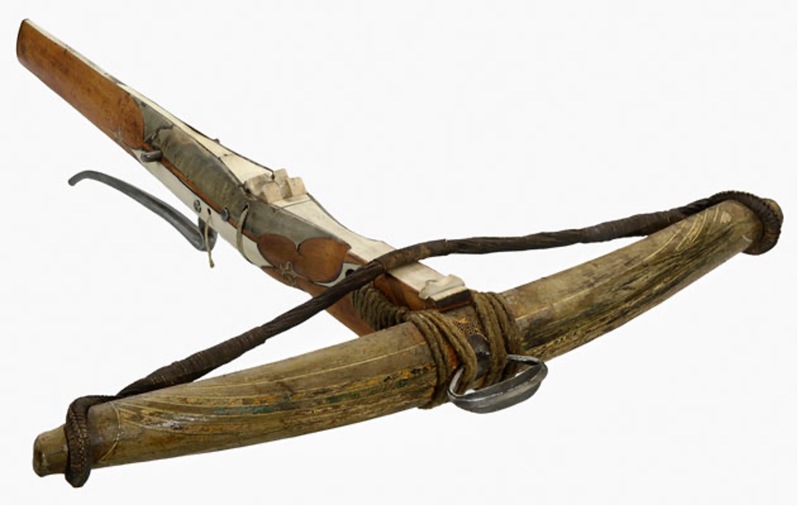
The crossbow is equipped with a composite prod, likely constructed from layers of horn and sinew, bound to a wooden tiller with a bridle made from (probable) hemp cord. An iron stirrup is bound to the front of the prod and tiller with leather cords. The tiller is decorated with inlays, likely made from bone, with thin lateral strips onlaid on each side, terminating in fleur-de-lis figures just ahead of the nut. The bridle hole through the tiller, behind the prod, is also decorated with bone inlay. Additional bone inlays on each side at the top of the tiller begin midway between the prod and nut, and reach backward and terminated at the midway point between the nut and the butt. Near that location mounted in the top is an iron hook, which provides an anchor point for a “krihake”, also known as a “Samson belt” or “doubler belt”, spanning aid. The entire top surface of the tiller is veneered in bone. The single-axle lock mechanism consists of a curved, “L”-shaped trigger lever that engages with the antler rolling nut, which is in turn secured with cord. The bottom of the tiller is also decorated with bone inlays: a small shield shape extends from the front of the tiller to the mid point between the prod and nut, and an inlay shape exactly mirroring design and position of the side inlays completes the bottom decoration.
A crossbow with a steel prod mounted to a dark wooden stock using metal brackets (bow irons). The stock is decorated with perforated brass and steel inlays and features a carved lion couchant beneath, serving as a palm rest. A brass plate was later added for reinforcement to prevent the stock from cracking. The crossbow is equipped with a single axle, revolving nut lock mechanism to hold the string in place. A metal foot stirrup at the front assists with spanning. The trigger lever, part of the lock mechanism, is skewed to the right side of the stock. An extension hand grip made of brass or steel is fitted beneath the stock for improved control and handling.
Materials/Media Wood, steel, brass
Dimensions/Measurements Length: max 1055 mm
Width: max 670 mm
Height 190 mm
Weight 6060 g
This German schnepper-type slurbow crossbow features a wooden stock with a gun-shaped butt. It was likely that a compartment in the butt was used to store lead shot which suggests that this crossbow could shoot both bolts and pellets. Behind the lock, there was a removable flat plate that would allow the crossbow to switch between pellets and bolts. There is a cheek rest and a brass butt cap. The lock mechanism was a set trigger with a catch lock. There is a simple curved metal trigger guard. There are elaborate decorative inlays of floral motifs over the stock, likely made of bone or ivory. The curved steel prod passes through the front of the stock and is secured by a bridle. The bridle and bowstring are made of twisted sinew or hemp cord. Decorative pom poms are attached to the bridle. A metal suspension ring is riveted to the top of the stock. The groove near the front of the stock suggests that there was likely a bolt rest possibly of bone or ivory.
This crossbow features a thick curved composite prod secured to the stock by a rope bridle. A brass suspension ring at the top of the stock is also secured by the bridle but appears to be a later addition. There is a bolt rest made of bone set into the front of the stock with black lines possibly from etchings of bone or buckhorn. The thick stock is made of poplar wood with bone inlays. The lock mechanism is a single-axle rolling nut secured by a nusfaden made of hemp cord that passes through a small hole. It has a long metal lever trigger. The stock is reinforced with a long iron rivet that goes through it and an additional iron pin seen behind the prod to prevent cracking.
This composite crossbow features a wooden stock that tapers towards the butt with a cheek rest. The prod made of composite wood and likely covered with birch bark or parchment for waterproofing is secured to the front of the stock with a bridle. A circular metal suspension ring is also secured to the top of the stock by this bridle. The bowstring is composed of darkened twisted cords possibly hemp. The lock mechanism is a double-axle rolling nut secured by a nusfaden possibly made of hemp cord that passes through a small hole. The trigger is a simple metal lever. The sides of the stock have decorative inlays in geometric patterns with the part near the nut appearing a darker colour possibly made from animal horn and the lower side and the top appearing lighter possibly made from bone. The lateral lugs of metal are used to attach a spanning device.
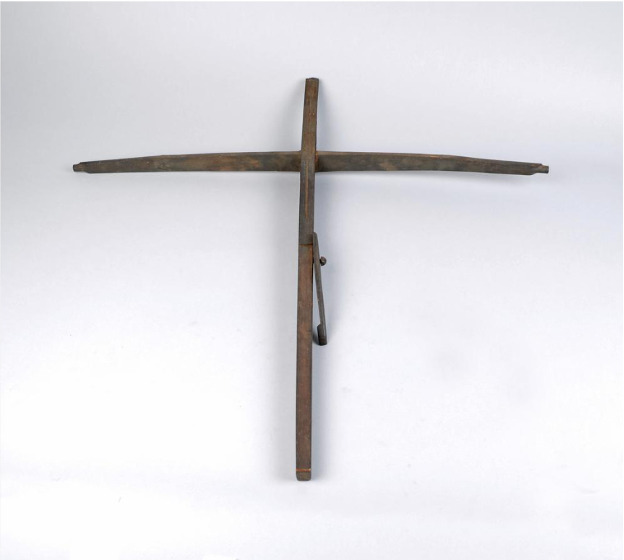
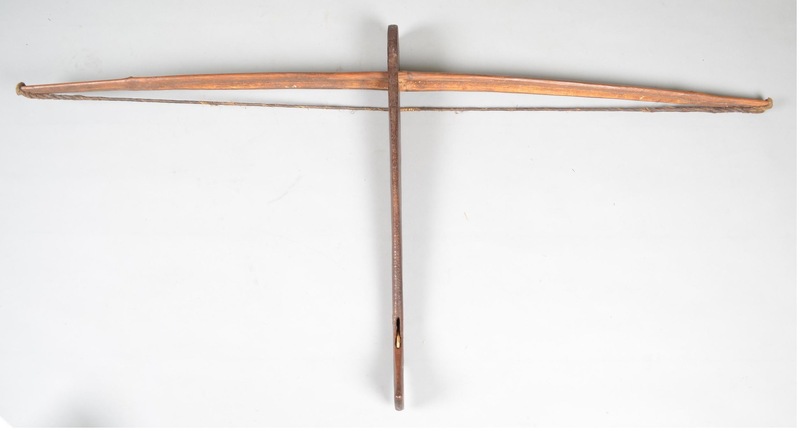
This crossbow features a thin, straight wooden stock and prod. The prod is attached horizontally through a rectangular slot cut near the front of the stock. A simple wooden lever trigger is mounted underneath the stock, secured with a visible pivot point.
Materials/Media Wood
Dimensions/Measurements Height: Height: 5.30 centimetres
Weight: Weight: 555 grammes
Width: Width: 72.20 centimetres
Depth: Depth: 70.10 centimetres
Other notes Purchased from: Prof Nicholas Tapp
Purchased from: Khin Thitsa
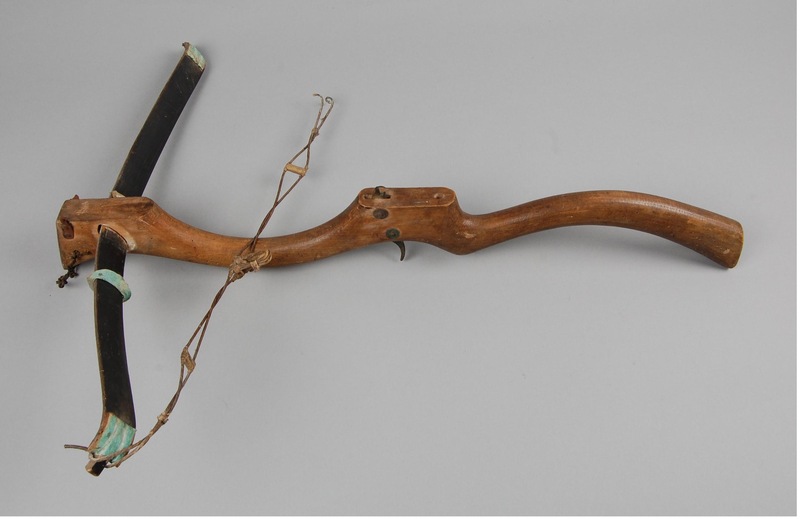
This crossbow features a thick wooden stock shaped in a wave-like form. The front end of the stock is block-like in structure. A metal prod is fitted through a hole near the front of the stock. The lock mechanism is a double axle type, with visible components on the top surface. Beneath the stock, a metal trigger is mounted. The crossbow is strung with two bowstrings that are twisted together, creating a pattern similar to a double helix.
Materials/Media Wood, hide skin, metal
Dimensions/Measurements Height: Height: 8 centimetres
Weight: Weight: 560 grammes
Width: Width: 66 centimetres
Depth: Depth: 52 centimetres
Other notes Donated by: Capt A E Johnston, RN
This crossbow, made by the Mishmi, features a thin, straight wooden stock and a matching thin wooden prod. The prod is inserted through a hole near the front of the stock and is not supported by a bridle. A thin bowstring, believed to be made from elephant hair, is tied to the ends of the prod. A small bone trigger is mounted near the end of the stock. The crossbow was obtained from a Mishmi tribesman and is noted for its powerful performance, with the arrow flight described as faster than the eye can follow.
Materials/Media Wood, bone, hair
Dimensions/Measurements Height: Height: 8.50 centimetres
Weight: Weight: 1.04 kilograms
Width: Width: 126.50 centimetres
Depth: Depth: 62 centimetres
Other notes Purchased from Miss J Gough-Thomas
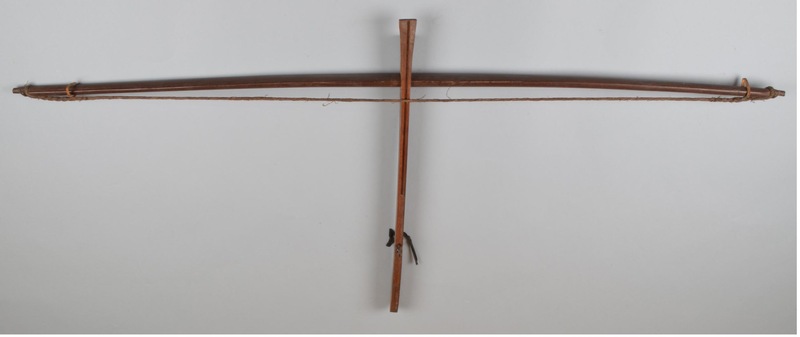
This crossbow is made entirely of wood and strung with vegetable fibre. The stock is thin and features a narrow groove running along its length. A small wooden axle mechanism is visible on the top of the stock near the butt end. The wooden prod is thin, and nearly straight in shape.
Materials/Media Wood, fibre
Dimensions/Measurements Height: 5.80 centimetres
Weight: 625 grammes
Width: 51.40 centimetres
Depth: 117 centimetres
Other notes Donated by: W Hanson Rawles