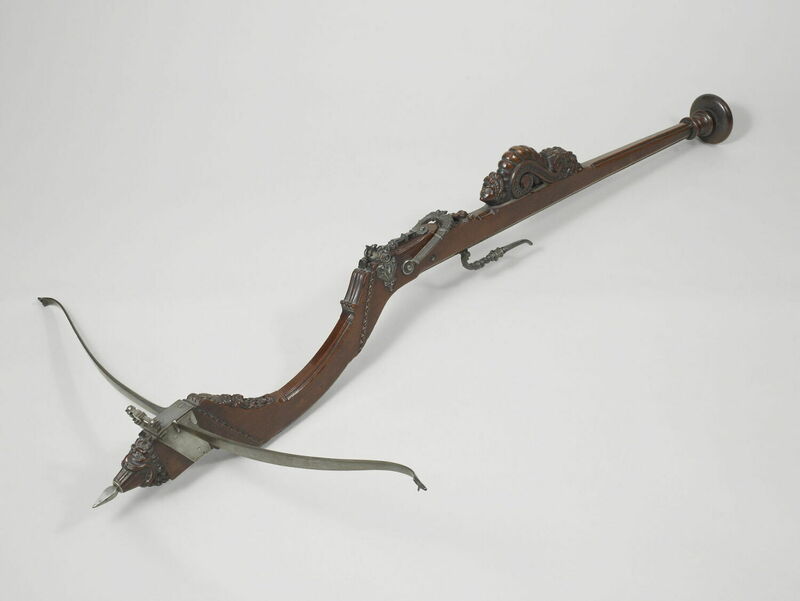
This Italian-style pellet crossbow is made of wood and steel. Bow irons connect the steel bow to the wooden stock. The tip of the stock is carved in the shape of a lion’s face with an open mouth. A pyramidal steel spike protrudes from that lion’s mouth. The stock is finely carved with a variety of other faces as well. The face of a bearded man is carved into the stock just past the bow. The stock then curves downwards and back upwards. There is some steel decoration, including a sight in the form of an arch which folds back. Another face (possibly animal or human) is carved into the stock, followed by an entire frog carved as though sitting on the stock. Then there is a large decoration formed out of two faces (a younger, cherubic face and an old, bearded one) connected by a shared mass of hair. Their hair is stylized into curling designs possibly meant to resemble horns or leaves.
This crossbow has a steel lever-type trigger.
As of fall 2025, this crossbow is not on display.
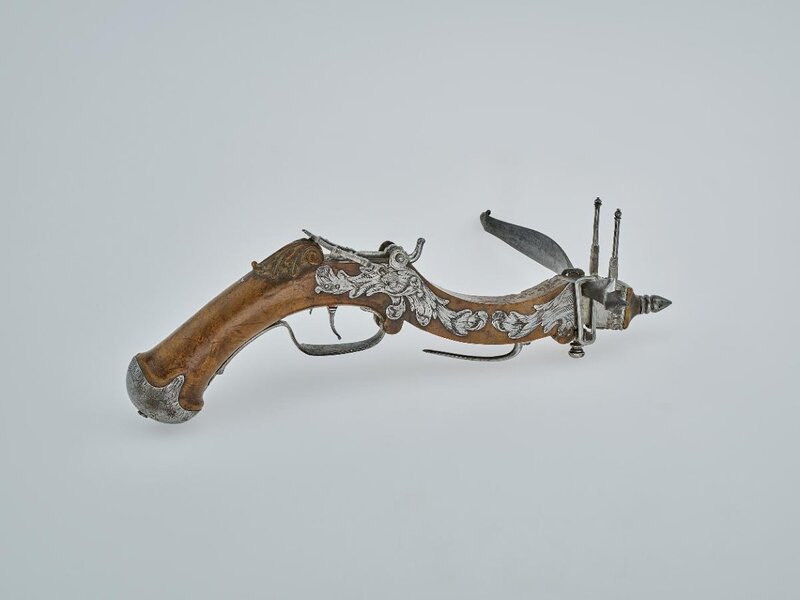
This small pistol-shaped pellet crossbow has a steel prod, connected to a wooden stock with bow irons. The crossbow is inlaid with steel, which has been carved and engraved to resemble plant leaves. Part of the stock also bears this plant motif. The crossbow has an arch-shaped steel sight, folded down in the photos. Its trigger is a hair trigger, protected by a continuous trigger guard. A steel protrustion on the underside resembles the lever-type triggers on older crossbows and is likely decorative. The end of the stock curves to form the grip of the “pistol" shape. There is a steel spike on the tip of this crossbow.
Note: Pellet crossbows are also called bullet crossbows and stone crossbows. In Italian, a small pellet crossbow is called a "balestrino."
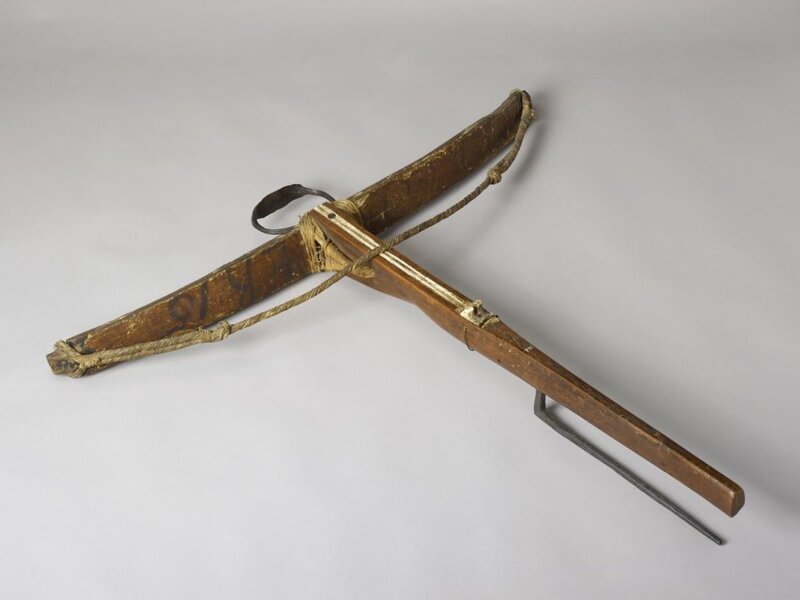
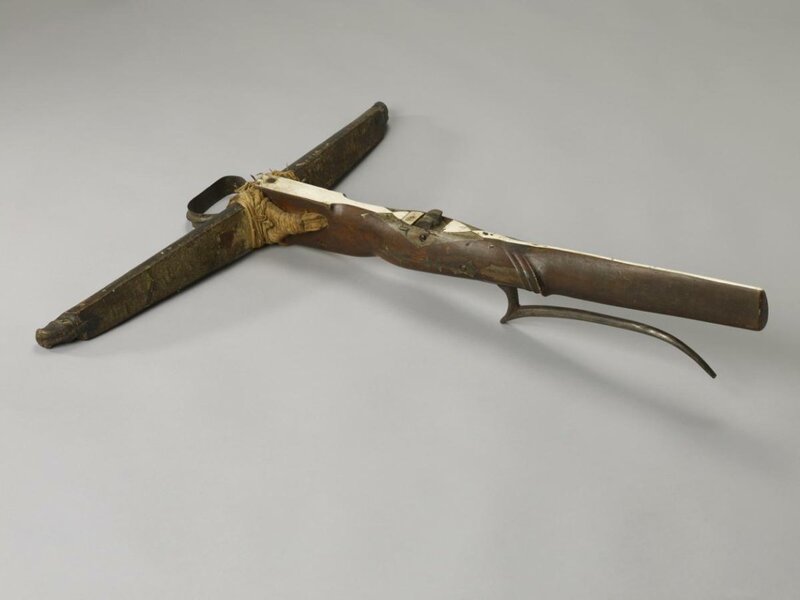
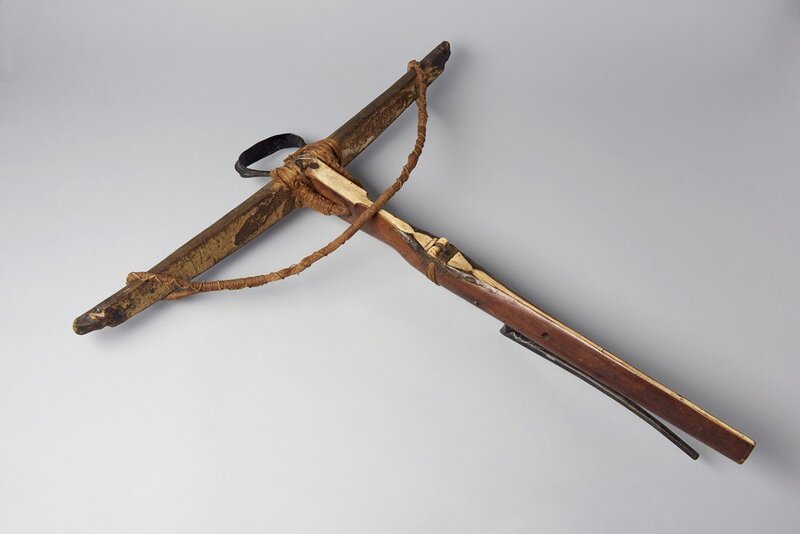
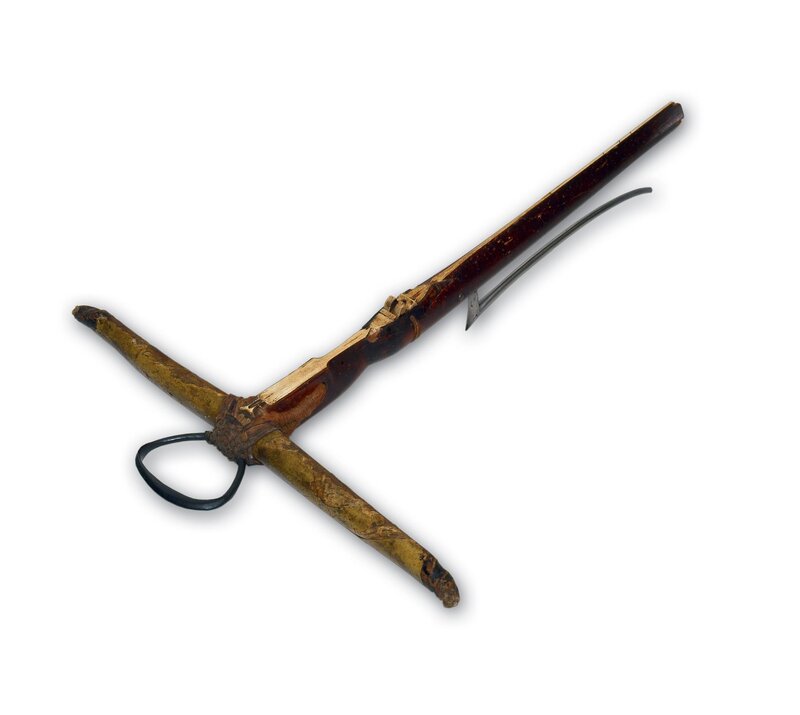
The composite bow of this large crossbow has notches on the ends to hold the bowstring (restoration). The bow is covered in birchbark with a fish skin motif, which protects it from humidity. Fragmentary traces remain. Bindings attach the stirrup, bow, and stock together. The bindings go through a hole in the stock to help secure it. Bone inlay forms the bolt rest. It was likely once painted red, as there are traces of red paint on it. The iron, lever-type trigger forms a right angle.
The tips of the composite bow have notches meant to hold the now-missing bowstring. The bow was covered in birchbark with a fish skin pattern pressed into it, though little remains of it now. It helped to protect the composite bow from humidity. Bindings attach the stirrup to the bow and proceed through a hole in the stock, keeping them all firmly in place. On the side of the stock near the bindings, there is a gothic E, likely a maker's mark or owner's mark. The stock is beautifully carved with unique curved ridges. The museum says that these interact specially with the cranequin. The wooden nut is a reproduction.
The ends of the composite bow have notches meant for the bowstring (the original is lost - the bowstring in the picture is a reproduction). The composite bow was once covered in birch bark, pressed with a fish skin pattern, to prevent humidity damage. Bindings go around the stirrup and bow and through the stock to secure them all together. Inlay made of deer’s antler goes down the stock. A gothic-style “E” is found on the right side of the stock, likely a maker’s mark or owner’s mark. The emblem of the Arsenal of Fribourg is found near the end of the stock.
The crossbow is not currently on display (as of fall 2025).
The stirrup is made of iron. It is bound directly to the composite horn bow and wooden stock with leather straps. The leather straps go around the bow and through a hole in the stock. The bow is straight and has lost its bowstring. The side of the bow facing away from the user has several layers of animal tendon. To prevent the bow bar from drying out, the crossbow maker applied birch bark. The stock is made of fruit wood, with some bone additions. The trigger is likely iron. There is no cheekplate and no distinguishable cheekrest. In terms of decoration, a small Basel crozier is found on either side of the stock, near the front.
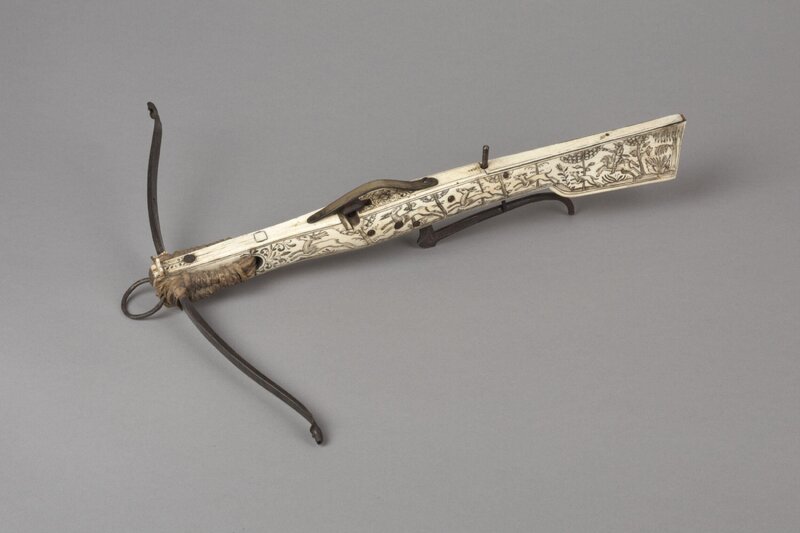
This c.17th century German crossbow was crafted for the use of a child, as indicated by the reduced size. The bow would have been used to prepare children adequately for activities of adulthood such as war, hunting and target shooting of which they were expected to be highly skilled in. The wooden stock of the bow is partially covered in stag horn and engraved with a lively hunting scene. Closest to the butt end of the crossbow is a depiction of a male figure on a horse that is up on its hind legs, indicating a swift pace forward. The mustached subject totes an undecipherable weapon in his right hand, and is sporting a wide brimmed hat resembling that of a cowboy’s. In front of the subject, moving along the stock towards the prod are two four legged animals understood to be dogs, chasing a herd of deer running away from the horseback hunter. The length of the stock features sparse, stylized landscape engravings emulating German folk art of the period exhibiting various types of trees, bushes and grasses that the subjects run through. Beneath the bolt clip made of cow horn is a delicate floral engraving reflecting the folk art style, which fills this small space. Similar motifs are seen on a smaller scale around the reinforcing rivet, cocking pin (possibly a rear sight) and the bridle creating a cohesive ornamentation. The steel bow is un decorated and accompanied by the original rope fixing and suspension ring. The trigger guard, also crafted of steel, takes a more dramatic curved form than other German bows of the prior century.
The Victoria and Albert Museum acquired this item through the J.G. Joicey Bequest of 1919 and its prior provenance is unknown.
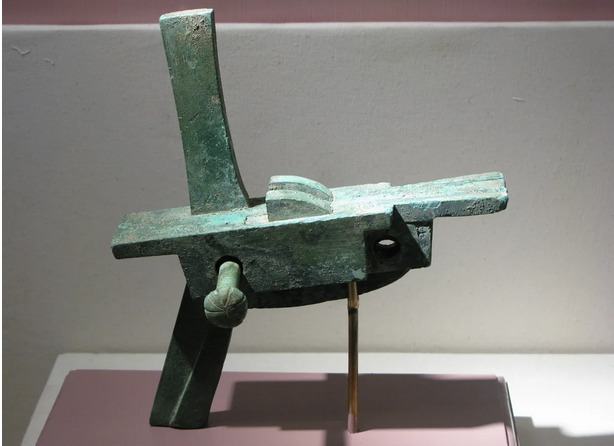
The tumbler here refers to the trigger mechanism of the crossbow. Found in the sites of Dong Son in the North, along with a storehouse of bolts, the artifact attached has been associated with the myth of the sacred crossbow, belonging to An Duong Vong, the supreme chief in the Red River Delta region, and mentioned as a divine object in the tragic romantic tale of his daughter, My Chau, and Trong Thuy. The tumbler itself is bronze, inspired by its Chinese counterparts, and the prod and the stock are most likely made of wood or bamboo. There seems to be a rope-like material for the binding. It lacks the complicated design of the repeating crossbow later observed in China and Southeast Asia, only requiring a simplistic composition. A rectangular block protrudes beneath the bolt rest, most likely the bridle block, which is more prominent than the crossbows found in Medieval Europe or China, possibly indicating its primitive arrangement. This is evidenced by the weapon lacking a stirrup, however, it is effective as it does not require a spring to span an arrow. It bears similarities to the crossbows crafted during the Qin dynasty, which allowed for infantrymen on the flanks of an army to shoot over long distances as the enemy came closer.
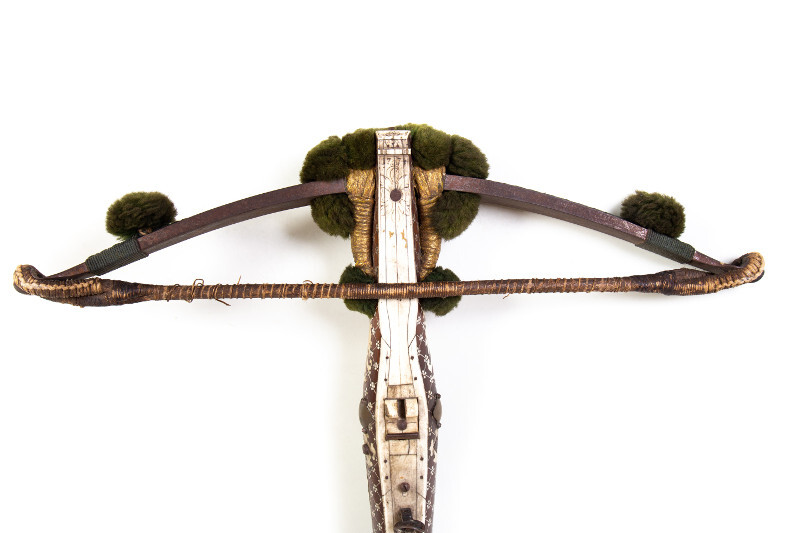
The prod is made of steel. The stock is wooden, with carved bone inlay. The bone inlay includes floral, animal, and grid designs. There are dark green woolen pom-poms. The nut is made of bone. The year 1774 is written on the crossbow.
Though little is known of its early history, this crossbow was likely used for hunting. This crossbow was recovered at the end of World War II amongst objects stolen (or assumed stolen) by the Nazis. Its owner was never identified; as such, it joined the MNR fonds. Objects in this collection are held provisionally by the French state until their rightful owners claim them. This is the only crossbow in that collection. It is currently on display in the Musée de l’Archerie & du Valois (as of fall 2025).
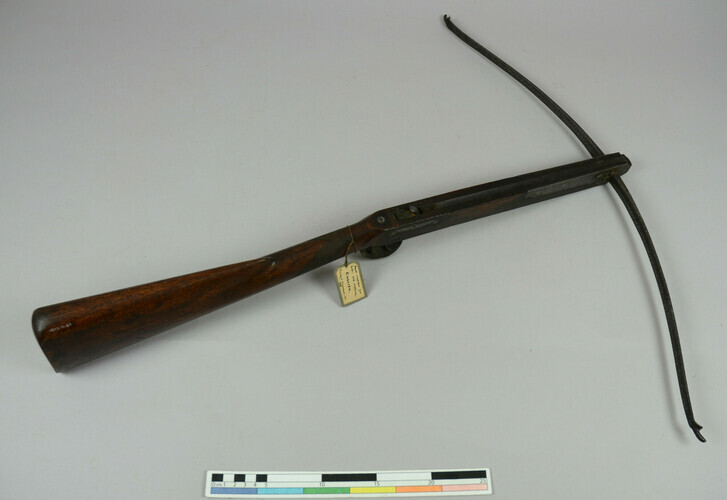
This crossbow is currently housed in the Pitt Rivers Museum and is dated between 1800-1900. The maker of the crossbow is unknown, but it most likely originated from the UK, particularly from England.
The crossbow features a black steel prod mounted transversely across the front of the stock, with two split points on either end. It also has a long wooden stock, enclosed in metal, with a central groove that guides the crossbow bolt and holds it in place for firing. There is also a cylindrical rolling nut that keeps the string in position until the trigger mechanism is activated. This nut is made from brass and is secured with a metal transverse pin. Additionally, the stock includes a large cheek rest, along with a rounded wooden butt at the rear. On the underside of the crossbow, there is a forged metal strap located equidistant between the butt and the front of the prod. The metal displays various designs, though they are hard to distinguish due to the low resolution of the image.
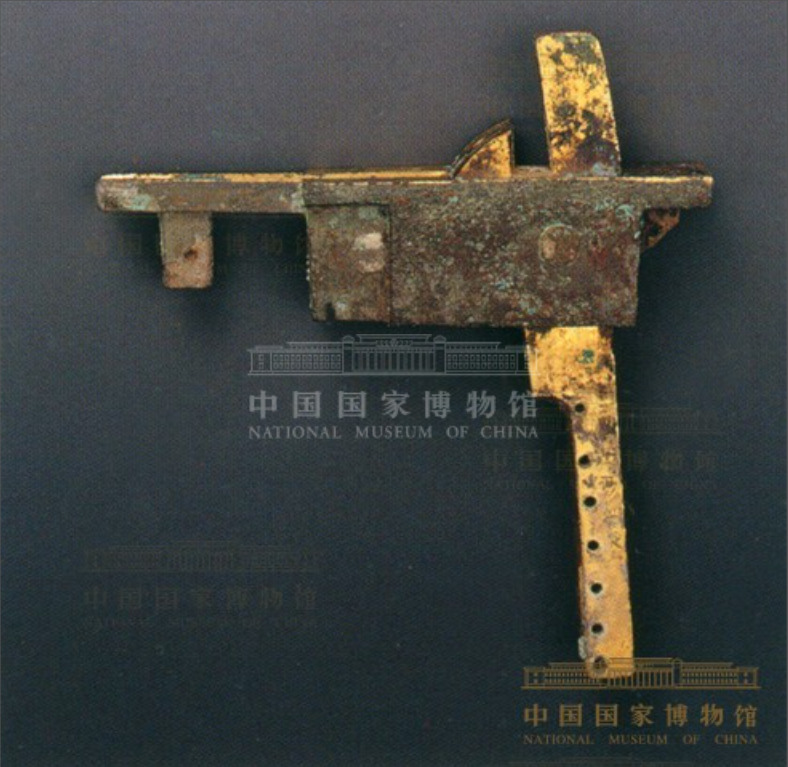
This gold-plated crossbow mechanism held by the National Museum of China is dated to the Western-Han dynasty, unearthed 1978~1980 in the Linzi district of the city of Zibo in Shandong province.
The mechanism comprises three parts: the wangshan (望山) and ya (牙)—the piece that sticks out at the top that functions as both the sight of the crossbow and the part of the mechanism that hooks the string in place; the xuandao (悬刀)—the trigger; and the gouxin (钩心)—the pawl. These are held together by two axles and are contained in a bronze guo (郭) or case.
The gold plating has corroded off at parts, and the museum description states that there are missing pieces of the mechanism (but it does not specify which, and it is not visible what is missing from the photo, so it is likely an internal piece of the mechanism that is missing). There is an inscription on the mechanism that reads “crafted by He, a work ___”. From context, the missing text likely goes with the word “work” to indicate the title of some kind of labour official.