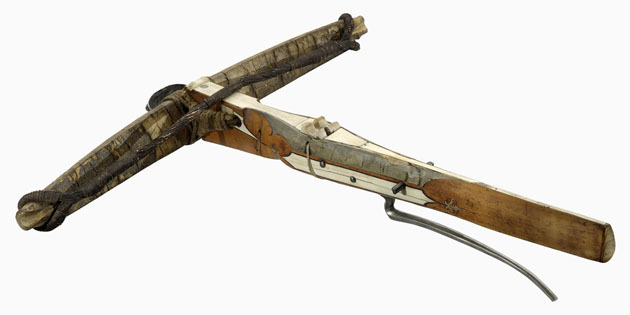
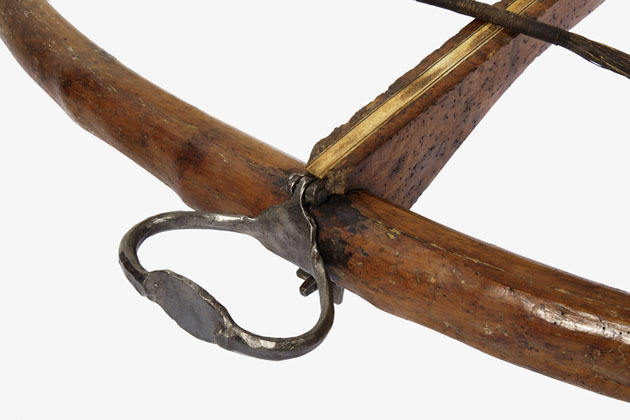
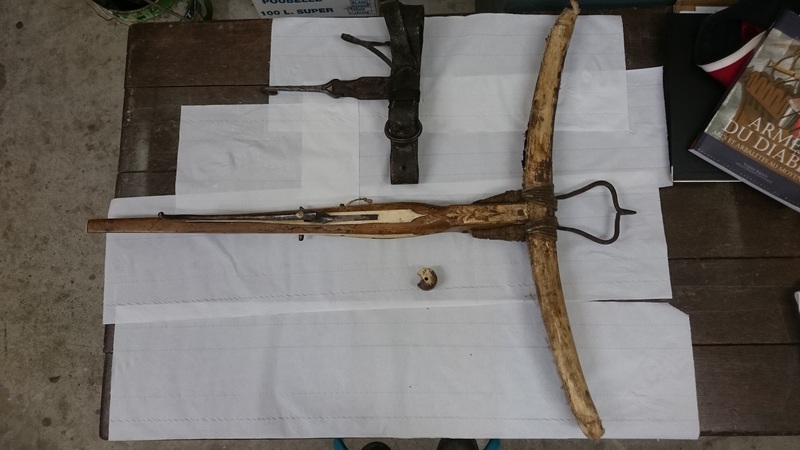
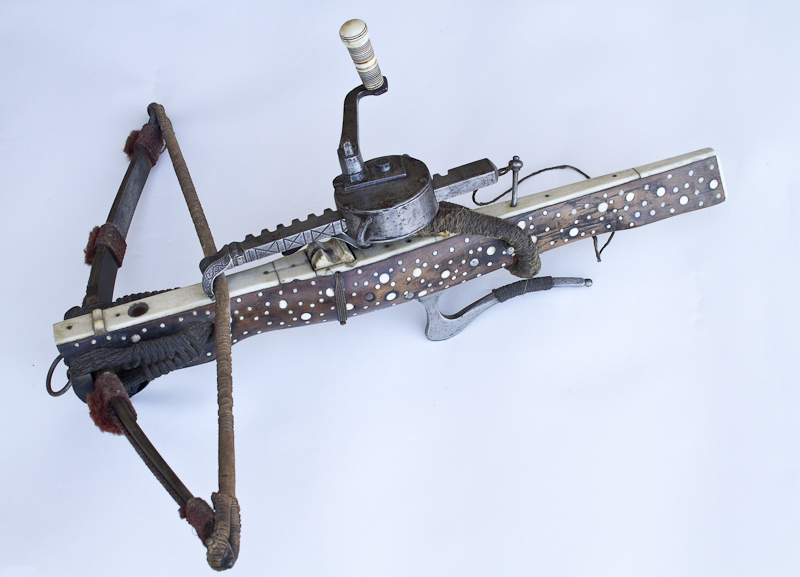
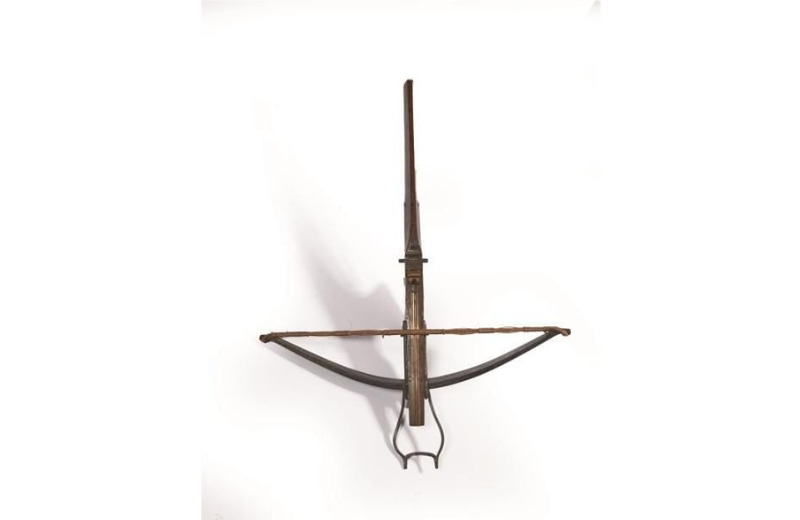
Having a one-foot stirrup-like mechanism in the front, it may not be a functional one. To support this theory, a bolt that resembles something a cranequin would use to hook onto is present near the trigger. The nussfaden is exposed, with no holes suggesting it had no cover on it originally. Elaborate plagues adorn both sides, with what seems to be ivory along the top of it. A gray decoration piece also runs across the length of the crossbow, rather than a singular color. It is well adorned with decorative imagery all across both sides, suggesting some sense of profile.
Of a type known as a composite bow, it is constructed of different substances. Wood (especially yew) is prevalent. This is reinforced with rams horn or baleen (a keratinous horn-like material from the mouths of larger species of whale) and sinew – records tell us this was from cattle and seals. This sandwich of materials was held together with fish glue and, if not varnished, then wrapped in parchment or birch bark painted with a chequered design (possibly to look like snakeskin). This method of composite construction was known in Europe from at least the 13th century. Although the stronger steel-bowed crossbow was increasing in popularity in Europe by the 15th century, it has been suggested that the composite bow was more pliable and less likely to fracture under pressure in certain conditions such as hunting in winter. A biographical account of German Emperor Maximilian has a woodcut showing him hunting chamois high in the Alps with this type of weapon. The lavish decoration on bows of this kind has led to the assumption that they were purely used for hunting. However, there is contemporary artwork showing beautifully decorated bows of this kind being used by soldiers.
The gracefully shaped tiller is tapered and thickened at the points were strength is most important. The bones of the animals it may have been used to hunt are used to decorate it. There is stag bone decoratively inlaid into the wood. Functional components such as the nut would also have been made from venery by-products. In 1225 an Englishman was ordered to hand over all the deer antlers in his forest to the king’s crossbowmaker.
This crossbow from Glasgow's collection has its prod built entirely out of wood. Featuring a one-foot stirrup that is connected with a hinge-like mechanism embedded into the wood itself, it suggests that the prod is able to be replaced by swivelling outwards and redrawing a new prod into the slot. A latchlike mechanism can also be speculated to be under the prod of the bow. Featuring a simplistic design, the most outstanding aspect is the lack of any decoration, with a 2 axel trigger mechanism holding a walnut nut most likely reinforced with iron for durability. The top of the crossbow is in a different shade, most likely from repeated firing or an inlaid groove for the bolt. A bolt clip also seems to be missing, potentially a different style of design for this series.
The bow of this crossbow is an exceptional example of an extremely rare object indeed. One of the leading authorities on the subject has pointed out that ‘wooden medieval crossbows are very rare and all of uncertain date’.
A bow of similar form was excavated at Berkhamsted Castle in the early-20th century that may date from the siege of 1216. It is the gnarled and knobbly appearance of the bow’s back that is most diagnostic. Many late-13th and early-14th century manuscript illustrations show artistic portrayals of this feature. An excellent example of this is a crossbowman in a crucifixion scene in the Book of Hours (prayer book) of Jeanne d’Evreux by Jean Pucelle dated to 1324-28. This knobbly shape has been achieved by the bowyer carving round the knots in the yew to retain the optimum strength. Wooden bows, however, were used in Europe up to the 15th century and this carving technique also continued to be used.
Whatever its exact date, this bow is an extremely rare and important survival of a weapon that would have been a commonplace sight in medieval Europe. An indication of this is the 1,131 crossbows inventoried in the Venice Arsenal in 1314.
Crossbow with a composite bow and a stirrup. This bow consists of several layers of horn strips covered with tendons, then bark, and finally a layer of paper decorated with painted dots and scrollwork.
More recent strings hold the bow to the stock, as well as a stirrup probably dating from the 19th or 20th century.
The pear wood stock, which is relatively long and thin, is decorated with strips of bone or deer antler glued on in the Gothic style, as well as horn inlays in the form of scrollwork. Two inlays appear to be missing (grooves are still visible in the wood). A cord, the purpose of which is unknown, protrudes from underneath the bow. Between the trigger and the nut, a metal pin for attaching a cranequin appears to have been added at a later date. The top of the stock, just before the bow, is decorated with an engraving that appears to be a coat of arms: two fish facing each other diagonally, a flower at the top right, and a clover at the bottom left; the tip at the top left of the coat of arms continues into a scroll motif.
The stock houses a wooden nut made from deer antler, clearly turned on a lathe and reinforced with an iron insert. This nut is no longer held in place due to the absence of an axle; it was probably secured with nussfaden, as suggested by the rope mark imprinted in the wood at this location.
The long iron trigger, although now deformed, was forged with particular care. At its base, two engraved circles are visible, as well as the letter “E,” possibly a craftsman's mark, near one of the circles.
The armament belt that accompanies this crossbow has been partially reconstructed. Its leather is not original, but it has a buckle and hook that may date from the 15th century.
Materials: wood (pear), deer antler, horn, tendon, iron, string (unknown fiber), bone, bark. Leather and iron for the cocking strap.
Hunting crossbow with a trigger mechanism incorporating contemporary restorations. The steel bow is decorated with 4 red pompoms, which are held in place on the stock by ropes and wedges. The upper part of the crossbow is entirely covered with nailed bone plates. The rest of the stock is decorated with circular bone inlays of two different diameters, which have white spots like a deer, suggesting it's function as a hunting crossbow. The stock incorporates a turned bone nut, which may be modern given the condition of its steel insert. This nut is held in place by an exposed nussfaden. Above this nut, a relatively modern safety catch has been added to protect it. The trigger is partially covered with a waxed cord, potentially for better grip. There is a second retractable trigger, as well as a pin/bolt that is clearly intended to hold part of the mechanism in place. A metal pin attached to a cord allows the mechanism to be reset via a hole in the stock.
The cranequin is attached to the crossbow using rope and a metal pin that passes through the stock. The bone-handled crank, which hooks onto the crossbow's string, is used to wind up the notched bar. It ends in a hook decorated with engraved foliage. The end of the notched bar is engraved with the letters “IW”.
The removable cranequin, placed on top of the crossbow and attached to a metal pin passing through the stock, is used to cock the steel bow reducing the strength needed from the user. The hook on the notched bar catches the string and the crank is then used to turn the cogwheel inside the cranequin, gradually pulling back the bar, which bends the bow by pulling on the string, resulting in a lighter crank than draw weight.
Materials: crossbow: wood, steel, string (fiber unknown), bone, wool
Cranequin: steel, string (fiber unknown), and bone
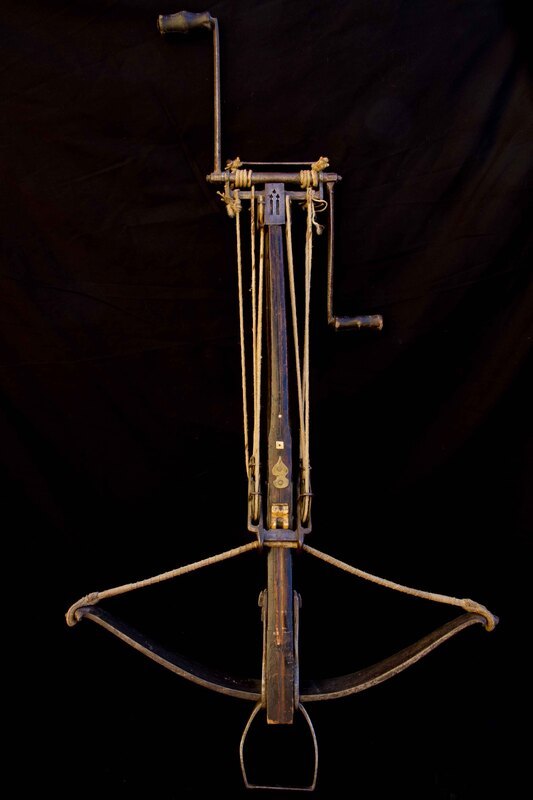
This crossbow has a single foot metal stirrup, with no transverse pin in sight. The thick metal bow has a simple shape and does not appear to bear any craftsman's mark. The accompanying windlass is held in place by a system of metal wedges in the stock.
The stock is plain, with the only decorations being brass plates cut to represent a griffin on either side of the nut, most likely serving as part of the nussfaden. A small brass plate in the shape of a spike on top of the stock, preceded by two small bone inlays.
The nut is made of deer antler, reinforced with an iron insert. It is surrounded at the front and rear by two plates, also made of deer antler. The trigger, made of ferrous alloy, has a simple shape.
The muzzle has a pulley-hook assembly with no decoration, except for small trefoils adorning the ends of the rods holding the pulleys. The pulleys themselves are made of brass or copper alloy. One of the two small ones has been damaged, and the rod holding it has been repaired with brass solder. The cranks are unadorned. At least one of the two wooden handles has been replaced, suggesting this crossbow has been constantly maintained over the years. The windlass housing has a cut-out candle pattern and is framed by two metal pulleys for interfacing. It is possible that the windlass and the crossbow form a composite unit together.
Materials: wood, antler, ferrous alloy, brass, bone, plant fibers
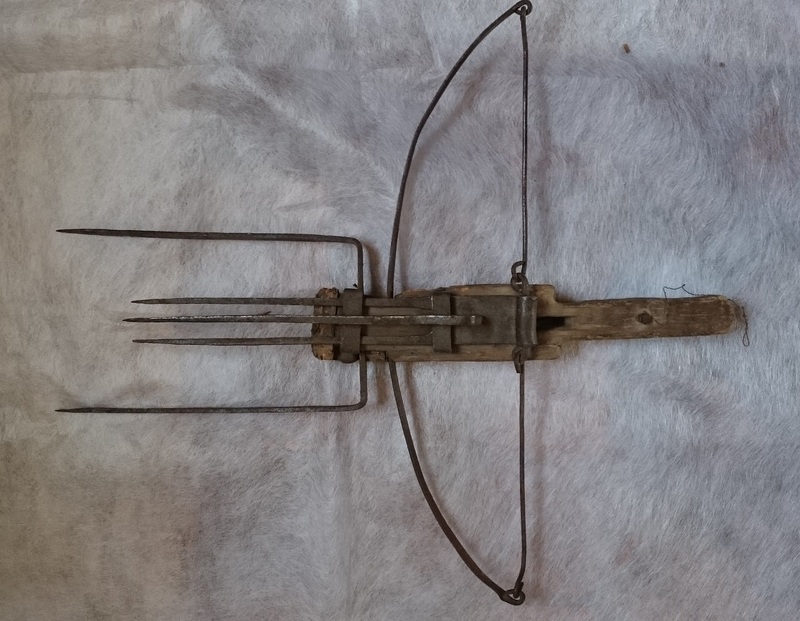
This mole trap crossbow from Château de Castelnaud is planted in the ground using a fork, which is composed of two prongs on the side. The bow has a three-part steel “string” connected to a sliding trident. This crossbow is designed purely for stationary hunting, with a short handle that has a tension-based trigger mechanism. With a thin steel prod and string, this crossbow is purely used to trap small animals. with a sliding trident to impale the target rather than having bolt clips, or bolts at all. The build of this crossbow is simple, having an overall paddle shaped wooden core with metal components only in the trident construct, the limbs and the string (wire?).
From the information given, this type of trap was still in use at the end of the 19th century. It is camouflaged and placed vertically in the path of small animals such as moles, weasels, martens, and stoats. After tensioned, it is held in careful balance by a wooden stick until an animal passes between the prongs of the fork, in which it will spring and impale it (Ethnological Guide 2).
Materials: Ferrous alloy, wood
References:
Catalogue of the study gallery of the Museum of Popular Arts and Traditions in Paris, Ethnological Guide 2. Gathering, hunting and fishing, pp.33-34.
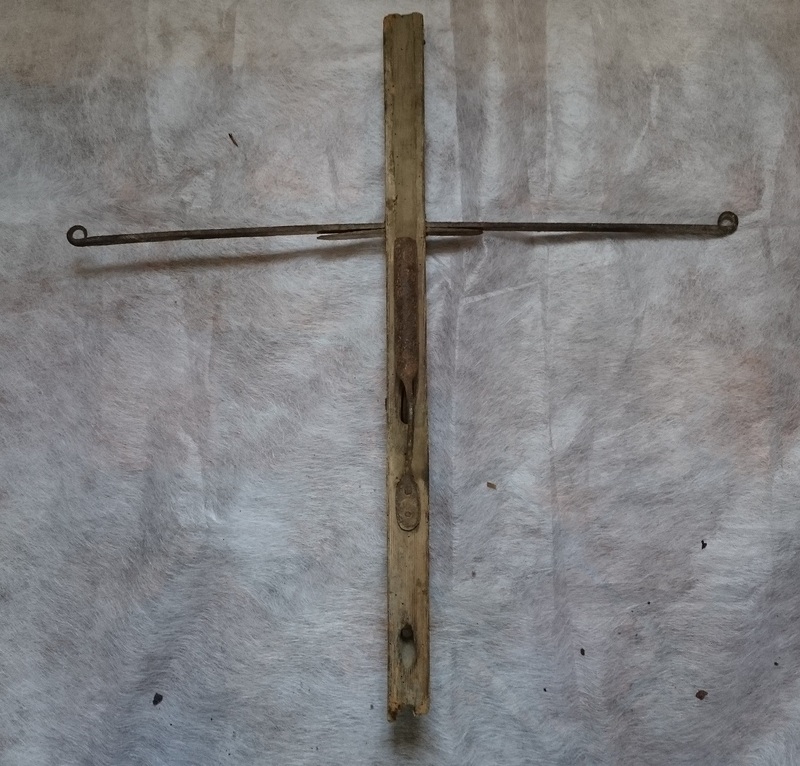
Hunting crossbow with a stock that appears to be a recycled part, damaged at its base, this crossbow from Château de Castelnaud is very primitive. The thin ferrous alloy bow is held in the stock by a through iron wedge and small wooden wedges. Having most of the features missing, this crossbow is very bare bone. A tall semi-circle bolt guide is installed on top of the stock, along the carved groove on the top of the bow to interface the bolt. The trigger, mounted on a flat spring, controls the metal nut. The trigger mechanism seems to be built in one piece, flat spring and nut. The stock seems to be broken off as the butt of the bow is fractured.
Materials: ferrous alloy, wood
On the tip of this bow, there is a wrought iron stirrup with two points in it, facing forward. The prod (bow) is likely steel and bears its original bowstring. The prod connects to the stock with bow irons. The stock is wooden and plain in design. The crossbow has a steel sight which does not fold back, as well as a trigger guard and a steel trigger. Those who handled the crossbow described the stock as being mounted on a piece of bone.
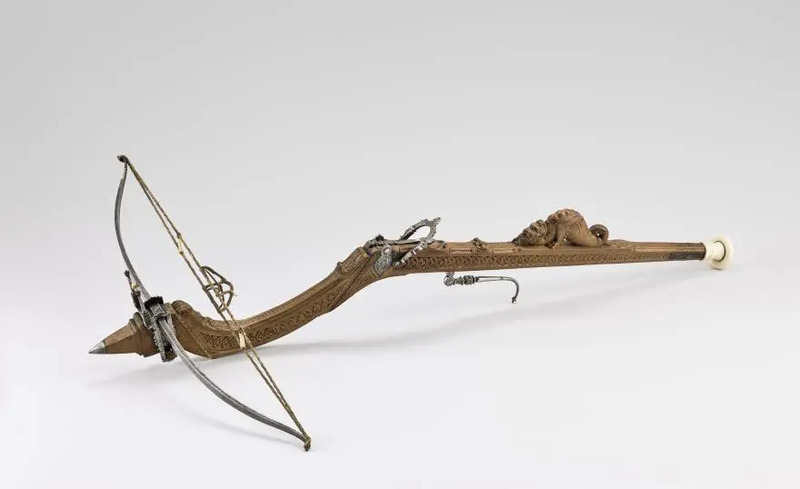
On the front of the crossbow, there is a pyramidal spike tipped in metal. The prod (bow) is made of steel. Bow irons connect the bow to the wooden stock. The stock is carved with lines and floral motifs in low relief. There is a metal (likely steel) sight in the shape of an arch, which can be folded back. There is a metal trigger lever. Strikingly, a fantastical beast with the head of a bearded man, carved in the round, sits towards the back of the stock. The crossbow ends in a white knob.
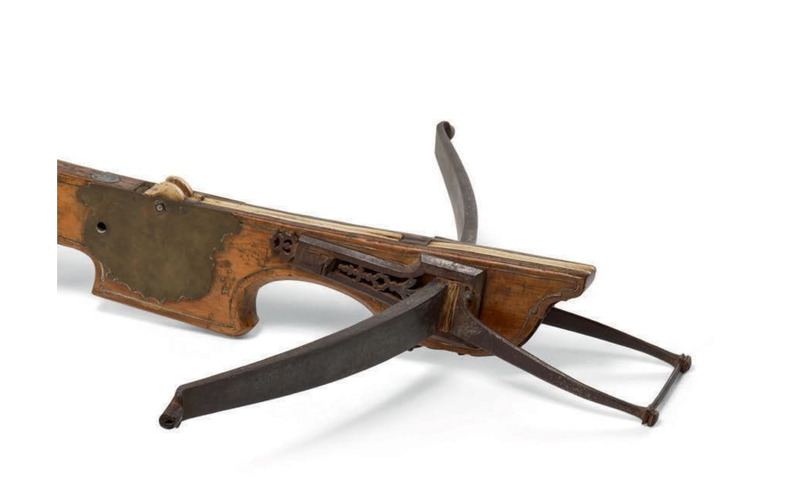
At the tip of the crossbow, an iron stirrup protrudes. The prod (bow) is made of wrought iron. Decorated bow irons secure the prod to the walnut wood stock.
The stock is quite plain, though a few decorative lines, made of inlaid metal, run along the edges. The nut is made of bone. Notably, the right side of the stock has a tarnished silver dedication plaque but it is no longer legible (at least in available photos). The trigger lever is made of brass and wrought iron.
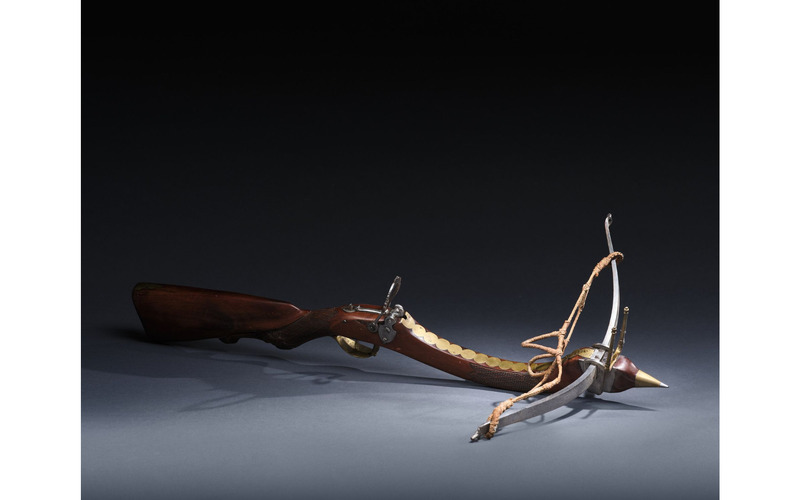
The tip of the crossbow has a brass spike tipped in iron. The bow is made of wrought iron and the bowstring is likely original. The bow is attached to the wooden stock with bow irons. The sections of the stock intended for gripping are carved with a harlequin grid pattern. The downward curve of the stock (common in pellet crossbows) is decorated with brass plates. There is a foldable sight (likely iron) and a hair trigger with a continuous brass trigger guard. Further down the stock, on the top of the stock, there is the carved face of a bearded man with glass eyes and a wild expression. A flower is carved on the right side of the butt of the stock.
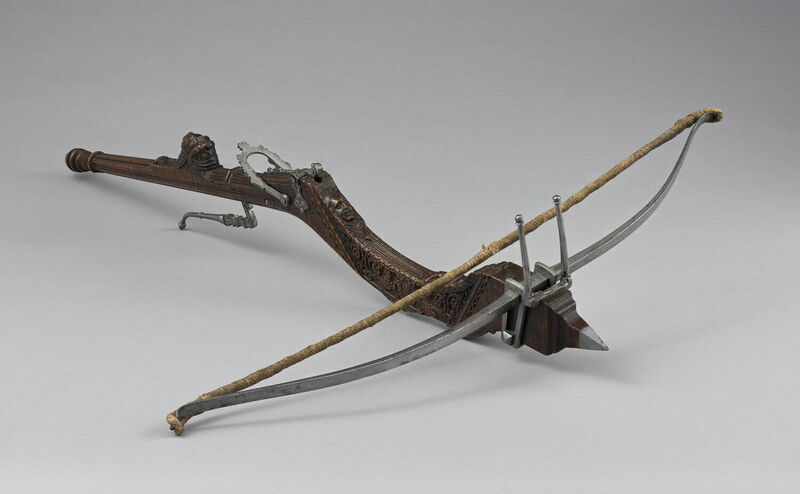
The tip of this crossbow has a pyramidal spike.
The steel bow is connected to the wooden stock with bow irons. The downward curve in the stock (common on pellet crossbows) is finely carved with the same low relief on the right and left sides. This low relief depicts flowering plants, two creatures with human heads and animal bodies, and a human face between them. Simpler geometric patterns line the edges of the design, including patterns of dots and straight and curved lines.
The top and bottom of this curved section of the stock are carved with faces and decorative lines. The top has two human faces, one of which is bearded. The bottom has one bearded face which could be human or beastial. Farther down the stock, the face of a woman carved in the round protrudes significantly. Decorative lines go to the end of the stock, which ends in a knob.
As for the metal parts, there is a steel trigger lever and a foldable steel sight in the shape of an arch. There is a steel hook mechanism which attaches to the bowstring. The bowstring is a restoration, and is a traditional bowstring rather than the double bowstring typical of pellet crossbows.
This crossbow first appears in the collection of Pierre Révoil (1776-1842). It stayed at the Museum of Decorative Arts (Musée des Arts décoratifs) from 1924 to 1987. The crossbow's supplementary inventory number, beginning with P, refers to its place in the Pierrefonds, the collection of its original collector.