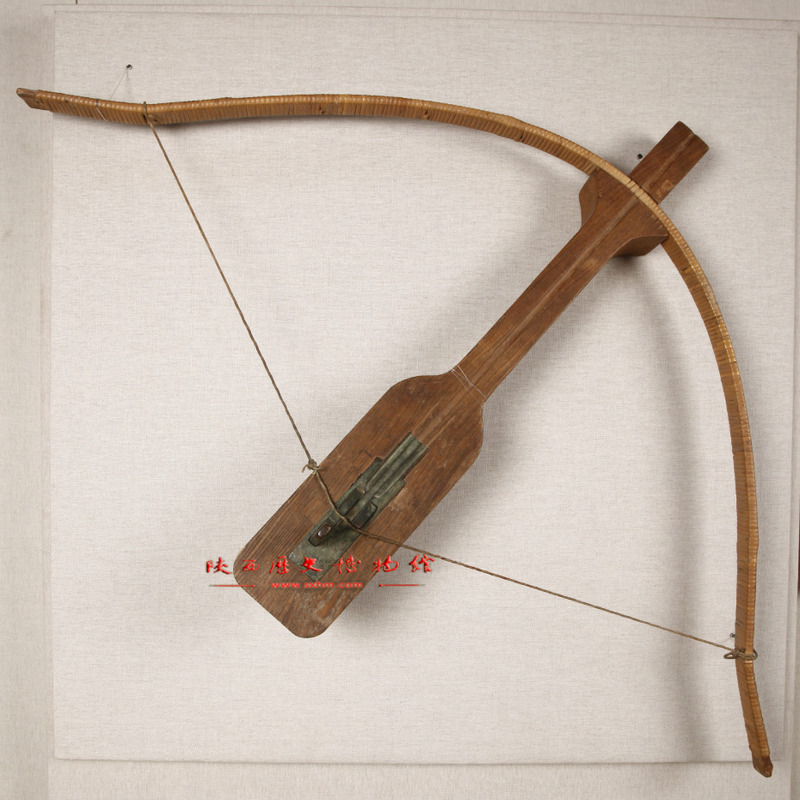
This crossbow mechanism held by the Shaanxi History Museum is dated to the Qin dynasty. The specific location of its unearthing is not listed.
From the angle in the photo, only the sight and nut, or the wangshan (望山) and ya (牙), and the top of the bronze casing, or guo (郭) is visible. There is a groove that goes down the middle of the casing's top surface which continues onto the wooden stock of the crossbow. This groove would be where the arrow rests during drawing and aiming. The crossbow mechanism is nested in what is likely a replica of a crossbow design from the time. In this replica, the two prongs of the nut are shown holding back the crossbow string, with the sight upright and poised for aiming. It is not visible from the photo here, but a mechanism like this likely includes the sear, or gouxin (钩心) and the trigger, or xuandao (悬刀) working in tandem to allow the nut to lock the crossbow string in place.
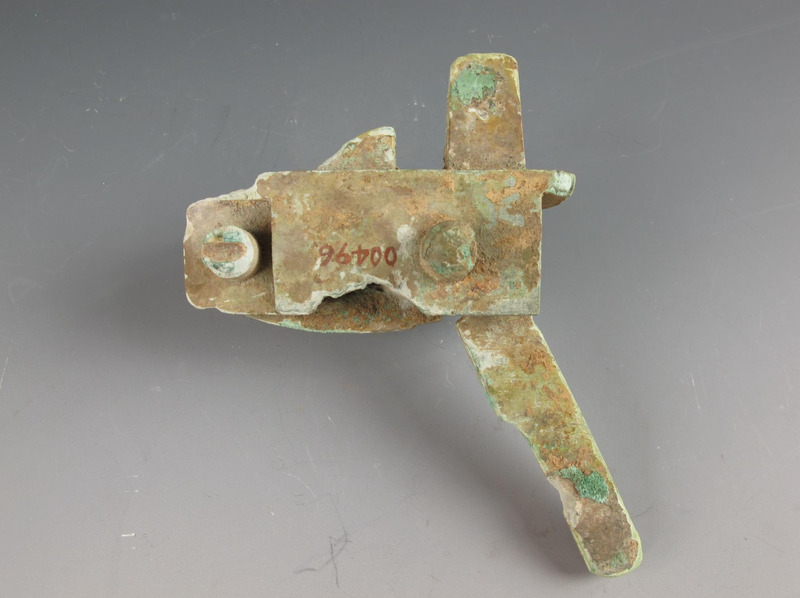
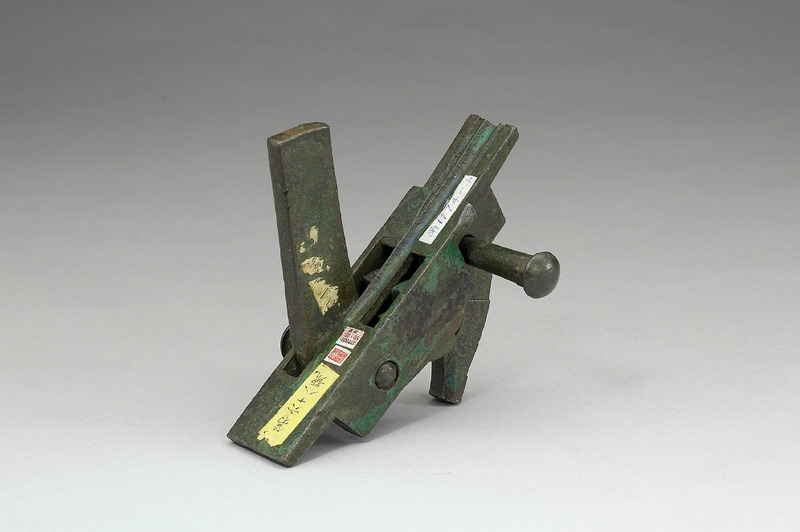
This crossbow mechanism held by the Zhejiang Provincial Museum is dated to the Han dynasty. The specific location of its unearthing is not listed.
The mechanism is made of bronze and comprises the typical parts of a Chinese crossbow mechanism. The long rectangular protrusion at the top of the mechanism is the sight, or wangshan (望山).The small hooks sticking out in front of the sight are a part of the same component as the wangshan and serve as the nut, or ya (牙). It appears that on this specimen, one of the ya has been broken off. The rectangular handle at the bottom of the mechanism is the trigger, or xuandao (悬刀), and within the casing there is a sear, or gouxin (钩心) connecting the sight and nut and the trigger. The mechanism is held together by bronze axle pins and held within a rectangular bronze casing called the guo (郭) which has a groove that goes down the middle of its top surface which would continue onto the wooden stock of the crossbow. This groove would be where the arrow rests during drawing and aiming.
Although the mechanism is made of moving parts, it appears that for this specific specimen, corrosion has impacted the mobility of the mechanism as can be seen from the partially sealed gaps between component parts.
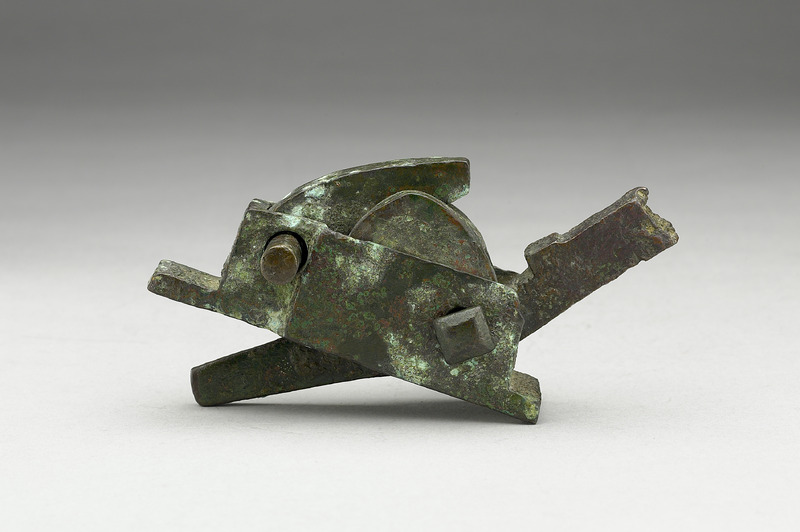
This crossbow mechanism held by the National Palace Museum is undated. The specific location of its unearthing is not listed.
The mechanism is made of bronze and comprises the typical parts of a Chinese crossbow mechanism. In the photo, the mechanism is positioned upside down. Thus, in the display, the long rectangular protrusion at the bottom of the mechanism is the sight, or wangshan (望山). A part of the same component and hidden within the casing is the nut, or ya (牙). It is not visible from any of the photos here due to the angle of the mechanism. The rectangular handle at the top of the mechanism is the trigger, or xuandao (悬刀), and within the casing sticking out of the opposite side of the trigger there is a sear, or gouxin (钩心) connecting the sight and nut and the trigger. The mechanism is held together by bronze axle pins and held within a rectangular bronze casing called the guo (郭) which has a groove that goes down the middle of its top surface which would continue onto the wooden stock of the crossbow. This groove would be where the arrow rests during drawing and aiming. A look at the bottom of the mechanism shows how the sear connects with the trigger and the sight and nut.
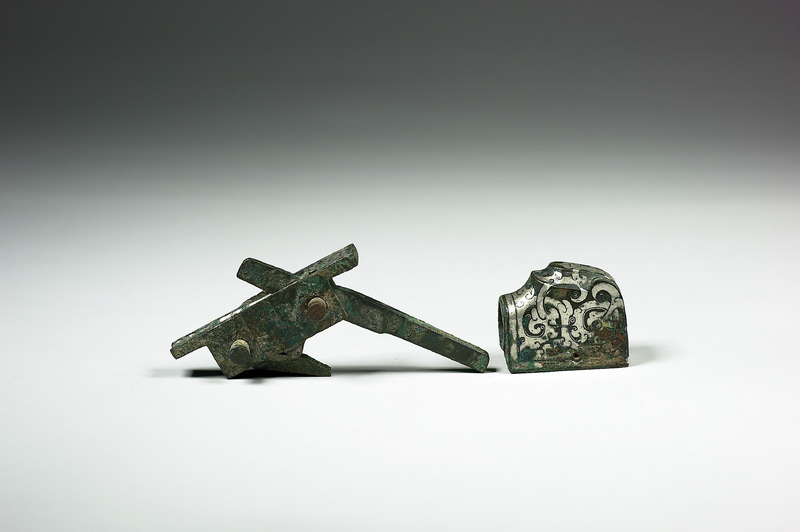
This crossbow with silver inlay held by the National Palace Museum is dated to the Warring States period. The specific location of its unearthing is not listed.
The mechanism is made of bronze and comprises the typical parts of a Chinese crossbow mechanism. The long rectangular protrusion at the top of the mechanism is the sight, or wangshan (望山). A part of the same component and hidden within the casing is the nut, or ya (牙), partially visible from the top of the mechanism as the small hooks inside the casing. The rectangular handle at the bottom of the mechanism is the trigger, or xuandao (悬刀), and within the casing there is a sear, or gouxin (钩心) connecting the sight and nut and the trigger. The mechanism is held together by bronze axle pins and held within a rectangular bronze casing called the guo (郭). The top of the bronze casing—the part visible even when inserted into the stock of the crossbow—has a groove in the middle which would continue onto the wooden stock of the crossbow. This groove would be where the arrow rests during drawing and aiming. The top of this bronze casing has also been inlaid with silver with flowing cloud-like designs.
Found with this mechanism is a bronze cap similarly inlaid with silver in flowing cloud-like designs. This cap was likely affixed to the butt of the crossbow stock as both protection for the butt of the crossbow during drawing and rest as well as decoration. Part of the silver inlaid design on both the top of the bronze casing and the bronze cap have been corroded off.
This engraved bronze crossbow mechanism held by the National Palace Museum is dated to 228 CE during the Wei Kingdom’s rule in the Three Kingdoms period. It was unearthed within Wei Kingdom territory.
The mechanism comprises the typical parts of a Chinese crossbow mechanism. The long rectangular protrusion at the top of the mechanism is the sight, or wangshan (望山). The two small hooks sticking out in front of the sight are a part of the same component as the wangshan and serve as the nut, or ya (牙). The rectangular handle at the bottom of the mechanism is the trigger, or xuandao (悬刀), and within the casing there is a sear, or gouxin (钩心) connecting the sight and nut and the trigger. The mechanism is held together by bronze axle pins and held within a rectangular bronze casing called the guo (郭) which has a groove that goes down the middle of its top surface which would continue onto the wooden stock of the crossbow. This groove would be where the arrow rests during drawing and aiming. The bronze axle pin at the front of the casing is missing from this specimen.
There are engravings on the crossbow mechanism, however the museum does not provide a transcription. But from the images shown, it can at least be made out that there are engravings that indicate the specific date of manufacture. On the image depicting a flat surface of engraved words, the words “太和二年” (taihe er nian), meaning “the second year of Taihe” can be made out. Taihe is a reign title used by the Wei emperor of the time to designate the period of his reign. Taihe began in 227 CE, so the second year of Taihe corresponds to 228 CE.
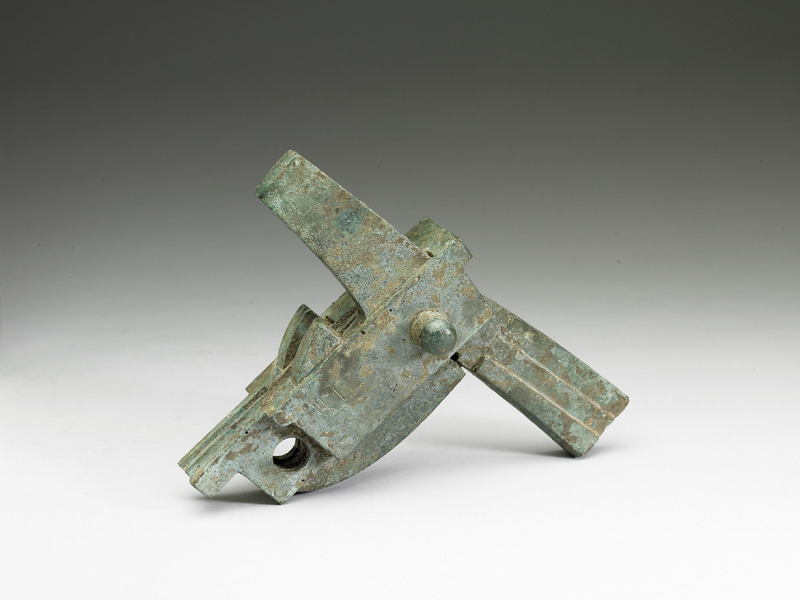
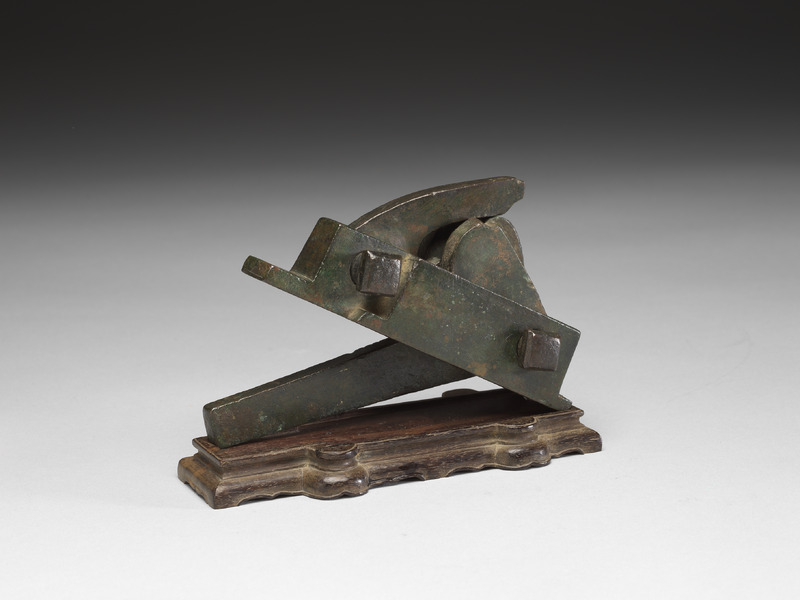
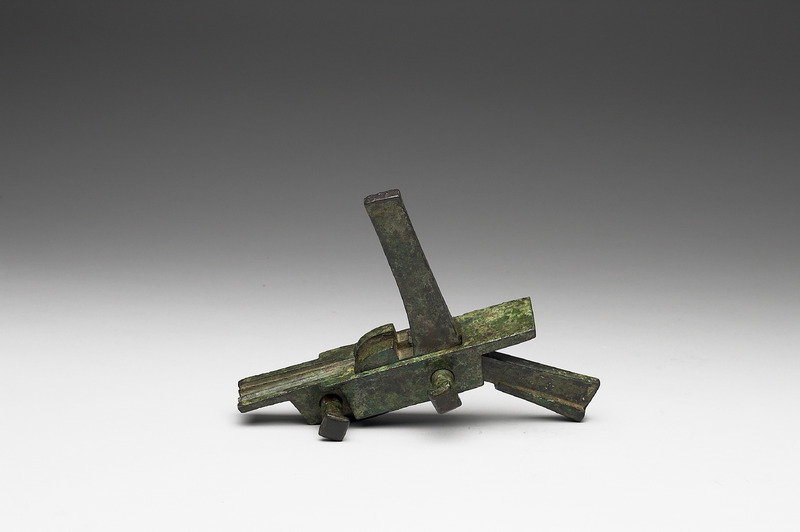
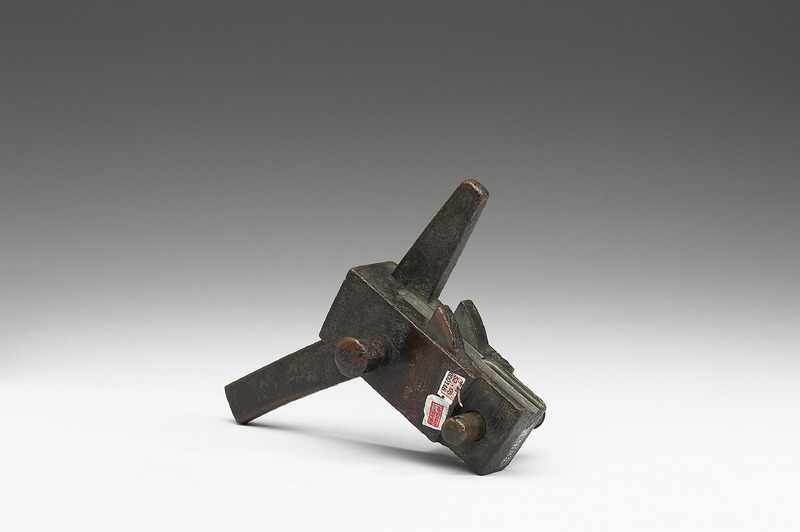
This crossbow mechanism held by the National Palace Museum is dated to the Han dynasty. Its specific location of unearthing is not listed.
The mechanism is made of bronze and it comprises most of the typical parts of a Chinese crossbow mechanism. In the photos, the mechanism is positioned upside down. Thus, the long rectangular protrusion at the bottom of the mechanism is the sight, or wangshan (望山). The two small hooks sticking out in front of the sight are a part of the same component as the wangshan and serve as the nut, or ya (牙). The slightly curved component peeking out from the top of the casing is the sear, or the gouxin (钩心). The whole mechanism is held by two axle pins within a casing, or guo (郭) which has a groove that goes down the middle of its top surface which would continue onto the wooden stock of the crossbow. This groove would be where the arrow rests during drawing and aiming. The trigger does not appear to be present in this specific mechanism.
This crossbow mechanism held by the National Palace Museum is dated to the Han dynasty. Its specific location of unearthing is not listed.
The mechanism is made of bronze and it comprises most of the typical parts of a Chinese crossbow mechanism. The long rectangular protrusion at the top of the mechanism is the sight, or wangshan (望山). The two small hooks sticking out in front of the sight are a part of the same component as the wangshan and serve as the nut, or ya (牙). The rectangular handle at the bottom of the mechanism is the trigger, or xuandao (悬刀), and within the casing there is a sear, or gouxin (钩心) connecting the sight and nut and the trigger. The mechanism is held together by two bronze axle pins and held within a rectangular bronze casing called the guo (郭) which has a groove that goes down the middle of its top surface which would continue onto the wooden stock of the crossbow. This groove would be where the arrow rests during drawing and aiming.
This crossbow mechanism held by the National Palace Museum is dated between the Han and Six dynasties period. Its specific location of unearthing is not listed.
The mechanism is made of bronze and it comprises most of the typical parts of a Chinese crossbow mechanism. The long rectangular protrusion at the top of the mechanism is the sight, or wangshan (望山) the museum description states that there are silver inlays on the sight as aiming guides, but these inlays are not visible from any angle in the given photographs. The two small triangular hooks sticking out in front of the sight are a part of the same component as the wangshan and serve as the nut, or ya (牙). The rectangular handle at the bottom of the mechanism is the trigger, or xuandao (悬刀), and within the casing there is a sear, or gouxin (钩心) connecting the sight and nut and the trigger. The mechanism is held together by two bronze axle pins and held within a rectangular bronze casing called the guo (郭) which has a groove that goes down the middle of its top surface which would continue onto the wooden stock of the crossbow. This groove would be where the arrow rests during drawing and aiming.
According to the museum description, this crossbow mechanism is recorded in Rong Qing’s old collection “Songzhai Jijin Records”
This crossbow mechanism held by the National Palace Museum is dated between the Han and Six dynasties period. Its specific location of unearthing is not listed.
The mechanism is made of bronze and it comprises most of the typical parts of a Chinese crossbow mechanism. The long rectangular protrusion at the top of the mechanism is the sight, or wangshan (望山). A part of the same component and hidden within the casing is the nut, or ya (牙), partially visible from the top of the mechanism as the small hooks inside the casing. The slightly curved component hanging out from the bottom of the casing and propping up the mechanism in the position it is shown in the photo in is the sear, or the gouxin (钩心). The whole mechanism is held by two axle pins within a casing, or guo (郭) which has a groove that goes down the middle of its top surface which would continue onto the wooden stock of the crossbow. This groove would be where the arrow rests during drawing and aiming. The trigger does not appear to be present in this specific mechanism.
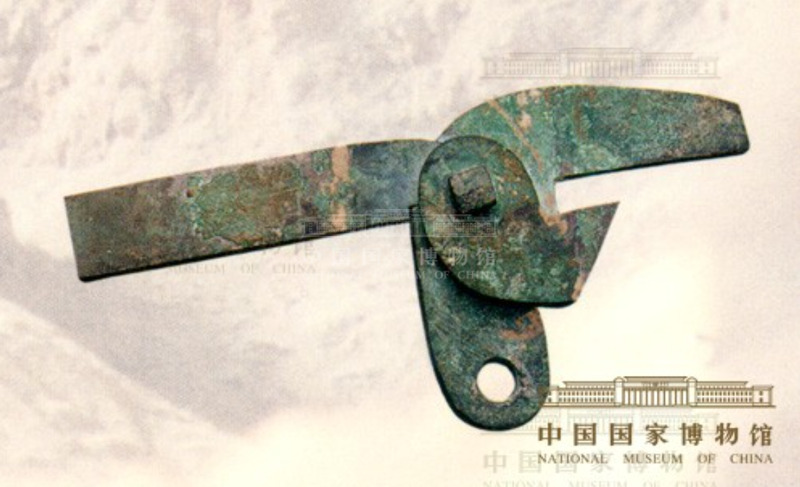
This Bronze Crossbow mechanism held by the National Museum of China is dated to the Qin dynasty, unearthed in 1974 in the Terracotta Army pits in the Mausoleum of Qin Shi Huang in the Lintong district of the city of Xi’an in Shaanxi province.
The mechanism shown here comprises most of the typical parts of a Chinese crossbow mechanism. The double pronged component on the right of the photo is the part that serves as the sight and nut, called the wangshan (望山) and ya (牙) respectively. The long piece to the right of that is the trigger, or xuandao (悬刀). And the short piece in the middle connecting the two is the sear, or gouxin (钩心). It lacks a casing, or guo (郭), and its affixed directly into the crossbow stock using bronze axle pins that slot through the holes in the mechanism’s component parts and into notches carved on the interior faces of the stock. This crossbow was likely drawn using arm strength, and, as with the other military weaponry unearthed from the Terracotta Army pits, was used by the Qin military against other states in the warring states period.
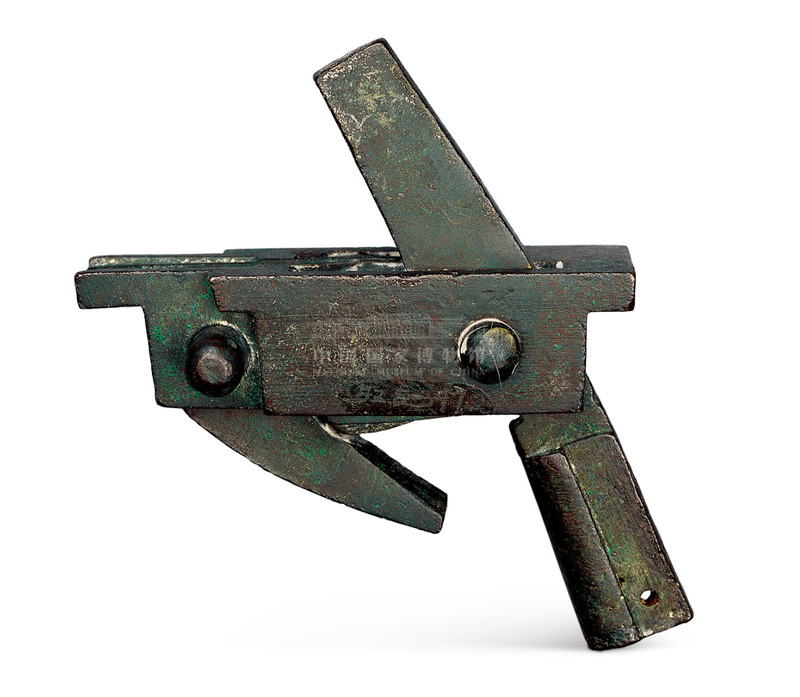
This bronze crossbow mechanism held by the National Museum of China is dated to the Wei Dynasty of the Three Kingdoms period. It was unearthed within Wei Kingdom territory.
The mechanism comprises the typical parts of a Chinese crossbow mechanism. The component that protrudes from the top of the mechanism is the wangshan (望山), which functions as a sight. Unseen in the image but a part of the same component is the ya (牙), which is a second, shorter protrusion in front of the wangshan that serves as the nut that holds the crossbow string in place when cocked. The component protruding from the bottom right of the mechanism is the trigger, or xuandao (悬刀), and within the rectangular bronze casing, or guo (郭) is a third component called the gouxin (钩心), or the sear which connects the trigger and the nut. The top surface of the bronze casing has a groove that goes down the middle of its top surface which would continue onto the wooden stock of the crossbow. This groove would be where the arrow rests during drawing and aiming. The mechanism is held together by two axles visible from the outside of the casing.
The name of the craftsmen who crafted the mechanism as well as the date of creation has been etched onto the mechanism. The museum description provides no clear information about what these details are, but it references the year 241CE in its description. During this period, the Wei, Shu Han, and Wu kingdoms were at war, and the Wei kingdom boasted both great manpower and technology. Crossbows by this time in the Wei kingdom were manufactured by government offices called shangfang (尚方), one office handled the crafting of the bronze components in the mechanism, and another handled the body of the crossbow itself, with an inspector supervising the overall crafting process.
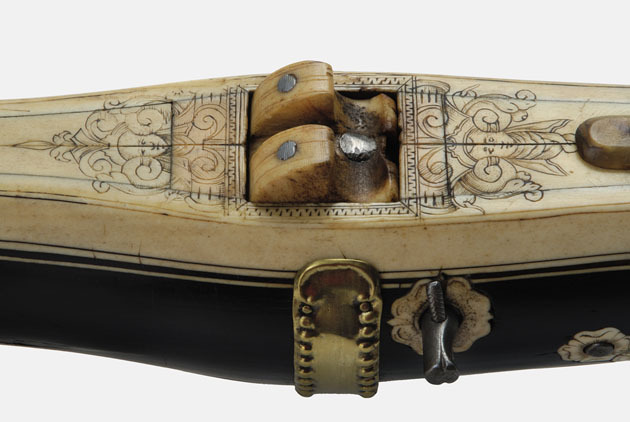
Crossbow, the tiller inlaid with engraved buck-horn. Made in Germany in the 16th century. This steel bow features elaborate detailing around each inserted axles and nussfaden. A swiveled back bolt clip with a flared up portion, potentially as a signt, can also be seen, with decorations resembling royalty around the iron reinforced nut. The axles also seem to have a lot of care put into them, some having carvings in them. This bow is also mostly comprised of black coloring, having only thin exposed areas around the top and bottom of the bow body.
The cranequin is also equally elaborate, having the full zodiac in two rings, having 6 on each. Each zodiac has their own distinct symbols neighbouring them too. It has a distinct cage for all the gears within the mechanism, giving it a sleek modern look.
From the Craven Collection.