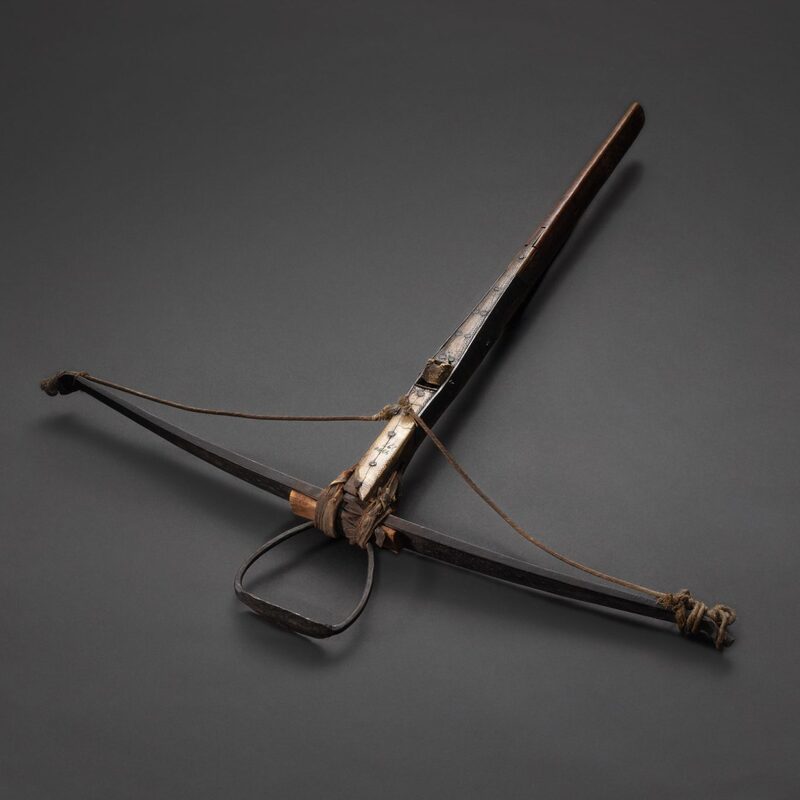
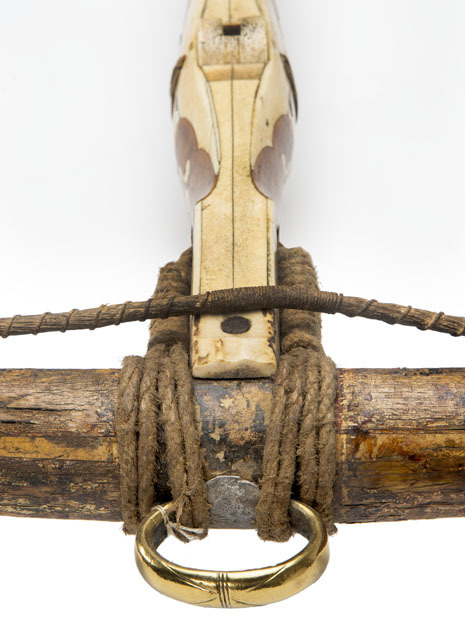
The prod and the stirrup are made of metal, having a wooden stock with iron and bone inlays. A cloth binding attaches the bridle block to the metal prod. There is a roller nut made of bone on top of the cavity of the trigger mechanism, and an iron trigger is located beneath the tiller, which is not visible in the image. There is no rear sight built for this crossbow and the butt stock is narrow, making this weapon more simplistic in terms of design and usage. According to the source, the user would be placing one foot in the stirrup and pull the string into the nut. The string would be made of moose sinew, and it is assumed that the string shown belongs to a later century, composed from a different rope-like material.
The bone inlay states the date as 1646, but it is unclear whether other parts also belong to that specific date or whether they were altered later in the century.
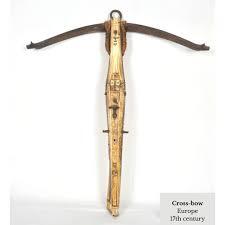
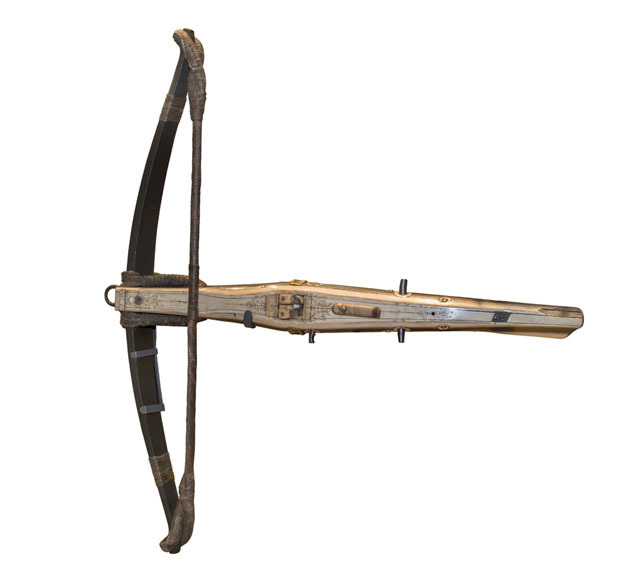
The stock is made of ivory, engraved with creeping designs of flowers and leaves along with a few triangular symbols at the edge of the butt stock. The bow and suspension ring are both made of steel and parts of the stock appear to be nailed in with some sort of screws. The bridle is made of rope. The rear sight, rivet, nusfadden, cocking pin, nut, and trigger appear to be intact. However, the bolt clip is missing and it is hard to confirm the parts underneath as this is the only image publically available of the crossbow.
Note: The image can only be found in a facebook post by the official account of the Salar Jung Museum and its description is in a special catalogues released by the institution. Both have been linked below.
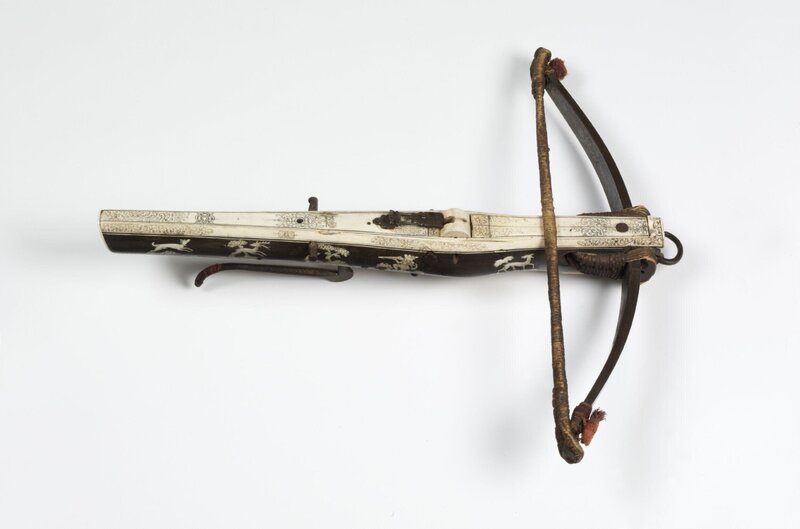
This German hunting crossbow has a stock made of ebony and engraved antler. The length of the stock is inlaid with antler carvings of hunters and various kinds of forest animals such as deer. These scenes are completed with stylized foliage setting the figures in a natural space. The top and bottom of the stock are paneled with antler and engraved with delicate foliage and florals. On the underside of the stock, just below the lock the letters “L.D.M” are prominently engraved and described by the Museum to be the stockmaker’s mark. Below the letters, further engravings resembling feathers, leaves or flames can be observed. On the top of the stock, the space around the lock is carved with highly detailed foliage. The steel trigger guard, bolt clip and rear sight are etched with foliage and floral patterns. As described by the Museum, the steel prod has the fabric remnants of the fabric that would have once been added for decoration.
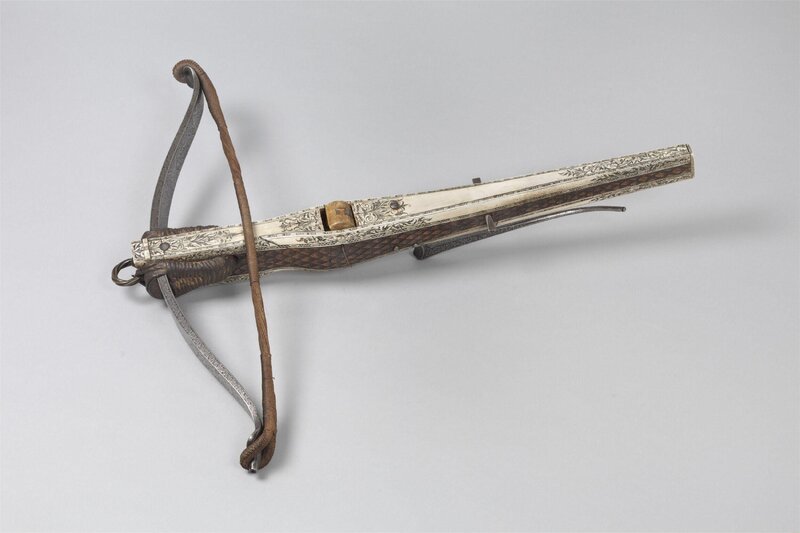
This German hunting crossbow features an engraved wooden stock inlaid with panels of engraved staghorn. Along the side of the wooden stock a raised harlequin pattern. The top of the stock is an inlaid panel of staghorn which has been engraved with delicate foliage at the butt, around the lock and the reinforcing rivet. The stock has also been engraved with repeating geometric patterns and groups of small lines. On the side of the stock, just below the lock is a small four legged mammal engraved in staghorn. Uniquely, the steel prod and trigger guard are also etched with delicate stylized foliage, masks, beasts and male figures.
As noted by the Victoria and Albert Museum, the rope cords and trigger nut may be original to the crossbow. This crossbow was left to the Museum in 1931 by Mr. G. H. Ramsbottom through Art Fund. Its prior provenance is unknown.
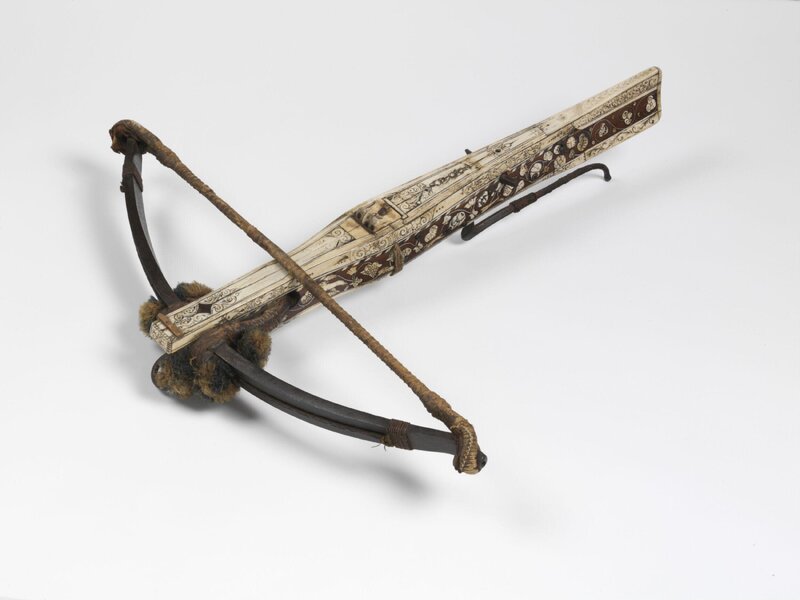
This German crossbow would have been used by European nobles for hunting. The stock is made of walnut and is inlaid with engraved staghorn. The deep brown of the walnut creates a sharp contrast with the cream antler designs. Towards the butt end of the stock there is a myriad of stylized florals creating a balanced pattern. In the middle of the stock, around the transverse pin and the trigger guard, the designs become more intricate. In the staghorn portion of the stock directly above the transverse pin a small four legged mammal is engraved and surrounded by stylized abstracted designs that create a sense of motion for the animal. In front of the Nussfaden, the engraved design continues and another four legged mammal is repeated. Directly above the Bridle a tiny rabbit is engraved and also surrounded by ornamentation that emulates a sense of motion. The underside of the stock also features the repeating floral design found on the side and next to the bridle is an engraved figure dressed in draped cloth, holding a staff. The underside of the stock, closest to the prod, has an engraving perhaps resembling the face of a lion or a man with a large nose, prominent teeth and flowing hair. The steel prod is decorated with fabric pom poms that would have once been brightly coloured and now are a deep green hue.
The provenance is not described on the Museum website.
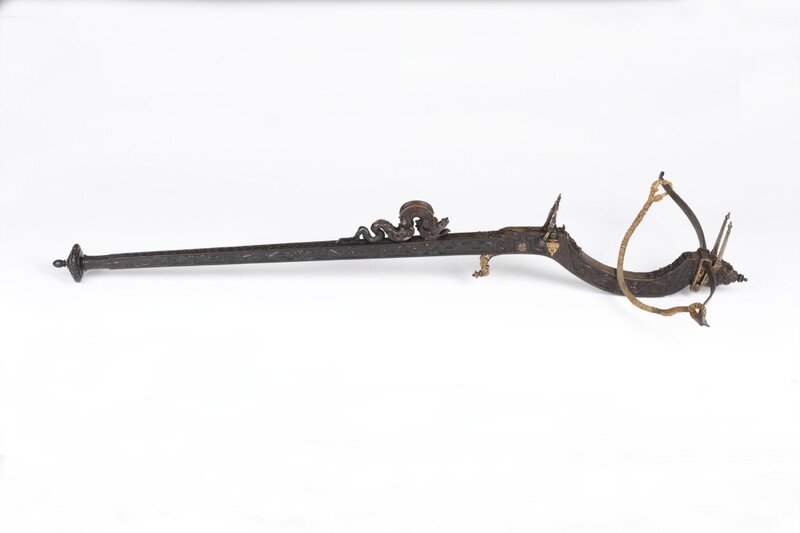
This Italian Stonebow would have likely been used in the later half of the sixteenth century by nobles for hunting. This example in particular is remarkable for its intricate carving and gold damascening. The stock of the crossbow is extremely slender and forged from ebony. Along the entire length of the stock is ornamented with highly detailed carvings described by the Victoria and Albert Museum to be dolphins, masks, grotesques and foliage. The butt end of the stock demonstrates the use of a wood turning technique seen in furniture making, creating a wider rounded end with repeating bumps. Located just behind the trigger, a three dimensional grotesque carved of ebony is placed on the top of the stock. The steel hardware used for the trigger, the mounts, the transverse pin and rear sight are damascened (overlaid) in gold and feature an engraved abstracted design consistent with the style of the other carvings. On various parts of the stock including the carved grotesque and the u-shaped portion of the stock, signs of wear can be observed through a lightening of the wood, revealing a reddish hue.
This stonebow was acquired by the Victoria and Albert Museum in 1921 from the David Currie Bequest. It was previously part of the Spitzer Collection and may have been restored.
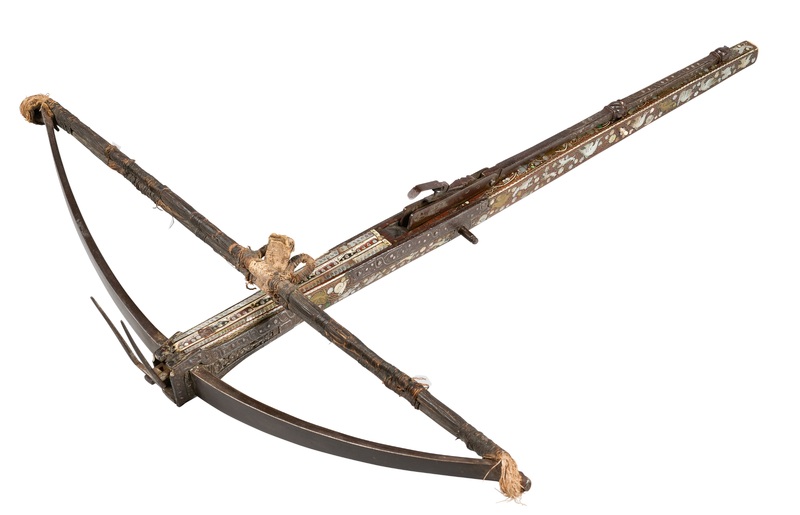
The wooden stock with ornately decorated with exotic birds and a chase scene with stags, hounds, and hares, along with circular and floral designs creeping between the animals. The birds seem to consist of gold foliage, and the other rope-like designs are made of mother-of-pearl. The iron prod is attached to a pointed pair of stirrup and the string has a pellet pouch, suggesting it was used to shoot pellets instead of bolts. The iron trigger mechanism is surrounded by images of staghorns and hounds. There is also a horn cap at the end of the butt stock. An iron bar consists of a pair of lugs for a spanning device, inlaid with silver to match the trigger mechanism itself.
The crossbow was used as a stonebow by removing the nut which is visible because of the filled cavity, the trigger mechanism, and the folded U-shaped fore-sight.
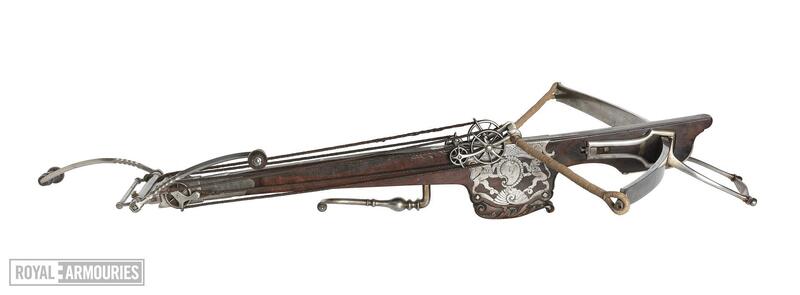
Steel bow secured to the rectangular wooden stock with bow irons which also holds stirrup with a curved bar in position all anchored by transverse pin. The front of the stock is thicker with a steel groove for the bolts. The nut is a copper alloy. The stock extends beneath the nut for a left hand grip. Inlaid reinforcing plates on both sides in the form of rampant lions holding an asymmetrical shell with the initials “G.R.” inside with a shell beneath them and scrolls above. The stock is thinner at the end where the top is inlaid with mother-of-pearl and the number “1162” inscribed. Butt is reinforced with a steel cover to take the windlass. Trigger is a lever with round baluster moulding. Bowstring with simple loops on each end covered with a circular winding. Bright, finished six-wheeled windlass, curved metal cranks with handles made of wood.
Inlaid with horn, this crossbow features clear stock and body distinction with the coloration difference between horn and wood. Having a two-pinned trigger system, the nussfaden seems to be rusted contrary to the well-maintained crossbow body. The transverse pin, front plate, ring and bridle are all built into the front, with a loose string attached to the two ends of the prod. This may not be the original string perhaps. The handle seems to be consisting of bronze or plated with such, showing a worn out luster texture. Most of the essential pins have been covered up by the plating, having a very clean design. Glasgow Museum speculates that it is made in Germany, mid 15th century.
This steel crossbow with engraved horn features a thick body in construct, particularly in the nussfaden reinforcement. Having a metal piece around the midpoint between the nut reinforced with iron and the prod, it suggests something that resembles a handlegrip. It also includes a chin stock, as well as a wide axel for a cranequin anchor point. A ring is included in the front, rather than a full stirrup, suggesting that it's decorative and non-functional. A piece of the crossbow also seems to be missing from the top length of the crossbow near the stock, and the nut also seems to be damaged, showing small wear and tear. The prod is also asymmetrical, suggesting missing reinforcements on the right. The box plate of the cranequin also seems to be embellished with a metal plaque, potentially pierced and engraved. Glasgow Museum speculates that it is made in Germany, 16th century
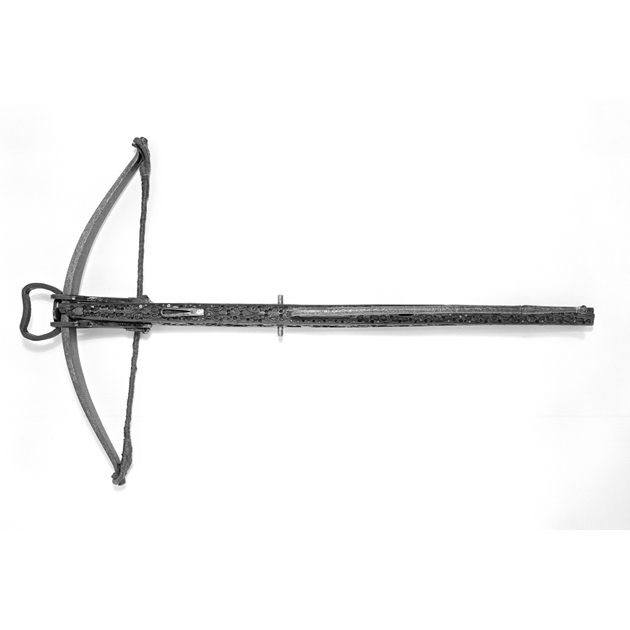
This crossbow is almost entirely gray, suggesting a full steel build. Endorned with elaborate carving in the top lining of it, maybe even the entire length of it, it suggests a wealthy commisioner to the crossbow maker. Contrary to the regular crossbows, the bridle is almost entirely gray, suggesting a steel reinforcement rather than string traditionally. A pin is present on the crossbow, potentially for the cranequin to interface with. However, the position of the bolt clip and the pin seems way too close on the bow, so further assumptions of the purposes cannot be made until more data is gathered.
The French nobleman René of Anjou (1409–80) penned a letter to a friend who had recently sent him two fine steel crossbows:
"I am told that you are a very good crossbowman and take great pleasure in shooting the crossbow. I tell you that, for my part, throughout all my life I too have taken great pleasure in it."
People of high status across Europe sent crossbows as presents to each other. François I of France sent Henry VIII eight crossbows in 1528. These were made by the royal crossbowmaker (arbalestrier du Roy) Robert du Mesnil. Ten years later François ordered another ‘douze belles arbalestes’ from this same craftsman. Henry also received crossbows as diplomatic gifts from the Holy Roman Emperor Maximilan I.
The bow of this crossbow is very special indeed. Not only is it beautifully decorated with etched and gilt strap- and scroll-work but it is adorned with a symbol denoting ownership by someone of great importance. The Royal coat of arms of England is supported by two animals: a lion and a dragon. Only the Tudor dynasty used this latter animal as an acknowledgement of their Welsh origins. One member of the Tudor dynasty who was an expert hunter and fond of target shooting was Elizabeth I. Every New Year’s Day she was presented with a ‘fair crossbow’ made by some of the finest craftsmen in her realm. This bow may well be one of these.
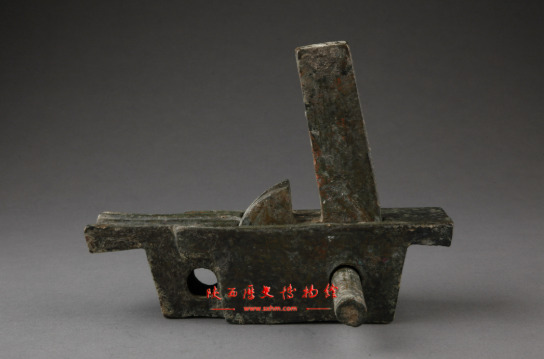
This crossbow mechanism held by the Shaanxi History Museum is dated to the Han dynasty. Its specific location of unearthing is not listed.
The mechanism is made of bronze and it comprises most of the typical parts of a Chinese crossbow mechanism. The long rectangular protrusion at the top of the mechanism is the sight, or wangshan (望山). The two small hooks sticking out in front of the sight are a part of the same component as the wangshan and serve as the nut, or ya (牙). The mechanism is held together by two bronze axle pins and held within a rectangular bronze casing called the guo (郭) which has a groove that goes down the middle of its top surface which would continue onto the wooden stock of the crossbow. This groove would be where the arrow rests during drawing and aiming. Within the casing there is a sear, or gouxin (钩心) connecting the sight and nut and the trigger. However, this particular mechanism is missing its trigger, or xuandao (悬刀), and there is one bronze pin holding the sight and nut in place, but the bronze pin at the front of the casing is missing.
The mechanism weighs 2.535kg, which is fairly heavy considering the missing components.