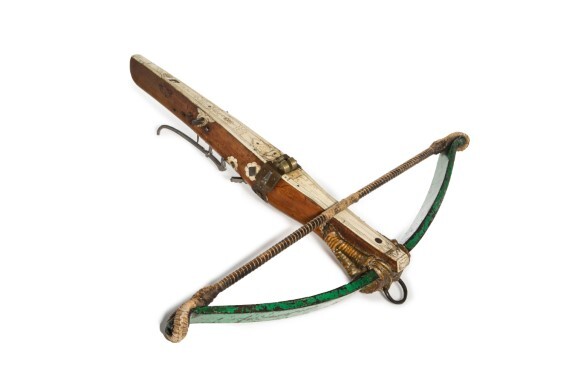
This German hunting crossbow is dated to the 16th century and features a stock made of fruitwood inlaid with bone, showcasing an intricate decoration carved in the stock. The ornaments on the bone inlay depict a hunting scene, flowers, a crouching lion, and more. The crossbow also contains a steel bow painted over in green, likely a later addition. At the rear of the stock is the engraved date ‘1524’ and a pair of initials that read “S D” and “A N.” Additionally, the stock has been braced with a brass bridle around its middle where the nut is located, likely a later addition as well.
This target crossbow is of Northern European origin, dating to the late 19th century. It contains a slim steel bow unusually positioned in the middle of the wooden stock and secured with copper alloy plates on both sides. It also features a scrolling rest at the bottom of the crossbow, a bolt groove at the top, an adjustable sight, and a double set trigger. Towards the back of the crossbow is an iron rest. On both ends are ornately designed iron terminals painted in gold.
There is a piece of wood broken off on the front tip of the crossbow.
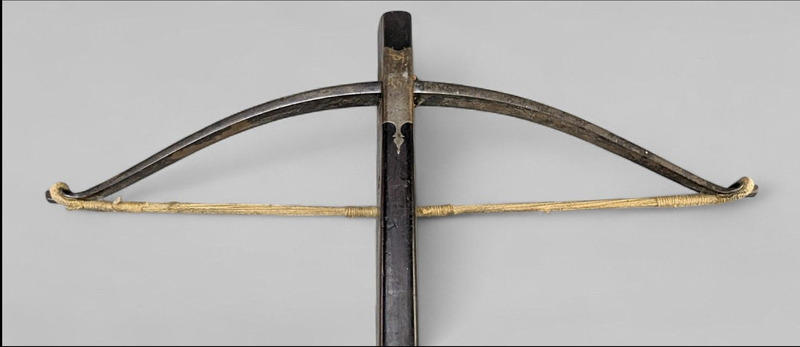
The crossbow’s metal prod connects to the ironwood stock with bow irons. The ironwood stock is long, straight, and rather plain. Some of the metal pieces have a decorative flair to their shape. (As examples, consider the underside of the bow irons and the nearby metalwork on the sides of the stock.) Farther down the stock, there is a cranequin lug protruding. The crossbow has a lever type of trigger.
The style - plain wood and lightly decorative metalwork - suggests possible English or Flemish origin.
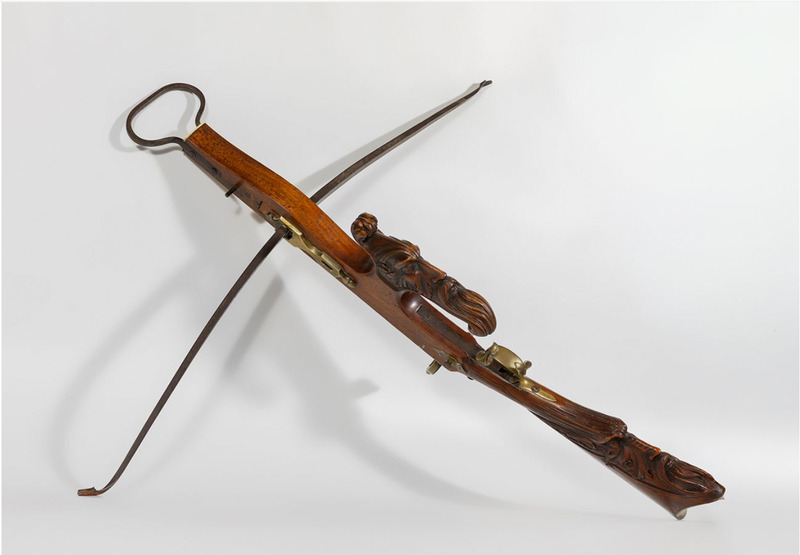
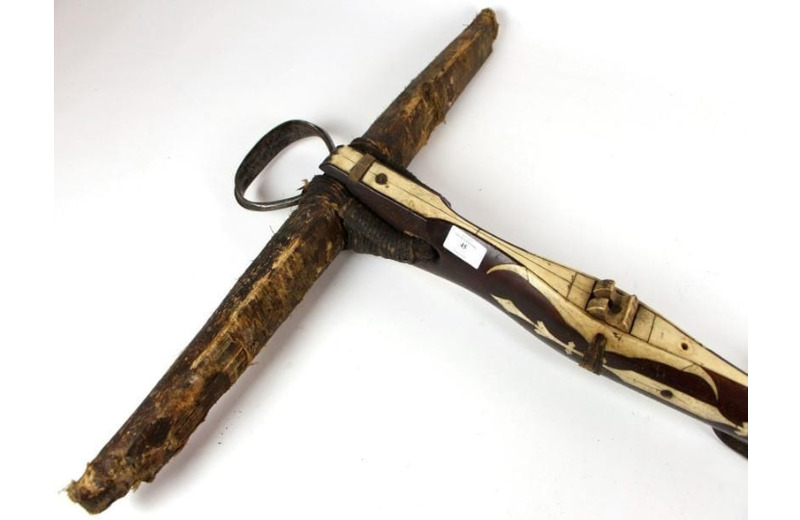
The tip of the crossbow has a stirrup or large suspension ring. The slender prod is made of unspecified metal. It attaches to the stock with brass bow irons. The stock is made of walnut wood and is decorated with two major carvings. The carvings depict a bearded man with leaves around his face. The auction house identified him as the “green man,” a European symbol of the cycle of nature. One carving of the man is on the hilt of the crossbow; the other is on the lower side of the butt. The crossbow lacks other carvings except for a few simple lines on the sides of the stock, above the trigger area. There is a brass trigger and trigger guard. There is a brass sight on the stock. The butt of the crossbow is capped in brass.
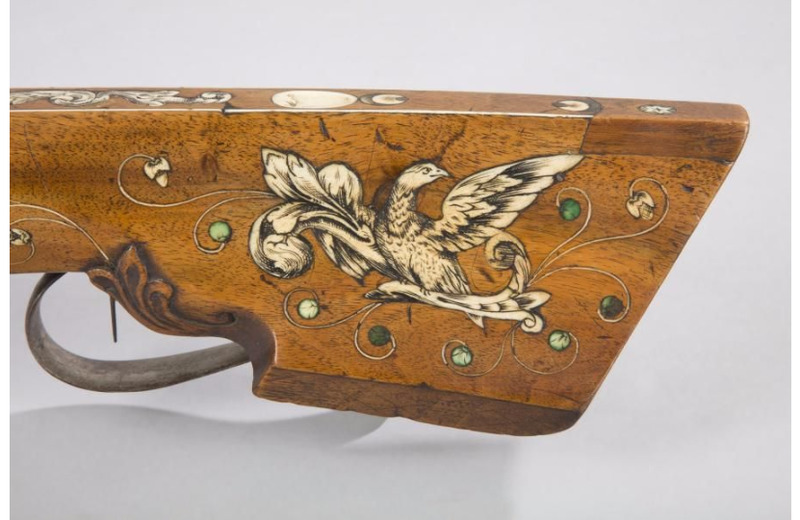
The tip of the crossbow has a small metal suspension ring. The wrought iron prod (which lacks its bowstring) connects to the stock with the help of bindings. The stock is made of fruitwood and inlaid with deer antler. Some of the deer antler inlay has been dyed, specifically the parts depicting plant motifs. On the cheekplate, the deer antler inlay depicts a bird. The top of the stock features a bolt clip.Towards the back of the top of the stock, there is an iron sight. This crossbow has a hair trigger with a trigger guard. On the stock, near the trigger, there is a small carving of leaves.
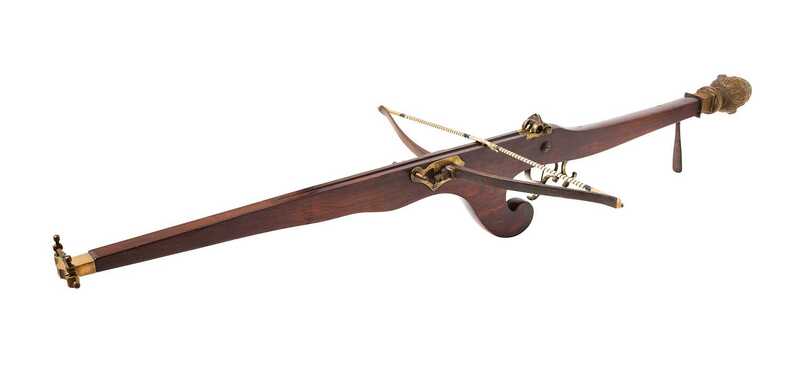
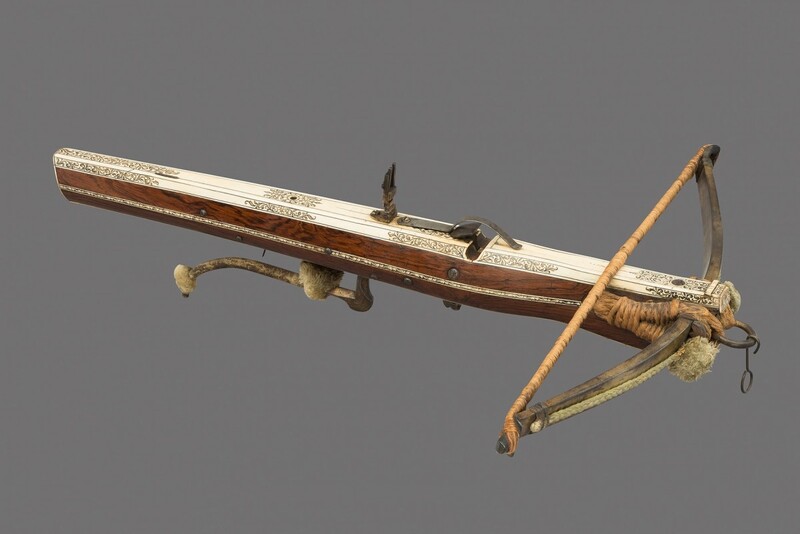
A sporting crossbow produced in Dresden, Germany in the late 17th or early 16th century. Bows of this type were popularly used by Eastern German nobility or landed classes for sporting competitions where participants would shoot wooden targets strung up high on at the top of a pole. The crossbow is made from staghorn and veneered with exotic hardwood and is classified as having a schnepper or “snap lock” that locks the string in place in preparation of shooting. It possesses a right-handed cheek rest, a mark from the crossbowmaker on the prod, and a folding sight used for aim. It also features two woolen pompoms on the trigger, two woolen pompoms at the front of the prod with a safety cord at its front, and a suspension ring hooked onto the stirrup for when the crossbow is hung up.
Materials: Steel, iron, gilding, wood, exotic hardwood veneer, staghorn, hemp cord, leather, silk
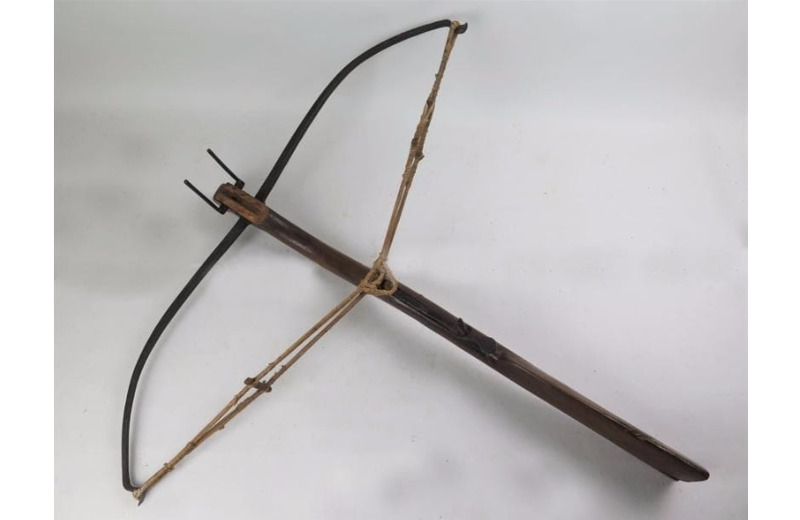
This crossbow has a thin metal prod and slender wooden stock. It lacks any visible decoration. Its bowstring is original. This crossbow has two sights. The one near the tip of the crossbow is made of two upright sticks; a cord would be tied between them and its height adjusted accordingly. There is another more traditional sight farther back on the stock. The trigger is not visible; it is possible that there used to be a hair trigger which broke off. The auction house does not comment on the crossbow’s place of origin.
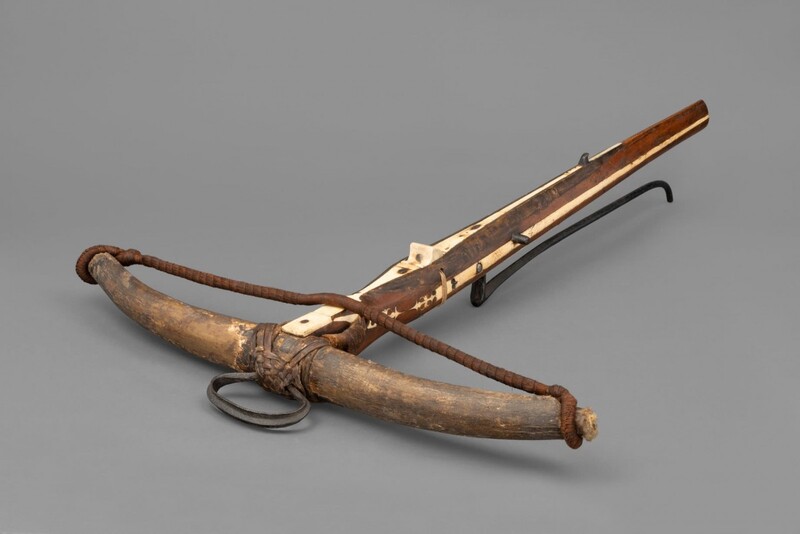
This composite crossbow was built in central Europe, likely Switzerland in the late Gothic period. Its stock is made from fruitwood and staghorn. Crossbows of this make were used for multiple purposes including sporting activities for hunting game as well as in battles. Its use for either activity relies upon the particular bolts or ‘qwarellys’ selected with the head of the bolt fashioned for the specific task. The crossbow features a leather binding that runs along the top of the prod, attaching it to the stock. The prod is made of cow horn with a string bow that is of corded hemp added later. At the top of the prod is an iron stirrup used as a foothold when spanning the crossbow.
Materials: Iron, fruitwood, staghorn, cow horn, bone, animal sinew, resin, paper, varnish, leather, corded hemp. The leather binding and string bow later.
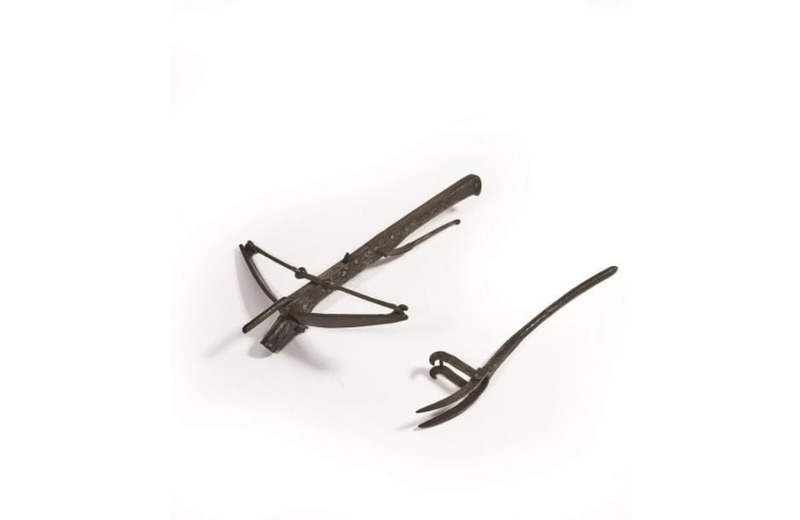
On the front end of the crossbow, a bolt rest juts out considerably. This crossbow likely has a steel prod. It seems to lack bindings, so it is uncertain how it attaches to the stock. Bow irons may have been used, but the picture is unclear. Instead of a bowstring, the prod has a chain made of three long steel pieces. This crossbow has a lever trigger.
The crossbow is accompanied by a steel goat’s-foot lever, or “pied à biche.” It was used to help arm the crossbow.
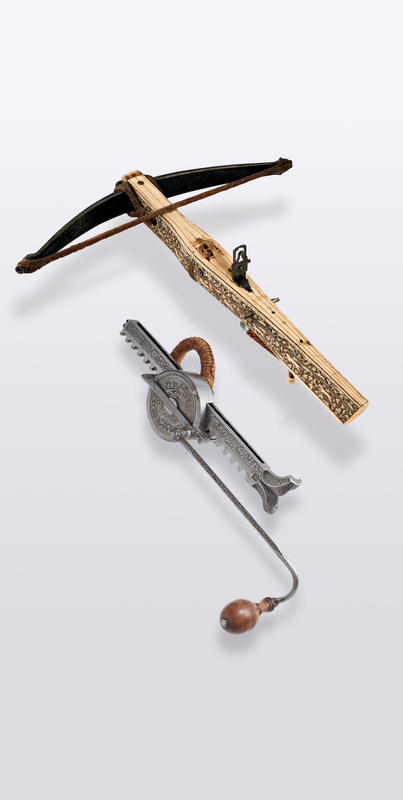
This hunting crossbow has a sinuous fruitwood stock decorated with bone inlay. The tip of the crossbow has a wrought iron stirrup, connected to the crossbow with the same bindings that attach the prod to the stock. The trigger is made of wrought iron.
The cranequin is made of wrought iron. It has a circle of braided or woven cord.
Bindings connect the steel prod to the wooden stock. The wooden stock is beautified with complicated ivory inlay. Towards the front of the underside of the crossbow, Mary Magdalene, a skull, and the year 1565 are visible. Towards the back, there is the fabled Roman woman Lucretia. These figures contrast with each other along the themes of religion, sexuality, and virtue. As noted by the Basel Historical Museum, this juxtaposition evokes the Renaissance and suggests the crossbow was commissioned by a cultured person.
This crossbow also has a bolt clip, likely made of horn, and a lever trigger.
The cranequin is decorated with motifs of flowers and vegetation. The winch part of the cranequin is decorated with hunting scenes as well, mirroring those of the crossbow. There is a wooden knob, decorated with simple lines, on the end of the cranequin handle. The cranequin materials and provenance are not commented on by the museum.
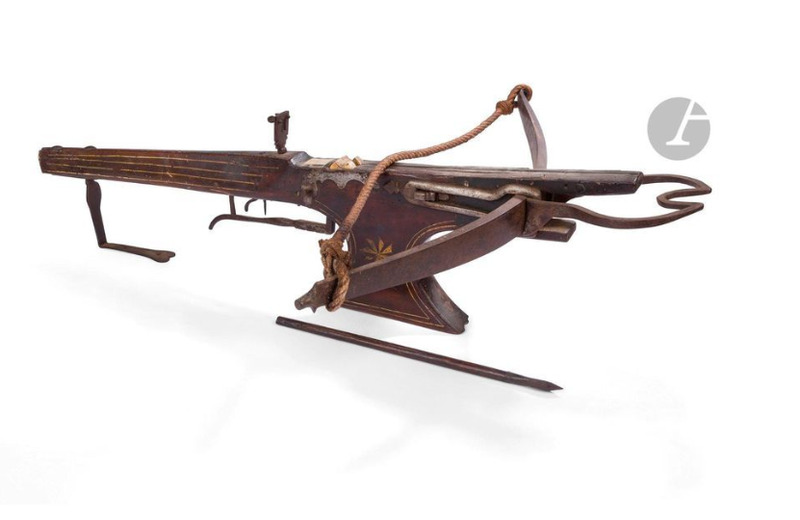
This crossbow has a wrought iron prod, upon which is written “ANTOINE FOURNIEZ 1757.” Bow irons connect the prod to the fruitwood stock. The stock is painted with a few decorative motifs, including lines and a pinwheel. The nut is made of bone. The sight is made of iron, and the other metal details are made of iron as well. The trigger system appears to be an example of a double set trigger. It is protected with a trigger guard. The most striking feature of this crossbow is the large suspension ring, which is shaped like the outline of a cloven hoof.