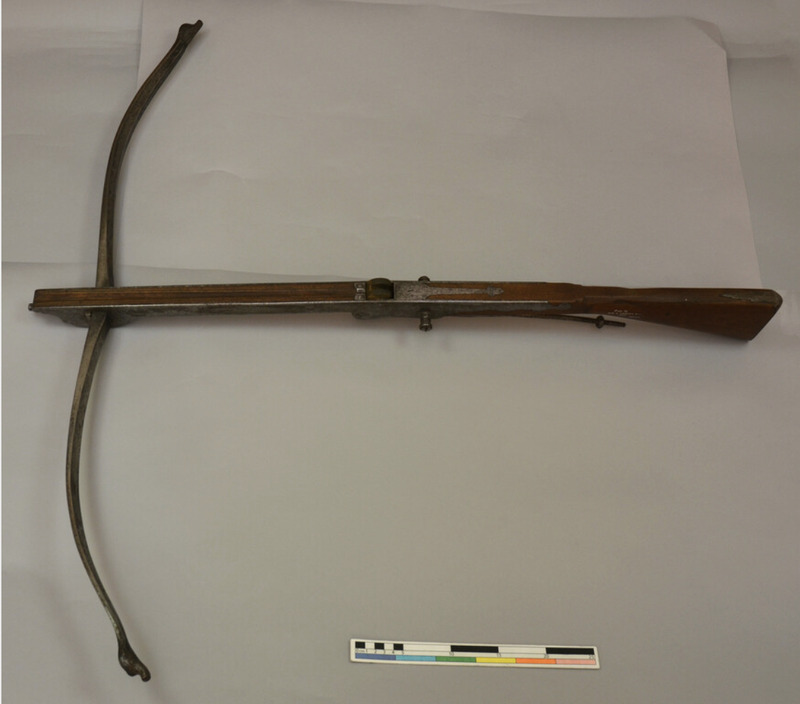
This is a quarrel shooting crossbow originating from England and dated before the year 1900. It is speculated to have been made in the 1700s though this fact is not confirmed. The crossbow was likely used to hunt deer and was used with a goats foot lever to span it. It has a steel prod attached to a wooden stock that also possesses a trigger arm. It features a nut made of brass metal set in place with a metal axial pin. In the middle of the stock is a channel for the boltheads shot from the crossbow. The trigger has two knobs on both of its sides, which are likely used for when the crossbow string is spanned in preparation of firing.
The wooden stock is shaped like a gun and the fore-end has a shell-like carving. There is a heavy iron butt plate. The butt is angle upwards to assist with bracing the crossbow on the shoulder when shooting vertically. There is a cheek rest on both sides for left and right handed shooters. The name of the maker "J.Prist is stamped on the left side of the steel prod. The prod passes through the middle of the stock and is secured by bow irons. The rear extension of the barrel is stamped with "J.PRIST/1901/1". The lock is a set trigger mechanism that can be adjusted by screws. There is an iron trigger guard shaped like a harp for the finger to protect the double triggers. In front of the prod are small pivot points (trunnions) that act as a support for the bending lever. The original bowstring made of linen cord runs through a groove along the back of a hexagonal barrel that extends from behind the latch to the front of the stock. Near the front of the barrel(muzzle) there is an adjustable front sight, while the rear sight is positioned above the cord groove.
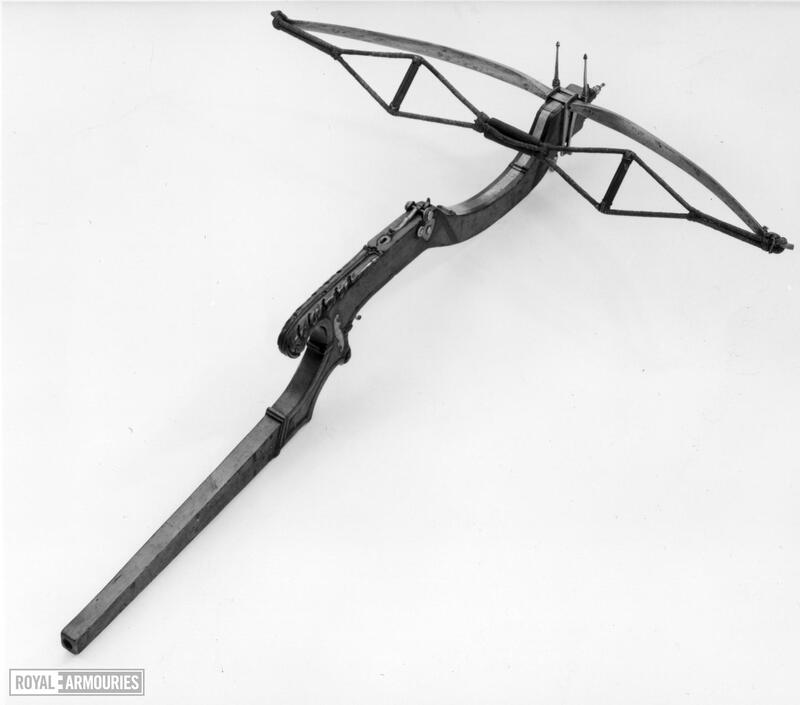
Used for small game. Wooden stock with a curved fore-end reinforced with a steel terminal. Behind the trigger, the stock curves to form a hand grip. Metal bow secured with bow irons with sight fork attached on top and a pyramidal spike at the front. Cord and cradle are preserved. Missing backsight. Carved with lines of acanthus leaves and, at the fore-end, a grotesque mask, in its open mouth a turned steel terminal.
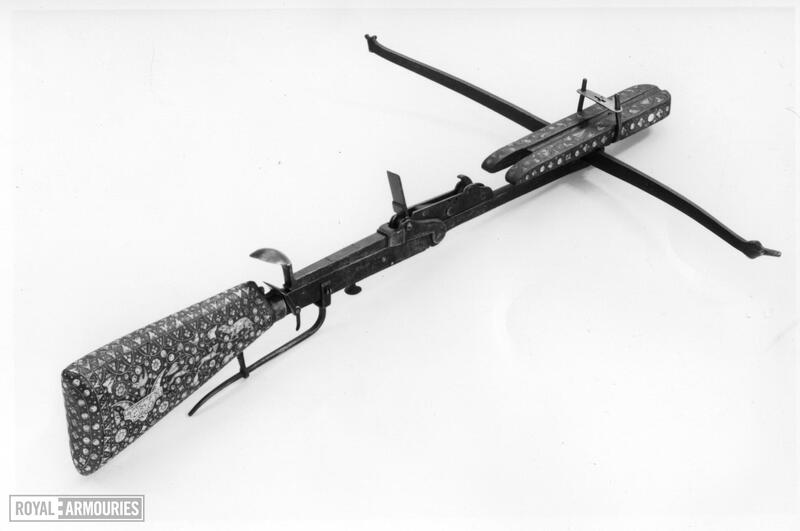
The fore-part is made entirely with steel in the usual German form but for a detachable bolt rest between the foresight pillars. The wooden butt of the stock resembles a gun stock and is inlaid with bone in intricate floral, animal, and geometric patterns also seen on the bolt rest. Long curved trigger guard. Rectangular metal backsight. Missing the cord and return spring for the cocking lever.
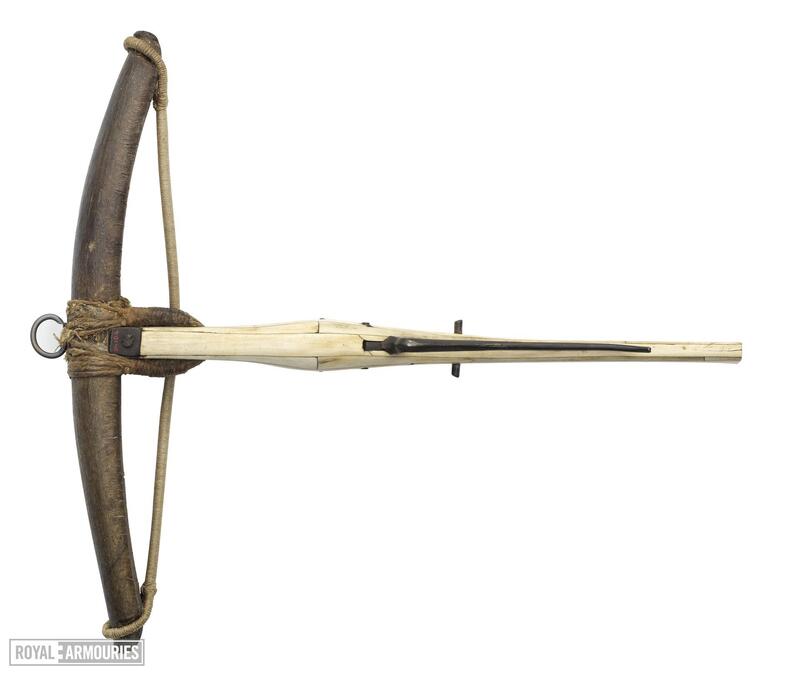
Thick bow has remnants of the original "snake skin" overlay(some damage) attached to the stock by a cord bridle. Wooden stock completely covered in bone with straight lines engraved. A long, curving iron lever-style trigger releases the horn nut. The stock narrows towards the butt and is pierced by a steel bar to hold the cranequin's loop in place.
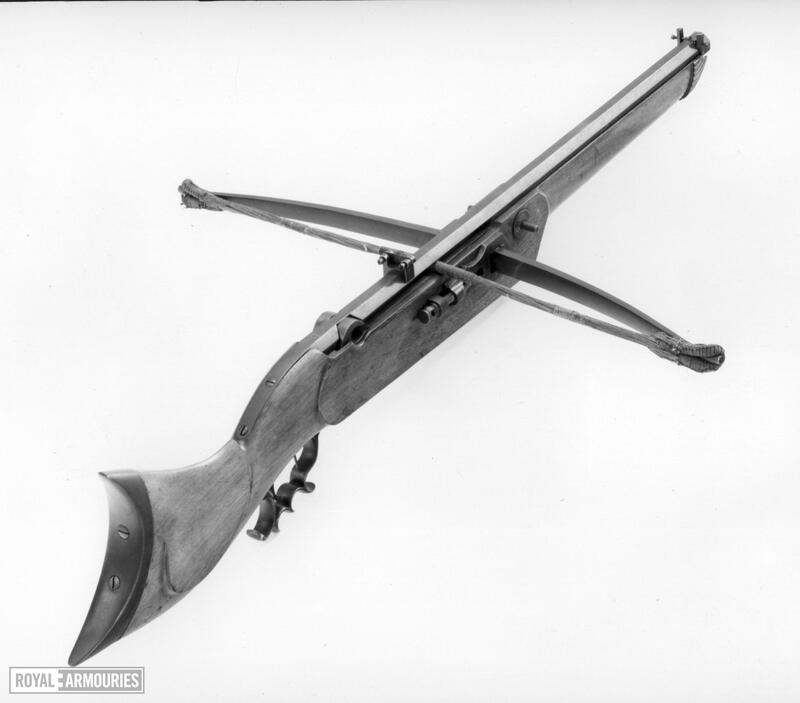
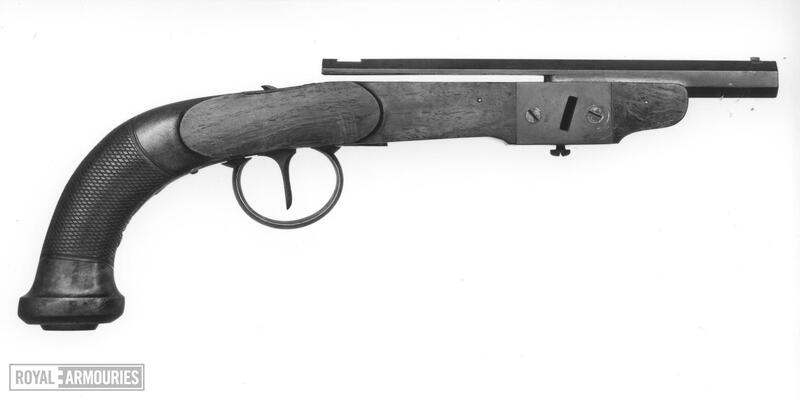
Brass lock mechanism. Octagonal barrel engraved “John Cuff, 106 Regent Street London”. The smooth core barrel can be used for both ball and bolt and is slotted for half of its length. Two detachable steel bows of varying strengths slide into a brass-enforced slot at the fore-end and are secured by a locking screw. Walnut shaft has a grip with a French-style checkered pattern. Hollowed detachable shoulder butt attached with a spring clip. Missing bowstring. Round metal trigger guard. Accompanied with a plain oak case with trade label "John Cuff, 106 Regent Street, Corner of Glasshouse Street".
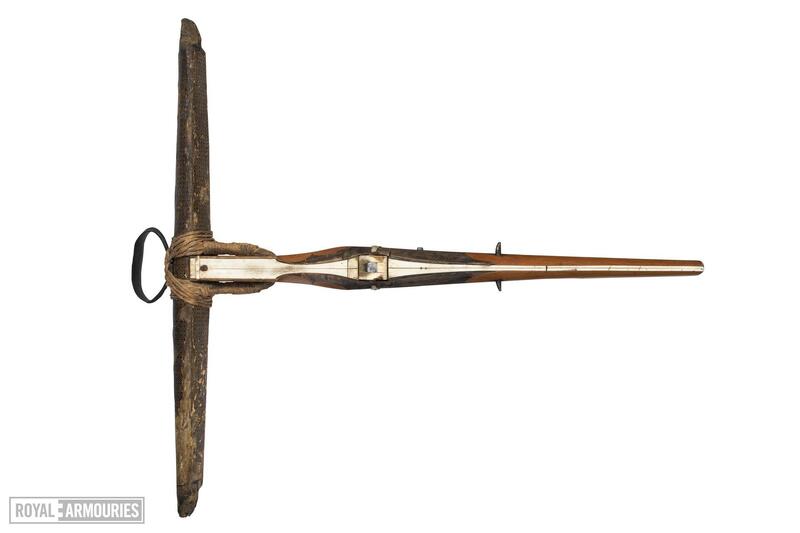
The bow is covered with birch bark decorated with paper(some damage) painted with a pattern of scrolling vines down the center of the front edge and a diaper pattern of many tiny dots on a black backdrop. Bow is held in position with cords (probably not original) with an oval, blackened iron stirrup at the front also secured with cords. Straight beech stock is wider in the middle inlaid with flat dark horn plaques(some damage) and white horn along the top edge with a horn/ivory bolt rest(appear to be slightly off center). The staghorn nut rotates on a later cord pivot and has a metal insert. Two iron pegs for a cranequin. Stocks narrows towards the cheek rest. Curved iron trigger lever.
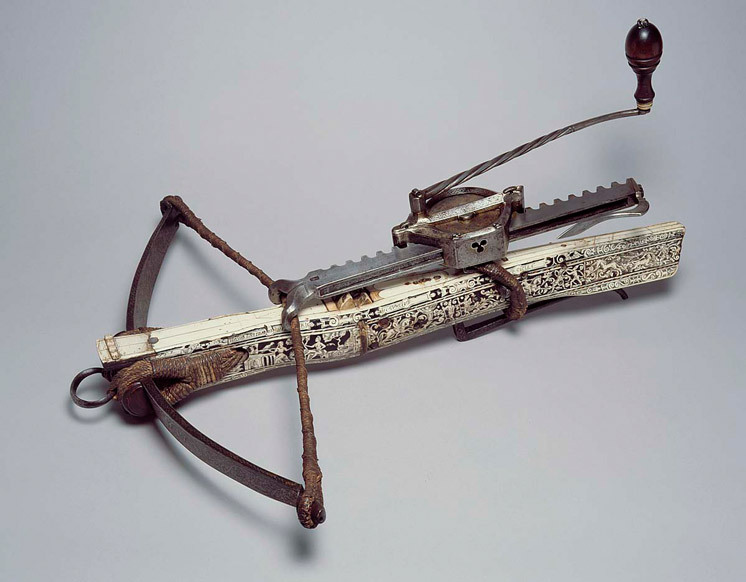
An ornately decorated hunting crossbow dated to 1557 in Germany. It possesses a wood and horn and steel inlay illustrating floral patterns and battle scenes and ivory woodcuts that depict characters of the Old Testament figures such as David and Bathsheba and ancient Roman heroes. It contains a wooden single axis nut, secured with a “nut thread” or nussfaden. Other components include a metal cranequin that spans the crossbow, a metal stirrup used to assist with spanning, a wooden prod and stock, and a hemp bowstring.
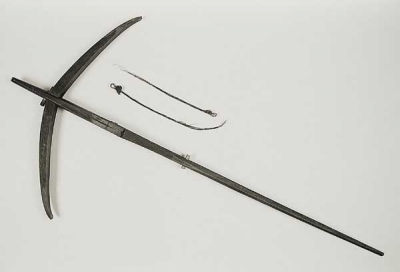
This crossbow is of west-central African origin, specifically originating from Gabon and used by the Fange and Mpongwe peoples. Its prod and stock are made of wood. An old and rare feature the crossbow possesses is a “split stock trigger mechanism,” where the prod’s handle is split by a small peg that functions as a trigger. Such a trigger mechanism only bares the most similar resemblance to fishing crossbows of Scandinavian origin.
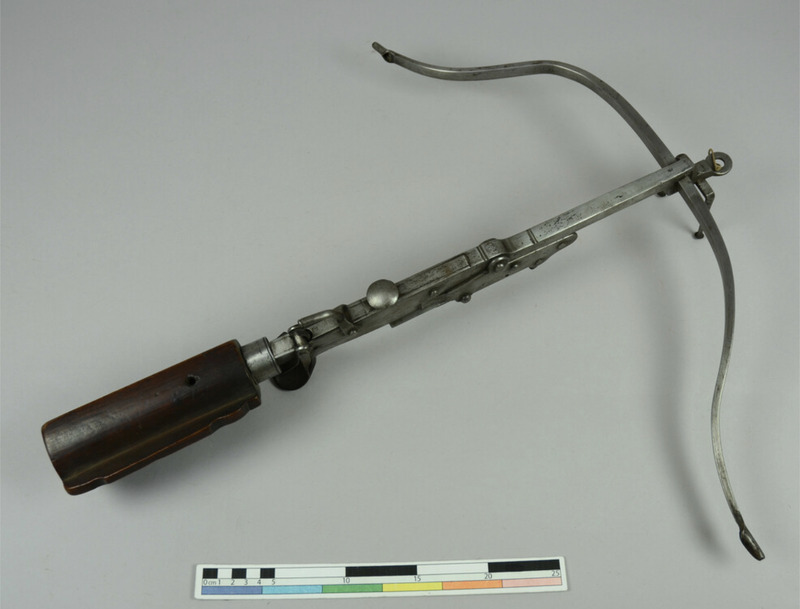
This bullet crossbow is from Northern European origin, likely originating from the United Kingdom and Northern Ireland in approximately the 17th and 18th centuries. It was used in sporting events and contains a high rear sight used for shooting long range distances. It features a steel prod with a wooden butt towards the end of the steel stock. The stock also contains an engraved mark that reads the letters “HR” and the illustration of a bird, though it appears to be almost destroyed.
Measurements: Length: max 570 mm, Width: max 535 mm, Height: max 118 mm
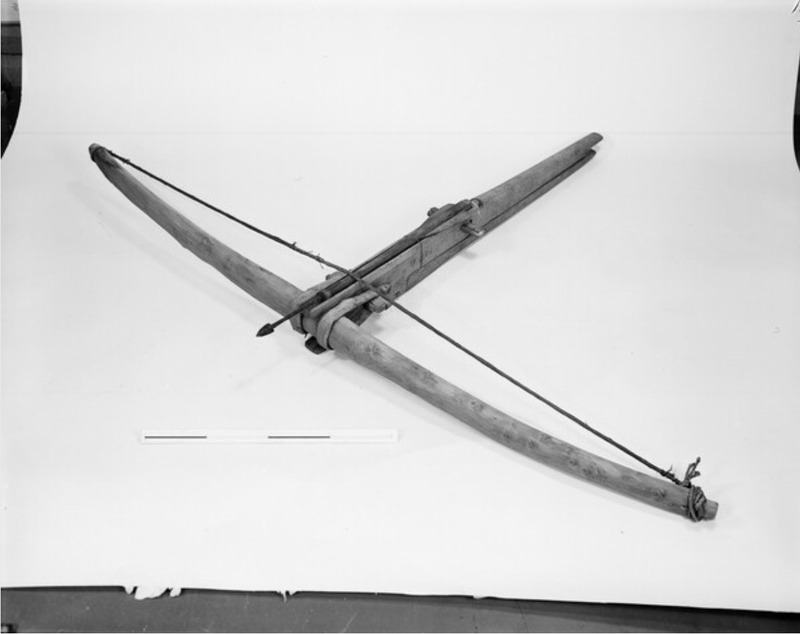
This whaling crossbow is from Norway. Its approximate date of construction is unknown, but is however dated to before 1909. It possesses a wooden prod that is attached to the stock with two pieces of rounded wood with openings fitted to the size of the prod, therefore securing it in place. The string of the prod is made of twisted sinew. Through the center of the stock is a metal peg visible on both sides, and the initials “UJN” are engraved in the stock.
Measurements: Length: max 940 mm, Depth: max 623 mm total, Depth: max 98 mm, Width: max 1465 mm total, Width: max 1465 mm, Length: max 1050 mm total
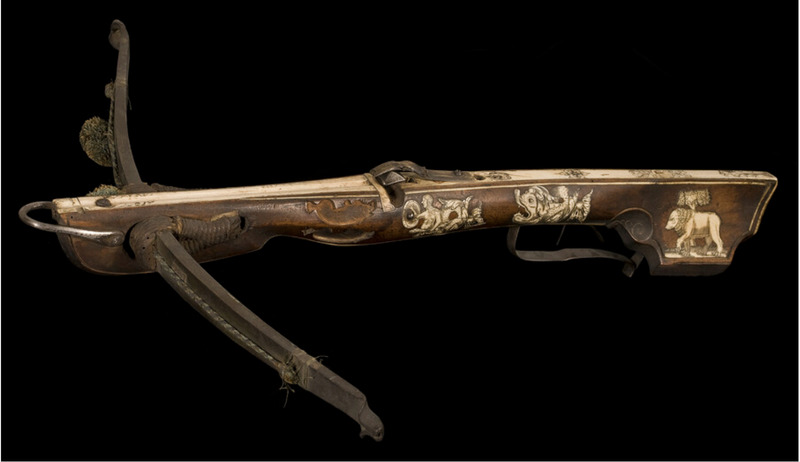
This crossbow is likely of German origin and was used as a sporting crossbow that is of half-sized equipment, otherwise known as a “Halberüstung.” Its stock is made of wood with richly carved bone inlay that illustrates beasts and mythical sea creatures such as mermaids and sea monsters. It features a steel prod with a safety cord at its front and two woolen pompoms and the right side of the prod. It also possesses a complex trigger system with a snap lock mechanism or “Schnepper” that would lock the string in place, though the string from this crossbow is missing. The butt of the stock is concave on its right side, acting as a cheek rest for the crossbowman. At the back of the stock is an ivory plate that has the year 1647 engraved. The crossbow also contains a backsight that is rotated to flip the cord over that is unleashed with its hair trigger. Its draw weight is approximately 700 lbs.
Measurements: Length: max 670 mm of stock, Length: max 590 mm of bow, Weight 2300 g