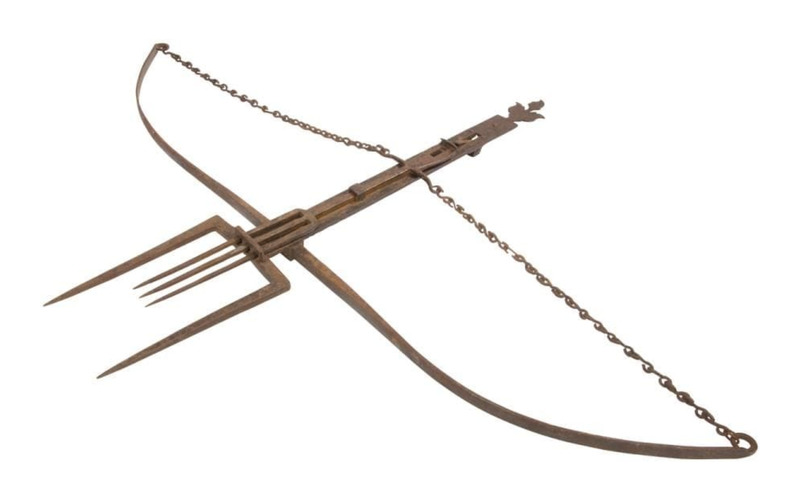
This crossbow is a hunting trap primarily intended for burrowing animals, such as the mole. It can be positioned near the opening of a burrow so that the animal can be shot as it emerges.
This crossbow is made entirely of wrought iron. Its supporting fork is composed of the two longest prongs on either side of the center. The three smaller central prongs belong to the reusable trident, which is permanently attached. The trident is used instead of crossbow bolts. The prod is long and relatively thin. The bowstring is a metal chain. The prod ends in the shape of a small decorative plant design.
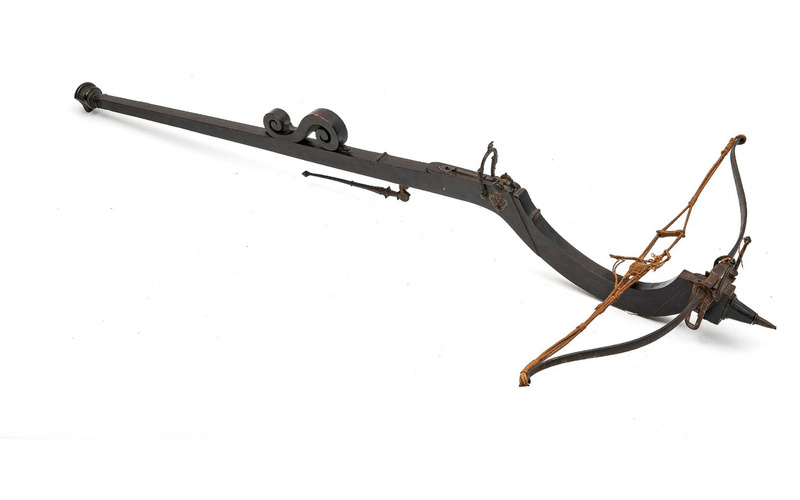
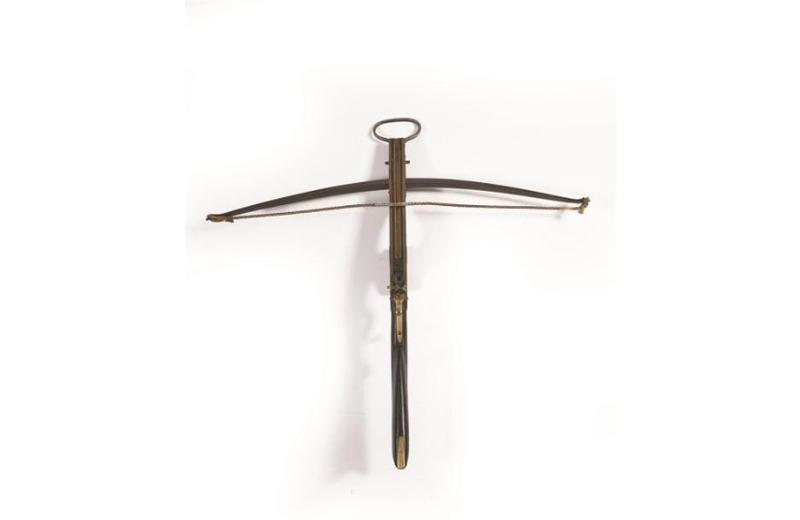
The crossbow is tipped with an eight-sided spike. Nearby, there is a sight made of two sticks, between which a string would be tied. The prod is made of wrought iron, with a bowstring made of braided hemp cord. Bow irons would have originally secured the prod to the stock, but the bow irons have come loose. The stock is relatively plain. It is made of dark-colored wood, possibly rosewood. It is four-sided, as is common among pellet crossbows. On the top of the stock, there is a metal sight, lightly decorated, in the shape of an arch. The trigger is the lever type. The hook, sight, and trigger are all likely iron. The stock ends in a knob, which has a piece missing.
The crossbow is decorated with golden filament, of which traces remain. Those traces are visible at the front of the crossbow on the eight-sided spike and on the small strip of metal supporting the sight made of two sticks. Traces are also visible on the stock near the hook and near the axle on which the hook turns, as well as on the trigger.
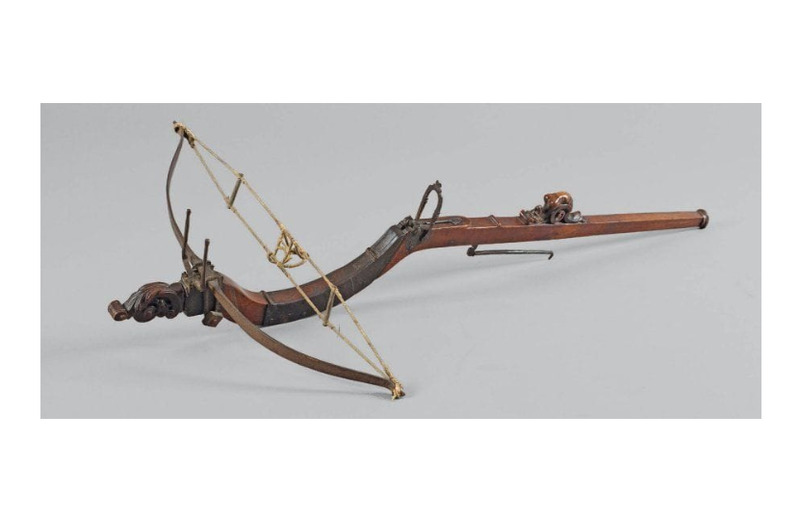
At the tip of the crossbow, there protrudes a carving of curling vegetation. On the top of the crossbow, there are two sticks which would have formed a sight by tying a string between them. The prod is made of wrought iron and has a bowstring made of braided cord, with small wooden supports to keep it in position. The prod connects to the stock via bow irons. The stock is made of cherry wood. The curved part of the stock seems to have metal plating reinforcing it, right up to the catch area. Near the catch, there is a foldable sight made of wrought iron in the shape of an arch, lightly decorated. There is a wrought iron hook to catch the bowstring with. Farther down the stock, on the topside, there is an elaborate carving of a naked woman, seemingly contorted with her back extremely arched. She appears to have no legs; it is unclear whether she is meant to be a mermaid or whether her legs are not visible due to the camera angle. The rest of the stock is very plain and ends in a small knob. The trigger is a lever made of wrought iron.
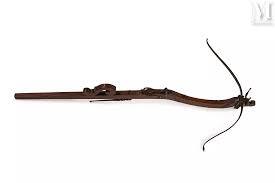
This pellet crossbow, or stone bow, has a sight made of two sticks at the front. It has an iron prod. The prod may be connected to the stock via bow irons, but that is uncertain due to the blurriness of the image. The stock is wooden, carved with sinuous curves and scrollwork. The metalwork dates to 17th century Italy, but the wooden parts are likely from the late 19th century. The crossbow appears to have a lever trigger, but that could simply be a trigger guard covering a different type of trigger; the blurriness of the image makes it uncertain.
There is a suspension ring at the tip of this crossbow. The prod is metal and lost its original bowstring between 2018 and 2021. Brass bow irons connect the prod to the wooden stock. The stock is painted or stained black. On the topside of the stock, the groove for a crossbow bolt is lined in brass. Farther down the stock, there is the rolling nut and a sight made of brass and steel. On the underside of the stock, a wooden support protrudes, likely intended to steady the crossbow while the user shoots while lying on their belly. The trigger is made of brass. The trigger guard is elaborate with a curling design and it is made of brass. The crossbow ends in a butt shaped like a rifle.
On the topic of decoration, the sight and bow irons have light curling designs on their edges, and the trigger guard curls elaborately, but the wood of the stock is quite plain.
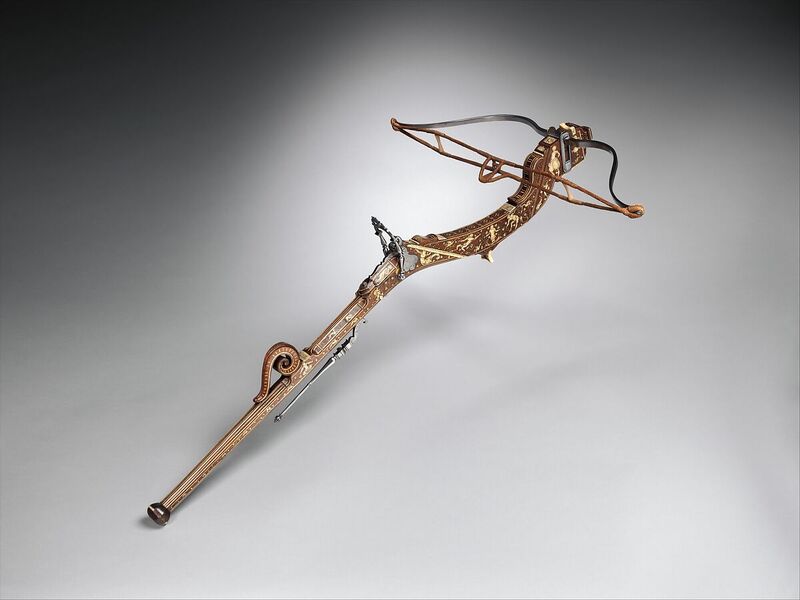
This is an extremely decorative pellet crossbow with the stock most likely composed of cherry wood and a steel prod. The stock is engraved with flowing vines, lined leaves, and flowers at their tips and lines cross over them in the front, most likely inlaid with mother-of-pearl. A wolf or fox is pictured under the line along with muscled man with armbands and serpent tail near the other line. There are detailed carvings of naked humans with a women holding two strands of flowers and vines appearing out of her feet. Swans and other birds surround the humans. The wide rear-sight appears to be made of iron alloy and a small boy appears to be crawling towards its direction on the stock. A spiral shaped piece is protruding at the back of the stock with straight marks drawn on it and a the image of a human is carved under it, sitting cross-legged. The slender trigger as a conical, ridged tip. There is a large steel clip around the bow and the string is made of hemp.
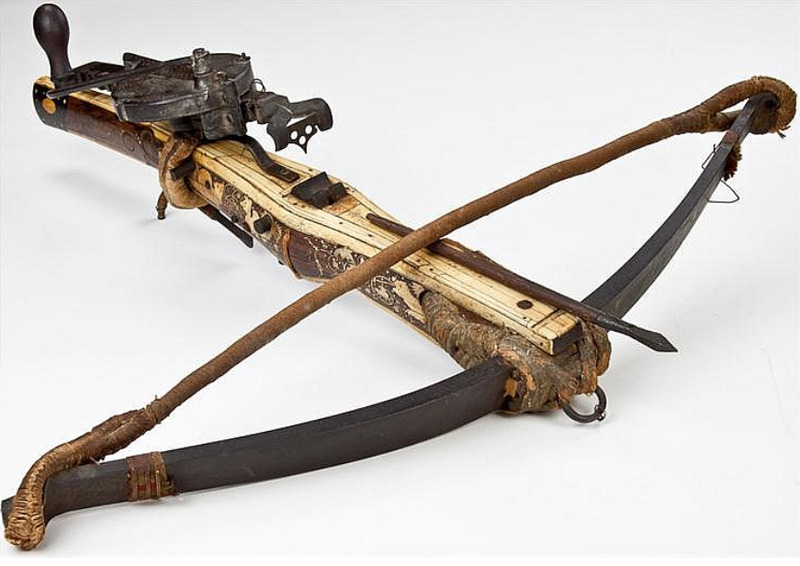
This hunting crossbow has an oaken stock adorned with bone and mother-of-pearl inlays depicting mythical creatures, such as dragons and serpents, set against a backdrop of dotted vines and floral patterns. One of them near the attached winder seems to have the image of the sun or moon rising behind it. According to the source, the steel bow is gilded with designs of strawberries and leaves, and while it is stated that they are still somewhat visible, it is hard to decipher them from the provided images. The top of the stock is composed of striated bone and the nut lock is still intact. The winder is attached near the cheek rest through a clip and tied around the transverse pin. The design of the winder’s hook is quite unique as it is pointed with three holes drilled into it. The auction house description states that its shaft has been inscribed with the name ‘BARTOLOME’, which could refer to the Austrian crossbow maker- ‘Bartolomew’. It is important to note that the auction house does not provide any additional sources to support this claim. However, both the winder and the bolt are stated to be of the same time period and original to the crossbow.
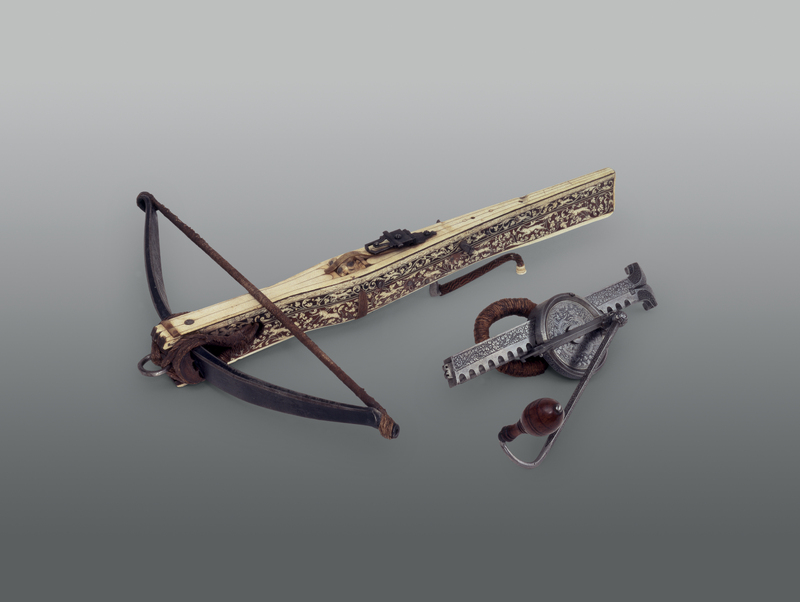
The crossbow has a steel prod and a wooden stock with ivory inlays. The sides of the stock are decorated with vines and floral arrangements and animals like horses, hares, and wolves. According to the source, beneath it at the front of the stock is St Mary Magdalene and a skull with the date, 1565 and at the back is the image of Lucretia, a Roman figure whose rape and suicide led to the establishment of the Roman Republic. Her story was very well-known in the sixteenth century and closely associated with humanist ideologies. However, these figures are not visible in the images featured on the auction house’s sight. The prod binding is made of hemp rope, looping around the steel suspension ring. The trigger also appears to be covered in hemp. The bolt clip and nut lock are still intact, along with the U-shaped rear sight.
The cranequin or rack and pinion winch is made of steel and ornately designed with various floral patterns carved into the rack and wheel. It would be placed on the stock, and the hook would be attached to the string to span the crossbow. This did slow down the firing rate of the weapon, making it inferior to firearms during battle but still useful for hunting.
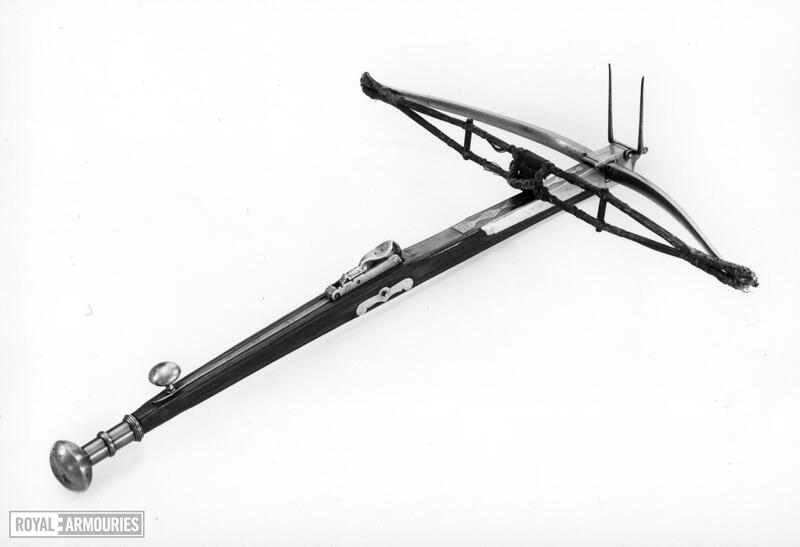
Wooden straight square stock reinforced with metal at the fore-end where the bow passes through and is secured with wedges. Decorative brass plate inlaid on stock. Uses a spring catch mechanism to lock the pivoted cord-hook in position. A spherical steel button on top of the stock is pushed down to release the catch. Folding back sight and sight fork, front sight is missing. The cord and cradle is preserved. Steel spherical butt.
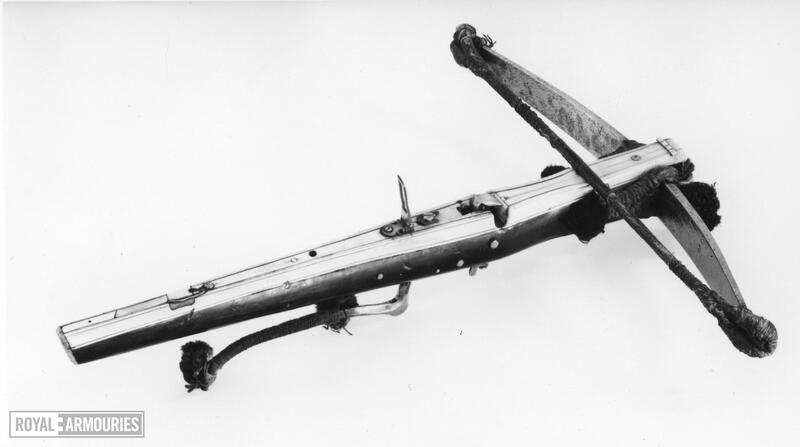
Wide steel bow with maker's mark stamped on the inner side set into the wooden stock and secured by a bridle of cord decorated with pommels which pass through a ring at the fore-end. Twisted cord bowstring with simple loops on each end. Strips of bone inlay on underside of stock. Top of the stock is covered with a layer of bone ornamented with straight engraved lines. Bone butt plate. The name ‘Eberlein’ engraved into the bone above the cheek rest. Rectangular folding brass backsight and bone foresight. The locking mechanism is a wing nut on the underside and there is a pivoting steel catch which grips the drawn string. Long steel lever trigger with cord grip decorated with pommels. Piece of metal lock plate missing.
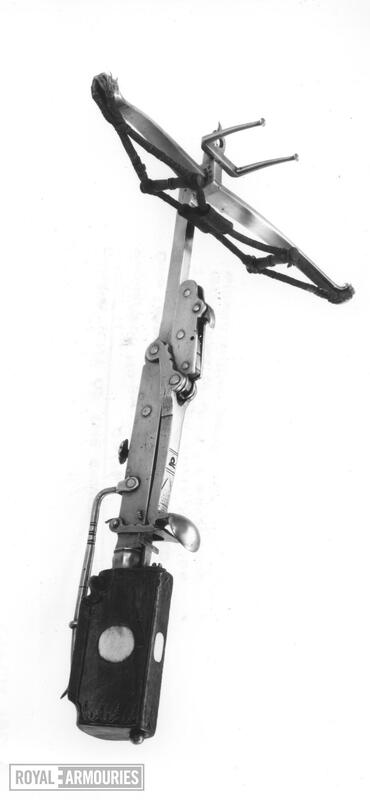
German Kugelschnepper. Metal bow. Metal stock and lever engraved with scale and foliate patterns. Lever is stamped with a mark. The fore-end is formed by a suspension ring with a spike on top and the sight fork attached behind. Wooden butt with light engravings has 4 inlaid circular plaques of bone, one missing . There is a cheek rest. The cord and cradle are preserved. The back sight and foresight are missing.
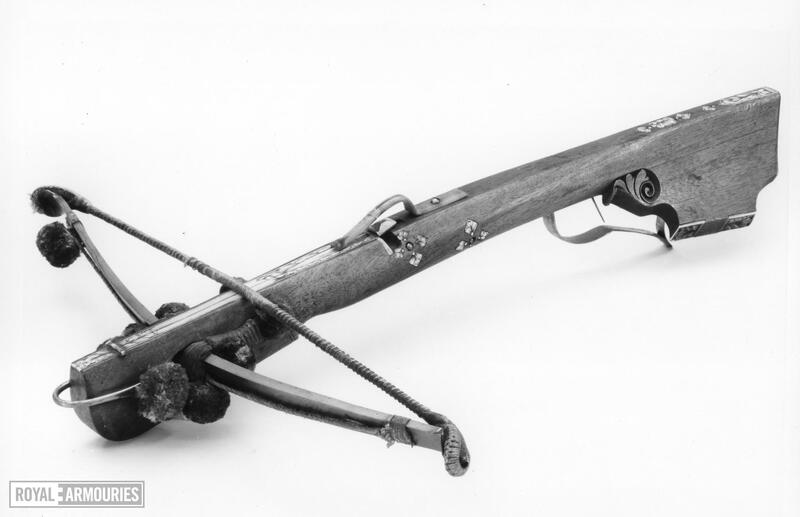
The steel prod stamped with a mark passes through the front of the wooden stock and is secured by a twisted cord bridle. Faded woolen pom poms that were originally red or deep in pink colour surround the bridle. The bowstring is preserved and is made of twisted cord. There is a metal suspension ring attached to the top of the stock. The bolt rest is inlaid with stag horn engraved with foliage motifs with the initial "G.E" at the front possibly belonging to the maker. There is also transverse support for the bolt head. The side of the stock and above the cheek rest has small inlays of stag horn engraved with floral patterns. The butt plate is made of horn with No. 15 engraved. On the underside of the stock there is another inlay of stag horn engraved with "BILNITZ". The lock mechanism is a steel snap-down catch controlled by a hair trigger. There is a bolt clip made of horn. The trigger-guard is made of steel and extend to provide comfort for fingers.
The crossbow is intended to be spanned by a wooden goat's lever.