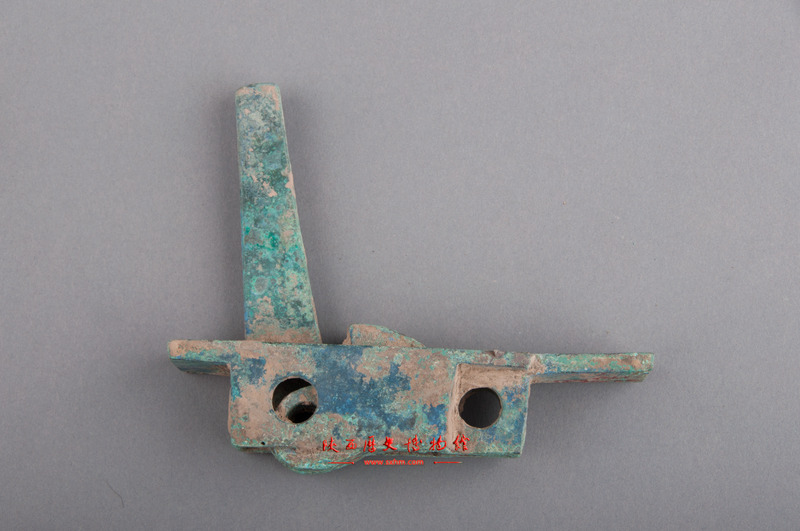
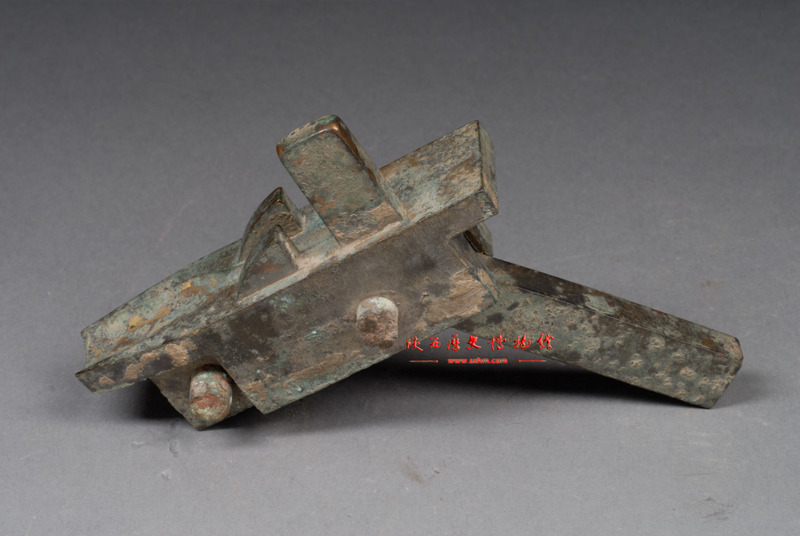
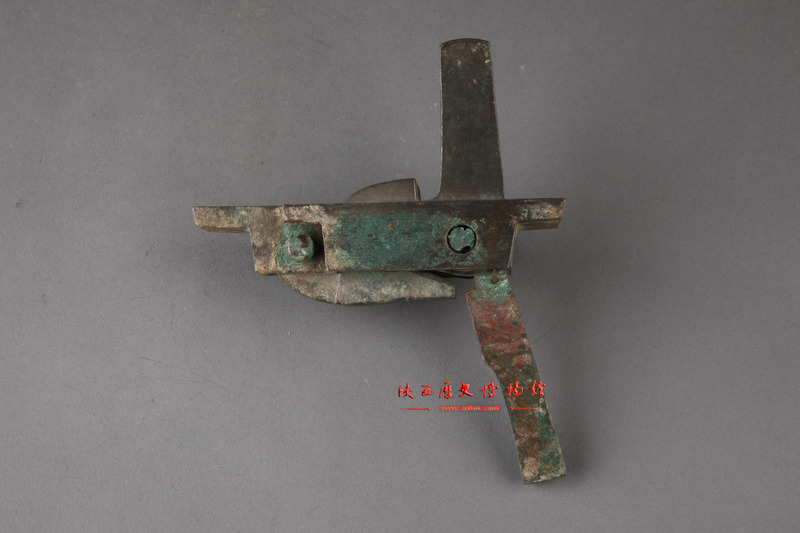
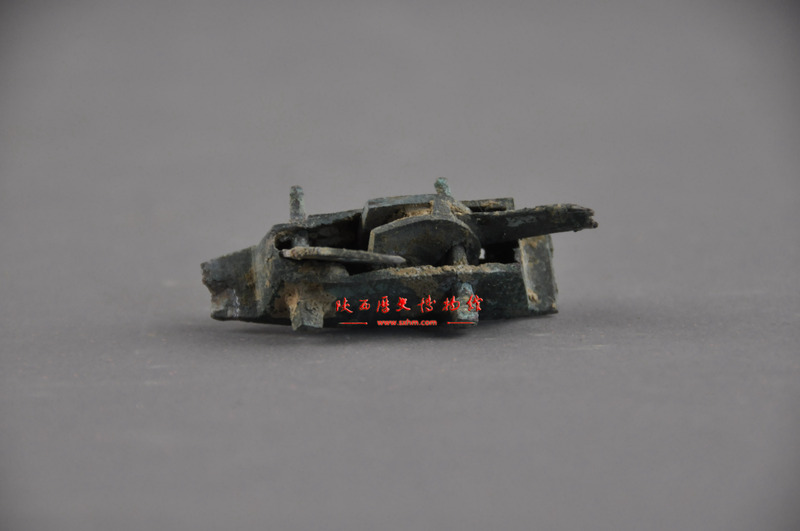
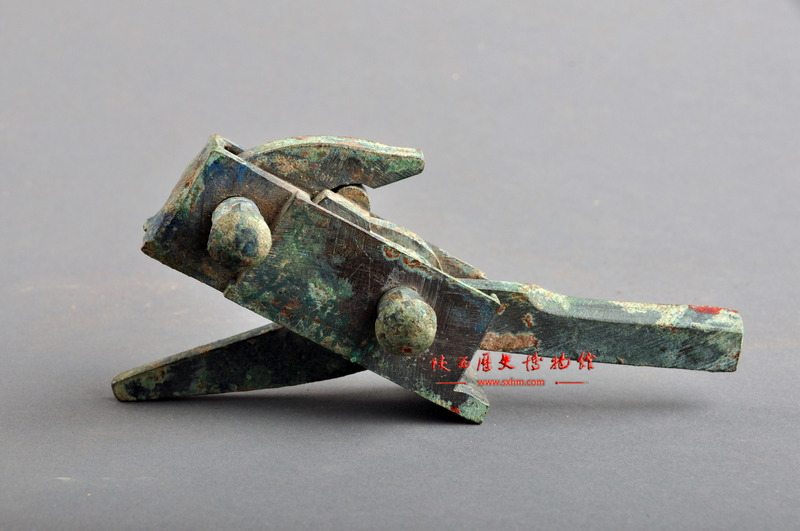
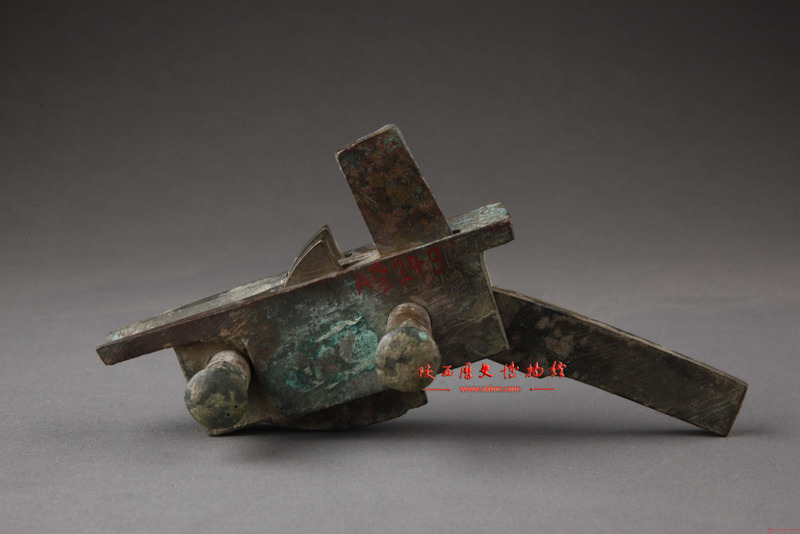
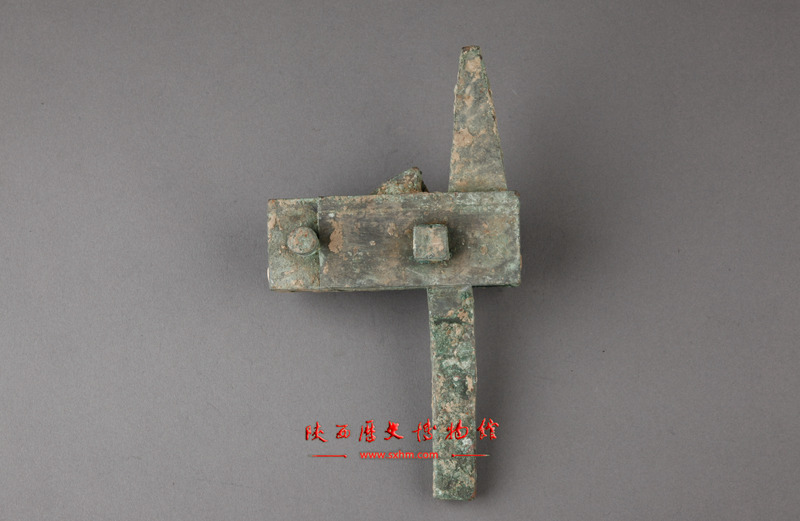
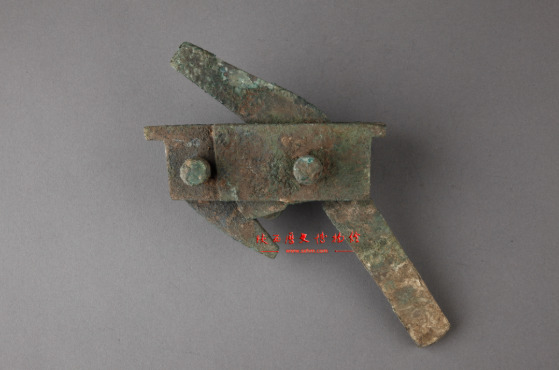
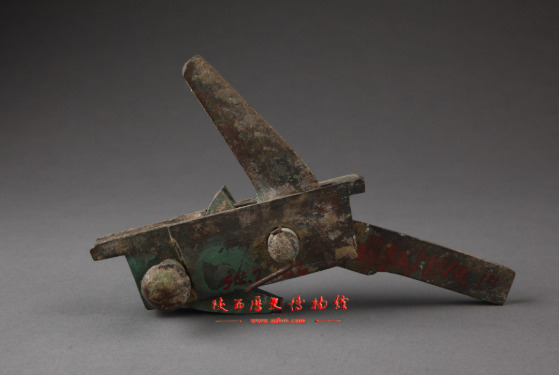
This crossbow mechanism held by the Shaanxi History Museum is dated to the Han dynasty. Its specific location of unearthing is not listed.
The mechanism is made of bronze and it comprises most of the typical parts of a Chinese crossbow mechanism. The long rectangular protrusion at the top of the mechanism is the sight, or wangshan (望山). The two small hooks sticking out in front of the sight are a part of the same component as the wangshan and serve as the nut, or ya (牙). Within the bronze casing, or guo (郭) there is a sear, or gouxin (钩心) that would connect the sight and nut and the trigger. The top surface of the bronze casing has a groove that goes down the middle of its top surface which would continue onto the wooden stock of the crossbow. This groove would be where the arrow rests during drawing and aiming. This specific specimen is missing the trigger, or xuandao (悬刀), and the two axle pins that hold the mechanism together in the guo.
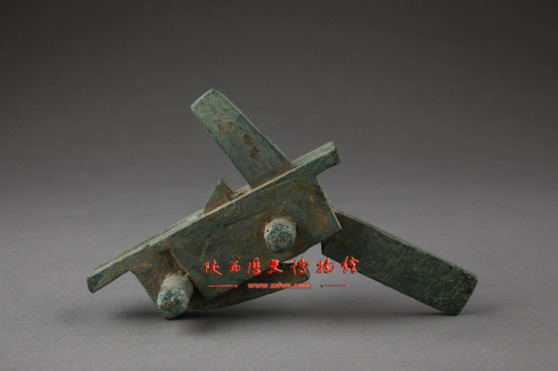
This crossbow mechanism held by the Shaanxi History Museum is dated to the Han dynasty. Its specific location of unearthing is not listed.
The mechanism is made of bronze and it comprises most of the typical parts of a Chinese crossbow mechanism. The long rectangular protrusion at the top of the mechanism is the sight, or wangshan (望山). The two small hooks sticking out in front of the sight are a part of the same component as the wangshan and serve as the nut, or ya (牙). The rectangular handle at the bottom of the mechanism is the trigger, or xuandao (悬刀), and within the casing there is a sear, or gouxin (钩心) connecting the sight and nut and the trigger. The mechanism is held together by two bronze axle pins and held within a rectangular bronze casing called the guo (郭). The top surface of the bronze casing has a groove that goes down the middle of its top surface which would continue onto the wooden stock of the crossbow. This groove would be where the arrow rests during drawing and aiming.
Remnants of the gold plating are visible in sparse patches on the mechanism. In the photo, they are particularly visible on the groove that holds the arrow on the guo. However, they have otherwise been corroded off the surface of the mechanism.
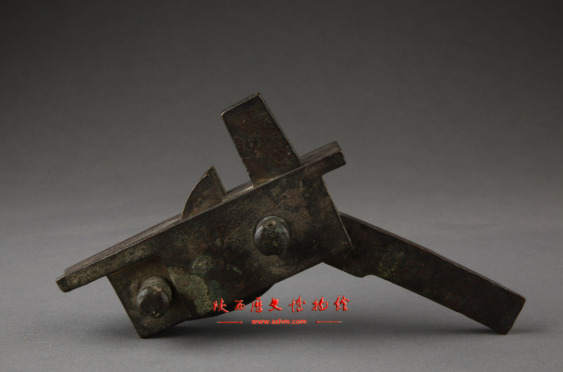
This crossbow mechanism held by the Shaanxi History Museum is dated to 253 CE, which is the 16th year of Yanxi, a reign title used in the Shu Han state during the Three Kingdoms period. Its specific location of unearthing is not listed.
The mechanism is made of bronze and it comprises most of the typical parts of a Chinese crossbow mechanism. The long rectangular protrusion at the top of the mechanism is the sight, or wangshan (望山). The two small hooks sticking out in front of the sight are a part of the same component as the wangshan and serve as the nut, or ya (牙). The rectangular handle at the bottom of the mechanism is the trigger, or xuandao (悬刀), and within the casing there is a sear, or gouxin (钩心) connecting the sight and nut and the trigger. The mechanism is held together by two bronze axle pins and held within a rectangular bronze casing called the guo (郭). The top surface of the bronze casing has a groove that goes down the middle of its top surface which would continue onto the wooden stock of the crossbow. This groove would be where the arrow rests during drawing and aiming.
This crossbow mechanism held by the Shaanxi History Museum is dated to the Han dynasty. Its specific location of unearthing is not listed.
The mechanism is made of bronze and it comprises most of the typical parts of a Chinese crossbow mechanism. From the low angle given in the photo,the sear or gouxin (钩心) of the mechanism can be seen, which is the part that connects the sight and nut to the trigger. Attached to the sear, what appears to be a broken trigger, or xuandao (悬刀), can be seen as well. The sight, or wangshan (望山) and the nut, or ya (牙), are not visible in the photo, and could possible be missing given the title of the mechanism. The mechanism is held together by two bronze axle pins within a rectangular bronze casing called the guo (郭). The top surface of the bronze casing is not visible, but it would have a groove that goes down the middle of its top surface which would continue onto the wooden stock of the crossbow. This groove would be where the arrow rests during drawing and aiming.
This crossbow mechanism held by the Shaanxi History Museum is dated to the Han dynasty. Its specific location of unearthing is not listed.
The mechanism is made of bronze and it comprises most of the typical parts of a Chinese crossbow mechanism. In the photos, the mechanism is positioned upside down. Thus, the long rectangular protrusion at the bottom of the mechanism is the sight, or wangshan (望山). The two small hooks sticking out in front of the sight are a part of the same component as the wangshan and serve as the nut, or ya (牙). The rectangular handle at the top of the mechanism is the trigger, or xuandao (悬刀), and within the casing and poking out at the top of the mechanism in the photo is the sear, or gouxin (钩心) connecting the sight and nut and the trigger. The mechanism is held together by two bronze axle pins and held within a rectangular bronze casing called the guo (郭). The top surface of the bronze casing has a groove that goes down the middle of its top surface which would continue onto the wooden stock of the crossbow. This groove would be where the arrow rests during drawing and aiming.
This crossbow mechanism held by the Shaanxi History Museum is dated to the Han dynasty. Its specific location of unearthing is not listed.
The mechanism is made of bronze and it comprises most of the typical parts of a Chinese crossbow mechanism. The long rectangular protrusion at the top of the mechanism is the sight, or wangshan (望山). The two small hooks sticking out in front of the sight are a part of the same component as the wangshan and serve as the nut, or ya (牙). The rectangular handle at the bottom of the mechanism is the trigger, or xuandao (悬刀), and within the casing there is a sear, or gouxin (钩心) connecting the sight and nut and the trigger. The mechanism is held together by two bronze axle pins and held within a rectangular bronze casing called the guo (郭). The top surface of the bronze casing has a groove that goes down the middle of its top surface which would continue onto the wooden stock of the crossbow. This groove would be where the arrow rests during drawing and aiming.
This crossbow mechanism held by the Shaanxi History Museum is dated to the Han dynasty. Its specific location of unearthing is not listed.
The mechanism is made of bronze and it comprises most of the typical parts of a Chinese crossbow mechanism. The long rectangular protrusion at the top of the mechanism is the sight, or wangshan (望山). The two small hooks sticking out in front of the sight are a part of the same component as the wangshan and serve as the nut, or ya (牙). The rectangular handle at the bottom of the mechanism is the trigger, or xuandao (悬刀), and within the casing there is a sear, or gouxin (钩心) connecting the sight and nut and the trigger. The mechanism is held together by two bronze axle pins and held within a rectangular bronze casing called the guo (郭). The top surface of the bronze casing has a groove that goes down the middle of its top surface which would continue onto the wooden stock of the crossbow. This groove would be where the arrow rests during drawing and aiming.
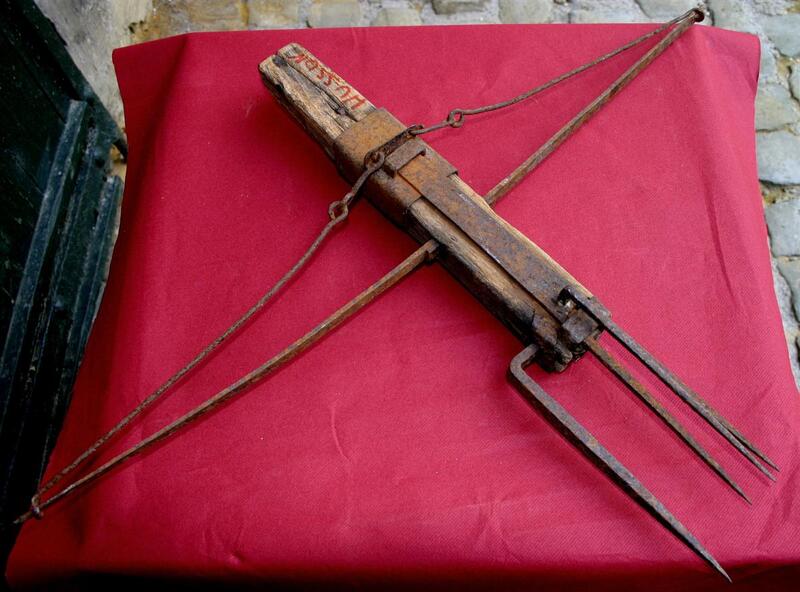
This crossbow is a hunting trap primarily intended for burrowing animals, such as the mole. It can be positioned near the opening of a burrow so that the animal can be shot as it emerges.
Its supporting fork would have been composed of the two large prongs on either side of the center (only one remains). The three smaller central prongs belong to the reusable trident, which is permanently attached. The trident is used instead of crossbow bolts. There is a small metal strip attached to the stock which goes between the prongs of the trident to intentionally restrict its range. This helps keep it attached to the crossbow. The prod is long and relatively thin. The supporting fork, prod, trident, and accompanying mechanisms are made of metal. The bowstring is made of four metal links. The stock is wooden.
A similar, more complete trap crossbow can be found here: