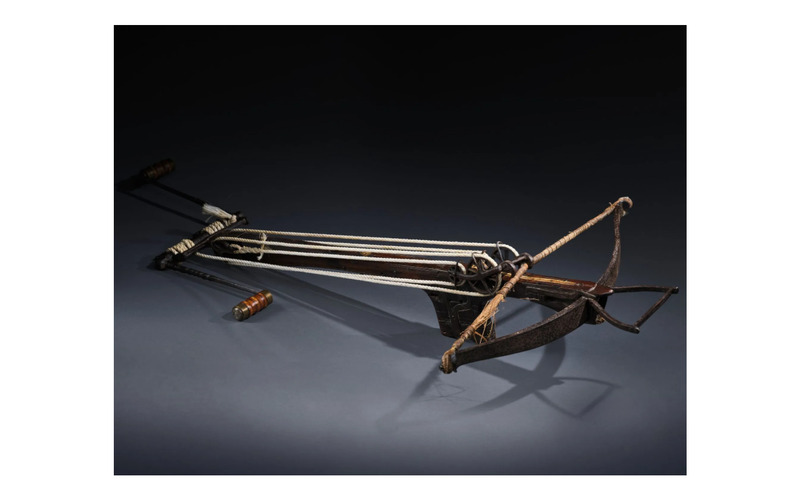
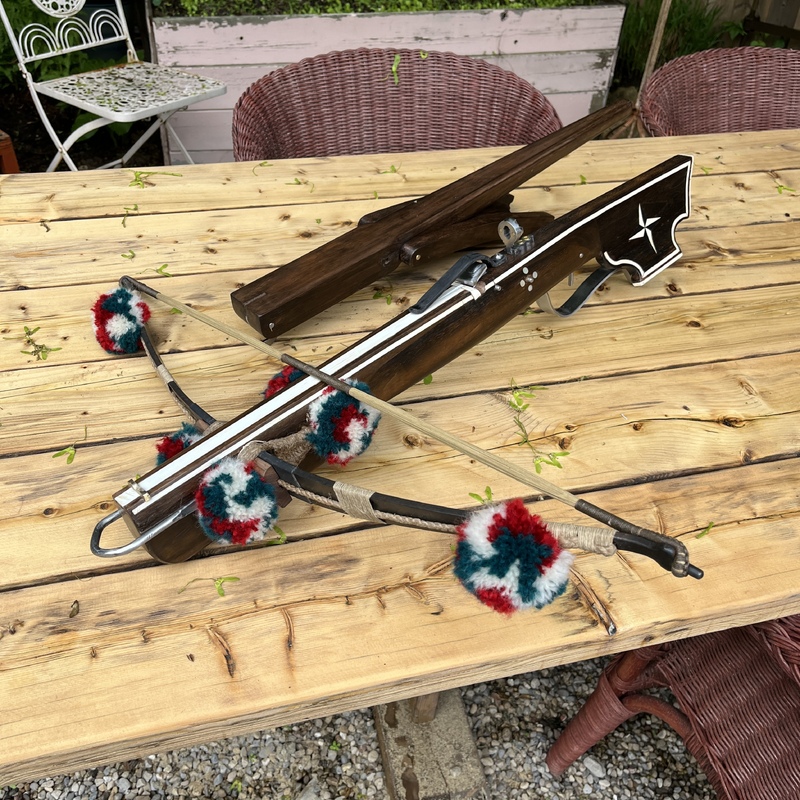
At the tip of the crossbow, there is a large stirrup. The prod is made of wrought iron and is rusted. The bowstring is original and is frayed. Bow irons secure the prod to the stock. There appears to be bone inlay along the bolt groove.
In the photo, the lock system is obscured by the windlass.
A large wooden support protrudes from the bottom of the stock. It appears to be damaged, showing extensive horizontal cracks. The wooden support has a piece of metal nailed or riveted into it, which seems to hold the wooden support together.
The stock is generally straight and plain. There are a few decorative lines along the edges of the stock. The end of the stock is obscured by the windlass.
The windlass itself is made of a dark metal, possibly iron or steel. The part of the handle intended for gripping is covered with wood and a warm-colored metal, possibly brass. The part of the handle not intended for gripping has decorative twisting in the metalwork, which suggests that it is made of wrought iron.
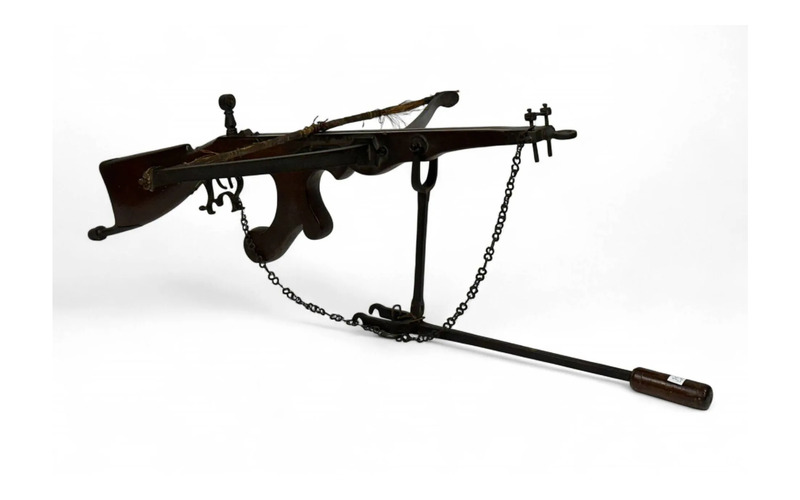
At the tip of the crossbow, there is a closed metal ring attached. The tip of the crossbow appears to be encased in metal. The prod is made of wrought iron. Bow irons secure the prod to the stock. The stock is made of walnut wood. The bowstring is fraying, but it is not clear whether it is original or a restoration. The stock features a wooden support protruding from the bottom. The wooden support is notably sculpted into two protrusions, a shorter one in the front and a longer curling one towards the back. The crossbow seems to have a rolling nut and a diopter sight. The crossbow seems to have a double set trigger. The trigger guard seems to be made of three metal pieces, all of which form decorative curls. The lock seems to be a rolling nut. The crossbow ends in a butt which is like a rifle’s, except that a long thin piece of wood, ending in a knob, protrudes from the butt.
This crossbow is accompanied by its spanning lever.
The chain accompanying the crossbow is a later decorative addition.
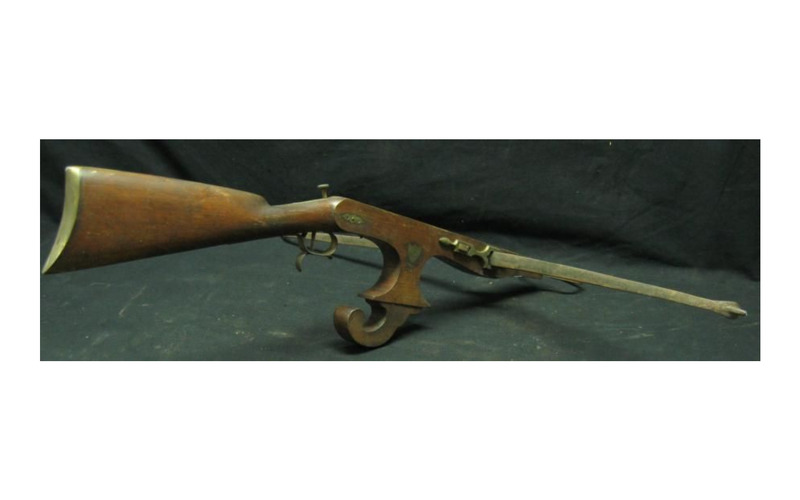
The front of this crossbow is not visible in the photo, so one cannot tell whether it has a suspension ring, stirrup, or other features on the tip. The area of the bolt rest is also obscured. The metal prod is missing its bowstring. Bow irons, which seem brass, secure the prod to the stock. The stock is made of mahogany. The stock features a large wooden handle protruding downwards. Where the stock morphs into the upper part of the handle, there is some metal inlay in the shape of a shield, possibly representing the coat of arms of some organization. Unfortunately, the details have worn away. The upper part of the handle is clearly continuous with the stock, but the lower, curly part of the handle appears discontinuous with the upper part of the handle. Historical Belgian crossbows often featured a wooden support which was continuous with the stock and which had a flat bottom to support the crossbow against the ground (to be used when the user was shooting while lying on their belly). This context and the discontinuity in the shape of the handle implies that the lower, curly part of the handle is a later addition.
There is a trigger guard protecting the trigger. The stock ends in a butt like a rifle’s. This butt has a metal cap on the end which seems brass.
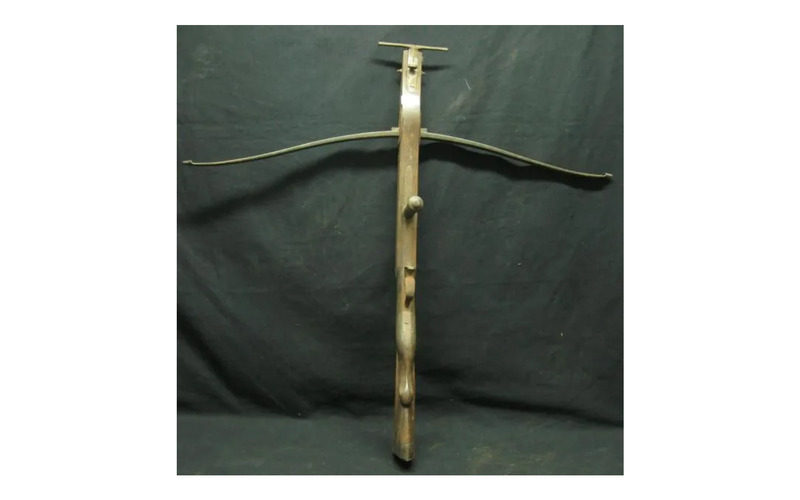
Due to the angle and quality of the photo available, it is difficult to discern very much about this crossbow. For example, the photo does not show the areas where one expects to find the lock, the sight(s), the trigger, and the bolt rest. The areas which are likely to display any existing decoration (the top and sides of the stock) are also obscured. However, some information about the crossbow can still be gleaned.
At the tip of the crossbow, there is a metal stick perpendicular to the stock. It attaches to the crossbow with small flat metal plates which go underneath (and presumably also above) the crossbow. The prod is metal. It appears to be simply wedged through a hole in the stock. There appears to be a piece of wood also shoved in with it to help increase the pressure holding the prod in place.
From the bottom of the stock, a handle protrudes. It appears approximately cylindrical. Further along, the trigger guard is visible. It appears rusted. Past the trigger guard, the butt of the crossbow appears to be sinuously carved, though its exact shape is indiscernible.
The auction house notes that the stock is made of walnut wood.
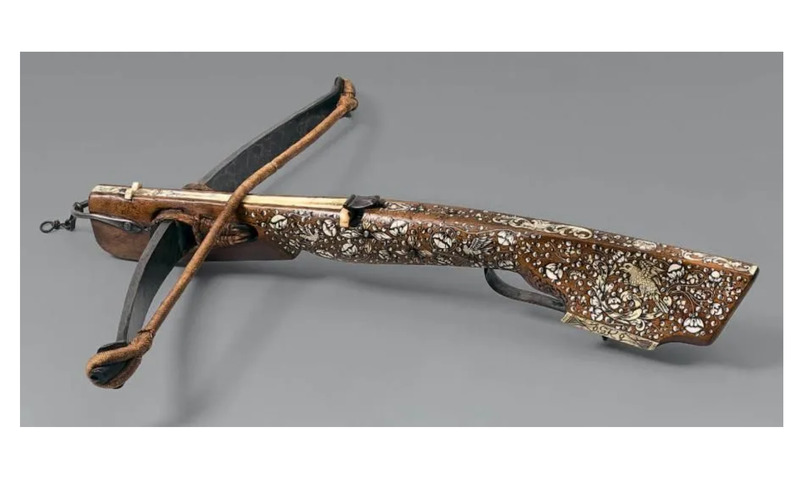
On the tip of this crossbow, there is a very small suspension ring. The prod is steel and has its original bowstring. Bindings secure the prod to the fruitwood stock. The bolt rest and related bonework is still present.
The lock is a catch or clap lock mechanism. The trigger is not visible in the photo, but there is an iron trigger guard. At the end of the stock there is a cheekplate.
In terms of decoration, the crossbow is very ornate. The bonework near the bolt rest has some artistic designs, though they are not clear in the photo. The stock has extensive bone inlay of birds and hazel tree branches, covering an area starting at the bindings of the prod and reaching to the very end of the crossbow. Additionally, the top of the stock and the cheek rest have scrollwork, evocative of the rinceaux style. The largest bird on the crossbow is in the centre of the lightly concave cheek rest. At the very bottom of the cheek rest, there is a small plaque with the initials “G K” in the middle. The auction house notes that this crossbow is in very good condition.
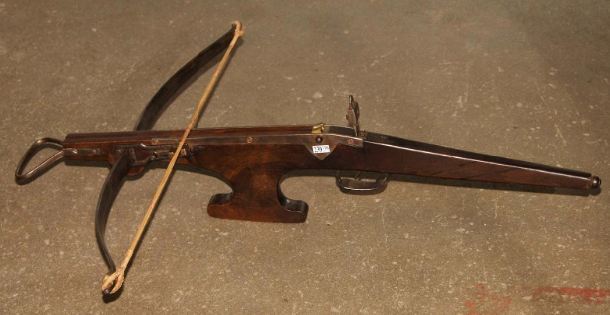
At the tip of the crossbow, there is a large, roughly triangular stirrup. The stock is wooden. The prod is metal, likely steel. It connects to the prod with bow irons.
On the bottom side of the stock, there protrudes a large wooden support, likely intended to stabilize the crossbow for the user to fire it while lying on their belly.
The catch and trigger systems are not easily visible in the photo provided.
There is a sight on the top side of the crossbow, likely brass. The trigger is protected with a trigger guard, also likely brass. The end of the stock tapers into a small knob.
In style, the crossbow is quite plain, with one notable exception. There is a brass plaque with an engraved tree branch and the words “De edelevoetboog, Keizerlijk Gilde, St Joris.” This refers to the Imperial Guild of St. Joris, a Flemish crossbow guild whose patron saint was St. George. Accordingly, near the brass plaque, there is a coat of arms with the red cross of St. George.
The Inventory of Movable Heritage of Brussels notes that this crossbow belonged to Ernest Kockart.
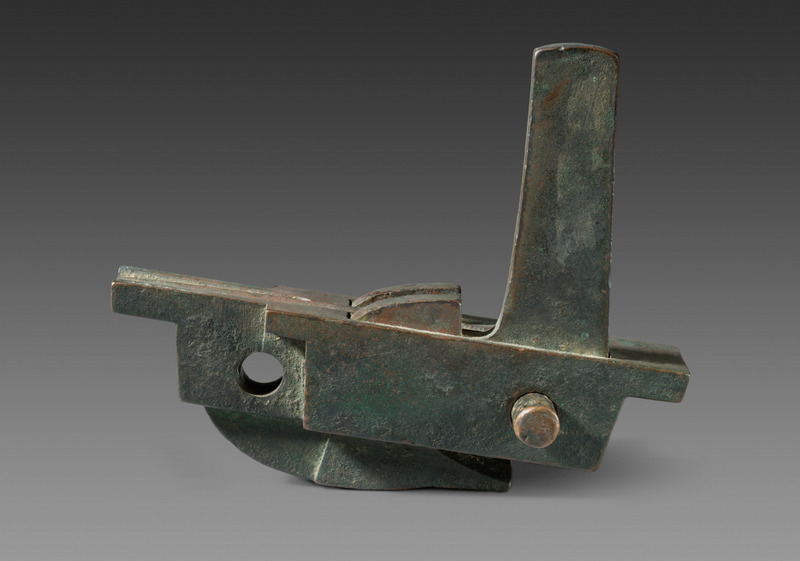
This crossbow mechanism held by the Shanghai museum is dated to 124CE. The specific location of its unearthing is not listed.
The mechanism is made of bronze and it comprises most of the typical parts of a Chinese crossbow mechanism. The long rectangular protrusion at the top of the mechanism is the sight, or wangshan (望山). The two small hooks sticking out in front of the sight are a part of the same component as the wangshan and serve as the nut, or ya (牙). The rectangular handle at the bottom of the mechanism is the trigger, or xuandao (悬刀), and within the bronze casing, or guo (郭) there is a sear, or gouxin (钩心) connecting the sight and nut and the trigger. The mechanism is held together by two bronze axle pins. The top surface of the bronze casing has a groove that goes down the middle of its top surface which would continue onto the wooden stock of the crossbow. This groove would be where the arrow rests during drawing and aiming.
It is not visible from the photo, but given the museum title that provides details about the specific date and origin of the crossbow mechanism (being of the Shuyan office and from the third year of the Yanguang reign title), there might be an inscription on the crossbow mechanism that is indicative of this information.
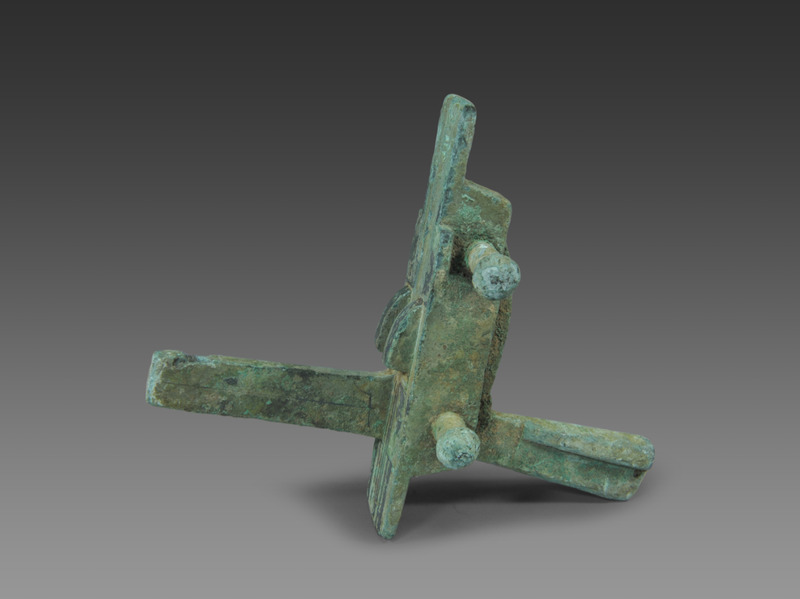
This crossbow mechanism held by the Shanghai museum is dated to the Han dynasty. Its specific location of unearthing is not listed
The mechanism is made of bronze and it comprises most of the typical parts of a Chinese crossbow mechanism. The long rectangular protrusion at the top of the mechanism is the sight, or wangshan (望山). The two small hooks sticking out in front of the sight are a part of the same component as the wangshan and serve as the nut, or ya (牙). The rectangular handle at the bottom of the mechanism is the trigger, or xuandao (悬刀), and within the bronze casing, or guo (郭) there is a sear, or gouxin (钩心) connecting the sight and nut and the trigger. The mechanism is held together by two bronze axle pins. The top surface of the bronze casing has a groove that goes down the middle of its top surface which would continue onto the wooden stock of the crossbow. This groove would be where the arrow rests during drawing and aiming.
It is not visible from the photo provided by the museum, but given that the museum has titled this entry as a “Crossbow Mechanism with Inlaid Bird Design”, there might be an inlaid bird design on a different surface of the mechanism.
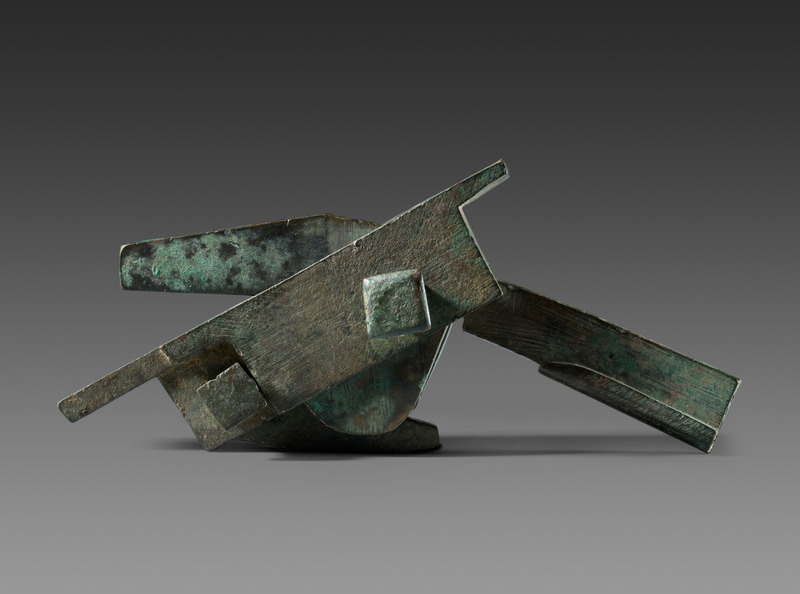
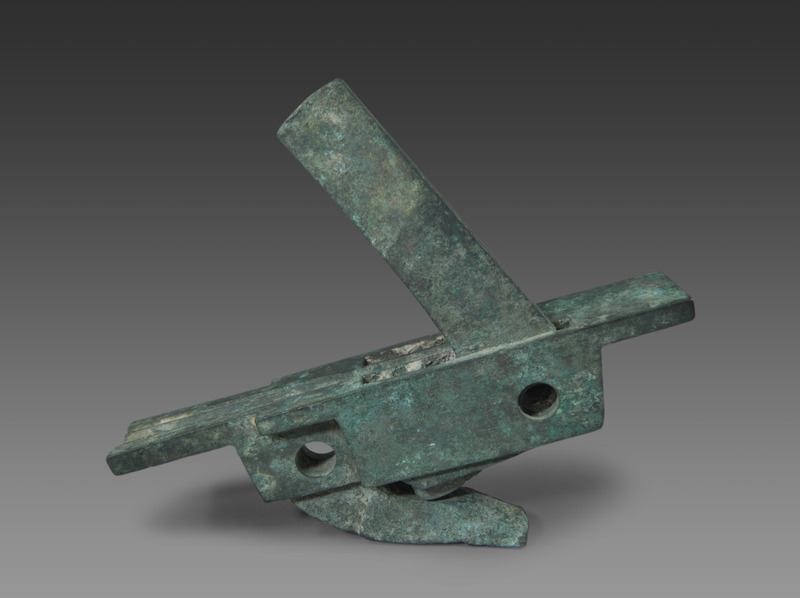
This crossbow mechanism held by the Shanghai museum is dated to 259CE. Its specific location of unearthing is not listed, but it would have likely been unearthed from former Shu territory.
The mechanism is made of bronze and it comprises most of the typical parts of a Chinese crossbow mechanism. The long rectangular protrusion at the top of the mechanism is the sight, or wangshan (望山). The two small hooks sticking out in front of the sight are a part of the same component as the wangshan and serve as the nut, or ya (牙). Within the bronze casing called the guo (郭) there is a sear, or gouxin (钩心) that would connect the sight and nut with the trigger. The top surface of the bronze casing has a groove that goes down the middle of its top surface which would continue onto the wooden stock of the crossbow. This groove would be where the arrow rests during drawing and aiming. This specific mechanism is missing the trigger, or xuandao (悬刀) and the front bronze axle pin that holds the mechanism together.
It is not visible from the photo, but given that the museum titles this mechanism as being from the second year of Jingyao, it is likely that the year of manufacture is inscribed on the crossbow mechanism somewhere.
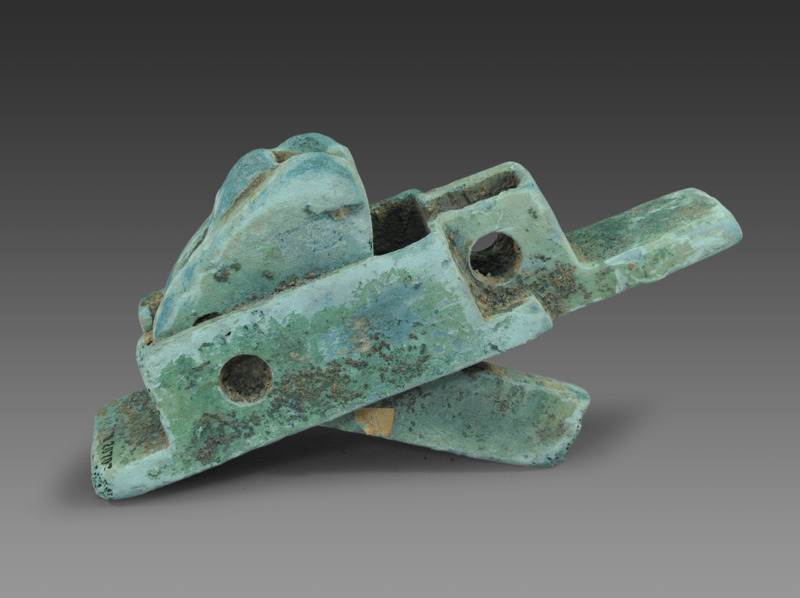
This crossbow mechanism held by the Shanghai Museum is dated to the Western Jin dynasty, 291CE. Its specific location of unearthing is not listed.
The mechanism is made of bronze and it comprises most of the typical parts of a Chinese crossbow mechanism. The long rectangular protrusion at the top of the mechanism is the sight, or wangshan (望山). The two small hooks sticking out in front of the sight are a part of the same component as the wangshan and serve as the nut, or ya (牙). The rectangular handle at the bottom of the mechanism is the trigger, or xuandao (悬刀), and within the casing there is a sear, or gouxin (钩心) connecting the sight and nut and the trigger. The mechanism is held within a rectangular bronze casing called the guo (郭). The top surface of the bronze casing has a groove that goes down the middle of its top surface which would continue onto the wooden stock of the crossbow. This groove would be where the arrow rests during drawing and aiming. This specific specimen is missing the two bronze axle pins that hold the mechanism together within the guo.
It is very faintly visible from the photo, but there are fine inscriptions on the guo of the mechanism. Given that the museum website titles this crossbow mechanism as one that comes from the first year of the Yuankang reign title of the Western Jin dynasty, it might be possible that the inscriptions indicate at least the date of manufacture.
This crossbow mechanism held by the Shanghai Museum is dated to the Han dynasty. Its specific location of unearthing is not listed.
The mechanism is made of bronze and it comprises most of the typical parts of a Chinese crossbow mechanism. In the photo, the mechanism is positioned upside down. Thus, the long rectangular protrusion at the bottom of the mechanism is the sight, or wangshan (望山). There would be two small hooks sticking out in front of the sight, which are a part of the same component as the wangshan and serve as the nut, or ya (牙). Within the bronze casing, or guo (郭) there is a sear, or gouxin (钩心) that is meant to connect the sight and nut to the trigger. The top surface of the bronze casing has a groove that goes down the middle of its top surface which would continue onto the wooden stock of the crossbow. This groove would be where the arrow rests during drawing and aiming. This specific specimen is missing the trigger, or xuandao (悬刀), and the two bronze axle pins that would hold the mechanism together within the guo.