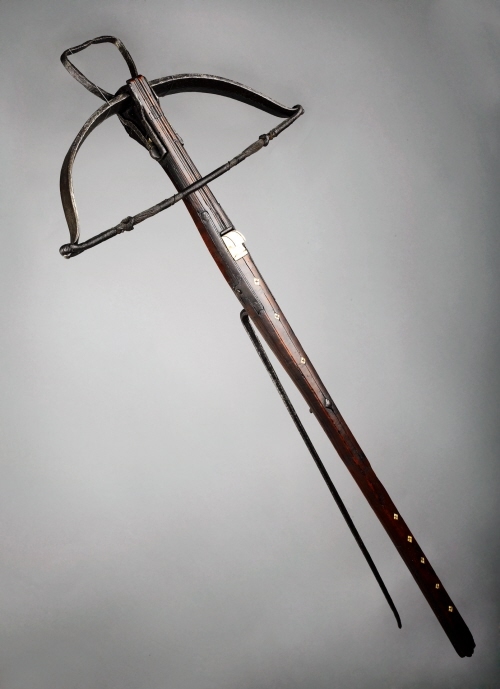
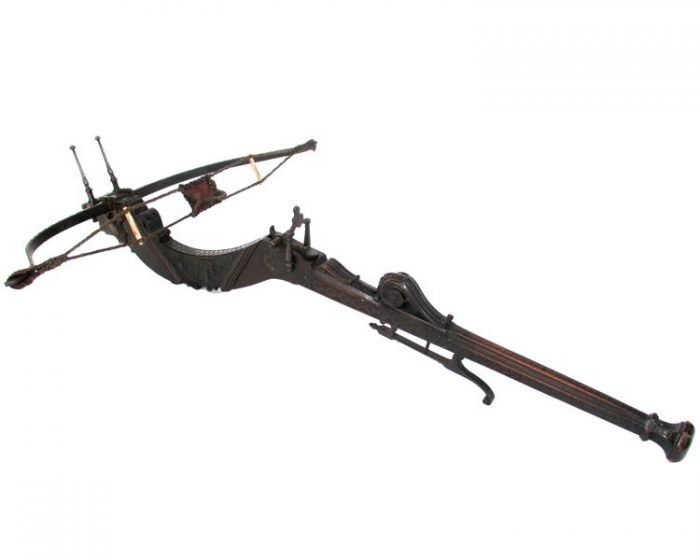
"Curved steel bow with two indecipherable marks on the inner surface secured to the stock by an iron bridle with a metal stirrup at the front for the foot. Long thin dark wooden stock with small diamond shaped inlays of horn on the top. Terminal for the bolt. Walrus ivory nut. Original bowstring. Long lever trigger. At the end of the butt a small portion of wood has broken off. “On the underside, in front of the trigger-lever at the place where the stock is gripped by the left hand, the surface is roughened with fine parallel ridges in low relief. On the underside at the forward end is an iron hook, probably for suspension, and farther back is a short hook or claw for use when bending the bow with a cord and pulley.
The nut is without an axle of any sort. It is retained by being larger than the hole of entry, except when it is rolled back until the forward edge of the cord-slot coincides with the rear lip of the hole, when the nut can be lifted out. The lever-trigger acts directly on the underside of the nut.”
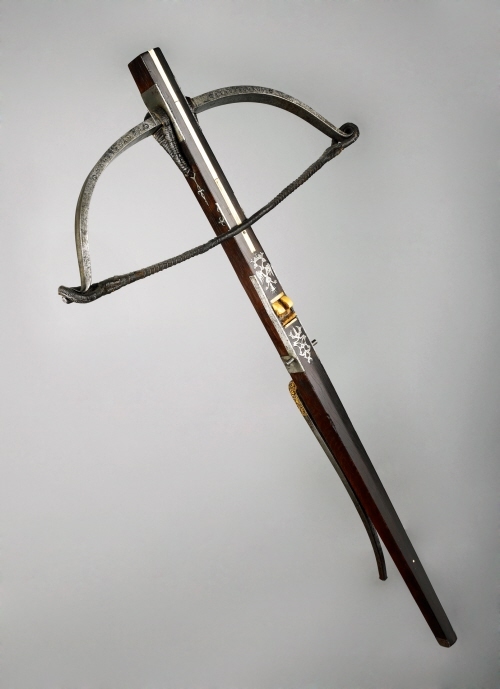
"Crossbow, the steel bow secured to the stock by a bridle of twisted cord. It is stamped four times with the maker's mark and inscribed:
D O M F E R N A N D O | R E I D E R O M A N O S
On the inner side the mark again appears four times together with the inscription:
I V A D E | N C I N A S
The cord remains.
Straight, slender stock or tiller of dark walnut, rectangular in section reinforced with steel plates at the passage for the bow and alongside the lock. The groove for the bolt is inlaid with antler, the nut of the same material. In front of the nut the Imperial eagle is inlaid in steel, while behind it is a simplified shield ensigned with the Imperial bonnet and charged with a double eagle and the Golden Fleece depending below. Steel transverse lugs for a goat's-foot lever.
Long trigger lever of square section, the base overlaid in gold with arabesque foliage, and on the underside with the signature:
I V A N D E N S I N A S
At the tip are traces of further gold overlaid, the right side appearing to have borne an inscription now illegible, the left a form of key pattern. To the underside of the stock is hinged a small lever, which, when unfolded, rests on the inner surface of the trigger lever like a strut, thus preventing any movement of the latter and forming a safety-catch."
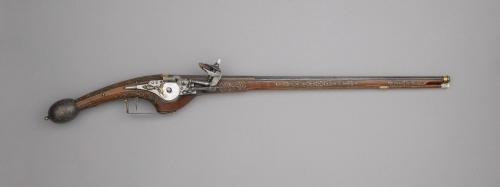
"Wheel-lock pistol, with a long, slender barrel, octagonal at the breech, except for a circular gilt collar, four-fifths of an inch deep at the breech end; a similar collar is at the muzzle. The octagonal portion is inlaid in gold and silver with minute arabesque ornament. This decoration recurs at the muzzle, which is finished with a turned moulding. The rest of the surface is blued. Near the breech is stamped a maker's mark, I B, and a crossbow, attributed to Jean le Bourgeois of Lisieux. The flange at the base of the breech is incised with two sighting notches. Long breech-strap reaching to the butt, also inlaid with scrolls.
The lock has an external wheel held in position by a single small bearing-plate formed as a pair of leaves terminating in an urn-shaped finial. This bearing-plate and a small, baluster-shaped bridle connecting the screw and spring of the cock are gilt, while the rest of the lock was formerly blued. Press-in pan cover release. The mechanism of the lock is of the French fashion with the mainspring secured inside the stock (see also A1179).
Walnut stock of French form, inlaid with delicate interlacing ornamentation of brass and silver wire. On either side of the breech-strap in silver wire is the monogram D.C. In front of the trigger-guard is stamped the number 211. Oviform butt of steel terminated with gilt button, inlaid with arabesques in gold and silver, the ground blued. A narrow steel plate on the underside of the stock runs from the butt to a point in front of the trigger-guard which is attached to it; this and the trigger-guard are inlaid en suite with the rest. The shaped steel screw-plate, which also acts as a bearing for the wheel-pivot, typical of these French pieces, is similarly inlaid. Single ramrod pipe of gilt steel. Wooden ramrod with antler tip and gilt ferrule."
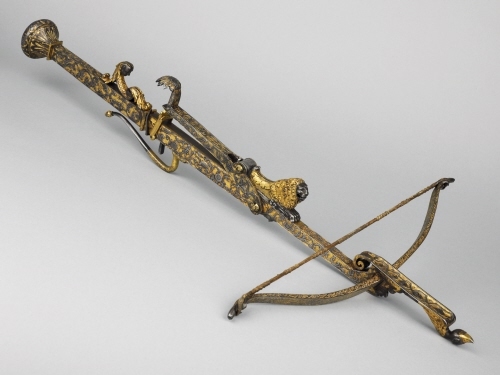
This crossbow is made entirely of steel. The prod is decorated with etched designs of flowing foliage and hunting animals on a gilded background, and the bowstring made of twisted cord is still intact. The stock has a rectangular shape and ends in a flattened, pear-shaped butt. Its surface is carved in low relief with bands of scrollwork and strapwork, along with scenes of boar hunting, birds, and other animals. The decoration is blued against a golden background.
A lever for drawing the prod is permanently attached along the top of the stock and is decorated to match. At its front end is a catch shaped like a reclining lion and its hinged jaw grips the string when the lever is pushed forward. The lever is then pulled back and secured by a pivoting gilt-brass collar. The trigger operates a bar located beneath the lion.
An almost worn-away inscription "AVBERT A LVNEVILLE" is hidden on the top of the stock beneath the lever. Just behind the lever is a raised decorative feature carved as a scrolling volute that ends in a human-headed creature surrounded by acanthus leaves.
Beyond the prod is a bolt rest, about four inches long, for holding a stone or bullet with its front end decorated with a carved harpy, matching the gilded and strapwork style of the rest of the stock. The trigger guard is curved and ends in a pineapple-shaped knob.
The steel bow is retained by an iron stirrup and the string attached is made of bone spacers accompanied with a sort of sinewed pouch, belonging to a later period. The tiller curved stock is etched with guilloche ornament, and crisscrossing scales along with an insignia made of overlapping stripes called 'chevrons' and winged beast, which although not visible, are not properly visible in the image. There is an arrow-like shape to the rear-sight followed by a spiral arched back on the stock carved with acanthus leaf designs. The crossbow's slender shape converges into a circular butt stock and while the patterns on it are subtle, they are still highly detailed.
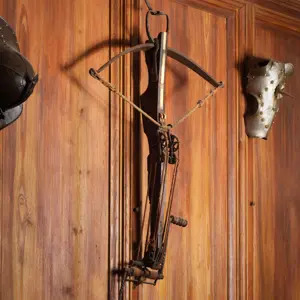
This crossbow has an iron prod and stirrup and a string that is pulled to the hook, connecting to the windlass with small wheels, attaching it to the stock. The stock appears to be inlaid with bone or horn and the nut is made of bone. The windlass' handle is attached to the butt stock to span the bolt.
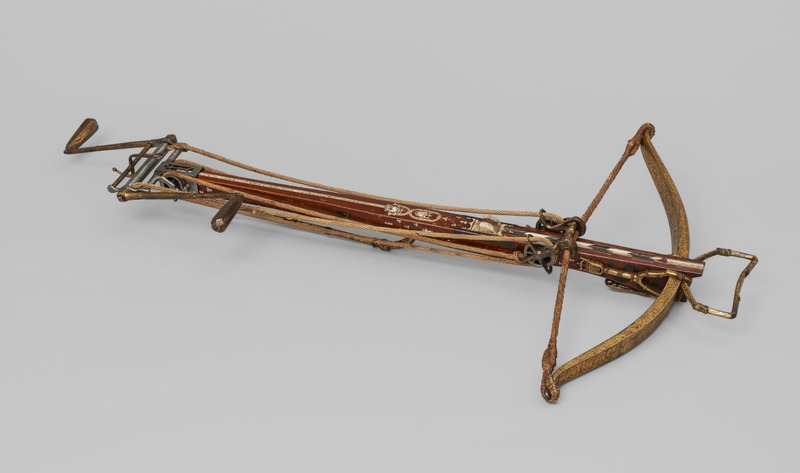
The prod, the trigger, the stirrup are made of iron and the bow is carved and etched with gold floral patterns, implying its Spanish roots along with the shape of the crossbow itself. There is a slightly visible stamp on the bow . The stock is painted with the French royal coat of arms and the coat of arms of Anne de Bretagne, along with Louis' personal symbol of the Order of the Porcupine, indicating it to be a hunting weapon meant for Louis XII of France, manufactured in Spain. It is inlaid with ebony and ivory vine and floral designs. The prod binding clasped around the bridle is composed of iron instead of rope and the nut is made of antler. A windlass is seen to be hooked on the string, however, it is unclear whether the mechanism also belongs to the same time period.
The museum site states that it probably posed as a diplomatic gift to Louis XII from Philip I the Fair of Spain but due to political disputes remained in the possession of the Hapsburg dynasty.
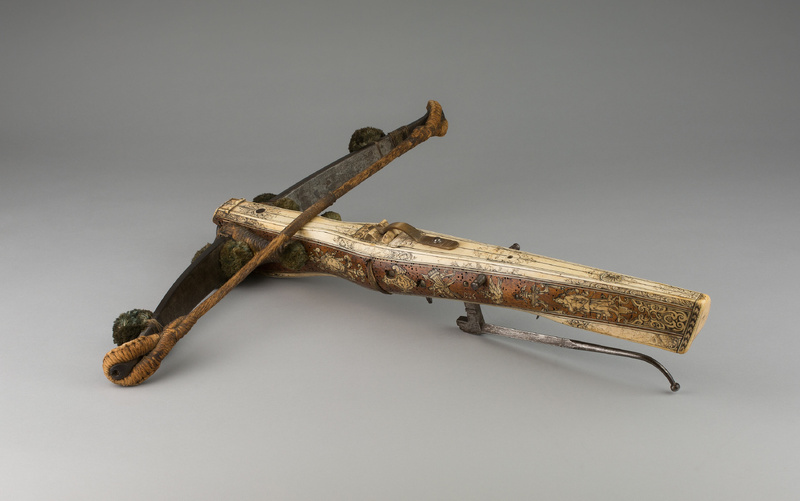
A hunting crossbow originating from Dresden, Germany. It features a wooden prod with four woolen pompoms at its front and two behind the prod situated in the corners at the top of the stock. It features a woven hemp fiber string and a transverse pin used to help span the crossbow string with a spanning device. Two additional wooden pompoms are at the upper portion of the stock. The stock itself is made of walnut veneered with staghorn. Along the top of the crossbow are intricate floral engravings and at its sides it is ornately decorated with mythological figures, beasts, and items. It has a single axis nut trigger mechanism used to fix the bowstring in place prior to firing and is secured with a thread through the nut.
Materials: Steel, walnut, staghorn, bovine horn, bone, silk fiber, and hemp
Dimensions: 12.7 × 62.2 × 59.7 cm (5 × 24 1/4 × 23 1/2 in.)
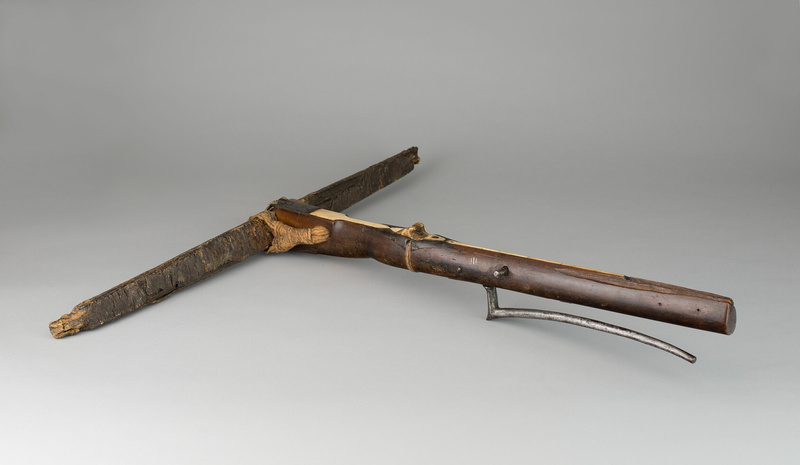
A composite crossbow comprising of bone, horn, and sinew and bound together with glue made of animal skin. It is waterproof as its prod enveloped in painted birch bark but does show significant wear as its underlying layers have surfaced. The stock is made of cherrywood and inlaid with bone. It possesses a single axis nut kept in place with a thread known as the nussfaden. It contains a steel transverse pin used as a hold to span the device in preparation of firing. Its trigger is also made of steel. At the fore of the prod is a steel plate, a later addition which served as a repair and used as an area to keep the crossbow bolts in place.
Dimensions 12.1 × 77.5 × 78.8 cm (4 3/4 × 30 1/2 × 31 in.)
A wooden crossbow originating from India in the Kerala region. Its prod comprising two pieces of bent wood joined together bands made of cane plant and crosses through the upper portion of the stock. The stock is made of wood and widens towards its rear. Toward the end of the stock curved cylindrical trigger mechanism likely made of horn although this is uncertain.
Width: max 1410 mm, Depth: max 60 mm, Length: max 715 mm
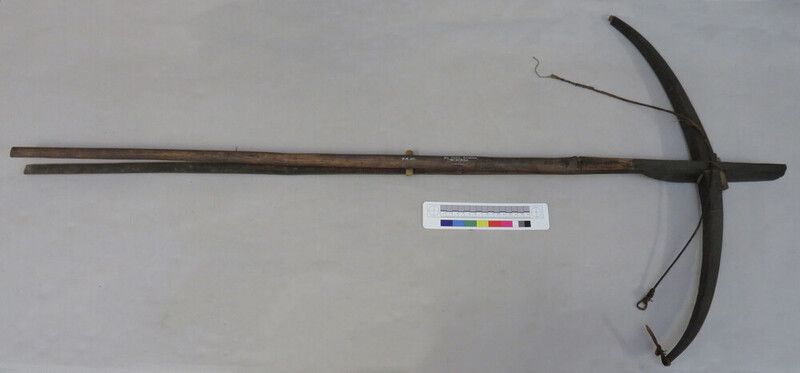
A wooden crossbow originating from Gabon in Central Africa and used by the Fang peoples. The prod is made of wood and crosses through the stock. The string of the bow is split away from the prod and kept attached to the stock using a metal wire. The stock itself is made of wood and is split down the middle with a round peg separating it.
Length: max 1286 mm, Width: max 958 mm, Depth: max 55 mm
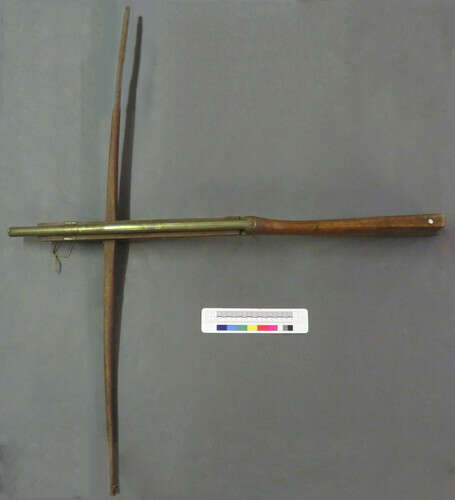
A crossbow, likely of European origin, although this is uncertain. It has a wooden prod that cuts through the middle of the crossbow. Its original bowstring is missing. The stock is made out of wood and features a metal barrel of copper alloy on the top of the stock. The butt of the stock widens in shape, flaring outwards in a similar resemblance to a musket or a rifle. Carved into the stock are the letters “A B.”
Length: max 830 mm, Width: max 980 mm, Height: max 120 mm