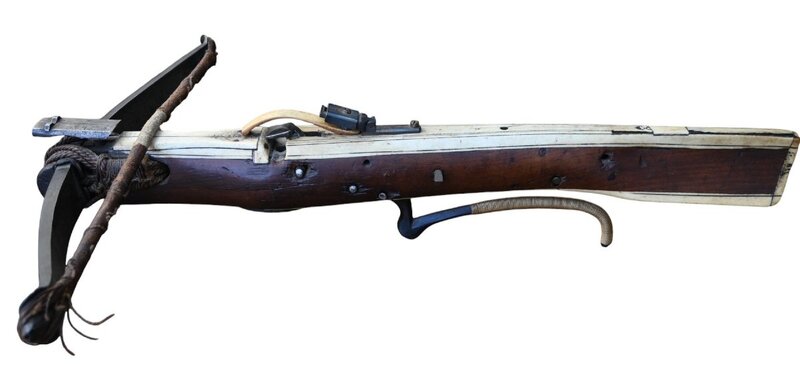
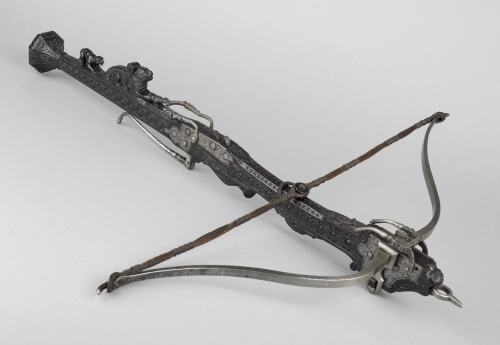
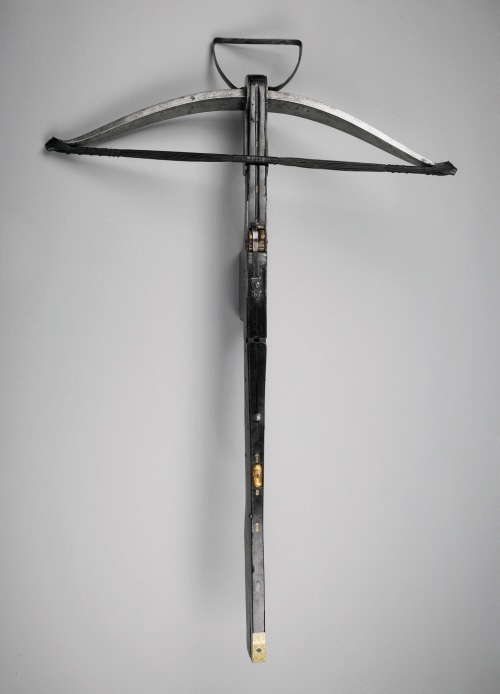
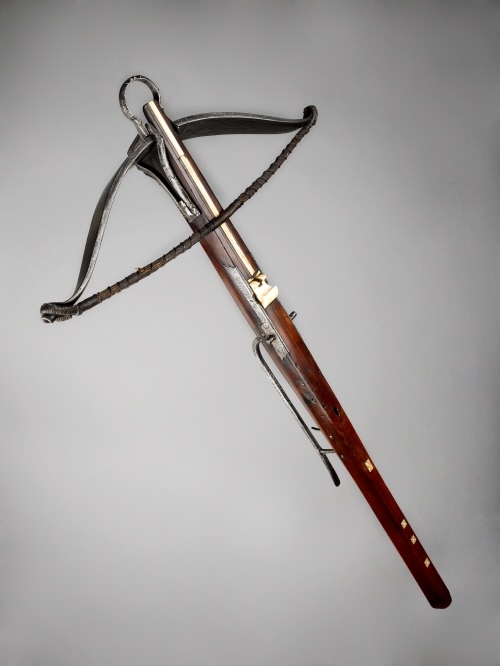
This crossbow has a blackened steel prod with a string made of horn and bridle binding made of dark brown rope. There is an upper front plate on top of the prod. The wooden stock is inlaid with horn and the lock mechanism is made of iron. The square rear sight is folded over the bolt clip. The middle of the stock is beveled unevenly with several dents on the wood. The butt stock is damaged as well as shown with the black oxidization. The crossbow has an iron trigger guard and trigger with partial white roping.
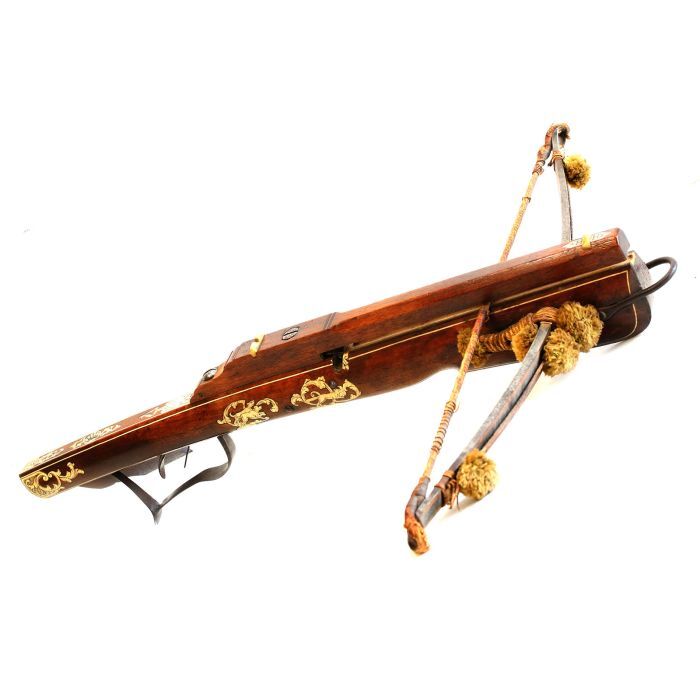
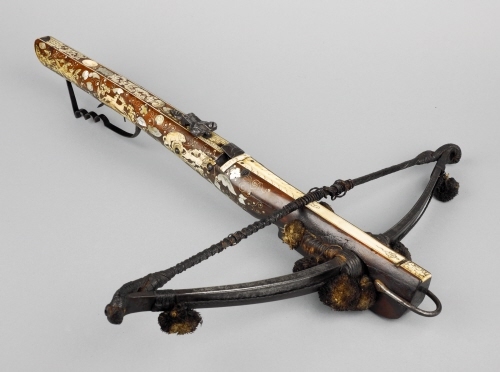
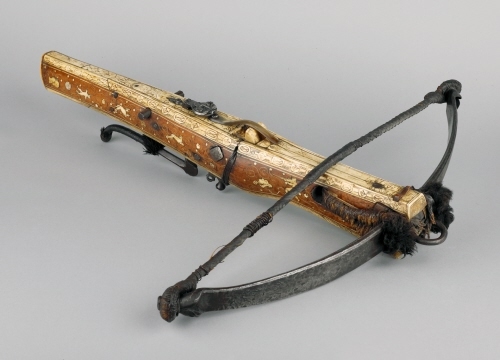
The crossbow has a steel bow with yellow pom-poms (the auction website mentions it as green which appears to be a mistake) at the edges and near the prod binding and stirrup. The stock is made of fruitwood and a gilt cylindrical bar is attached to the prod. The sides of the stock are engraved with pictures of hounds, stags, and does. At the top of the stock and the cheek rest is inlaid with bone and gold foliage in the style of eighteenth century Late Baroque art. The top of the cheek rest gold decorated floral panels and part of the stock is hollowed out for the position of the thumb. The bolt channel is composed of bone and the date along with a stag is engraved near the string release. The nut mechanism, also made of bone, appears to be incomplete and there is a curved double trigger beneath the stock along with a setting chord.
According to the auction website, the butt stock is carved with the number 1 and the names of gunmakers, I.G.E and Ertell which cannot be seen in the image and while the crossbow appears to be made by them, the father and son duo are not recorded as crossbow makers.
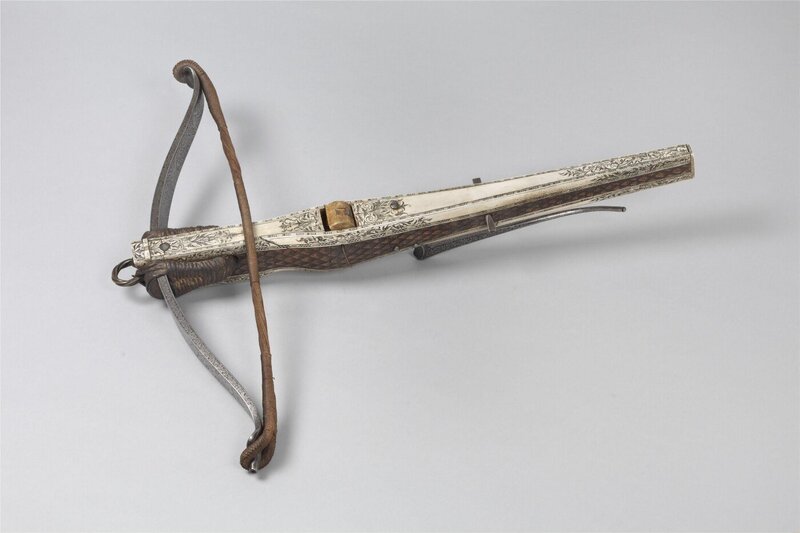
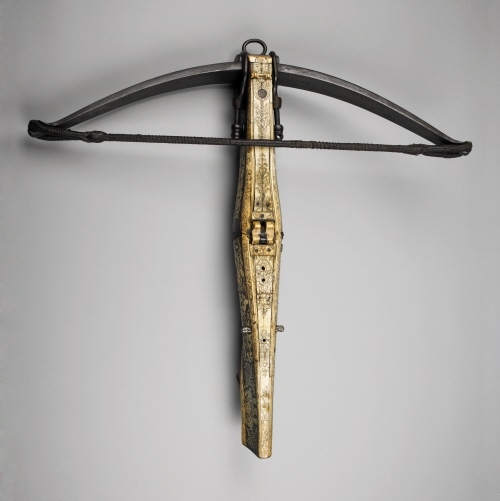
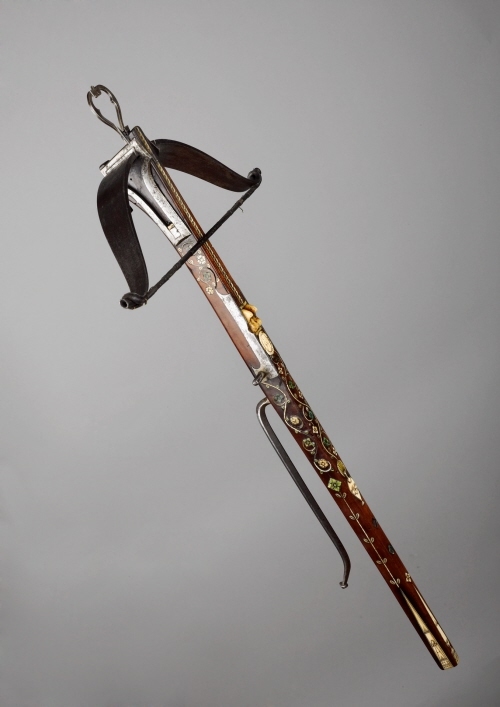
This crossbow has a steel bow and etched with relief patterns of mask and foliage through a process involving acid. There is a steel coiled stirrup and rope string attached to the bow. The top of the wooden stock is composed of a staghorn panel and decorated with detailed leaf designs and intricate rhythmic vines of foliage. The cheek rest also contains a similar decoration. There are triangular patterns on the side of the stock, and a steel transverse pin is visible. The trigger mechanism is similar to the bow as it is also made of steel and engraved with floral reliefs. There appears to be no rear sight and the nut lock seems to be composed of wood or staghorn. According to the museum website, this is an example of a crossbow mostly used for hunting by central European nobles in the sixteenth century.
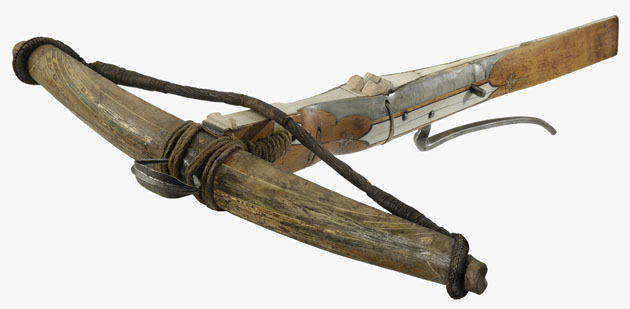
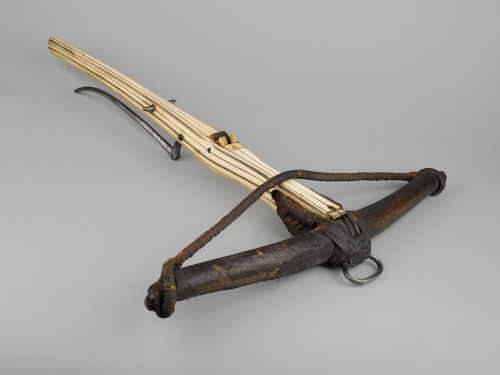
The wooden, possibly yew, prod and stock are especially thick, which were less likely to fracture under pressure. The suspension ring, transverse pin, trigger as made of iron and there is also some type of iron plating beside the nut, which is possibly composed of antler bone, on the stock. It is also inlaid with ivory or stag bone with a curved type of etching near the prod binding made of rope. The decorations on the stock are with minimal but still visible, suggesting it to be mostly used for royal hunting.
"Stone-bow or prodd, the steel bow with a double curve. The string, with its sling, remains. This is not of the usual double type but consists of a single twisted skein, which divides in the centre to hold a small ebony button hollowed on its inner face to receive the bullet.
Stock or tiller of ebony, the neck only slightly curved. It is of square section with bevelled edges and is decorated with carving in low relief. On the fore-end in front of the bow is a double lion's mask (above and below) from the mouth of which issues a steel, spiked ring, possibly for suspension, or to obtain purchase in bending. Behind the bow is carved a grotesque bearded mask and a band of scales, and similar ornament is on the underside of the neck; in front of the trigger is a caryatid figure. On the upper surface at the rear is a projection carved as a couchant lion holding a hare in its paws, and behind it the figure of a dog in the round. The rest of the surface is ornamented with bands of guilloche and cartouche ornament. Octagonal pommel or butt of flattened pear-shape, the facets carved alternately with masks and interlacing bands; at the end is a medallion containing the letter H among foliage. On a sunken tablet immediately behind the bow is the date 1571."
"Crossbow, the steel bow of unusual size and strength; it is secured to the tiller by two powerful straining screws. Bow-string of twisted cord; small loop at the top for suspension.
Stock or tiller veneered with ebony inlaid with antler, the latter richly engraved with scrolled foliage, with hunting scenes along the sides, and near the butt with an achievement of arms; at the top is the date 1683. The arms (quarterly 1-4, two lions passant; 2-3, two bends; on a shield of pretence an arrow in bend between two mullets; crest: three ostrich feathers) are those of the Counts von Promnitz of Silesia. The stock is furnished with a foresight (permitting of lateral movement to allow for windage), a nut of horn, a pin for the claw of the cranequin, a safety-catch, trigger-guard and slight folding-trigger. There are two shallow notches at the top for the thumb to rest in when the piece was being discharged."
Crossbow, the steel bow stamped on the inner side with a maker's mark. It is attached to the stock by a bridle of cord decorated with tassels of yellow silk, and similar small tassels are attached to the outer face of the bow at each end.
Walnut stock or tiller, shaped with a cheek-piece to the butt like that of a rifle. There is a notch on the underside of the forward end for the left hand. Decorated with inlaid antler in the form of deer and hounds, the free spaces being filled with fine scrolls of antler and inlays of foliage in mother-of-pearl. The ornament is rather crude in design. There is no nut, the string being held by a pivoted steel catch. The horn spring which held the end of the bolt is missing, as also is the cross-piece which supported the neck at the forward end. There is a short groove for the bolt in front of the catch. This cross-bow is of the kind bent by a wooden lever of goat's foot type. Attached to the front end of the stock is a steel loop, showing traces of gilding, with which the hook of the lever engaged. Folding backsight with adjustable notch. Trigger with screw adjustment behind which is a cocking lever. The trigger-guard is indented for the fingers, and there is an oval depression for the thumb of the right hand in the upper part of the stock.
"Windlass crossbow, the strong steel bow stamped in three places with a maker's mark. The cord remains.
Stock of dark wood, furnished with a steel stirrup at the forward end, grooved for the bolt, and at the rear deeply slotted and reinforced with brass for a windlass. Antler nut. There is a curved, steel spring to hold the end of the bolt in place. The underside of the stock has a large projection in the centre to provide a firm grip for the left hand. The edges are outlined with fine lines of antler."
"Crossbow, the broad steel bow stamped with the maker's marks; bow-string of twisted cord; moulded steel loop at the top. The bow is bound to the stock with steel bands; beneath, a rivet with a heart-shaped head.
Long, straight stock or tiller of plain walnut inlaid with a few small plaques of antler engraved with quatrefoils; steel trigger, trigger-guard and lugs. Their proximity to the nut indicates that it was meant to be spanned by a goat's-foot lever, not a cranequin (no. 1327). The nut is of ivory with a steel face. A hole on top of the stock, two inches in front of the nut, was used to set the tumbler which connected the nut with the gun-type trigger."
"Crossbow, the bow of steel with loop for suspension above; it is bound to the stock with plaited cord decorated with the remains of silk tassels of dark blue or green; bow-string of twisted cord.
Bulky stock or tiller of light wood, resembling pear-wood, the sides inlaid with mother-of-pearl and veneered on the upper and undersides with antler, rather crudely engraved with figures of crossbowmen: one shooting at a popinjay, another spanning a crossbow with a cranequin, and on the sides are inlaid figures shooting at ground game; upon the butt-plate is the figure of a lady seated, and there are numerous masks, heads and bands of ornament. The fore-sight does not permit of transverse movement, and there is a hinged aperture-backsight of steel which can be adjusted both vertically and horizontally; horn nut over which a spring of horn is fitted– the use of this was to prevent the bow-string slipping off the quarrel when it was strung; steel pin for the claw of the cranequin, hinged trigger, safety-catch and trigger-guard."
"Small crossbow, the steel bow stamped in two places with a maker's mark. It is secured to the stock by a steel bridle. The cord remains. At the forward end of the stock is attached a heart-shaped iron loop, and on the underside a short hook, both for suspension.
Walnut tiller or stock inlaid with an ornament of flowing foliage of antler, partly stained green. Immediately behind the nut is an oval medallion of horn, engraved with a female head surrounded by an inscription PLESIR PASSE RICHESSE, and a date which appears to be 1583. There is a groove for the bolt inlaid with guilloche ornament in antler. Projecting steel lugs for the spanner.
Long faceted trigger-lever of steel. The lever-trigger acts directly on the underside of the nut."
"Crossbow , with a composite bow built up of layers of cane and whalebone, covered with parchment painted to imitate fish-skin with a double band of scrolled foliage along the top. It is bound to the stock with cord and plaited leather thongs; steel loop at the top; bow string of twisted cord.
Stock or tiller of wood veneered with longitudinal strips of antler incised with lines; there is a slot at the top for a movable foresight (now missing); it has a revolving nut, is pierced with a steel bar for the claw of the cranequin, and has a long steel trigger."