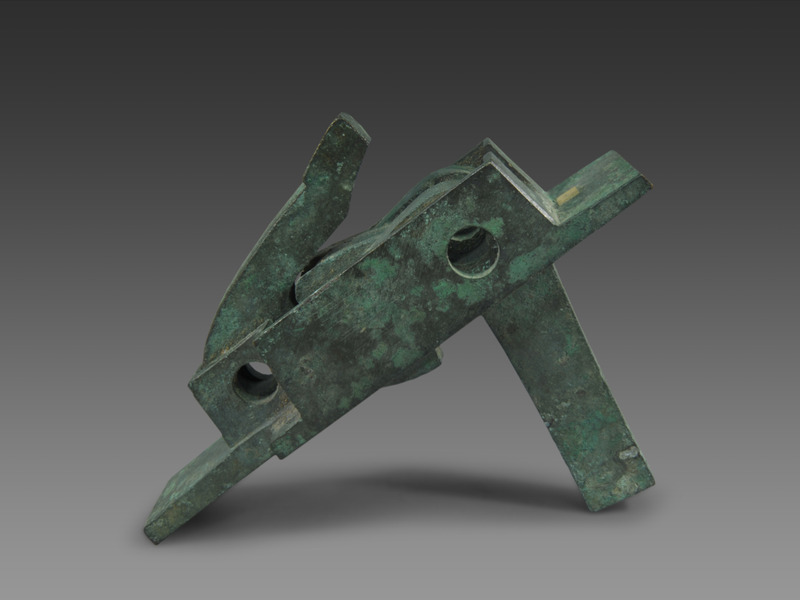
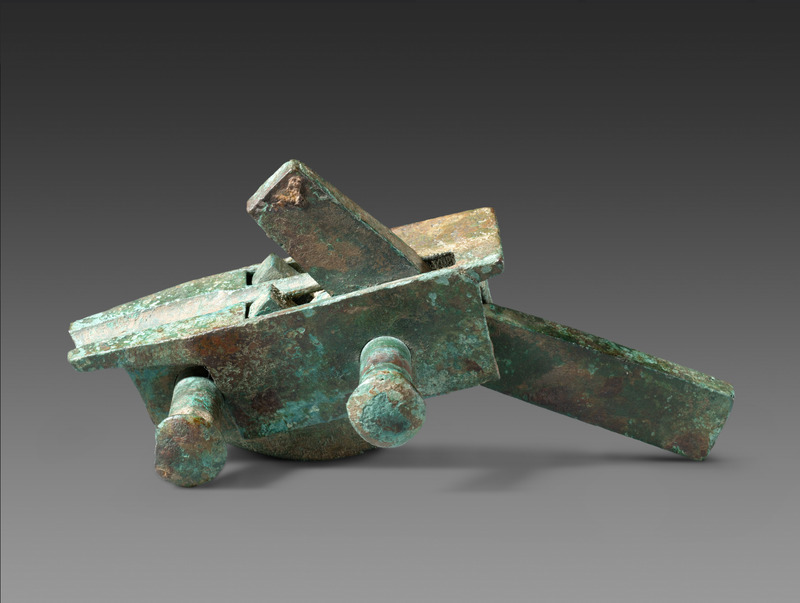
This crossbow mechanism held by the Shanghai museum is dated to the Han dynasty. Its specific location of unearthing is not listed.
The mechanism is made of bronze and it comprises most of the typical parts of a Chinese crossbow mechanism. In this photo, the mechanism is positioned upside down. Thus, the long rectangular protrusion at the bottom of the mechanism is the sight, or wangshan (望山). There are two small hooks that stick out in front of the sight which are a part of the same component as the wangshan and serve as the nut, or ya (牙). The rectangular handle protruding from the top of the mechanism is the trigger, or xuandao (悬刀), and within the bronze casing, or guo (郭) there is a sear, or gouxin (钩心) connecting the sight and nut and the trigger. The mechanism is held together by two bronze axle pins, but both are missing from this specimen. The top surface of the bronze casing which is oriented at the bottom in this image has a groove that goes down the middle which would continue onto the wooden stock of the crossbow. This groove would be where the arrow rests during drawing and aiming. The surface of the mechanism has been corroded and oxidised.
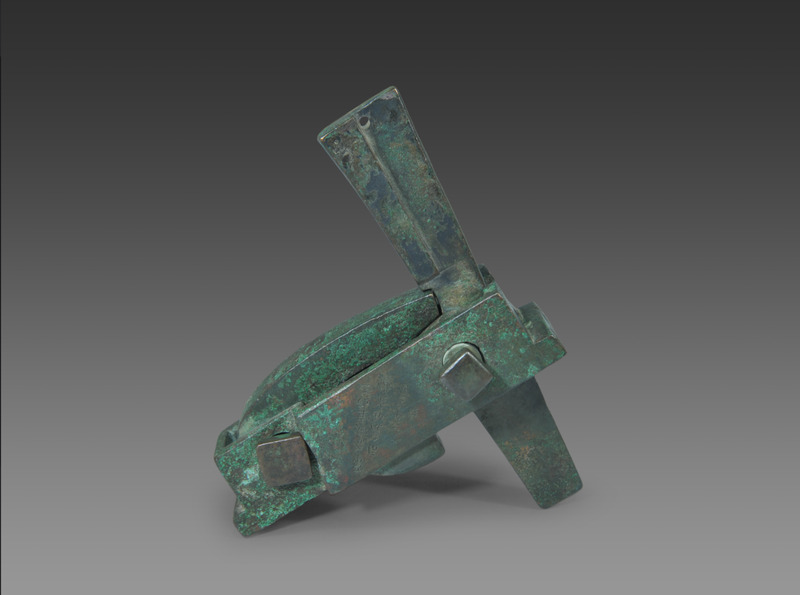
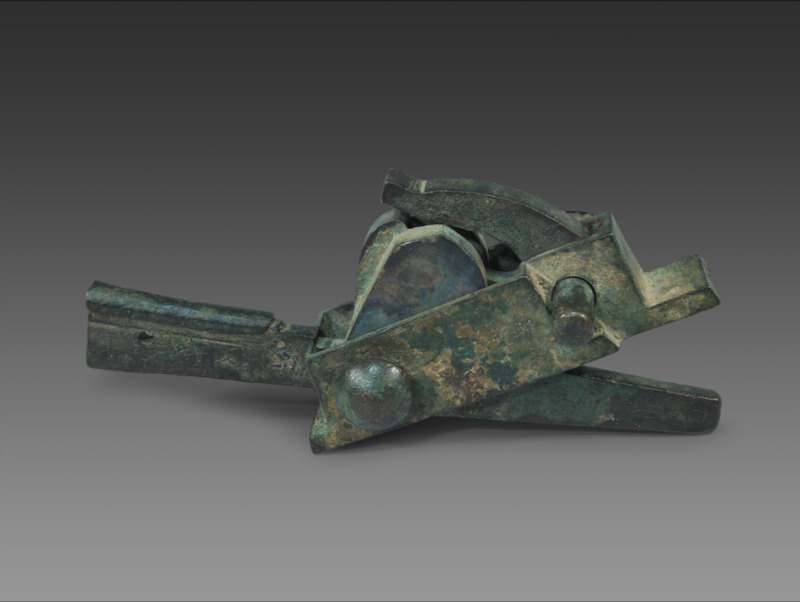
This crossbow mechanism held by the Shanghai museum is dated to the Han dynasty. Its specific location of unearthing is not listed.
The mechanism is made of bronze and it comprises most of the typical parts of a Chinese crossbow mechanism. In this photo, the mechanism is positioned upside down. Thus, the long rectangular protrusion at the bottom of the mechanism is the sight, or wangshan (望山). There are two small hooks that stick out in front of the sight which are a part of the same component as the wangshan and serve as the nut, or ya (牙). The rectangular handle protruding from the top of the mechanism is the trigger, or xuandao (悬刀), and within the bronze casing, or guo (郭) there is a sear, or gouxin (钩心), which hangs exposed from the mechanism in this photo, connecting the sight and nut and the trigger. The mechanism is held together by two bronze axle pins with square ends. The top surface of the bronze casing which is oriented at the bottom in this image has a groove that goes down the middle which would continue onto the wooden stock of the crossbow. This groove would be where the arrow rests during drawing and aiming. The surface of the mechanism has been corroded and oxidised.
On the casing of the crossbow mechanism there is text engraved which would typically indicate the date and location of manufacture as well as potentially the name of the craftsman and owner of the crossbow. On this specimen, the text is not clear enough to be completely decipherable.
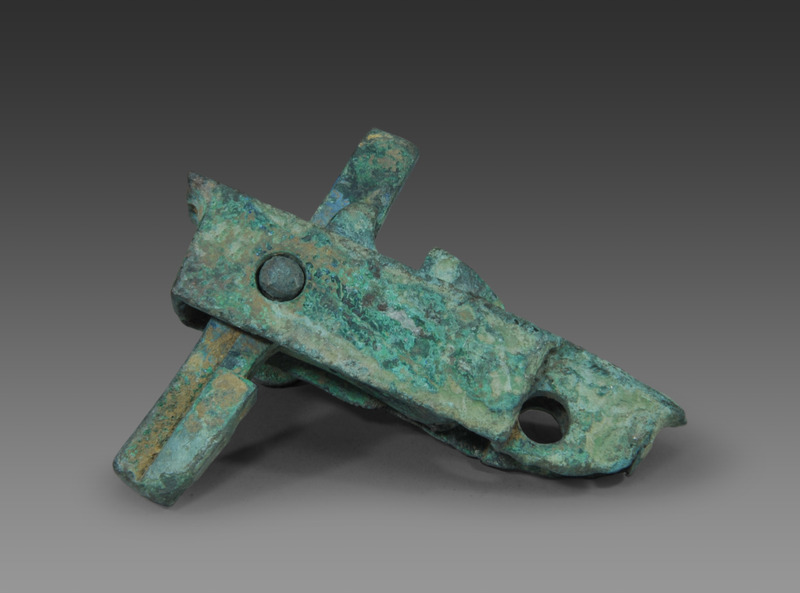
This crossbow mechanism held by the Shanghai museum is dated to the Han dynasty. Its specific location of unearthing is not listed.
The mechanism is made of bronze and it comprises most of the typical parts of a Chinese crossbow mechanism. The long rectangular protrusion at the top of the mechanism is the sight, or wangshan (望山). The two small hooks sticking out in front of the sight are a part of the same component as the wangshan and serve as the nut, or ya (牙). The rectangular handle at the bottom of the mechanism is the trigger, or xuandao (悬刀), and within the bronze casing, or guo (郭) there is a sear, or gouxin (钩心) connecting the sight and nut and the trigger. The mechanism is held together by two bronze axle pins, but this specific specimen is missing its front axle pin. The top surface of the bronze casing has a groove that goes down the middle of its top surface which would continue onto the wooden stock of the crossbow. This groove would be where the arrow rests during drawing and aiming. The surface of this mechanism has been corroded and oxidized quite severely.
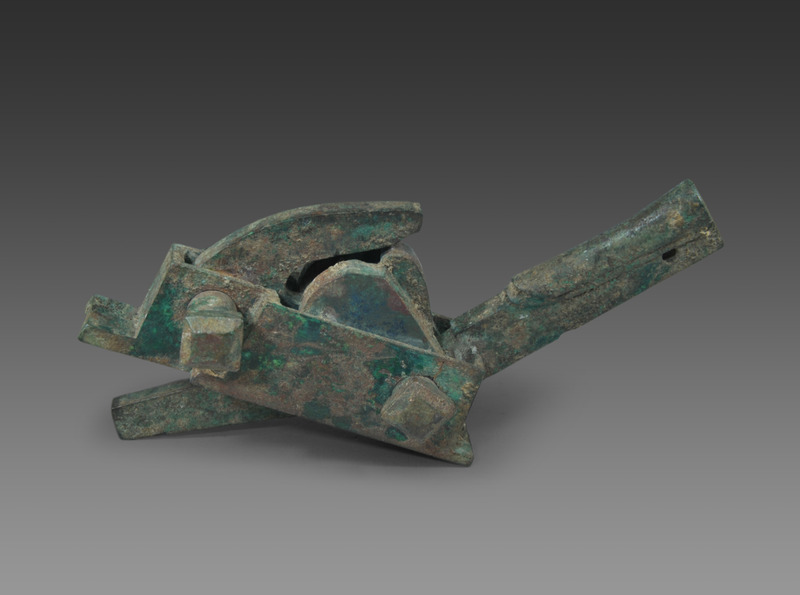
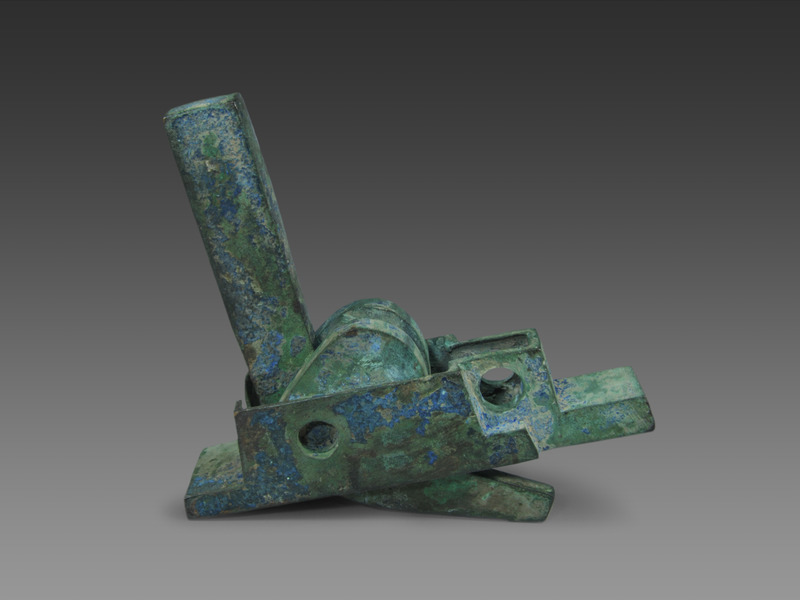
This crossbow mechanism held by the Shanghai museum is dated to the Han dynasty. Its specific location of unearthing is not listed.
The mechanism is made of bronze and it comprises most of the typical parts of a Chinese crossbow mechanism. In this photo, the mechanism is positioned upside down. Thus, the long rectangular protrusion at the bottom of the mechanism is the sight, or wangshan (望山). Not visible in the photo, there are two small hooks that stick out in front of the sight which are a part of the same component as the wangshan and serve as the nut, or ya (牙). The rectangular handle protruding from the right of the mechanism is the trigger, or xuandao (悬刀), and within the bronze casing, or guo (郭) there is a sear, or gouxin (钩心), which hangs exposed from the mechanism in this photo, connecting the sight and nut and the trigger. The mechanism is held together by two bronze axle pins with square ends. The top surface of the bronze casing which is oriented at the bottom in this image has a groove that goes down the middle which would continue onto the wooden stock of the crossbow. This groove would be where the arrow rests during drawing and aiming. The surface of the mechanism has been corroded and oxidised.
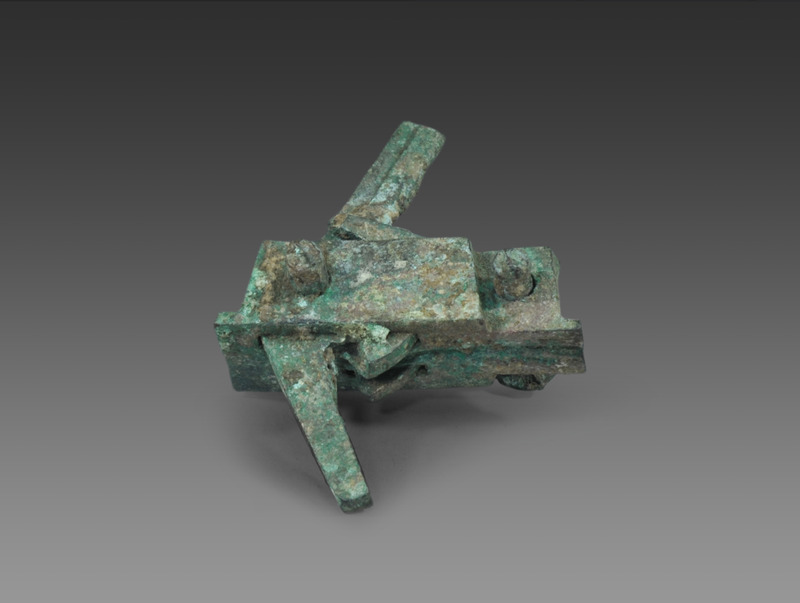
This crossbow mechanism held by the Shanghai museum is dated to the Han dynasty. Its specific location of unearthing is not listed.
The mechanism is made of bronze and it comprises most of the typical parts of a Chinese crossbow mechanism. In this photo, the mechanism is positioned upside down. Thus, the long rectangular protrusion at the bottom of the mechanism is the sight, or wangshan (望山). Not visible in the photo, there are two small hooks that stick out in front of the sight which are a part of the same component as the wangshan and serve as the nut, or ya (牙). The rectangular handle protruding from the top of the mechanism is the trigger, or xuandao (悬刀), and within the bronze casing, or guo (郭) there is a sear, or gouxin (钩心), which hangs exposed from the mechanism in this photo, connecting the sight and nut and the trigger. The mechanism is held together by two bronze axle pins, but both are missing from this specimen. The top surface of the bronze casing which is oriented at the bottom in this image has a groove that goes down the middle which would continue onto the wooden stock of the crossbow. This groove would be where the arrow rests during drawing and aiming. The surface of this mechanism has been corroded and oxidized quite severely, with patches of the surface appearing bright blue amidst the usual teal oxidation.
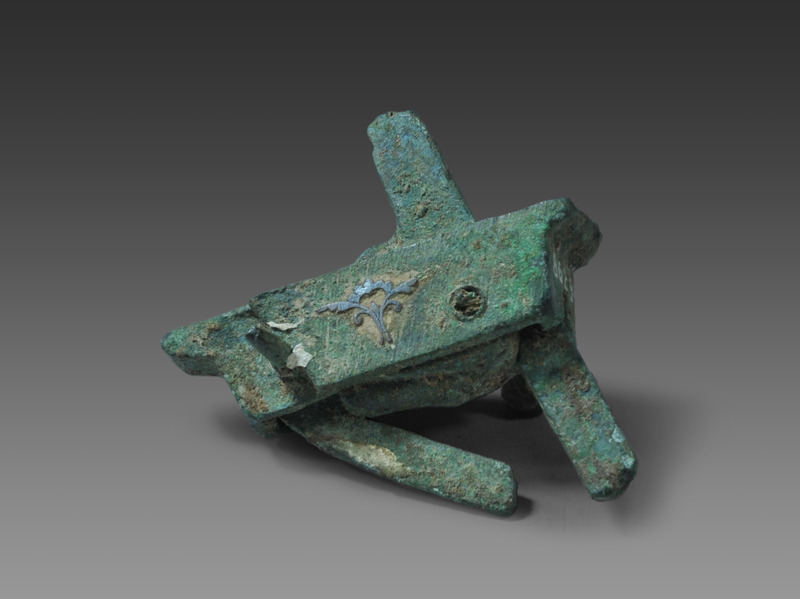
This crossbow mechanism held by the Shanghai Museum is dated to the Northern and Southern dynasties. Its specific location of unearthing is not listed.
The mechanism is made of bronze and it comprises most of the typical parts of a Chinese crossbow mechanism. The long rectangular protrusion at the top of the mechanism is the sight, or wangshan (望山). The two small hooks sticking out in front of the sight are a part of the same component as the wangshan and serve as the nut, or ya (牙). The rectangular handle at the bottom of the mechanism is the trigger, or xuandao (悬刀), and within the bronze casing, or guo (郭) there is a sear, or gouxin (钩心), which hangs exposed from the mechanism in this photo, connecting the sight and nut and the trigger. Unlike most crossbow mechanisms however, this specimen appears to only be held together by one bronze axle pin, having only one hole in the casing for the placement of the bronze axle which has been corroded through. The top surface of the bronze casing has a groove that goes down the middle of its top surface which would continue onto the wooden stock of the crossbow. This groove would be where the arrow rests during drawing and aiming.
The surface of this mechanism has been corroded and oxidized quite severely. But on the side of the mechanism’s casing there is what appears to be an insignia resembling a flower of some sort carved out of the surface. This might have been a craftsman’s signature or the clan or family crest of the owner of the crossbow.
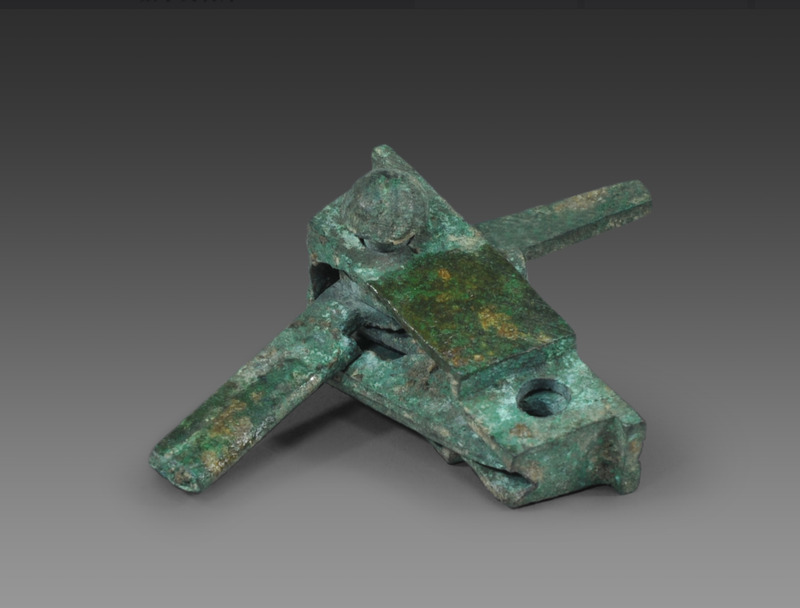
This crossbow mechanism held by the Shanghai museum is dated to the Han dynasty. Its specific location of unearthing is not listed.
The mechanism is made of bronze and it comprises most of the typical parts of a Chinese crossbow mechanism. In this photo, the mechanism is positioned upside down. Thus, the long rectangular protrusion at the bottom of the mechanism is the sight, or wangshan (望山). There are two small hooks that stick out in front of the sight which are a part of the same component as the wangshan and serve as the nut, or ya (牙). The rectangular handle protruding from the top of the mechanism is the trigger, or xuandao (悬刀), and within the bronze casing, or guo (郭) there is a sear, or gouxin (钩心), which hangs exposed from the mechanism in this photo, connecting the sight and nut and the trigger. The mechanism is held together by two bronze axle pins. The top surface of the bronze casing which is oriented at the bottom in this image has a groove that goes down the middle which would continue onto the wooden stock of the crossbow. This groove would be where the arrow rests during drawing and aiming. The surface of this mechanism has been corroded and oxidized quite severely, with some mechanism components appearing to have fused.
This crossbow mechanism held by the Shanghai museum is dated to the Han dynasty. Its specific location of unearthing is not listed.
The mechanism is made of bronze and it comprises most of the typical parts of a Chinese crossbow mechanism. The long rectangular protrusion at the top of the mechanism is the sight, or wangshan (望山). The two small hooks sticking out in front of the sight are a part of the same component as the wangshan and serve as the nut, or ya (牙). The rectangular handle at the bottom of the mechanism is the trigger, or xuandao (悬刀), and within the bronze casing, or guo (郭) there is a sear, or gouxin (钩心), which hangs exposed from the mechanism in this photo, connecting the sight and nut and the trigger. The mechanism would be held together by two bronze axle pins, but this specimen is missing the front axle pin. The top surface of the bronze casing has a groove that goes down the middle of its top surface which would continue onto the wooden stock of the crossbow. This groove would be where the arrow rests during drawing and aiming. The surface of this mechanism has been corroded and oxidized quite severely.
This crossbow mechanism held by the Shanghai museum is dated to the Han dynasty. Its specific location of unearthing is not listed.
The mechanism is made of bronze and it comprises most of the typical parts of a Chinese crossbow mechanism. The long rectangular protrusion at the top of the mechanism is the sight, or wangshan (望山). The two small hooks sticking out in front of the sight are a part of the same component as the wangshan and serve as the nut, or ya (牙). The rectangular handle at the bottom of the mechanism is the trigger, or xuandao (悬刀), and within the bronze casing, or guo (郭) there is a sear, or gouxin (钩心) connecting the sight and nut and the trigger. The mechanism is held together by two bronze axle pins. The top surface of the bronze casing has a groove that goes down the middle which would continue onto the wooden stock of the crossbow. This groove would be where the arrow rests during drawing and aiming. The surface of this mechanism has been corroded and oxidized quite severely.
This crossbow mechanism held by the Shanghai museum is dated to the Han dynasty. Its specific location of unearthing is not listed.
The mechanism is made of bronze and it comprises most of the typical parts of a Chinese crossbow mechanism. In this photo, the mechanism is positioned upside down. Thus, the long rectangular protrusion at the bottom of the mechanism is the sight, or wangshan (望山). Not visible in the photo, there are two small hooks that stick out in front of the sight which are a part of the same component as the wangshan and serve as the nut, or ya (牙). The rectangular handle protruding from the left of the mechanism is the trigger, or xuandao (悬刀), and within the bronze casing, or guo (郭) there is a sear, or gouxin (钩心), which hangs exposed from the mechanism in this photo, connecting the sight and nut and the trigger. The mechanism is held together by two bronze axle pins. The top surface of the bronze casing which is oriented at the bottom in this image has a groove that goes down the middle which would continue onto the wooden stock of the crossbow. This groove would be where the arrow rests during drawing and aiming.
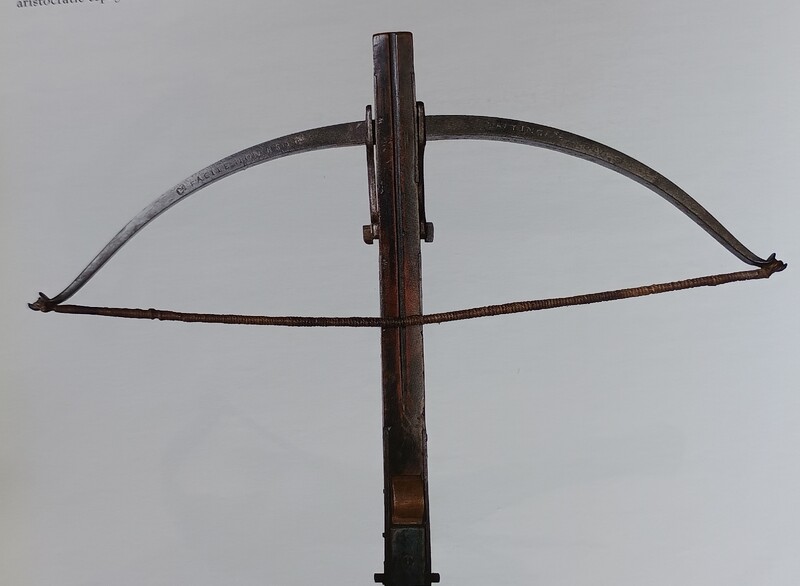
This crossbow has a metal prod which connects to the stock with bow irons. The stock is wooden and has a bolt groove. The nut is wooden, but it is not original. The original nut was probably made of bone. The trigger is a lever made of iron. The crossbow is mostly plain with a few notable exceptions. The stock ends in a brass pommel. There is some decorative metal inlay on the stock, near where the bowstring lies across the stock. The prod of the crossbow has the most notable decoration.
On the side of the prod, there are the words “IOAN BIANCO” and “EM VALENCIA.” On different parts of the prod, there are eight little images stamped into the metal. These images depict the Agnus Dei symbol, a Roman Catholic symbol meaning “Lamb of God.” This image contains a lamb with a flag and represents the sacrifice of Jesus.
On the topside of the prod, there is a Latin transcription which translates to the phrase, “it is not easy to hit the centre.”
The Museum notes that the Royal Armory of Madrid holds several similar crossbows made by Juan Bianco, both the Younger and the Elder. Those crossbows date to the mid-16th century. These crossbow makers worked for the Spanish aristocracy during the reigns of Charles V and Phillip II.
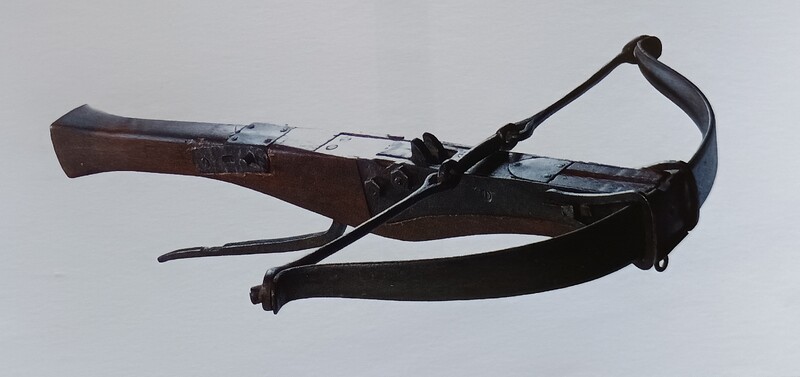
This crossbow originally dates to the 16th or 17th century, but its stock was reconstructed in the 18th century. In its original state, it was a war crossbow designed to shoot bolts carrying burning tow (coarse fibres).
Near the tip of the stock, there is a bolt groove carved directly into the wood. Bow irons, made of wrought iron, connect the prod to the stock. Three linked metal pieces serve the function of a bowstring. The steel prod sits on the very end of the stock rather than penetrating it. The wooden stock is generally four-sided, but not perfectly cuboid; the stock is thicker around the area of the catch mechanism, then narrows significantly before flaring slightly at the butt.
The top of the stock has a few metal plates: possibly to provide structural support, or possibly to evoke a time when this crossbow was entirely covered in metal plates. The trigger is a lever made of iron. The nut is made of metal.
The Museum explains the lack of a sight by stating that an incendiary bolt would not need to hit small targets, but merely surfaces that were flammable.