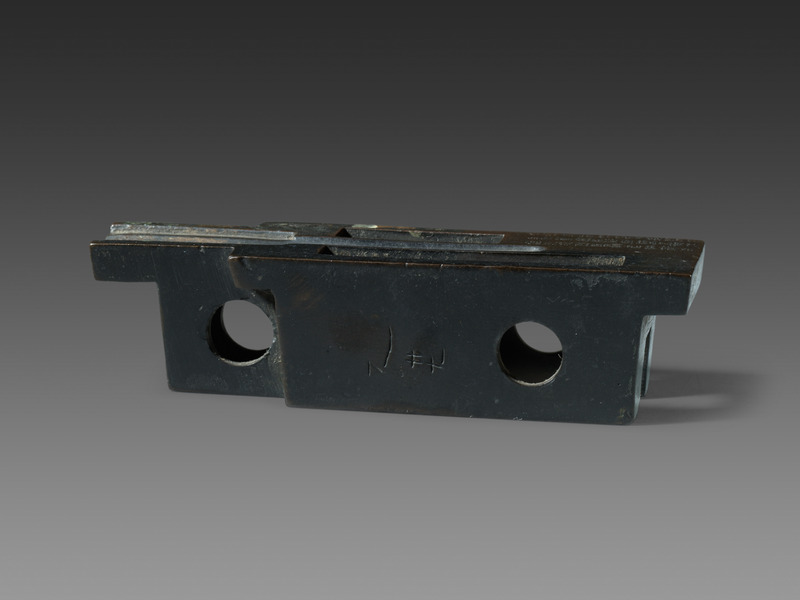
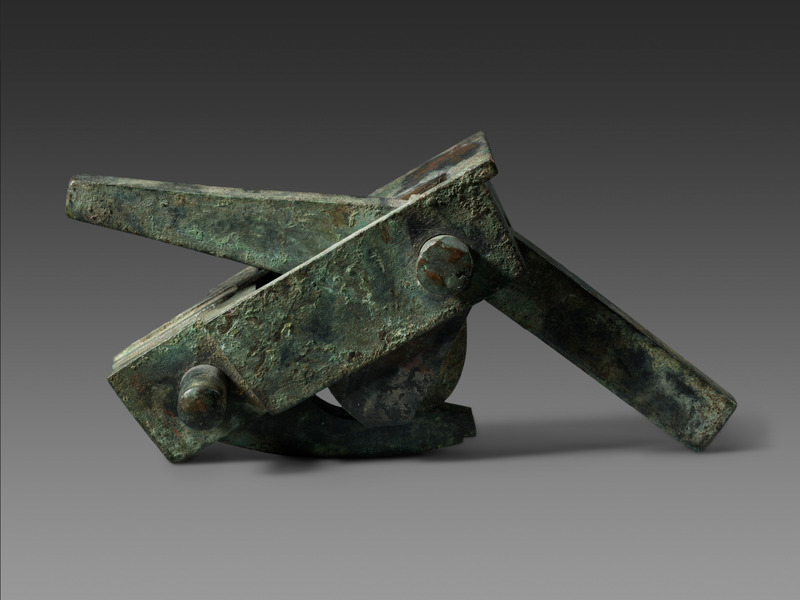
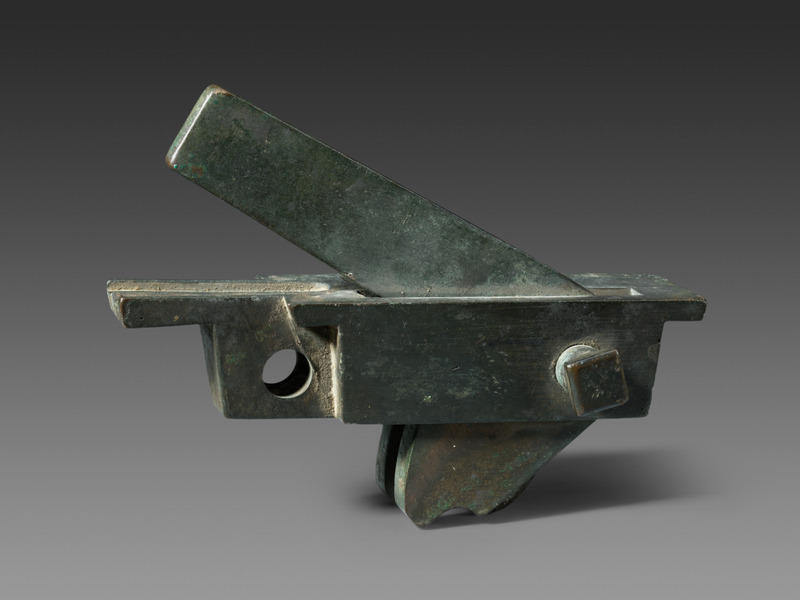
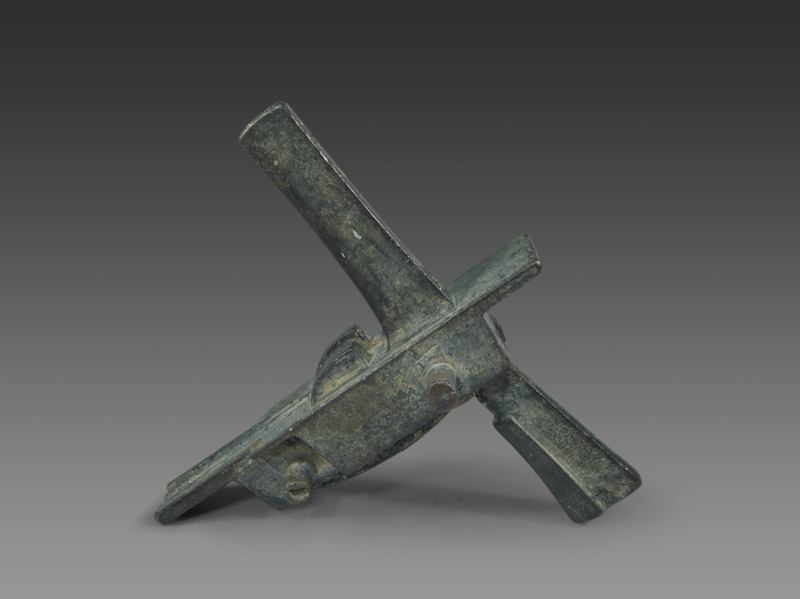
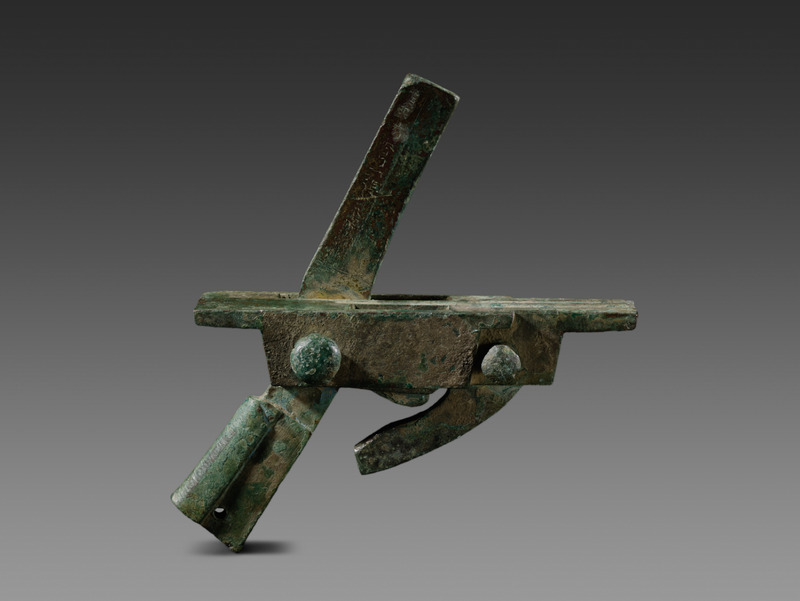
This crossbow mechanism casing held by the Shanghai museum is dated to the three kingdoms period. Its specific location of unearthing is not listed.
This mechanism casing, or guo (郭) is made of bronze and it would usually hold most of the typical parts of a Chinese crossbow mechanism. This specimen is missing its sight and nut, or wangshan (望山) and ya (牙); its trigger, or xuandao (悬刀); its sear, or gouxin (钩心), which would have connected the sight and nut and the trigger; and its two bronze axle pins which would have held the mechanism together within the guo. The top surface of the bronze casing has a groove that goes down the middle which would continue onto the wooden stock of the crossbow. This groove would be where the arrow rests during drawing and aiming.
There is engraving on the top surface of the guo which, at the angle it is presented in in the photo, cannot be clearly made out. However, given that the museum has been able to date the casing to a specific date, it is likely that there is information about the manufacture date of the crossbow mechanism included in the engraving. This information could alternatively have also been derived from archaeological context.
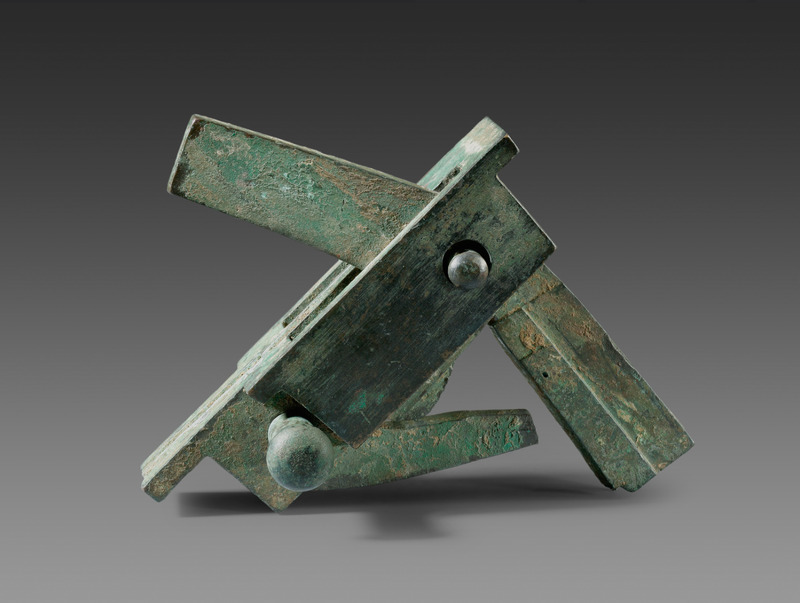
This crossbow mechanism held by the Shanghai museum is dated to the three kingdoms period. Its specific location of unearthing is not listed.
The mechanism is made of bronze and it comprises most of the typical parts of a Chinese crossbow mechanism. The long rectangular protrusion at the top of the mechanism is the sight, or wangshan (望山). The two small hooks sticking out in front of the sight are a part of the same component as the wangshan and serve as the nut, or ya (牙). The rectangular handle at the bottom of the mechanism is the trigger, or xuandao (悬刀), and within the bronze casing, or guo (郭) there is a sear, or gouxin (钩心), which hangs exposed from the mechanism in this photo, connecting the sight and nut and the trigger. The mechanism is held together by two bronze axle pins. The top surface of the bronze casing has a groove that goes down the middle which would continue onto the wooden stock of the crossbow. This groove would be where the arrow rests during drawing and aiming. The surface of the mechanism has been corroded and oxidised.
The museum names this specimen “Qin Changzuo Crossbow Mechanism”. “Qin Changzuo” in this name is likely the name of the craftsman or owner of the crossbow mechanism. This information could have been deduced from an engraving present on the mechanism itself but not visible in the given photo, or through using archaeological context
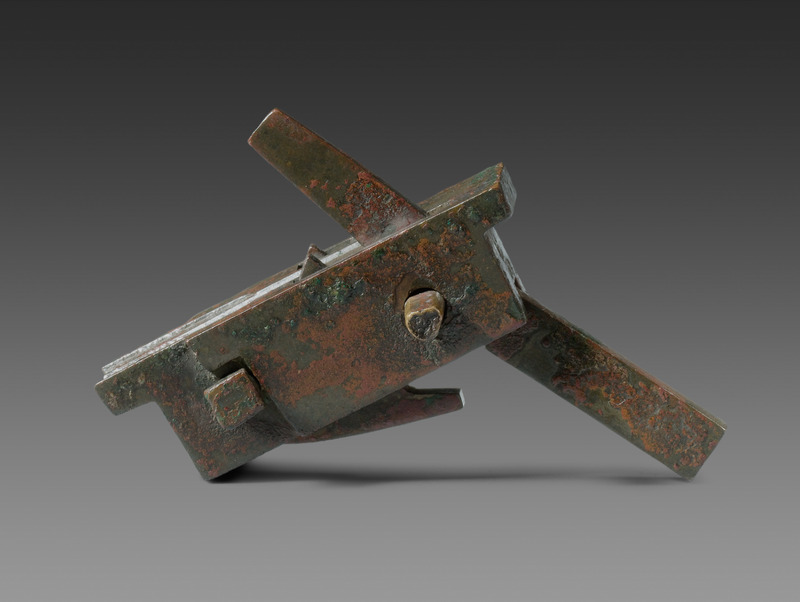
This crossbow mechanism held by the Shanghai museum is dated to the Yuan dynasty. Its specific location of unearthing is not listed.
The mechanism is made of bronze and it comprises most of the typical parts of a Chinese crossbow mechanism. The long rectangular protrusion at the top of the mechanism is the sight, or wangshan (望山). The two small hooks sticking out in front of the sight are a part of the same component as the wangshan and serve as the nut, or ya (牙). The rectangular handle at the bottom of the mechanism is the trigger, or xuandao (悬刀), and within the bronze casing, or guo (郭) there is a sear, or gouxin (钩心), which hangs exposed from the mechanism in this photo, connecting the sight and nut and the trigger. The mechanism is held together by two bronze axle pins. The top surface of the bronze casing has a groove that goes down the middle which would continue onto the wooden stock of the crossbow. This groove would be where the arrow rests during drawing and aiming. The surface of the mechanism has been corroded and oxidised.
The museum indicates that this mechanism was crafted by the imperial workshop (尚方). This could have been deduced using an engraving on the mechanism itself not visible in the photo given, or through archaeological context.
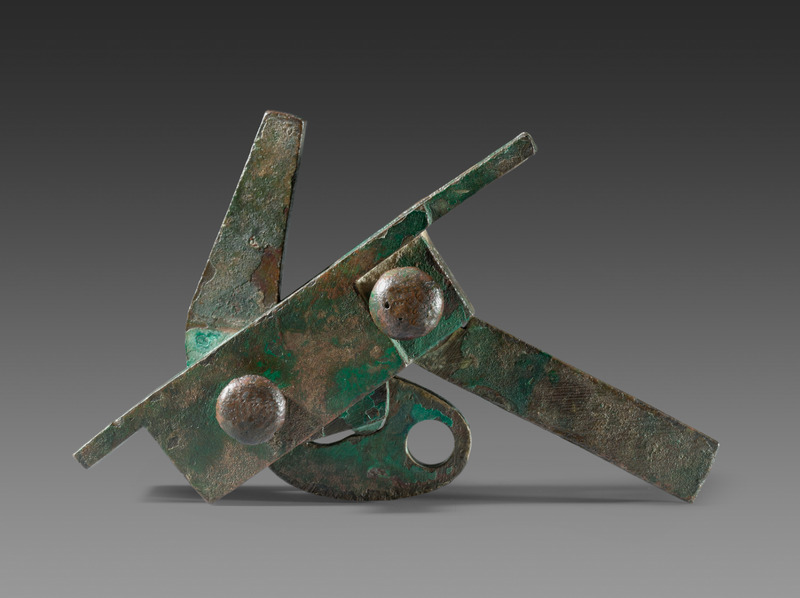
This crossbow mechanism held by the Shanghai Museum is dated to 216CE. Its specific location of unearthing is not listed.
The mechanism is made of bronze and it comprises most of the typical parts of a Chinese crossbow mechanism. The long rectangular protrusion at the top of the mechanism is the sight, or wangshan (望山). Not visible in this photo, the two small hooks sticking out in front of the sight are a part of the same component as the wangshan and serve as the nut, or ya (牙). The rectangular handle at the bottom of the mechanism is the trigger, or xuandao (悬刀), and within the bronze casing, or guo (郭) there is a sear, or gouxin (钩心), which hangs exposed from the mechanism in this photo, connecting the sight and nut and the trigger. The mechanism is held together by two bronze axle pins. The top surface of the bronze casing has a groove that goes down the middle which would continue onto the wooden stock of the crossbow. This groove would be where the arrow rests during drawing and aiming. The surface of the mechanism has been corroded and oxidised.
The museum has dated this crossbow mechanism precisely to the twenty-first year of Jian’an (216CE). This could have been done using an engraving on the crossbow mechanism itself that dates the specimen or using archaeological context.
This crossbow mechanism held by the Shanghai museum is dated to the Han dynasty. Its specific location of unearthing is not listed.
The mechanism is made of bronze and it comprises most of the typical parts of a Chinese crossbow mechanism. The long rectangular protrusion at the top of the mechanism is the sight, or wangshan (望山). The two small hooks sticking out in front of the sight are a part of the same component as the wangshan and serve as the nut, or ya (牙). The rectangular handle at the bottom of the mechanism is the trigger, or xuandao (悬刀), and within the bronze casing, or guo (郭) there is a sear, or gouxin (钩心) connecting the sight and nut and the trigger. The mechanism is held together by two bronze axle pins. The top surface of the bronze casing has a groove that goes down the middle which would continue onto the wooden stock of the crossbow. This groove would be where the arrow rests during drawing and aiming. The surface of the mechanism has been corroded and oxidised.
The museum titles this crossbow a “Fengjiu Crossbow Mechanism”. Fengjiu is likely the name of the craftsman who crafted the mechanism, and could have been indicated on the crossbow mechanism itself in the form of an engraving that is not visible in the photo, or been discovered through archaeological context.
This crossbow mechanism held by the Shanghai Museum is dated to the Eastern Han dynasty. The specific location of its unearthing is not listed, but it can be inferred that it was likely made in Hanoi when it came under the jurisdiction of the Eastern Han dynasty.
The mechanism is made of bronze and it comprises most of the typical parts of a Chinese crossbow mechanism. The long rectangular protrusion at the top of the mechanism is the sight, or wangshan (望山). The two small hooks that would stick out in front of the sight but that are hidden in this photo are a part of the same component as the wangshan and serve as the nut, or ya (牙). This specimen is missing its trigger, or xuandao (悬刀), and within the bronze casing, or guo (郭) there is a sear, or gouxin (钩心), which hangs exposed from the mechanism in this photo, connecting the sight and nut and the trigger. The mechanism is held together by two bronze axle pins, but this specimen is missing its front pin. The top surface of the bronze casing has a groove that goes down the middle which would continue onto the wooden stock of the crossbow. This groove would be where the arrow rests during drawing and aiming.
The museum was able to identify the origin of the crossbow as being from the Hanoi crafting office. This could be because of an engraving on the mechanism itself that is not visible in the photo or from archaeological context.
This crossbow mechanism held by the Shanghai museum is dated to the Han dynasty. Its specific location of unearthing is not listed.
The mechanism is made of bronze and it comprises most of the typical parts of a Chinese crossbow mechanism. The long rectangular protrusion at the top of the mechanism is the sight, or wangshan (望山). The two small hooks sticking out in front of the sight are a part of the same component as the wangshan and serve as the nut, or ya (牙). The rectangular handle at the bottom of the mechanism is the trigger, or xuandao (悬刀), and within the bronze casing, or guo (郭) there is a sear, or gouxin (钩心) connecting the sight and nut and the trigger. The mechanism is held together by two bronze axle pins. The top surface of the bronze casing has a groove that goes down the middle which would continue onto the wooden stock of the crossbow. This groove would be where the arrow rests during drawing and aiming.
The museum description also indicates that this crossbow mechanism has inlays in its design, but it is not visible from the given photo.
This crossbow mechanism held by the Shanghai museum is dated to the Han dynasty. Its specific location of unearthing is not listed.
The mechanism is made of bronze and it comprises most of the typical parts of a Chinese crossbow mechanism. The long rectangular protrusion at the top of the mechanism is the sight, or wangshan (望山). The two small hooks sticking out in front of the sight are a part of the same component as the wangshan and serve as the nut, or ya (牙). The rectangular handle at the bottom of the mechanism is the trigger, or xuandao (悬刀), and within the bronze casing, or guo (郭) there is a sear, or gouxin (钩心), which hangs exposed from the mechanism in this photo, connecting the sight and nut and the trigger. The mechanism is held together by two bronze axle pins. The top surface of the bronze casing has a groove that goes down the middle which would continue onto the wooden stock of the crossbow. This groove would be where the arrow rests during drawing and aiming. The surface of the mechanism has been corroded and oxidised.
There is engraved text on the side of the sight but it is not clear enough to be made out from the photo. The museum description also indicates that this crossbow mechanism has inlays in its design, but it is not visible from the given photo.
This crossbow mechanism held by the Shanghai museum is dated to the Han dynasty. Its specific location of unearthing is not listed.
The mechanism is made of bronze and it comprises most of the typical parts of a Chinese crossbow mechanism. The long rectangular protrusion at the top of the mechanism is the sight, or wangshan (望山). The two small hooks sticking out in front of the sight are a part of the same component as the wangshan and serve as the nut, or ya (牙). The rectangular handle at the bottom of the mechanism is the trigger, or xuandao (悬刀), and within the bronze casing, or guo (郭) there is a sear, or gouxin (钩心) connecting the sight and nut and the trigger. The mechanism is held together by two bronze axle pins. The top surface of the bronze casing has a groove that goes down the middle which would continue onto the wooden stock of the crossbow. This groove would be where the arrow rests during drawing and aiming.
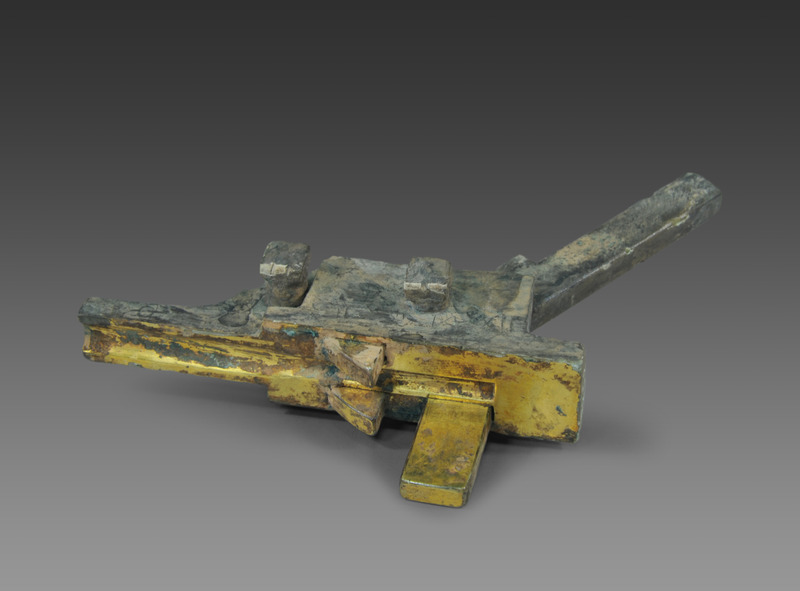
The top surface of the bronze casing and the sight and nut are gold-plated with slight corrosion on the edges and in the groove. It is uncertain if the mechanism was originally fully gold-plated and subsequently corroded, or if only the top surface was plated in the first place.
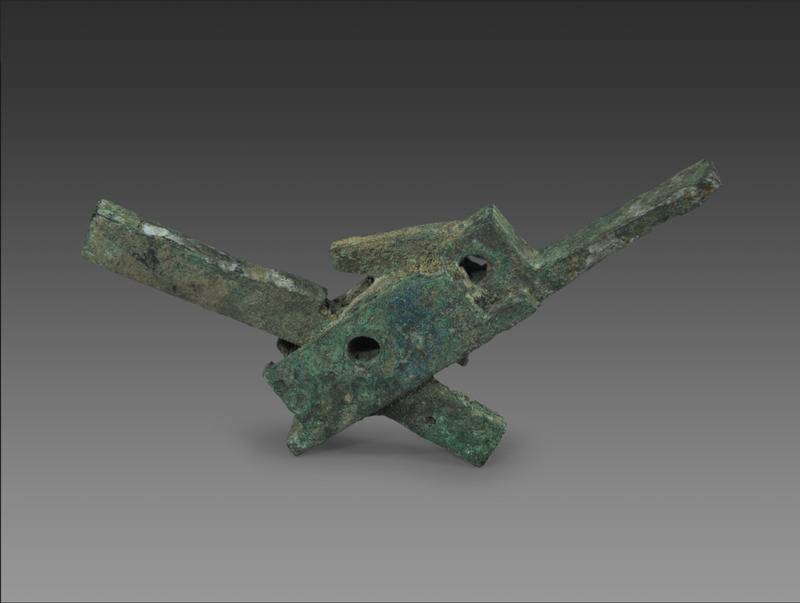
This crossbow mechanism held by the Shanghai museum is dated to the Han dynasty. Its specific location of unearthing is not listed.
The mechanism is made of bronze and it comprises most of the typical parts of a Chinese crossbow mechanism. In this photo, the mechanism is positioned upside down. Thus, the long rectangular protrusion at the bottom of the mechanism is the sight, or wangshan (望山). There are two small hooks that stick out in front of the sight which are a part of the same component as the wangshan and serve as the nut, or ya (牙). The rectangular handle protruding from the left of the mechanism is the trigger, or xuandao (悬刀), and within the bronze casing, or guo (郭) there is a sear, or gouxin (钩心), which hangs exposed from the mechanism in this photo, connecting the sight and nut and the trigger. The mechanism is held together by two bronze axle pins, but both are missing from this specimen. The top surface of the bronze casing which is oriented at the bottom in this image has a groove that goes down the middle which would continue onto the wooden stock of the crossbow. This groove would be where the arrow rests during drawing and aiming.
The surface of the mechanism has been corroded and oxidised. On parts of the mechanism (namely the gouxin, trigger, front of the casing, and base of the sight) there are specks of gold that indicate the mechanism was gold-plated. However, most of the gold-plating has been corroded off.
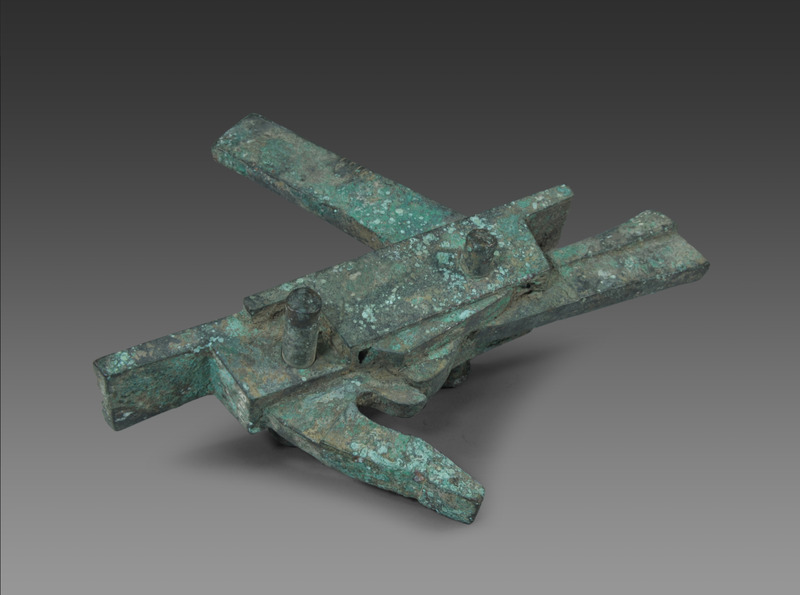
This crossbow mechanism held by the Shanghai museum is dated to the Han dynasty. Its specific location of unearthing is not listed.
The mechanism is made of bronze and it comprises most of the typical parts of a Chinese crossbow mechanism. The long rectangular protrusion at the top of the mechanism is the sight, or wangshan (望山). The two small hooks sticking out in front of the sight are a part of the same component as the wangshan and serve as the nut, or ya (牙). The rectangular handle sticking out towards the right of the mechanism is the trigger, or xuandao (悬刀), and within the bronze casing, or guo (郭) there is a sear, or gouxin (钩心), which hangs exposed from the mechanism in this photo, connecting the sight and nut and the trigger. The mechanism is held together by two bronze axle pins. The top surface of the bronze casing has a groove that goes down the middle of its top surface which would continue onto the wooden stock of the crossbow. This groove would be where the arrow rests during drawing and aiming. The surface of the mechanism has been corroded and oxidised.
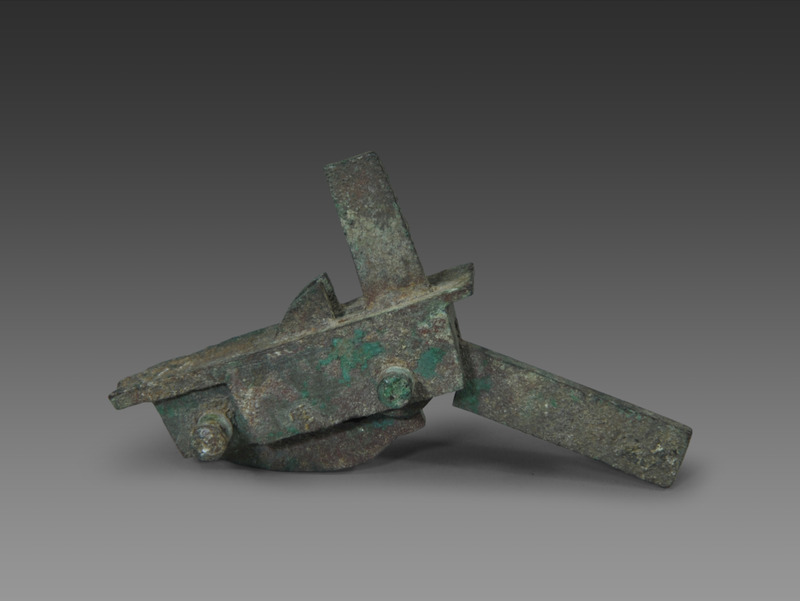
This crossbow mechanism held by the Shanghai museum is dated to the Han dynasty. Its specific location of unearthing is not listed.
The mechanism is made of bronze and it comprises most of the typical parts of a Chinese crossbow mechanism. The long rectangular protrusion at the top of the mechanism is the sight, or wangshan (望山). The two small hooks sticking out in front of the sight are a part of the same component as the wangshan and serve as the nut, or ya (牙). The rectangular handle at the bottom of the mechanism is the trigger, or xuandao (悬刀), and within the bronze casing, or guo (郭) there is a sear, or gouxin (钩心) connecting the sight and nut and the trigger. The mechanism is held together by two bronze axle pins. The top surface of the bronze casing has a groove that goes down the middle of its top surface which would continue onto the wooden stock of the crossbow. This groove would be where the arrow rests during drawing and aiming. The surface of the mechanism has been corroded and oxidised.