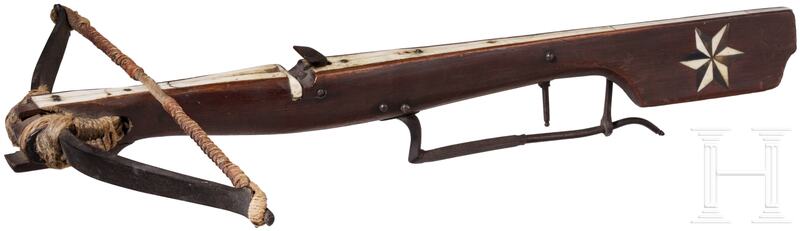
This crossbow features a slender steel arch, and doesn’t feature any branding throughout. The original bridle is mostly retained, but it is very frayed. It doesn't feature a suspension ring, but it features an underplate, perhaps for some form of attachment. The original string which features hemp windings is intact, however, the middle winding is missing. The body of the bow overall very cuboid and is made of brown stained fruit tree wood with bone inlays. The stock features an inlaid compass rose made of horn and leg. A multi-axis catch lock mechanisk with trigger pull and exceptionally long trigger guard can be observed around the handle of the bow.
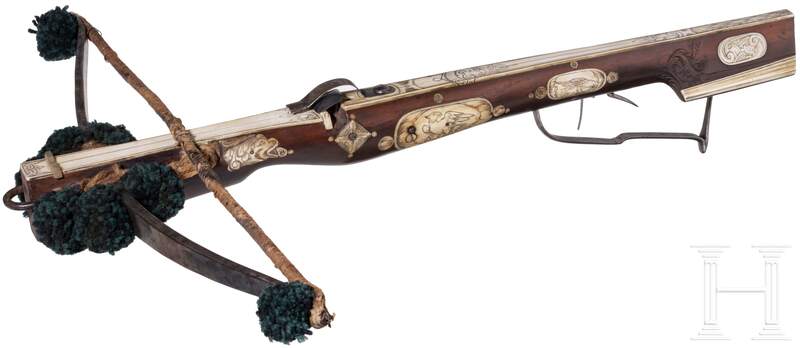
This crossbow has a slender steel prod, which has spotted patterns along it. Green wool pompoms along the prod of the bow are present. Old hemp tendons are string across the prod, and the slender bow body made of brown fruit tree wood, decorated on all sides with finely engraved bone inlays, including bird motifs, volutes, monsters, leaf motifs, etc., and delicate scroll carving and profile on the stop jaw. Inlays for the individual pins for the trigger system is also present, highlighting their positions. A catch is present with a nut reinforced well. An iron bolt holder is on the side, with an iron stirrup ring as decoration. A large trigger guard protects the set trigger and the hair trigger near the stock.
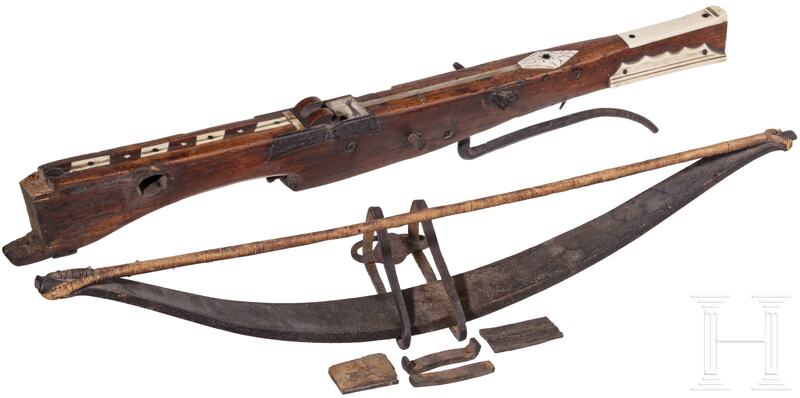
This bow features a heavy forged steel prod with hollow ends, on the inside of it a forged mark (crescent moon?) can be seen. The string is newly added onto the prod. The prod was anchored onto the bow with side-wedged prod irons, which are now loose. Separate wooden column with grooves indicated it had been below the iron prod lock plates. On the upper side of the column there is a bolt groove with block inlays of alternating shades of wood, the nut (wood) is newly added, and the rear bearing block and inlaid band behind it are missing, and at the end of the column there are supports made of polished stag horn and a Wuggle pattern at the base of the column. A four-axle lock with a simple spring-loaded folding trigger and two integrated iron pin pins for upholding the levers are on this bow body, and near the crossbow lock an iron transverse pin for the rack and pinion winch is embedded.
Hermann Historica adds that unique early Italian crossbows with a complex four-axle lock are previously known only from northern Alpine regions.
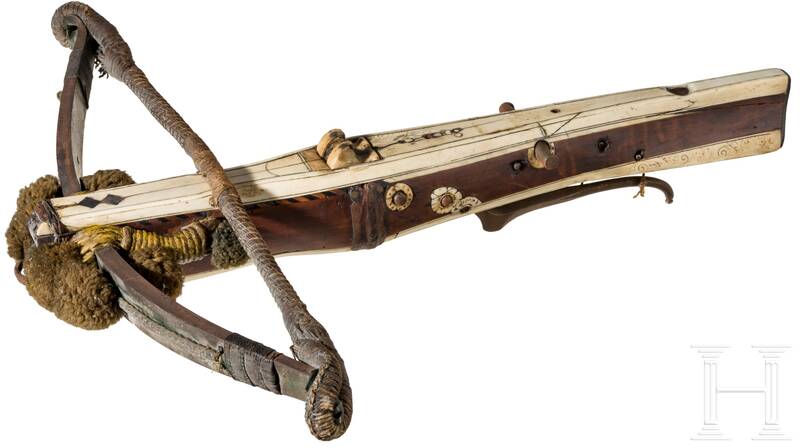
Featuring a heavy steel prod painted green on the inside, a clover mark is stamped on the right. The original bridle (with traces of gilding on yellow ground) and original knotted hemp string are both remaining taut. Decorations of green wool pompoms are slightly discolored from age. A tiller of finely grained brown wood is put underneath the belly of the bow, and the top and chamfered edges applied with engraved bone (polished staghorn), carved with volutes and floral motifs (rubbed). The underside is entirely applied with yellowish horn, with a butt cap of black-brown horn. The front three lock axles and cranequin lug are set within bone rosettes. The original antler nut is secured with thread and the nut thread is covered with a leather nussfaden. A multi-axle lock can be seen next to the hair set trigger with adjustable folding trigger, protected by a ridged iron trigger guard (the tiller inside is supported by an inconspicuously placed spring to maintain tension), while decorated with ivory inlays for each axle. A transverse pin is present near the rear for cranequin interfacing.
Hermann Historica notes that this is a used long crossbow ("halbe Rüstung") in fine overall condition with an exceptional amount of original substance.
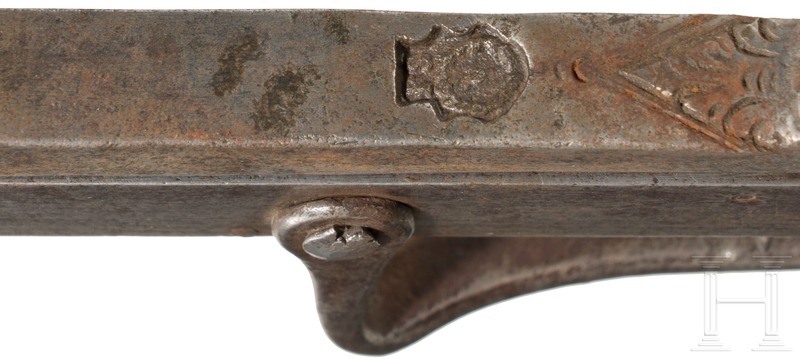
Wedged onto the bullet crossbow with a forged steel arch, a jagged wheel cross mark can be seen stamped on the inner right side of the bow. The hemp string has two wooden spacers and a leather ball bag for lead balls in it. The iron body is decorated with incised leaf decoration, and the hinged tensioning lever in the middle has the brand "PS" stamped on top. The levered cocking mechanism has a single-pronged nut and a functional hair trigger with an iron trigger guard forked at the base. The riveted inserted sight fork in the middle corresponds with the iron folding rear sight with rear sight on the top edge. The trigger guard featured beaded elements, and seems to be riveted onto the original body. The stock is wooden and red-brown stained, decorated with three engraved leg medallions, on which a female costume figure, a jumping lion and a jumping dog, each framed by filigree inlaid brass tendrils, the edges decorated with leg veins near the iron butt cap.
Hermann Historica adds that comparative pieces with the PS mark (probably for Paulus Seierlein, palester maker in Nuremberg, died in 1606) can be found, among others, in the Metropolitan Museum of Art in New York, in the Hallwylska Museet Stockholm, in the Germanic National Museum in Nuremberg and in private collections. The horsepower mark and the serrated wheel mark can both be traced to Nuremberg.
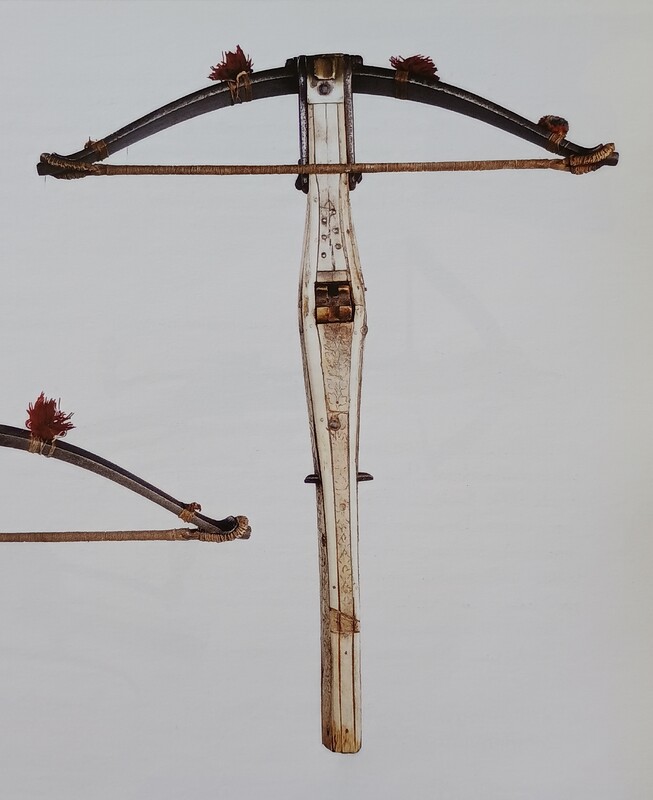
This crossbow’s prod is made of steel. The prod has three red pompoms attached to the prod with string. The string for a fourth red pompom is present, but the fourth pompom itself is missing. The prod connects to the stock with bow irons. On the tip of the stock, there is a metal bolt rest. The stock is made of wood mostly covered with ivory overlay.
The nut is made of bone.
The lever trigger has a decorative twist in the middle and a knob on the end. The presence of the decorative twist in the metal suggests it is made of wrought iron.
This crossbow would be spanned with a cranequin.
The ivory plates on the stock are carved with decorative images. On the right side of the stock, there is the image of a lady holding a basket and a flower. The rest of that side is carved with vines and an owl. On the left side of the stock, there is a man holding a dead bird by the neck. The rest of that side is carved with vines, a serpent or dragon facing off against a hunting dog, a large bird, a small bird, and an animal which could be a rabbit or small dog. On the top and the bottom of the stock, the images are much more faint. They seem to depict vines and leaves.
The ivory plates are damaged by multiple cracks. In some places, the cracked ivory is affixed to the stock with nails.
It is notable that the bow irons are likely a later addition, since they obscure the head of the man and the head of the lady on the sides of the stock.
It is worth noting that dragons are associated with St. George, the patron of the Old Crossbowmen of Visé. This is a possible reason why there is a dragon carved into the stock of this crossbow.
This luxury weapon was a gift from the Duke of Alba to the Royal Company of the Old Crossbowmen of Visé. It was given during a diplomatic meeting between the Duke and the Prince-Bishop of Liège, Gerard de Groesbeeck, in Visé in the year 1568.
During this event, the Old Crossbowmen held a shooting event in honor of their visitors. In recognition, the Duke gave them this crossbow, which they named the “Duc d’Albe” [in English: Duke of Alba] in his honor.
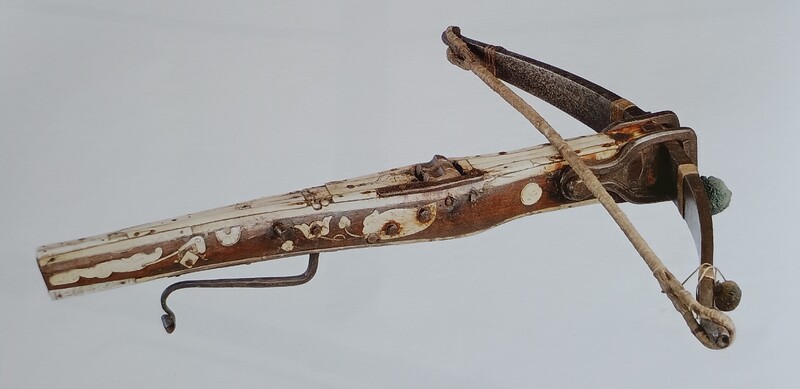
This crossbow was used to hunt big game. Its powerful metal prod is decorated with four pompoms. Bow irons secure the prod to the fruitwood stock. The stock has bone inlay. The top of the stock is completely covered by that bone plating. The nut is made of wood. Behind the nut, the initials “HB” are engraved into the bone inlay along with a little decoration. Beside the nut, there is an old repair, evidenced by a steel plate.
On the sides of the stock, bone inlay partially reveals the fruitwood beneath. The bone inlay forms floral motifs. It also depicts a crocodile-like animal and an indiscernible creature with a man’s face.
There is an iron lever trigger which ends in a decorative curl.
This crossbow was given as a gift from Marguerite de Valois to the Royal Company of Old Crossbowmen of Visé in 1576. Tradition states that the crossbow originated in 1538.
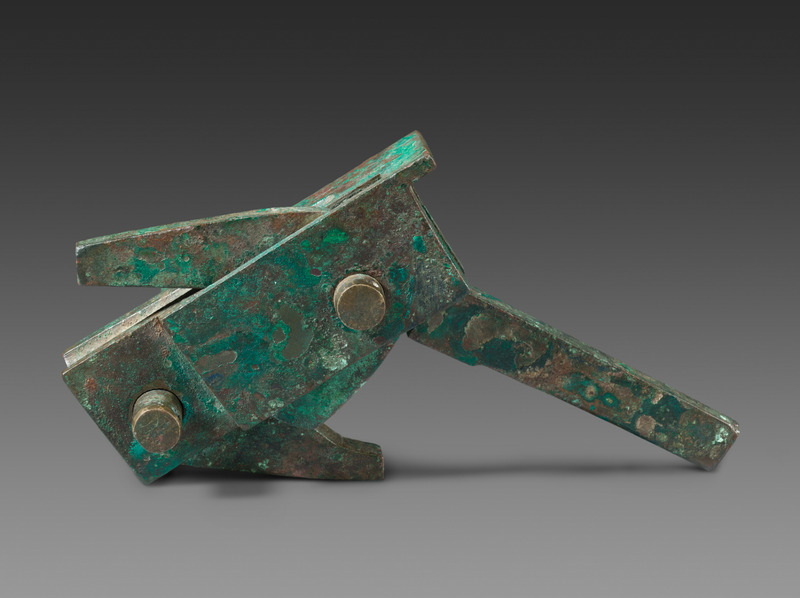
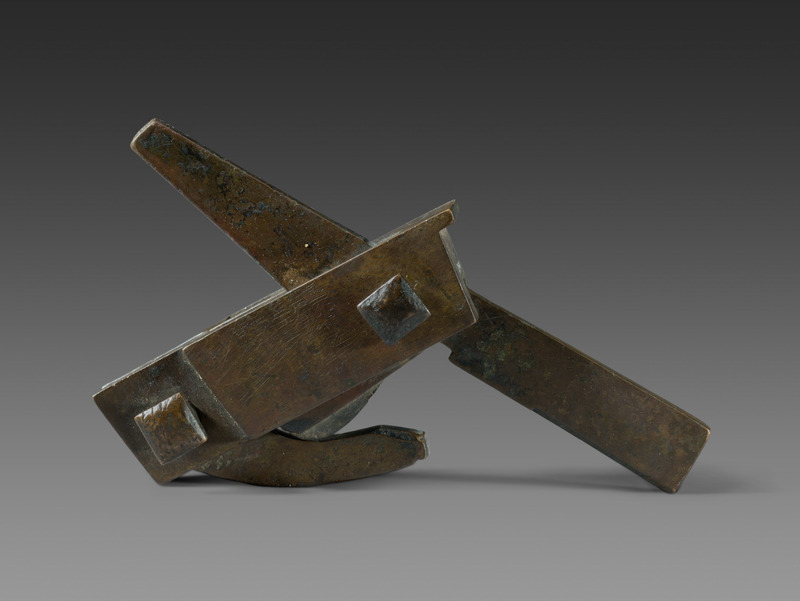
This crossbow mechanism held by the Shanghai Museum is dated to the Han dynasty. The specific location of its unearthing is not listed, but it can be inferred that it was likely made in Hanoi when it came under the jurisdiction of the Han dynasty.
The mechanism is made of bronze and it comprises most of the typical parts of a Chinese crossbow mechanism. The long rectangular protrusion at the top of the mechanism is the sight, or wangshan (望山). The two small hooks sticking out in front of the sight are a part of the same component as the wangshan and serve as the nut, or ya (牙). The rectangular handle at the bottom of the mechanism is the trigger, or xuandao (悬刀), and within the bronze casing, or guo (郭) there is a sear, or gouxin (钩心), which hangs exposed from the mechanism in the photo, connecting the sight and nut and the trigger. The mechanism is held together by two bronze axle pins. The top surface of the bronze casing has a groove that goes down the middle which would continue onto the wooden stock of the crossbow. This groove would be where the arrow rests during drawing and aiming. The surface of the mechanism has been corroded and oxidised severely.
The museum was able to identify the origin of the crossbow as being from the Hanoi crafting office. This could be because of an engraving on the mechanism itself that is not visible in the photo, or could be from archaeological context.
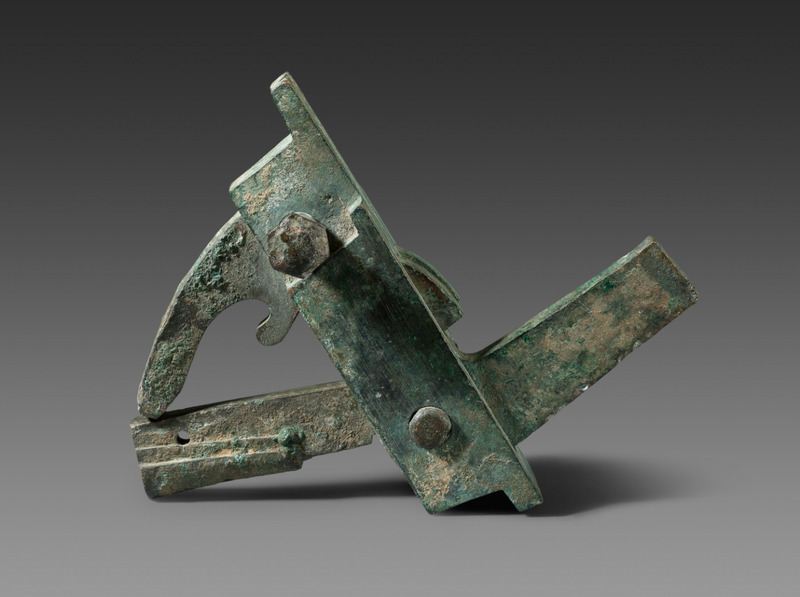
This crossbow mechanism held by the Shanghai Museum is dated to 96CE. Its specific location of unearthing is not listed.
The mechanism is made of bronze and it comprises most of the typical parts of a Chinese crossbow mechanism. The long rectangular protrusion at the top of the mechanism is the sight, or wangshan (望山). The two small hooks sticking out in front of the sight are a part of the same component as the wangshan and serve as the nut, or ya (牙). The rectangular handle at the bottom of the mechanism is the trigger, or xuandao (悬刀), and within the bronze casing, or guo (郭) there is a sear, or gouxin (钩心), which hangs exposed from the mechanism in this photo, connecting the sight and nut and the trigger. The mechanism is held together by two bronze axle pins with square ends. The top surface of the bronze casing has a groove that goes down the middle which would continue onto the wooden stock of the crossbow. This groove would be where the arrow rests during drawing and aiming.
There is engraving visible on the casing of the mechanism, part of it is decipherable as “eighth year of Yongyuan”, which is where the museum acquired the dating of this mechanism from.
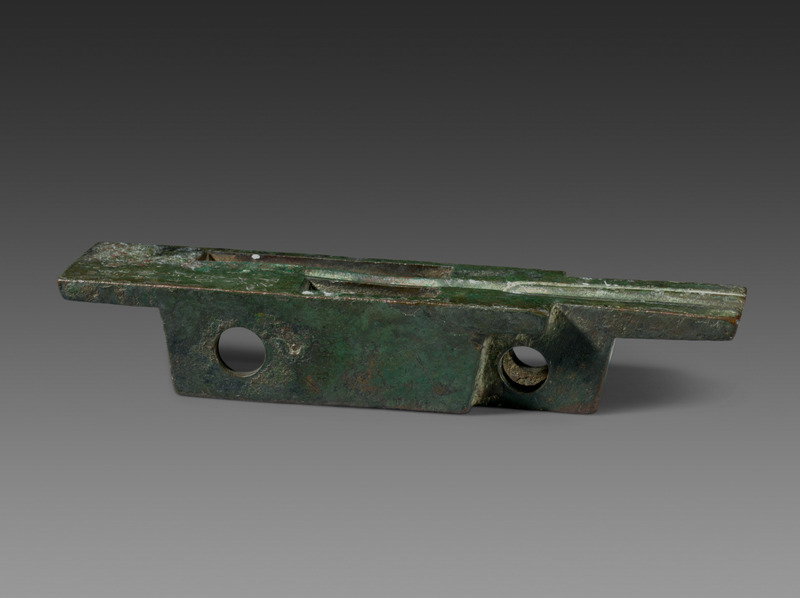
This crossbow mechanism casing held by the Shanghai museum is dated to the Han dynasty. Its specific location of unearthing is not listed.
The mechanism is made of bronze and it comprises most of the typical parts of a Chinese crossbow mechanism. The long rectangular protrusion at the top of the mechanism is the sight, or wangshan (望山). The two small hooks sticking out in front of the sight are a part of the same component as the wangshan and serve as the nut, or ya (牙). The rectangular handle at the bottom of the mechanism is the trigger, or xuandao (悬刀), and within the bronze casing, or guo (郭) there is a sear, or gouxin (钩心), which hangs exposed from the mechanism in this photo, connecting the sight and nut and the trigger. The mechanism is held together by two bronze axle pins. The top surface of the bronze casing has a groove that goes down the middle which would continue onto the wooden stock of the crossbow. This groove would be where the arrow rests during drawing and aiming. The surface of the mechanism has been corroded and oxidised.
The museum has indicated that this crossbow mechanism was crafted by the left arm of the imperial workshop. This could have been gleaned from an engraving present on the mechanism itself but not visible in the given photo, or from archaeological context.
This crossbow mechanism casing held by the Shanghai museum is dated to the Han dynasty. Its specific location of unearthing is not listed.
This mechanism casing, or guo (郭) is made of bronze and it would usually hold most of the typical parts of a Chinese crossbow mechanism. This specimen is missing its sight and nut, or wangshan (望山) and ya (牙); its trigger, or xuandao (悬刀); its sear, or gouxin (钩心), which would have connected the sight and nut and the trigger; and its two bronze axle pins which would have held the mechanism together within the guo. The top surface of the bronze casing has a groove that goes down the middle which would continue onto the wooden stock of the crossbow. This groove would be where the arrow rests during drawing and aiming.
There is engraving on the top surface of the guo which, at the angle it is presented in in the photo, cannot be clearly made out. However, given that the museum has identified it as belonging to or crafted by “Sunye” and of military rank, it is likely that there is information about the owner or manufacturer of the crossbow as well as its use included in the engraving. This information could alternatively have also been derived from archaeological context.
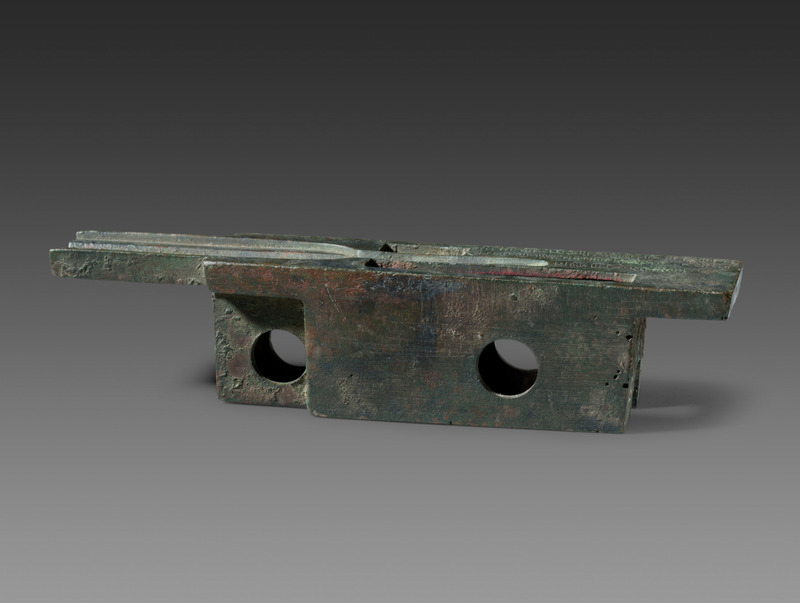
This crossbow mechanism casing held by the Shanghai museum is dated to 65CE. It was unearthed between the Henan and Anwei provinces.
This mechanism casing, or guo (郭) is made of bronze and it would usually hold most of the typical parts of a Chinese crossbow mechanism. This specimen is missing its sight and nut, or wangshan (望山) and ya (牙); its trigger, or xuandao (悬刀); its sear, or gouxin (钩心), which would have connected the sight and nut and the trigger; and its two bronze axle pins which would have held the mechanism together within the guo. The top surface of the bronze casing has a groove that goes down the middle which would continue onto the wooden stock of the crossbow. This groove would be where the arrow rests during drawing and aiming.
There is engraving on the top surface of the guo which, at the angle it is presented in in the photo, cannot be clearly made out. However, given that the museum has been able to date the casing to a specific date and triangulate its location of manufacture, it is likely that there is information about the manufacture date and location of the crossbow mechanism included in the engraving. This information could alternatively have also been derived from archaeological context.