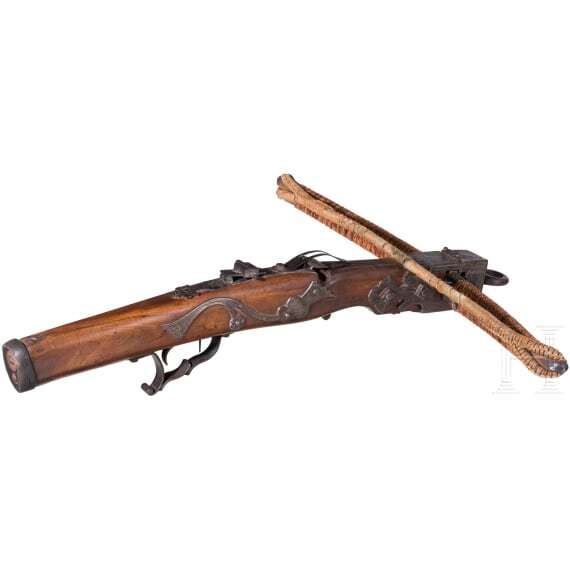
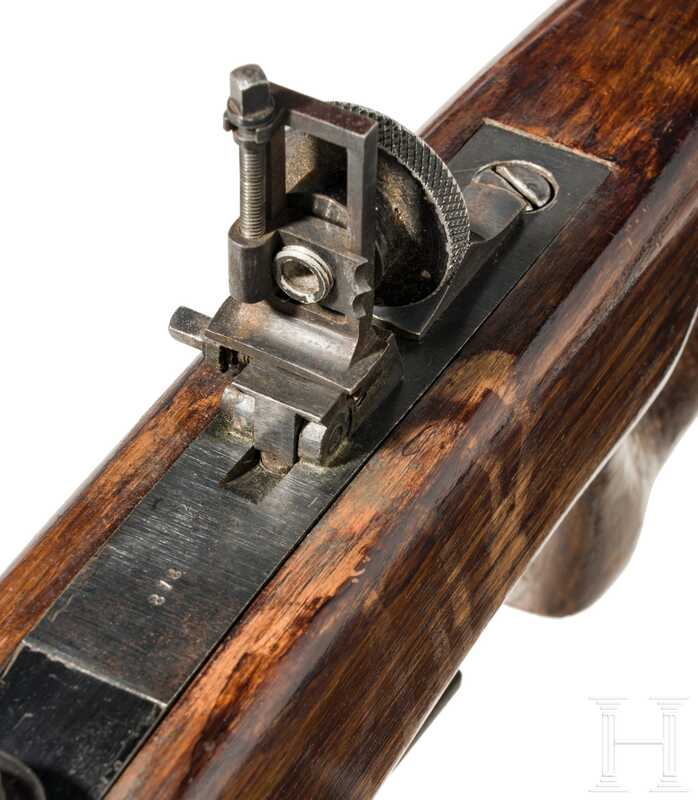
This bolt crossbow has a heavy steel prod with rope winding around both sides. There seems to be something in place between the prod and the bow body to secure it. A thick bundle of cord is winded around the prod. The large beveled rectangular bow body is built of brown, polished wooden with wrought-iron scroll decorations on both sides. No bolt rail, but a bolt rest is on top, a side-swiveling spring steel bolt holder and a folding diopter sight. The front of the bow has a suspension ring, and is built with iron reinforcements. The catch is operated with the resetting trigger in front of the trigger, and the guard seens to be forged with rolled metal. The butt is supplemented with a butt cap.
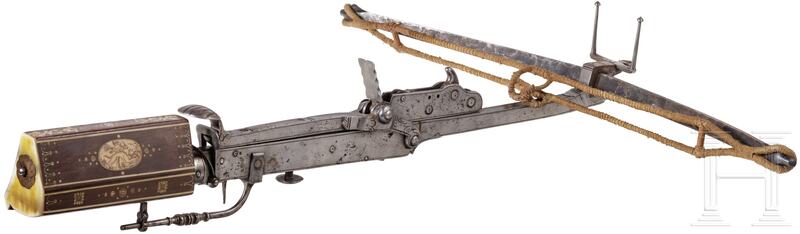
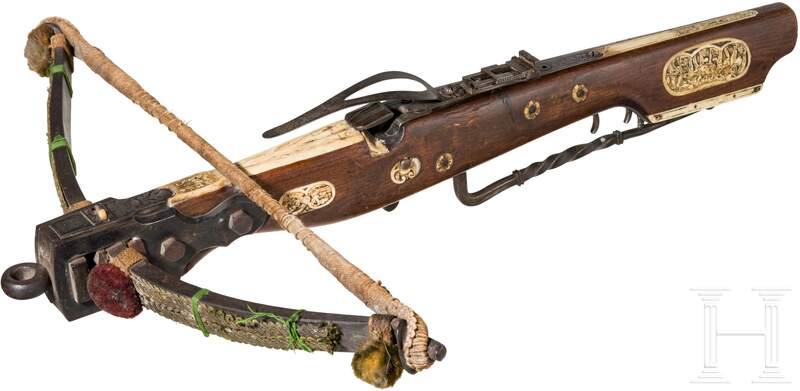
This pellet crossbow is forged mostly of steel, with the prod wedged into the bow body, with a pronged sight riveted. The hemp string holds a bullet pouch, with two wooden wedge to hold the string in place. The body is made entirely out of metal, with wooden elements near the stock. The body is subtly decorated with tendrils, and the cocking mechanism is imprinted with stamped squirrel mark and manufacturer’s initials "MS". The stock is made mostly out of wood, richly decorated with filigree bone inlays on each side in the center, an oval bone medallion engraved with hunting scenes. The stock is supplemented with a horn butt cap. The thumb grip and handle rest is cut in the shape of a spiral shell. A large lever is present ontop of the bow body. The trigger mechanism is housed in a complete case with a one-finger nut with a lever connect to it. The trigger features a long bead profiled trigger guard. A knob is infront of the trigger guard, most likely to reset the firing pin.
Hermann Historica notes that the bow and string are well replaced, and is a rare, large, decorated specimen. They also mentioned that comparable items with the said marks are on display, for example, in the Schwarzburg Princely Armoury, the German Hunting and Fishing Museum in Munich and the Bern Historical Museum.
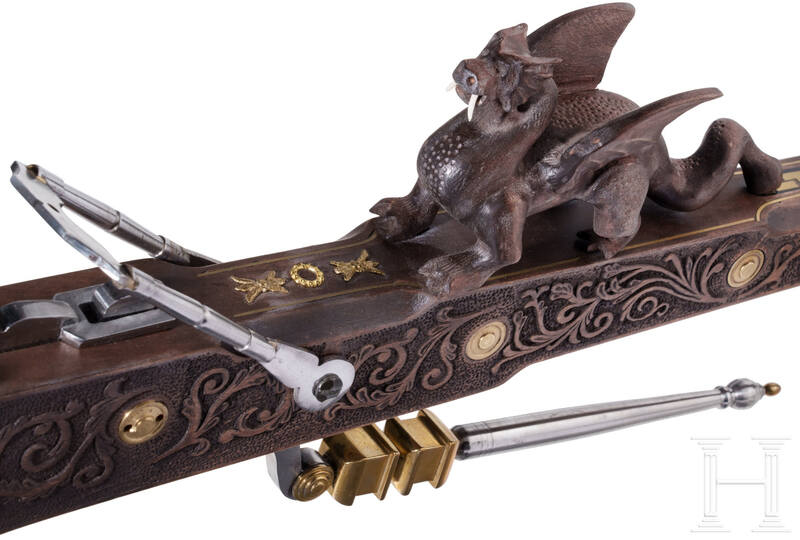
This bullet crossbow is decorated very elaborately, and according to Hermann Historica, produced in the style of the 16th century. The bow prod is narrow and elegantly curved out of spring steel, fixed with iron bridle fixtures, complete string made of two strands of hemp and leather bag. The strong, curved bow body is made of brown-stained, fine-grained wood, richly decorated with relief carvings, engraved inlays of white material and brass, at the top a fully sculpted dragon figure, and at the front end, a sculpturally carved lion's head, at the rear end a hexagonal spherical shape. An intact trigger locking mechanism with a shortened trigger bar is present. At the top, a set of iron folding sight aligns with diopter and rear sight, front a brass sight fork with an adjustable pearl sight on a string.
Hermann Historica notes that it is beautifully preserved and very representative.
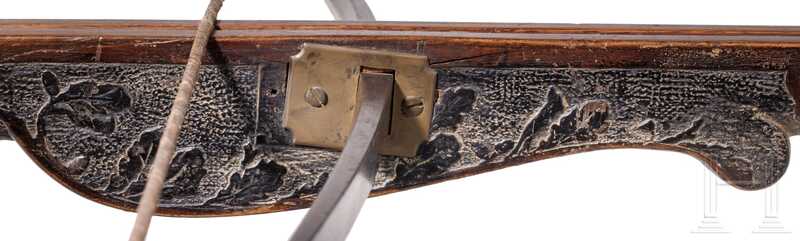
The crossbow features a heavy steel arch screwed in the middle, with a safety cord on the outside, and the prod is wrapped with white insulating tape. The body of the bow is composed with wood, with metal elements screwed into it. The bow body is physically tall, with an arched shoulder stock and massive cheek rest, capped off with metal. Some sort of magnetic contraption is present in the front, and the metal string is held down with a slide. There is a notch on the release slide, which may be used to engage with the bolt. Alligned with the bolt guides rail is a diopter sight, on top near the trigger. The trigger guard is speculated to be able to accomodate the whole hand, having a massive empty space for it to fit.
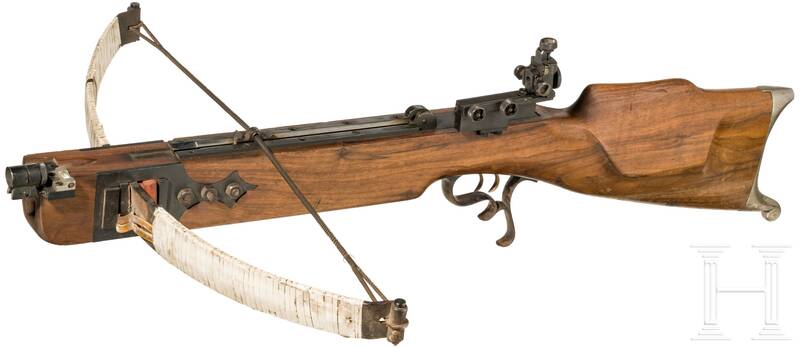
This heavy steel arch crossbow is screwed in the middle, a rectangular suspension ring in front. A set of multicolored safety cord is lined along the arch, wrapped with grey insulating tape in specific parts. This bow is fairly modern as the arch isn't connected to the strong with a rolled nock, but a metal axle through the string. The bow body is made of lacquered wood, and the a metal guide rail is screwed in on the top. Attached on top is a diopter sight and the metal bow clip, which is low in construction. A catch is in place instead of a nut, which seems to not be engaged in the picture. A large hole is present right behind the trigger, possibly for the thumb. Two levers are present in the guard, however, the trigger is unknown. A thin metal guard complements the square profile, and the stock is rounded for a cheek rest and shoulder support, arched inwards.
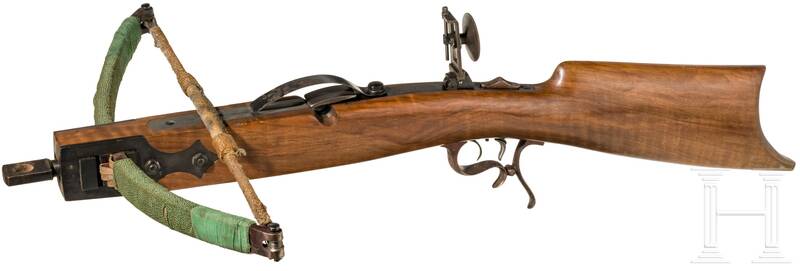
The crossbow’s original blackened steel arch is wrapped with green thread winding that encloses a black and yellow safety rope on the outside, with a wooden carved screwed, sturdy bolt holder. The original string is in place, and the wooden body is riddled with small cracks, brass and steel inserts. A spring steel bolt holder with its missing diopter sight can be seen on the top of the body of the bow. An intact flap lock covering the nut has a safety lever, and a trigger pull with a long curved brass trigger guard. Brass chain links on the ring and trigger guard as ornaments. The bow is partially slightly damaged, signs of use and age.
Hermann Historica descibes it as a shooting crossbow for target shooting before the Second World War, in this case probably from a Munich club (Winzerer or Frundsberger Fähndl).
This crossbow’s original steel arch has lighter blacking than before, with thread winding that encloses a black and yellow safety cord on the outside, and on top, a screwed on bolt channel. Featuring original string, The bow wooden body has brass and steel inserts to secure the prod, a very new spring steel bolt holder, however, the spot where the original diopter sight is is missing. A catch lock above the nut is seen, alongside the massive bolt clip that has been screwed into the bow, with the trigger pull protected by a brass trigger guard. Brass chain links on the suspension ring and trigger guard are placed as ornaments. The bow body is shaped very thinly and a cheek rest is jutted on one side.
Hermann Historica has speculated that it is a shooting crossbow for target shooting before the Second World War, in this case probably from a Munich club (Winzerer or Frundsberger Fähndl).
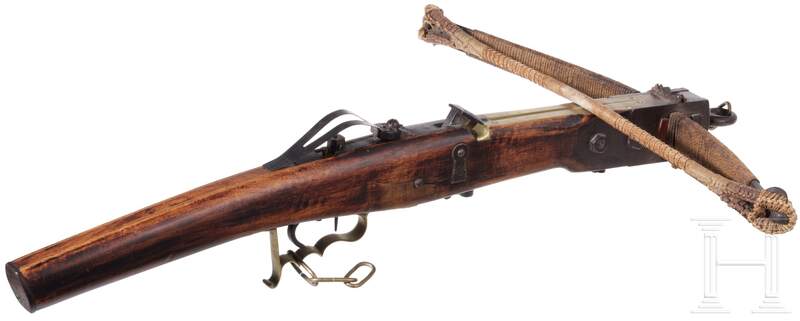
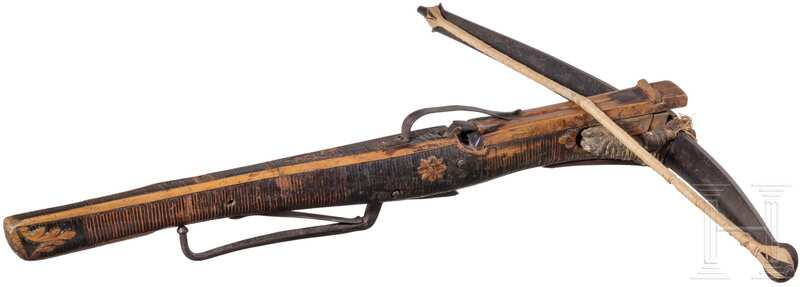
This bow resembles a slurbow but without its top cover, suggested by its long guiding rail. The stock is built with wood with metal accents flanking both sides of the The string is built with thick twisted intestines. Along the bow, Jagdlich carvings can be seen across the lower sides of the body and wooden stock, with wormholes and cracks in them. The metal fittings and bolt groove are fitted with iron, and in front a cross pin as a support for the cocking device. The spring-loaded nut lock needs readjustment. The bow shows slight damage, with signs of use and age.
This crossbow features a blackened steel arch, with loosened bridle rope holding. The rolled nocks seems to be frayed and broken. Alongside the bridle, all of the rope in the front has frayed. The bow has darkened downward stripes panels on wood with carved decorations (scallop, leaping hare, rosettes) and a rabbit near the stock. The body is thin with metal levers. On the underside of the prod, a suspension ring is attached in the front. A slide-in bolt channel and a steel bolt holder has been attached, clipping the bolt with the catch behind. An intact catch flap with a spring-loaded trigger rod is used as the catch mechanism of the bow.
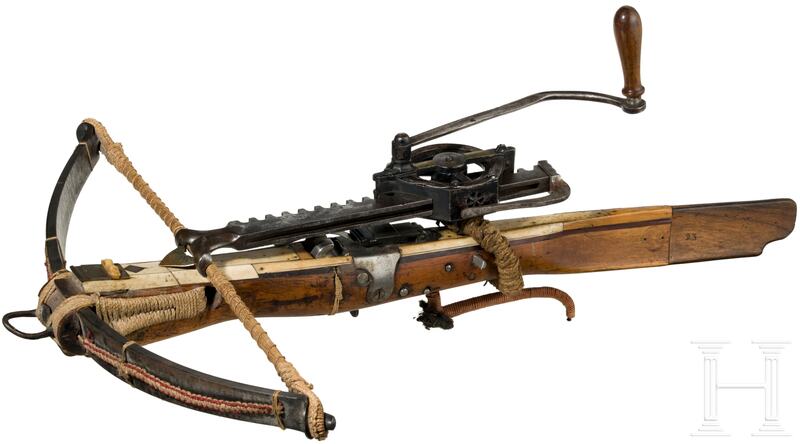
This crossbow has a sturdy firmly interlaced steel prod, and the manufacturer's stamp "J. Brutsche" showing twice on the upper edges. The hemp bowstring is secured with protective winding. The bellied tiller made of finely grained wood, the top and bottom veneered in polished staghorn, trimmed with accompanying strips of reddish brown wood. The nut is made of iron and secured with thread and a nussfaden to protect, a multi-channel lock and release mechanism built into the bow. The winding of the trigger guard and the safety string of the prod is made of red and white thread. The prod, string, nut, bolt channel, folding sight (aperture sight) and the wooden butt extension (stamped "23") all dated from the later periods of use. Moreover, the crossbow includes the associated, approximately 36 cm, intact rack-and-pinion cranequin, with an open housing at the top, three-spoke wheel, wooden handle, windlass, and belt hook.
Hermann Historica notes that complete crossbow of the half armour type with associated cranequin from a municipal Swiss crossbow shooting society, which used the weapon for many years and repeatedly repaired it. Similar crossbows can be found in the Swiss National Museum in Zurich.
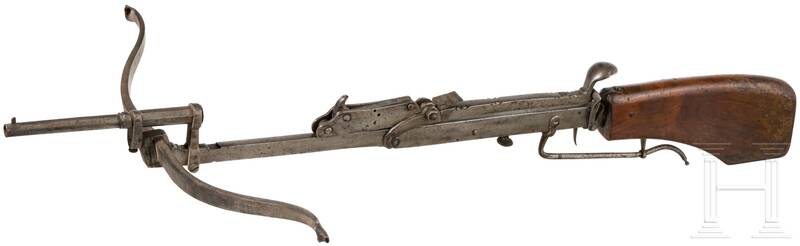
A barrel seems to have been wedged onto the forged steel arch of the bullet crossbow prod, supplimenting it with rear sight. resembling an english crossbow that’s operated by a lever and crank system, this bow reloads with the push and pull of a lever. A shortened folding rear sight can be seen near the cranking box, and the functional trigger with the piercing button to trigger the box is also positioned along the bow. A long crossbow trigger guard is in place for safety, and the engravings of nutwood flasks seem to be added later on. Revised in late use in the 19th century, it is partially slightly damaged with signs of age.