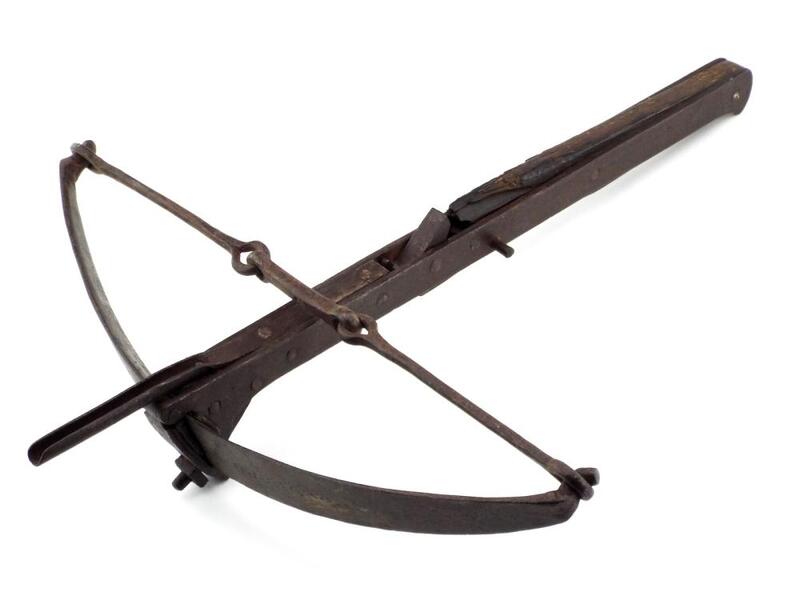
This 16th century crossbow is used to shoot fire crossbow bolts from the iron and wooden stock with a protruding bolt channel that hangs over the crossbow’s front end. The grip of the stock is made of wood, and the trigger mechanism is a rolling nut. There is also a metal transverse pin that runs through the stock. The iron prod is attached to the fore end of the stock with an iron stirrup. Instead of a string made of twisted fiber, there is an iron chain with circular loops on either side to attach to both ends of the crossbow.
Measurements: Full length 22 x 16.5 inches.
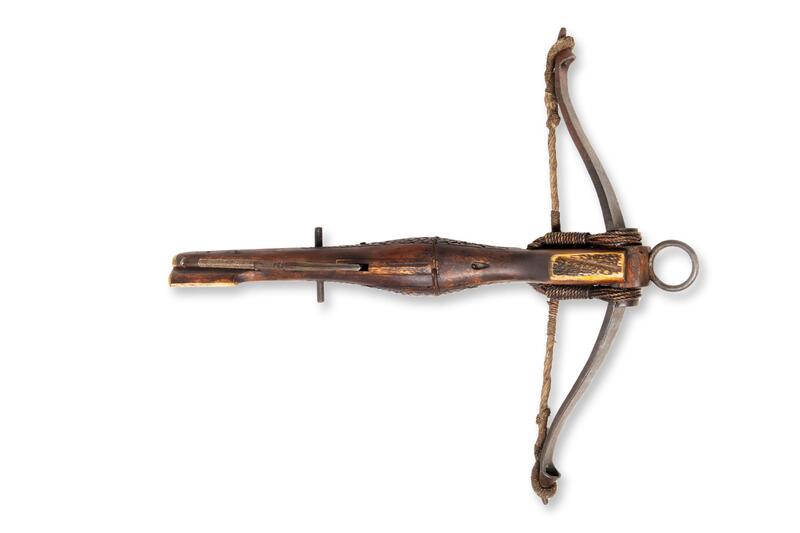
This German crossbow features a wooden stock with decoratively carved fish scale patterns that run along the sides of the stock. The upper surface of the stock contains a bone inlay with plant and floral imagery. At the butt of the stock is a concave cheek rest located on the left side for a right-handed user. The cheek rest features an inlay decoration of a bird. The trigger mechanism is a rolling nut made of bone with a string through the hole of the stock, securing it in place. The crossbow also features a metal transverse pin, used to aid in spanning the crossbow, passing through the butt end of the stock. The trigger lever is made of metal and is wrapped with a plant fiber string, while the end of the trigger is shaped like a knob.
Measurements: Length: 64.5 cm (length), 53 cm (width), Weight: 2.1 kg
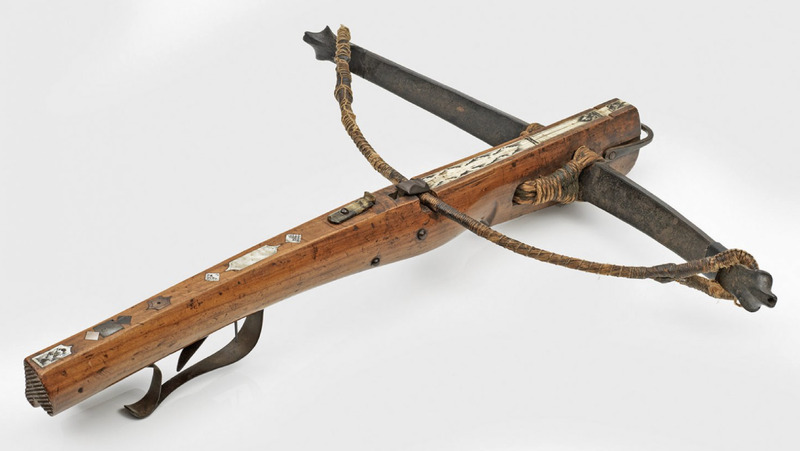
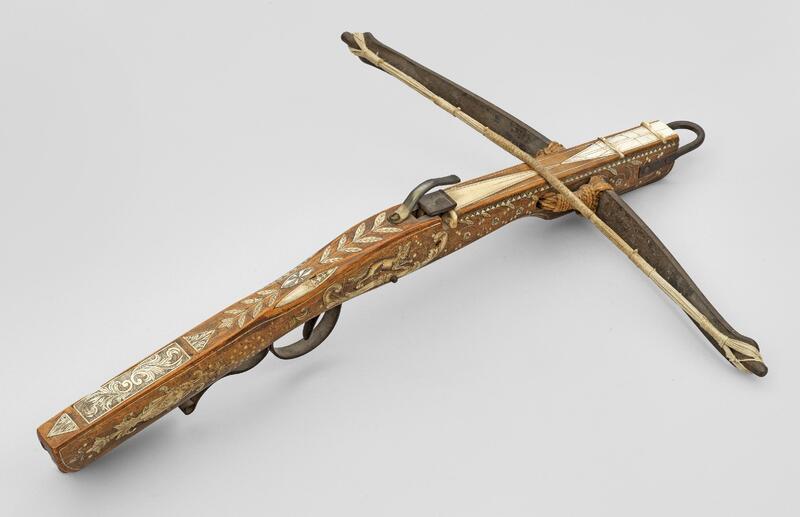
This German crossbow is dated to the 19th century. It features a walnut wooden stock that is inlaid with mother-of-pearl and bone. The inlay on the upper portion of the crossbow showcases a geometric decorative pattern. The stock slightly curves toward the butt. Mounted to the front of the stock is a metal stirrup. The trigger mechanism of the crossbow is an iron snap lock mechanism. The trigger lever is made of metal. The prod runs through the middle of the stock’s upper portion, passing through a slotted hole and fixed in place with a rope bridle. On the front of the prod is a maker’s mark, though not visible in the image. The string made of twisted hemp fiber is intact and secured in the lock.
Measurements - Length: 73 cm
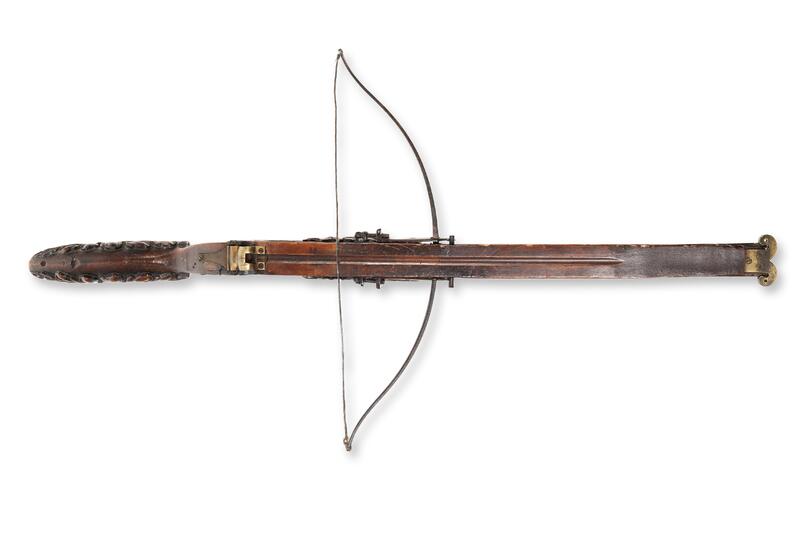
This target crossbow originates from the Netherlands in Holland and is dated to the 19th century. It features a wooden stock that is richly decorated with carved floral motifs at the butt of the stock and the wooden handle underneath the stock. Along the sides of the stock’s upper half is a carved pattern of ridges. The upper surface of the stock also features a carved groove that holds the crossbow bolts. The trigger mechanism of the crossbow is a rolling nut made of metal (possibly brass), and the trigger is also made of metal. The metal prod runs through the middle of the stock, and above the prod is a metal peg. The string is attached to the prod with minor signs of some fraying.
Measurements: Length: 107 cm (length), 56 cm (width), Weight: 3,3 kg, Bow Length: 560 mm
Condition: Excellent
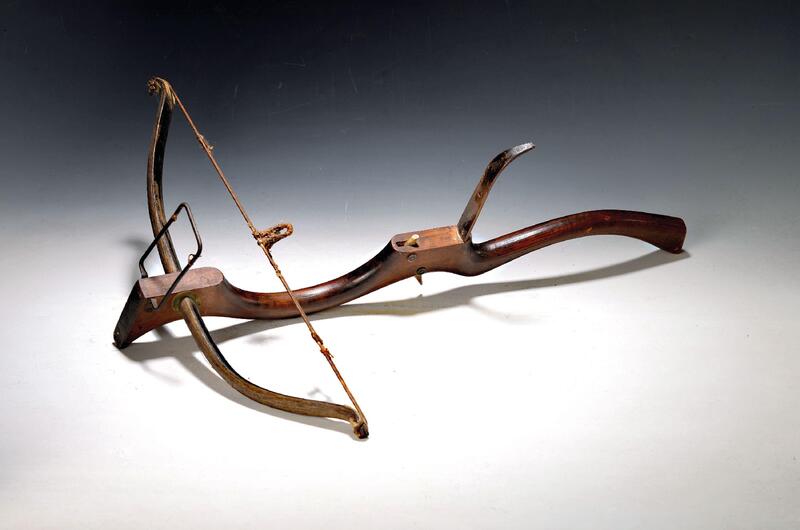
This pellet crossbow is dated to approximately 1900, with its origin of location unknown. It consists of a long wooden stock that curves downward at its upper half, while the butt curves upwards. In the middle of the stock is the bone trigger with two metal axles. Behind the nut is a wooden sight with a small aperture used for aiming. Fixed to the front of the stock is a rectangular stirrup. The string features a small cradle used to hold the pellets and shows signs of damage with slight fraying on either side.
Measurements: Length approx. 51.5 cm, Width 50.5 cm
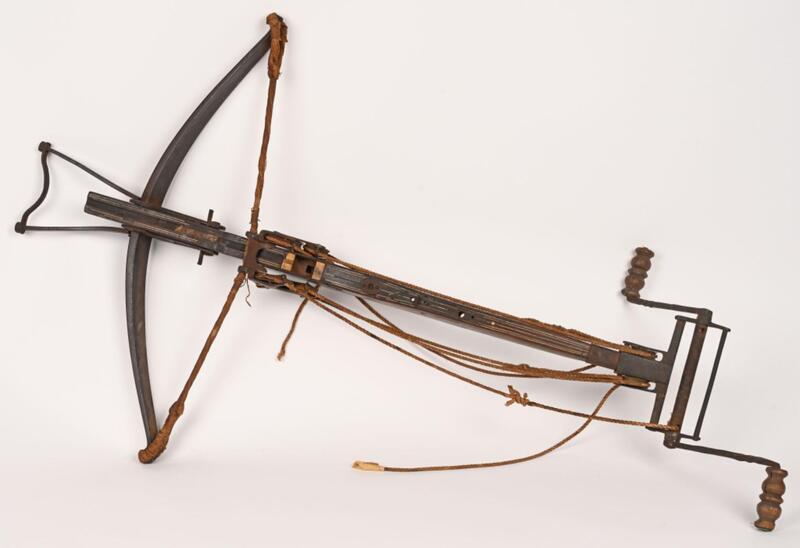
This Italian crossbow originates from the 16th century and can be classified as a Flemish target crossbow. Its stock is made of wood, and mounted on its front end is a triangular stirrup used to help span the crossbow. The spanning device, a windlass, is attached to the crossbow’s surface and is hooked onto the string made of twisted fiber. The windlass shows signs of damage to the crank handle and ropes. The bow is slender in shape and passes through the front of the stock in a slotted hole. The nut is missing. On the upper surface of the crossbow is a hollowed-out bolt channel.
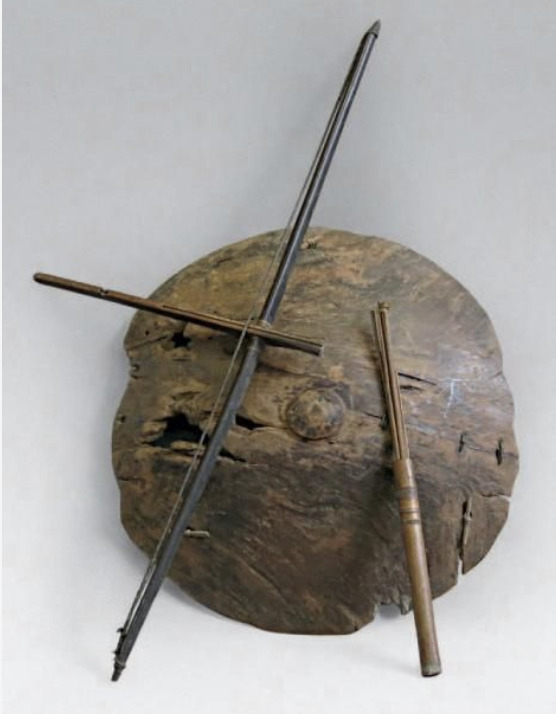
This crossbow originates from Gabon in West-Central Africa. It possesses a short stock that is made of wood and a bolt groove that runs along its upper surface. The darker prod in slender shape and spans wider in the crossbow stock. The string made of plant fiber is attached. The crossbow is typically used for hunting by the Fange peoples and functions on a “Skane” lock trigger mechanism, from the Scandinavian region. Upon pressing the trigger, the trigger pushes up at the peg and fires, thus releasing the crossbow bolt.
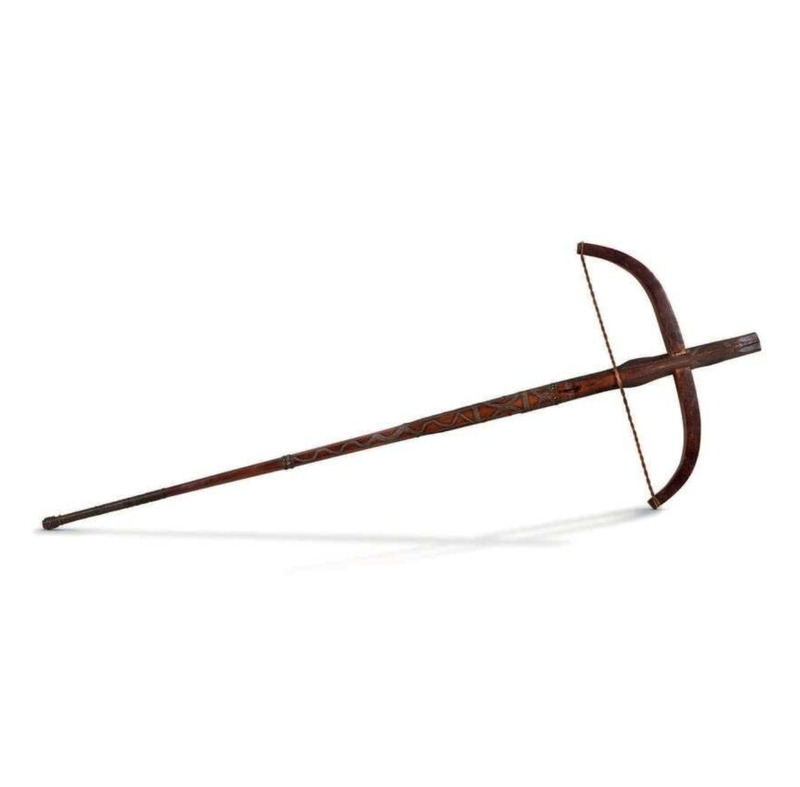
This crossbow originates from Gabon in West-Central Africa. Its use is linked to the Fange people, who would use it as a hunting crossbow. The crossbow consists of a reddish-brown wooden stock that is ornately decorated with bits of copper wire in a series of patterns. The stock widens at the front of the crossbow and tapers toward the end. Passing through the stock is a curved wooden prod, and attached to the prod is a string of twisted plant fiber.
Measurements: Length: 135 cm
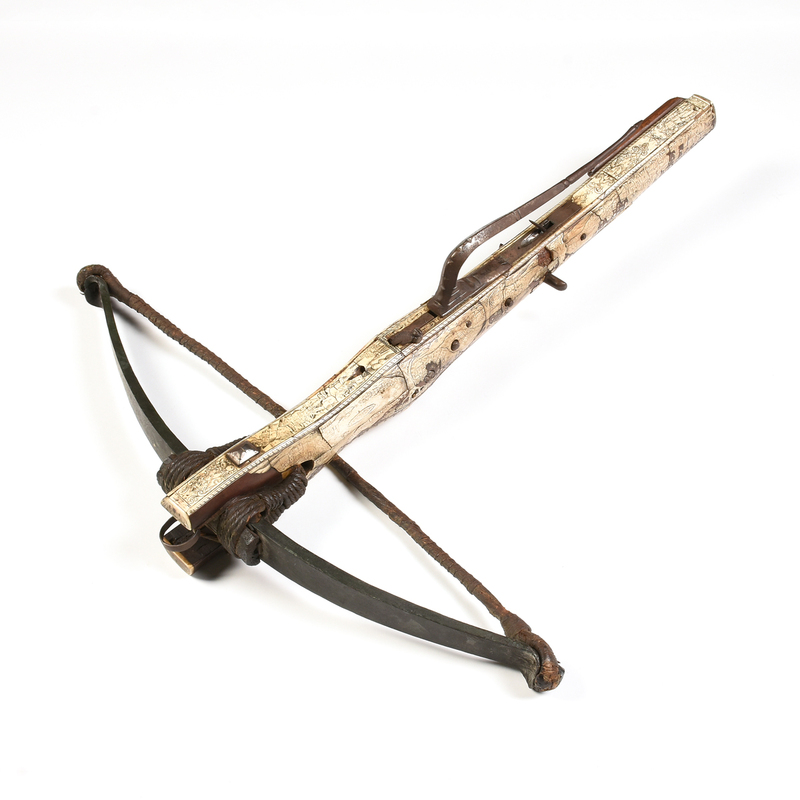
This German crossbow originates from Saxony and is dated to the 17th century. It consists of a rectangular walnut stock that is curved in the middle. The stock is ornately decorated with inlaid ivory and features scenes that depict plant and floral imagery. Other scenes include two deer that appear under a tree, a hare and a wolf or fox running away, and a woman in a veil and hat. The crossbow features a snap lock mechanism with an iron bolt clip above it. The prod is made of iron and passed through the upper middle section of the stock. Mounted onto the fore end of the prod is a metal stirrup, and the string is made of plant fiber. The prod is secured to the stock with a rope bridle. The trigger lever and locking mechanism are made of iron.
Dimensions: 75 cm x 59 cm
This sporting crossbow is dated to the late 16th century and originates from Germany. It consists of a wooden stock that is veneered and inlaid and across its surface and the butt of the stock. The stock features ornate decorations that depict a series of scrolled and spiral patterns, animals, and floral designs on the top and bottom of the borders. On the upper surface of the stock is an image of biblical figures such as Jacob, an angel, and a person and a stag wrestling behind the nut. Other scenes along the staghorn cheek rest depict three archers with bows and a king (likely Joshua) stabbed with two crossbow bolts. Underneath the stock are signs of damage and minor repairs to some imagery of women figures and an allegory about faith on the butt of the stock. The crossbow features a four-axel trigger system with a bone rolling nut mechanism that is secured with a piece of thread. There is also an iron transverse pin used to support the cranequin, a device that helps span the crossbow. The crossbow also has an opening for the cocking pin. The folding sight is located behind the rolling nut. The trigger is made of brass with a knob on its end. The butt-plate is made of staghorn and depicts a sign of Hope.
Measurements: 61.5 cm tiller
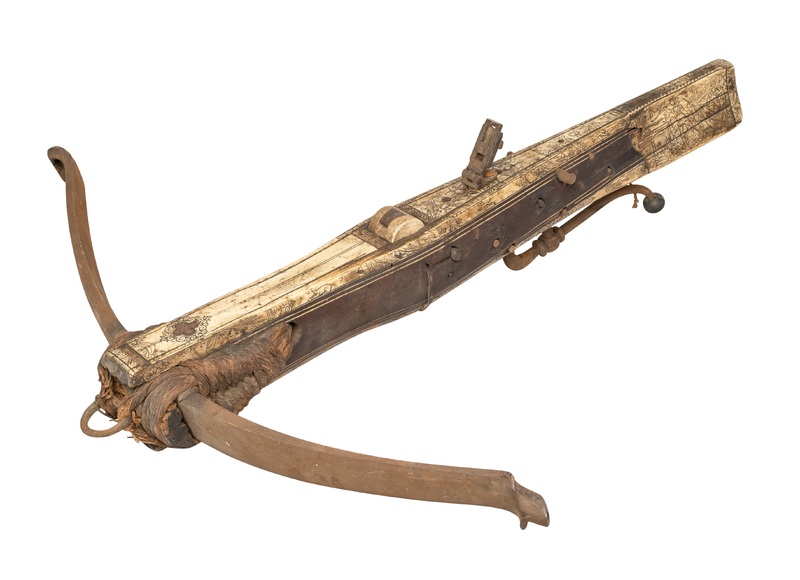
This rustung crossbow is dated to the 15th or 16th century and originates from Germany. The stock is made of fruitwood and has bone and mother-of-pearl inlays. On the upper surface of the stock are ornate decorations of scrolling tendrils. Embedded in the stock is a rolling nut made of bone, and above the nut is a metal bolt clip. The crossbow possesses a four-axle trigger mechanism, and the thread holding the nut in place appears to be broken, with its remains protruding slightly out of the hole for the thread. Along the sides of the stock are decorations depicting scenes from the Swiss folk legend, William Tell. The scenes depict William Tell (a Swiss folk hero) using a crossbow, including the famous scene of shooting an apple off his son’s head, Tell’s capture, and his release by the Austrian Vogt, Albrecht Gessler. The background of the scenes features a series of structures from cabins to castles in the Late Medieval and Renaissance style. The background also depicts scenes of a woman riding a horse, imagery of Lake Lucerne, and a final scene of William Tell holding a shield with a Swiss cross on it. The crossbow also features a metal trigger lever and a horn foresight. The prod is made of iron and is attached to the front of the stock, secured with a rope bridle. There are minor signs of damage, including a crack in the foresight. There are also signs of slight repairs made to the inlay of the crossbow.
Measurements: Height: 4" Width: 27" Depth: 30 1/8"
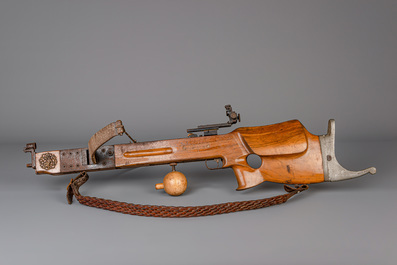
This Flemish target crossbow is the fourth in a series of four Medieval styled crossbow replicas, dated to around the 19th or 20th centuries. It features a rectangular wooden stock that widens toward the butt. Mounted on the fore end of the stock is likely a suspension ring. In the middle of the stock’s upper surface is a bolt groove, while the trigger mechanism behind it is made of metal. On the sides of the is a hollowed rectangular section. Beneath the middle of the stock is a sphere with a protruding peg, likely a second handle. The trigger lever is made of metal, and the handle behind it is made of wood, with an opening for the hands that act as a grip. The butt of the stock is fitted with a metal plate. Attached underneath the stock is a woven leather strap. The prod of the crossbow is made of wood and passes through the stock’s middle. The string is attached.