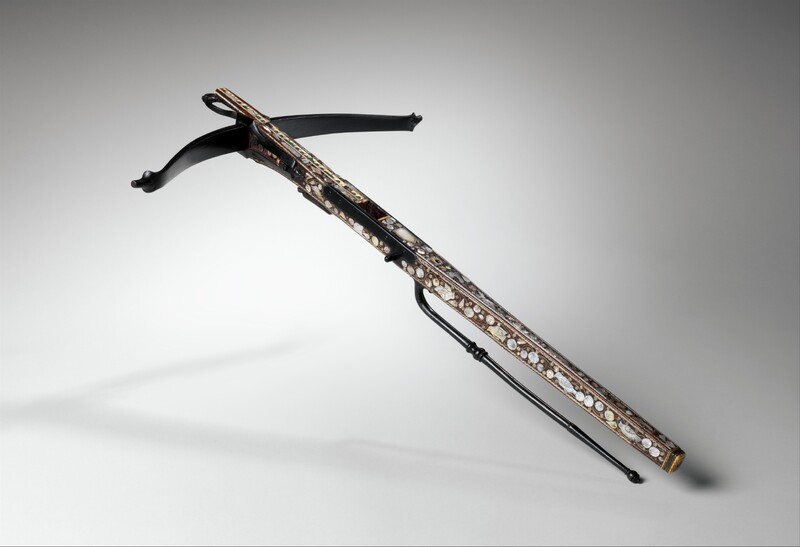
This crossbow theorized to be of British origin ca. 1600-1625 has a stock made of Indian rosewood which has been inlaid with staghorn and mother of pearl. The prod, trigger guard, transverse pin and suspension ring are crafted of steel, and appear to have been finished with a black pigment. The stock of the bow is slim, and tapers towards the butt end. Covering the stock are intricate carvings of birds rendered in various styles, as well as floral and leaf designs that swirl around the fauna. Given the lavish materials this crossbow has been made with, one may theorize it was created for and belonged to a noble or a person of wealth and status.
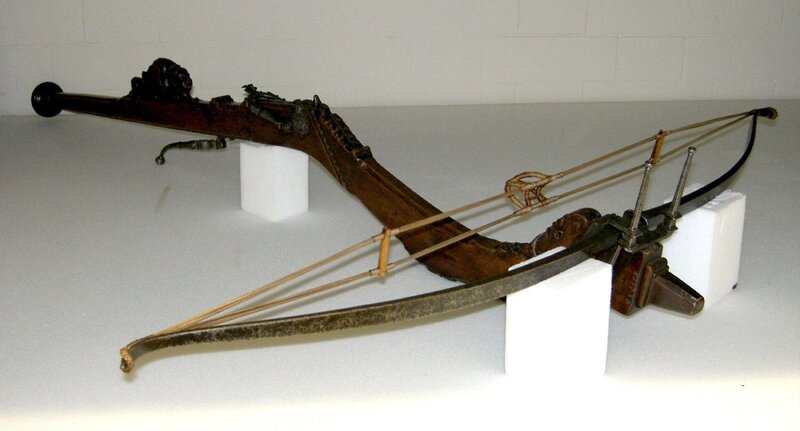
This ca. 1560 Italian Stonebow features a stock composed of walnut which has been intricately carved with ornate and representational motifs. The butt end of the stock tapers and has been finished with a turned wooden knob. This end of the stock also features a Chimera finely carved in the round. Moving towards the prod end, ornamental details have been carved into the stock, accentuating the form of the crossbow. The steel details of the crossbow including the trigger guard, rear sight and fore sight have also been carved with geometric details, creating square shapes where these pieces would traditionally be rounded. The prod is also crafted of steel and appears to have been strung with a later addition bow string. The rotating nut mechanism is also visible and features similar carved motifs.
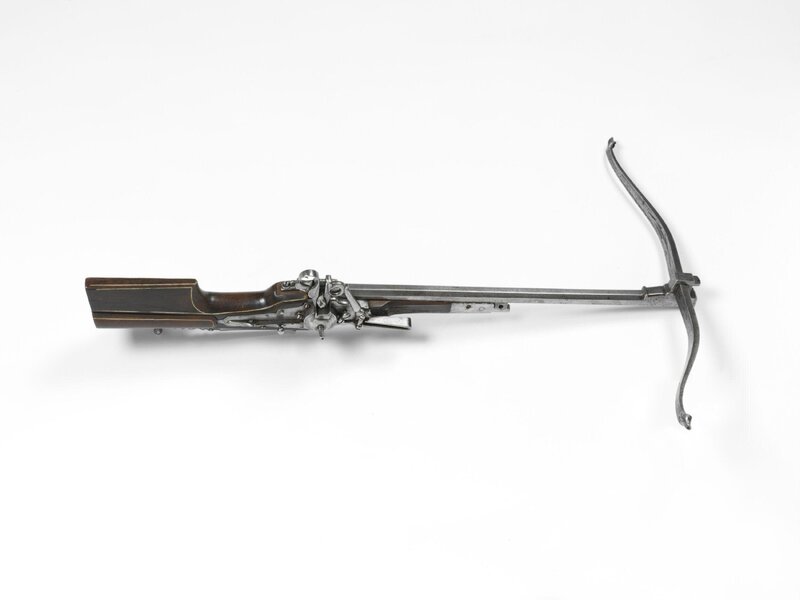
This combination weapon made in ca. 1620 Germany, unites the technology of a steel wheel lock used to fire a gun, with that of a traditional stone bow. The wheel lock is composed of a steel wheel placed under tension that when rotated, creates a spark to ignite the gun powder. In the case of this combination weapon, the wheellock does not ignite a spark but rather functions similarly to a rolling nut, in that it allows the bow string to be released in order to fire a bolt or pellet. These types of crossbows would have been made for use in hunting as well as target shooting and were likely created for European Noble men. The wheellock and prod are both composed of steel and have been incorporated into a wooden stock. The stock features minimal design and an inlaid ivory border. The steel plate attaching the mechanism to the stock features a distinct stamp in the shape of a shield, appearing to contain a cross entwined with a serpent. Though the Victoria and Albert Museum description does not provide a formal explanation for the significance of the stamp, it can be inferred this may have been a maker's mark, a guild symbol or even an apotropaic marking.
The metal prod is attached to the wooden stock with bow irons.
The nut is made of bone.
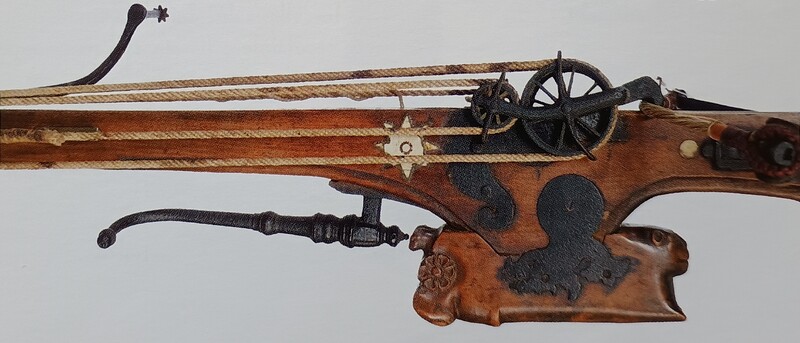
There is a wooden support underneath the crossbow, carved in the shape of a lion and attached to the stock with steel plates. The steel plates form delicate decorative designs. There is a flower carved into the lion support by the lion’s back leg.
On the side of the stock, above the trigger, there is an eight-pointed star of bone inlay.
The trigger is in the form of a metal lever with decorative ridges and a small knob on the end.
The Museum notes that crossbows of this type were often retrofitted with double set triggers. This sort of crossbow would have been used for target shooting or for war. They were popular amongst the armed sworn confraternities and among noblemen. This type of crossbow is still called a confraternity crossbow, or “arbalète de confrérie,” according to the Museum.
It is worth noting that the photos provided do not show the whole crossbow.
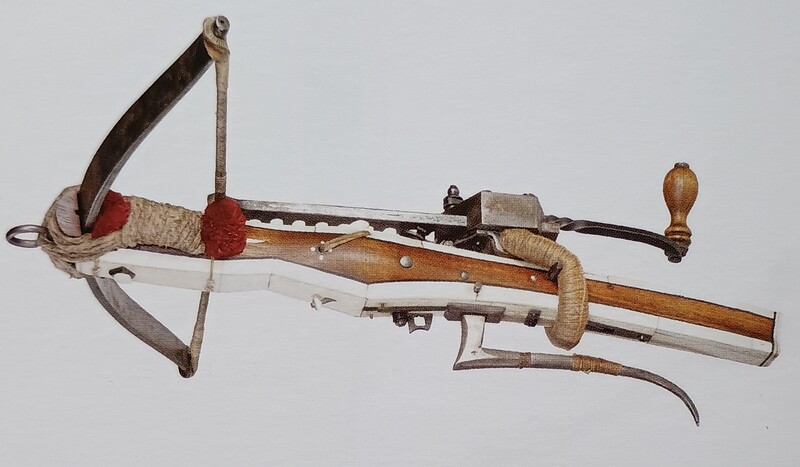
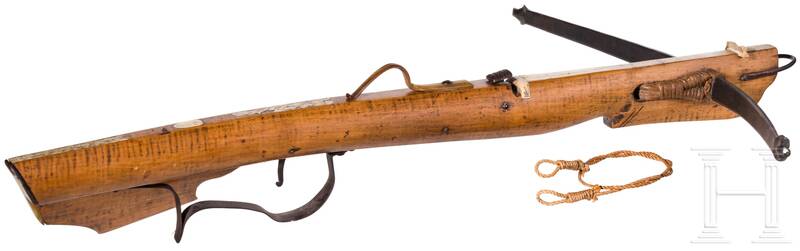
At the tip of this crossbow, there is a small suspension ring. The prod is steel and bindings secure it to the stock. There are red pompoms attached to the bindings - four in all. The stock is made of fruitwood. The top and bottom are plated with white bone. The fruitwood is visible on the sides.
The nut is made of bone. There is a nussfadden or “nut thread,” made of hemp, which ensures the nut does not fall off the crossbow. The trigger is metal and is in the form of a lever. There is a safety mechanism as well.
This weapon would be spanned with a cranequin, as shown in the photos. The cranequin shown is relatively plain, with a decorative twist in the metal rod that connects to the handle. The handle itself is covered by wood.
The Museum notes that this crossbow would have been used to hunt big game.
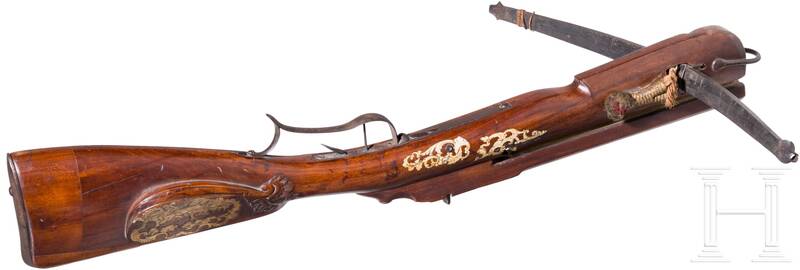
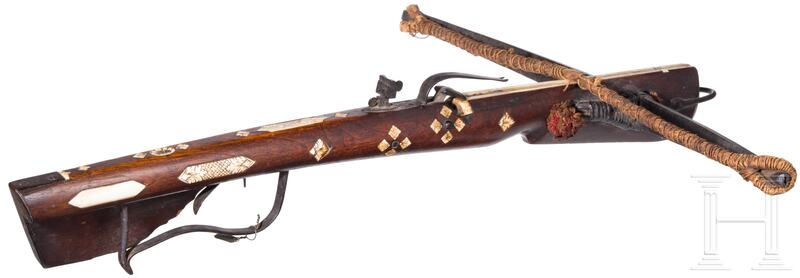
This crossbow features a strong blackened steel prod with gilt marks along the front. It has a set of sturdy bridles to hold the prod in place, braided safety cord around the prod, with ochre wool pompoms attached all over the front. The knotted hemp string is in place, and seems to be in good condition. The crossbow bow has an elegant fruit tree wood stock with subtle geometric inlays of polished bone, rocaille (a style of decoration with an abundance of curves) curves can be found near the trigger area. On top, a bone bolt track and the spring steel bolt clip is seen. The catch is intact with a curved metal trigger guard. The adjustable sight is well constructed, also in metal. Two axles can be seen right below, sporting the same geometric inlays. A button-shaped safety slide behind the cocking trigger is also featured, but not visible in the available picture. Elaborate decorations can be seen above the crossbow butt.
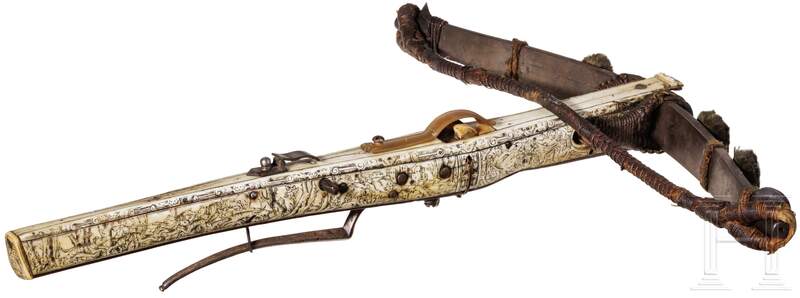
This crossbow features a heavy steel prod with knotted hemp bowstring and bridle, with decorative tassels of green woollen pompoms along the prod and front plate. The bow body is slender and wooden internally, as it is completely veneered in polished staghorn, lavishly decorated on all surfaces with blackened engravings, including iconographies such as scrollwork, masks, a barred helmet, a coat of arms with an armoured arm and scimitar (possibly from South Eastern Europe?), a bear and wild boar hunt, castle hill, Leda and the Swan, resting nymphs etc. The bone butt features an engraved stag's head. The nut is made of antler and secured with the nut thread. The bow also has a complete, multi-axle lock with a safety lever and simple folding trigger, and the trigger guard can be seen with remnants of gilding, and a transverse pin possibly for a cranequin. The horn bolt channel and folding brass sight seem to be newer than the dated bow, possibly later replacements, along with the bow and tassels.
Hermann Histiorica adds that this piece is extremely rare, slender version of the Renaissance crossbow with stunning, bone-inlaid tiller for a noble owner of high rank.
This wooden slurbow features a blackened steel arch and a large top cover. Due to the original bridle being broken, a section of wire can be seen attached to the prod to secure it to the bow. The elegant bow body is made of reddish-brown walnut wood with inlays of polished, finely engraved antlers. In front, a suspension ring is riveted onto the body. On the top of the cover guide rail an "I" is engraved, and on the front of the guide rail the year "1755" is engraved. However, there is a sight missing from the space that aligns with the rear sight. A set trigger and trigger sits within the trigger guard operating the catch trigger (obscured by the top rail), screwed into the wooden body. The antler inlays depict flowers and tendrils near the axels of the bow, a hunter shooting upwards at a flocks of birds on the other side of the stock, and two lambs flocking around with a hunter with a bow, presumably Diana on the cheek rest. The adjustable iron visor aigned with the rear sights is screwed on the top. There is a set of 4 arrows with two varying lengths accompanying the bow.
This crossbow has an unmarked blackened steel arch. The original bridle is blackened and very sturdy, and the hemp string is added afterwards for use. A suspension ring is riveted to the front, and the elegant body is made of reddish-brown walnut wood with iron fittings. The bow body can be seen with bone on the bow guide, as well as inlays of polished, finely engraved antlers that resemble a crest of a house in front of the front plate and stock. Diamond patterns are decorated around each pin of the bow, and scale-like patterns with flowery elements are also inlaid into the bow. A large trigger guard compliments the large stock, suggesting its power.
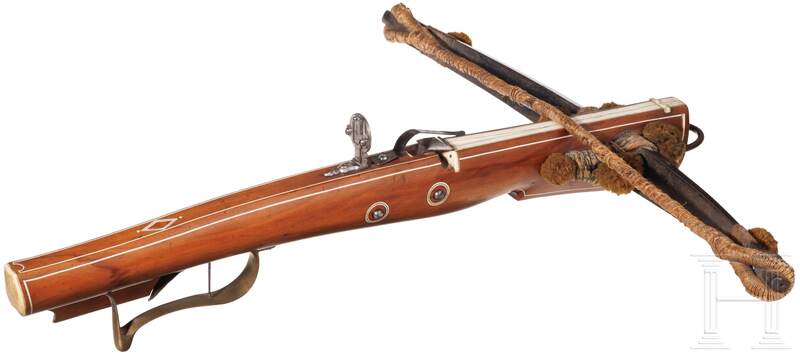
The bow prod is slender, with a blackened steel arch, original fixed bridle, with a missing string. The bow body is made of light, dense wood, with inlays of polished and engraved antlers. The catch well and bolt top rail is reinforced with bone. The bolt is shot with a simple trigger pull with a iron shaped trigger guard, with the original horn bolt holder swiveled out of the way. The front bolt rest is moved slightly out of position. Animal iconography (a pigeon?) can be seen on the stock, with similar inlays on the top of the bow as well. Rocaille decorations can also be seen near the handle, adding to its detailing.
Hermann Historica rates this piece a beautiful original preservation, and adds that similar archer's crossbows are known from the Dresden and Leipzig areas.
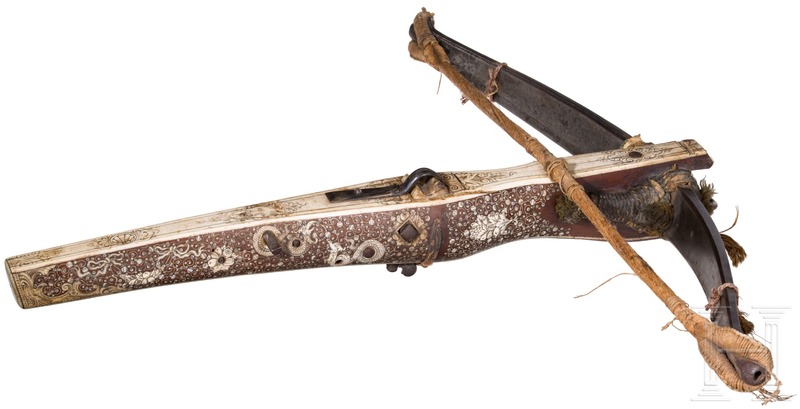
This heavy crossbow features a set of heavy, polished steel prod, with the mark of a wheel with a sun burst stamped on the inside on the right end. The original bridle and originally knotted hemp bowstring are still intact, with a yellow safety cord in the front of the prod. Tassels of green woollen pompoms are attached onto the front plate. The bow is rounded, with a curved body in brown fruitwood, lavishly embellished with blackened antler inlays, engraved with dense, delicate tendrils containing circular, stylized blossoms, serpent-shaped monsters coiling around the axles around the lock, bunches of fruit and wavy ribbon bows. A large curved border of with lattice on both sides is at the end of the butt, which is inlaid with smooth bone. The manufacturer's monogram "I.G.H." on the underside of the body, and the date "1717" at the front. The top and bottom are embellished with typical Hänisch décor in the form of mascarons and volutes. The original nut is made of antler and secured with nussfaden. It features a multi-axle lock, with a hair set trigger. The original bolt channel seems to be made out of brown horn with a ground visor rear sight.
Hermann Historica notes that this bow is unparalleled, whole weapon made by the crossbow maker to the court of Augustus the Strong. See H. Richter, Die Kunst der Armbrustmacher in Dresden, Beucha, 2008, pp. 25 - 44.
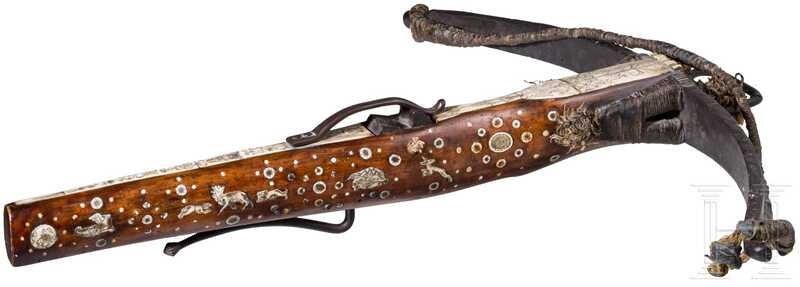
This crossbow in Hermann Historca’s auctions features a heavy forged prod, with the attached string very loose and unuseable on the rolled nocks. The front plate is secured with green wool plaster and iron reinforcements near the bridle. The strong walnut body's top is lined entirely with horn, with rich inlays of engraved and blackened iron parts, such as the bolt clip and suspension ring. Transverse pins can be seen that may be used to interface with a cranequin. Near the trigger, a balled iron lever is used to operate the nut. Mascarons, mythical and wild animals between dot interludes are inlayed into the body of the bow, perhaps as good fortune during hunts.