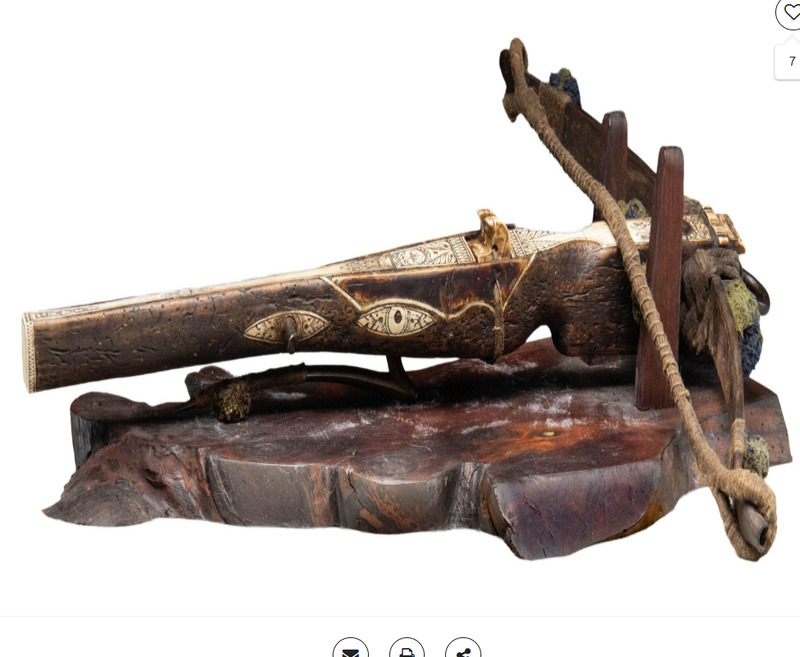
The crossbow has a steel prod with four blue and green pom poms attached to it reined by ropes along with an iron stirrup. The walnut stock is inlaid with bone on the top, sides, and butt. The top of the stock near the prod is decorated with motifs of two interlocking dragons. Near the nut is a design that the auction website describes as "Man-in-the-Moon" which appears to be surrounded by a triangle with a circular eye inside and leaf-like carvings below it. There are also panels of zig-zag patterns which protrude these patterns. The design carved on the side of the stock with bone resembles an eye with an iron stud piercing through the middle. It also has a steel trigger with a pom pom attached to it. There are small scratches on the butt stock indicating slight wear and tear.
This crossbow has a steel prod and a small suspension ring with bridle binding and string belonging to the same time period. There are red poms-poms attached to the prod with complete roping and near the binding. The fruitwood stock inlaid with antler and bone on the sides and top. The sides of the stock are etched with decorative patterns and the column of bone near the prod is engraved with a heart-shaped design while there is a floral pattern carved near the transverse pin. The iron rear sight is folded over the edge of the bolt clip covering the nut, composed of bone. It has a curved iron trigger guard and trigger.
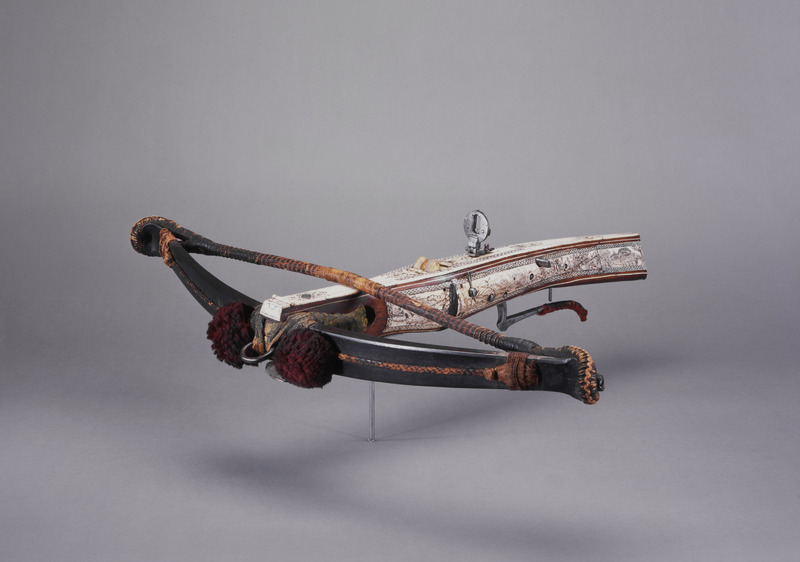
This crossbow has an iron prod with faded roping and a suspension ring along with a string made of hemp. There are two red-black pom poms attached to the top of the prod. The wooden stock is engraved with plaques depicting the story of the famous mythical crossbowman, Wilhelm Tell through the images of houses, trees, and animals. The top of the stock is also covered in geometrical patterns and forest-like landscapes. It has a nut made of bone ad a circular rear sight. The transverse pin is also visible behind the sight. The iron trigger guard is decorated with red roping below the trigger itself.
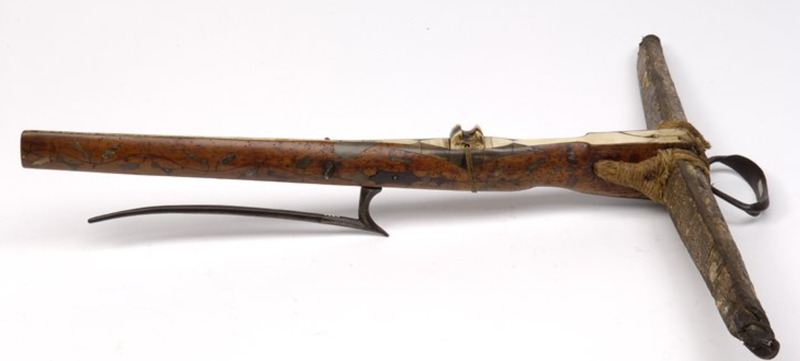
This crossbow has a prod inlaid with horn and covered with parchment and an iron stirrup along with bridle binding made of rope. The stock is either made of applewood, pearwood or hawthorn with columns of birch bark underneath. According to the website, the bottom of the stock is decorated with dotted patterns and motifs of leaf tendrils. The top of the stock is inlaid with horn and bone and nut is made of bone resting atop the inlaid bone with the weapon having a one-axle lock mechanism. The nussfaden, made of chords, is visible in the image as well. The side of the stock engraved with a coat of arms and zodiac signs along with leaf tendrils and calyxes (a type of flower). It has a long trigger guard and trigger extending to the butt stock.
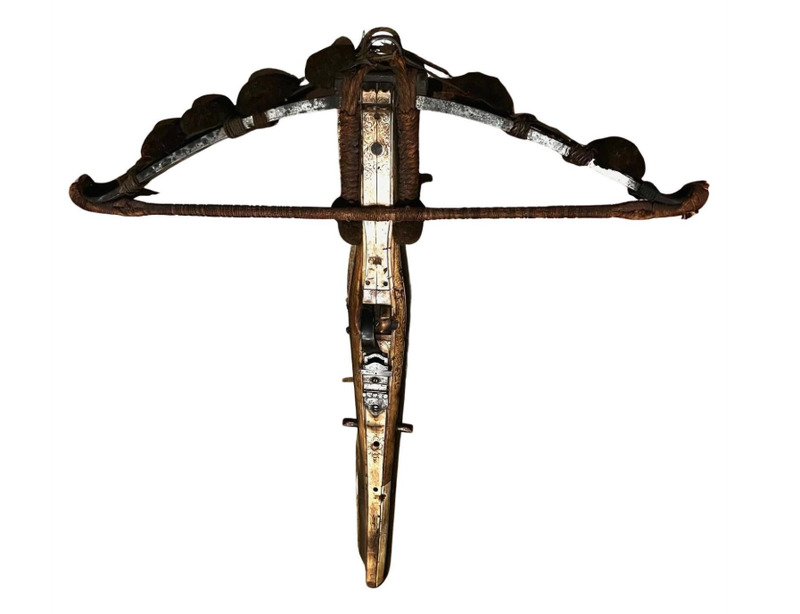
This crossbow has a steel prod and a circular suspension ring along with a string made of hemp that appears to be made of hemp. There is a rectangular steel plating near the prod and a thin binding tying it to the stock. It has a wooden stock and nut made of bone with an L-shaped steel plate near it. The transverse pins also appear to be made of steel. It has an iron trigger guard and trigger.
This crossbow is dated to before 1934 and originates from the Nagaland region of India. The use of this crossbow is linked to the Chang Naga people. It consists of a short wooden stock that narrows toward the butt, while the butt of the stock contains a trigger mechanism made of wood. The prod is made from an extended piece of split bamboo with a faint curve and passes through the middle of the stock’s upper portion. The string, made from twisted plant fiber, is intact and attached to either end of the prod.
Measurements: Height: max 56 mm, Width: max 362 mm, Length: max 1307 mm
Materials: Material Wood Plant, Material Cane Plant, Material Plant Fibre Yarn, Material Bamboo Plant, Process Carved, Process Perforated, Process Split, Process Wound, Process Twisted
A Flemish target crossbow, likely a 19th-century replica, originating more broadly in Northern Europe. It features a slim wooden stock inlaid with bone and ivory plaques and an ornately carved image of a lion coat of arms on the side of the stock. The prod is made of steel. Located at the fore of the prod is a steel stirrup used to help the crossbowman span the weapon. Attached to the top of the stock is a spanning mechanism that is likely a moulinet—a transportable pulley instrument—or a windlass. The crossbow possesses a complicated origin, originally dated as a 15th or 16th century crossbow from Genoa, Italy. It was later reassessed as a 19th-century replica with a Northern European provenance due to recent scholarly inquiry placing the style and condition of the weapon to be inconsistent with the originally dated time period and provenance.
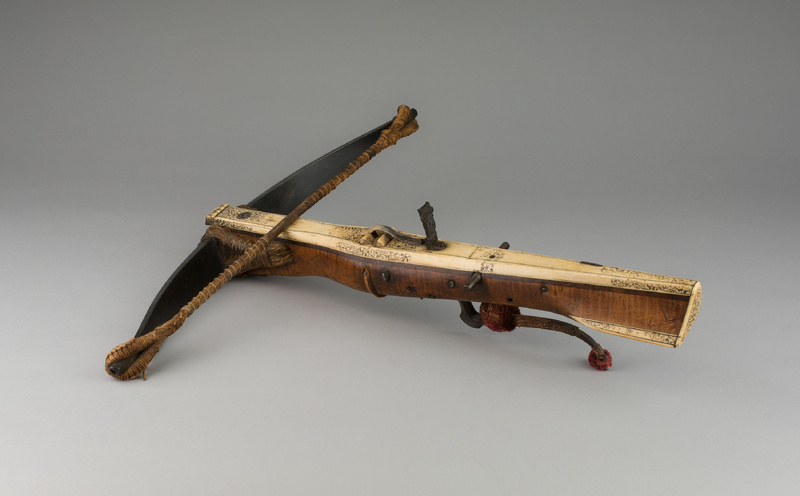
A German Halberüstung crossbow with a steel prod secured to the wooden stock by a hemp cord bridle. The stock is veneered with staghorn on its top side and at the butt of the crossbow. Further, it features detailed engravings around the upper end, the middle of the stock, and the butt of the stock. It possesses a rolling nut secured with a nusfaden, a four-axle trigger mechanism, and a metal bolt clip above the nut. Behind the nut mechanism is an adjustable folding sight. Running through the crossbow is a transverse pin used to support the crossbow’s spanning device. The butt of the stock contains a concave cheek rest made for a right-handed crossbowman. The string of the crossbow is of hemp fiber, while the trigger guard is made of steel and has a cord wrapped along it in addition to two red pompoms
Materials: Wood, steel, staghorn, cord, and silk fiber
Measurements: 14 × 62.2 × 58.4 cm (5 1/2 × 24 1/2 × 23 in.)
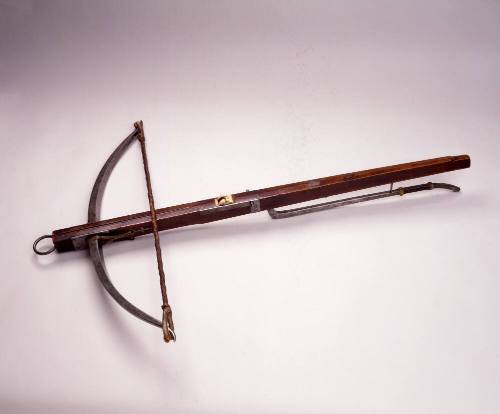
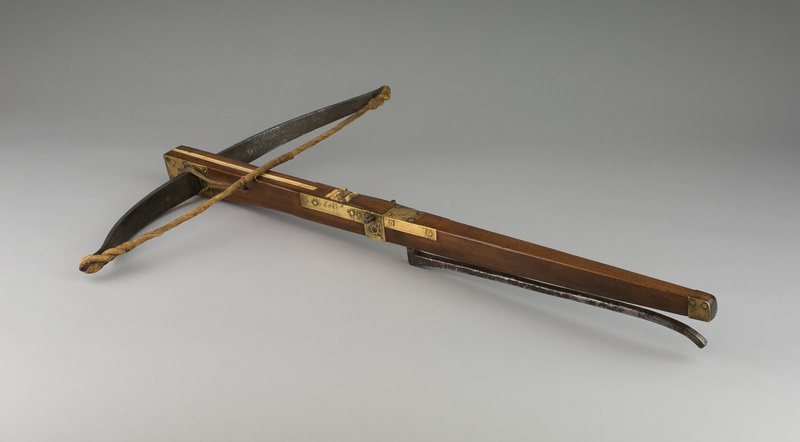
A Spanish style crossbow with a wooden stock made from fruitwood and a steel prod that runs through the middle of the front end of the crossbow. Of notable attention is the prod, where it is secured in place with both brass metal plate and a woven hemp cord wrapped around the prod itself and threaded through an opening in the upper portion of the stock. It possesses a rolling nut made of bone that is securely set within the wooden stock. The upper side of the crossbow features a bolt groove inlaid with bone. At the sides of the crossbow’s middle surrounding the nut are more brass metal plates and a transverse pin running through the stock. The butt of the crossbow is encased with brass metal plates as well, and the crossbow’s trigger is made of steel.
Materials: Steel, iron, brass, fruitwood, bone, and hemp
Measurements: 9.5 × 77.5 × 57.2 cm (3 3/4 × 30 1/2 × 22 1/2 in.)
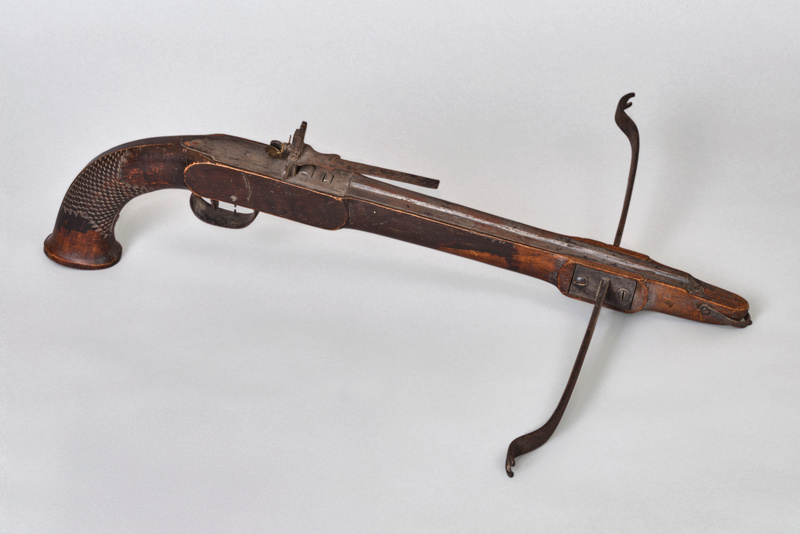
A pistol crossbow originating from Vienna in the 19th Century. The steel prod is fixed to the stock with metal plates and runs through the middle of the stock. The stock itself is made of walnut wood and features a groove on its upper surface made to hold the crossbow bolt. It features a steel nut trigger mechanism. The handle of the pistol crossbow is made of walnut and features a decorative fish scale pattern. The fore of the crossbow has what appears to be a suspension ring used to hang up the pistol crossbow.
Material: steel, walnut
Measurements: 48.0 cm, 48.0 cm chord length, weight: 0.9 kg
An Alpine rustung crossbow with a wooden stock and a steel prod. The stock is attached to the prod with woven hemp cord with the prod itself containing a hemp bowstring. The stock is made of wood and veneered in bone on its sides featuring a decorative design depicting mythological creatures both engraved and blackened. The crossbow possesses a nut mechanism held in place with a piece of thread. At the butt of the crossbow is a thumb rest made for a right-handed user. At its underside is a steel trigger mechanism. Towards the butt of the crossbow is a transverse pin running through the stock that is used to span in the crossbow in preparation of shooting.
Material: steel, wood, veneered in bone, engraved and blackened, hemp
Measurements Total length: 65.8 cm, 56.0 cm chord length, weight: 3.2 cm
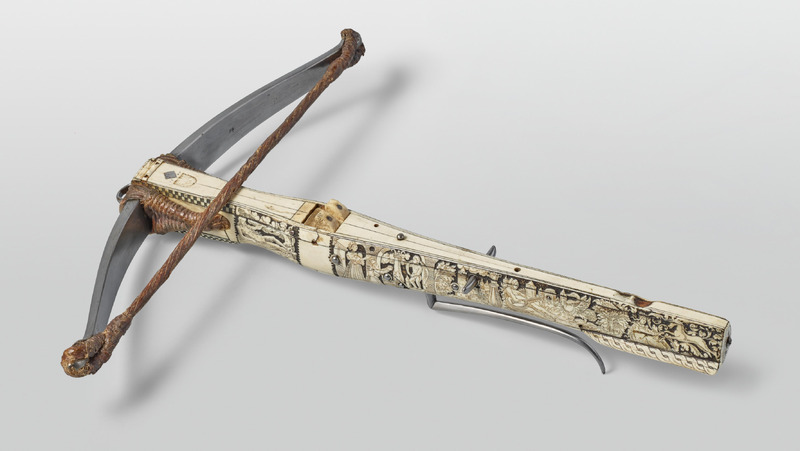
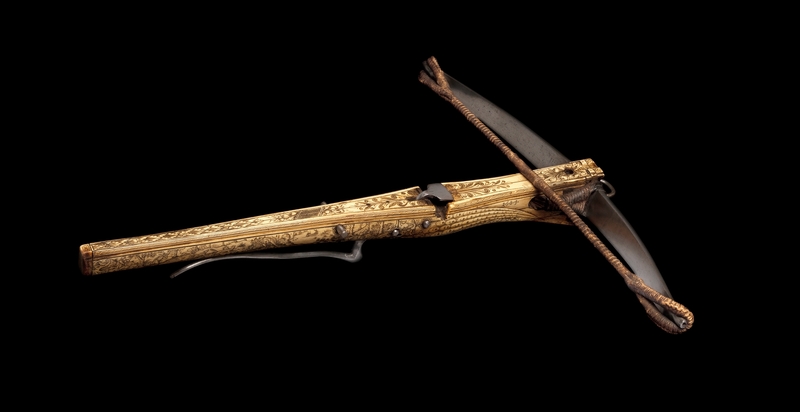
This crossbow is understood to have emerged from central Europe (possibly southern Germany) in the late 15th or early 16th century. The stock is made of wood and has been covered in remarkable carvings completed in staghorn. Notably, in the middle of the stock, just above the trigger guard, a scene of three figures hunting in a small fishing boat is featured. This scene stands out for its visual stillness, contrasting with the other livelier scenes featured on the stock. Viewers may also take note of the delicately engraved peacock feathers that follow the curvature of the stock. The prod, trigger guard, suspension ring, transverse pin and rolling nut are made of steel. The bowstring is recorded as being made of hemp. Along with the carvings depicting various hunting scenes, animals and ornamental florals are inscriptions reading “F.G.E” and “1584”. Though one would be inclined to infer the date inscription to have been carved at the time of its creation, it is theorized to not have been added until later, likely during the 19th century.