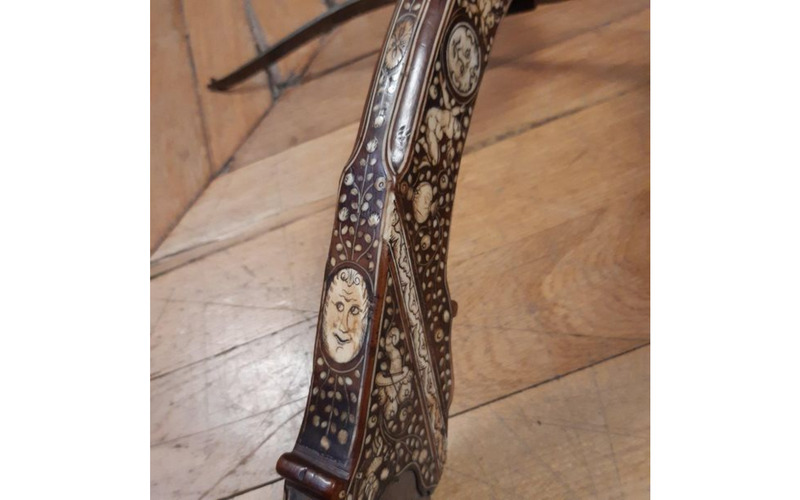
At the tip of this crossbow, there is a stylized blunt spike. There is a sight with a metal stick to the side, protruding vertically upwards. It is possible that there used to be another stick on the opposite side which broke off. The prod is made of steel and bow irons secure it to the fruitwood stock. The other metal parts are made of chiseled iron. The stock has very fine and extensive inlaid designs. These designs include faces (some stylized, some realistic), winged cherubs, animals, landscapes, flowers, and fruits. There is a background design of curling branches and circles which could represent fruits, nuts, leaves or flower buds. There are also friezes or strips of decoration at various places.
It is worth pointing out that there is a large foldable sight on top of the stock, which features beautiful curling designs. Behind that area, there are two sculptures of scrollwork. On the underside of the stock there is a hair trigger and a trigger guard.
The butt of the stock ends in a simple flat knob.
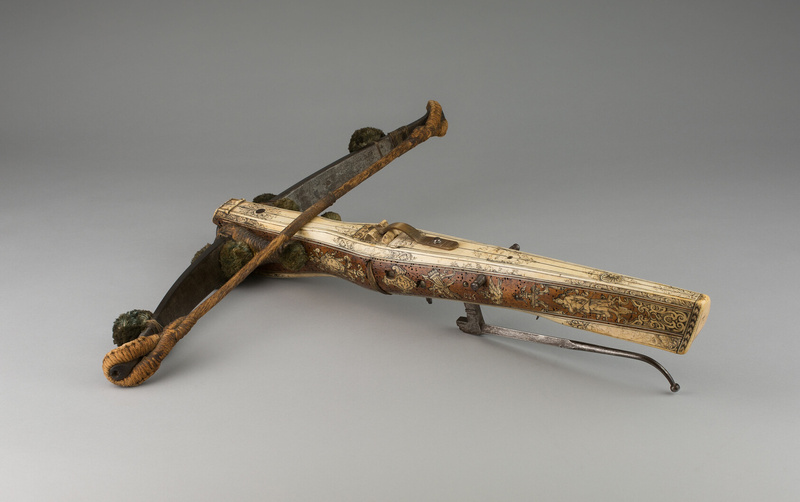
This crossbow has a steel prod with yellow-brown pom-poms attached to it and near the bridle binding. The walnut stock is inlaid with stag horn and ornately decorated with lively characters and designs. The top of the stock near the prod is engraved with leaf and floral pattern. Similar patterns can be observed near the nut which is made of bone and under the bolt clip. There is an open-mouthed human face with a floral crown engraving near the transverse pins and the edges are carved with small images of dogs and trees. The top of the butt stock has a shell-shaped decoration followed by more floral patterns. The side of the stock is engraved with a crowned woman's face and plants hanging below her chin near the pom-poms. There appears to be the depiction of a coat of arms, displaying a lion's face within a diamond-shaped draping next to the nussfaden. Other engravings include a bow and arrow with a quiver full of arrows, what appears to be a dove, the top component of a carriage and curtains, and what is most likely the hunting goddess, Diana with a bow and arrow in front of a hound. It has an iron set trigger, trigger guard, and trigger.
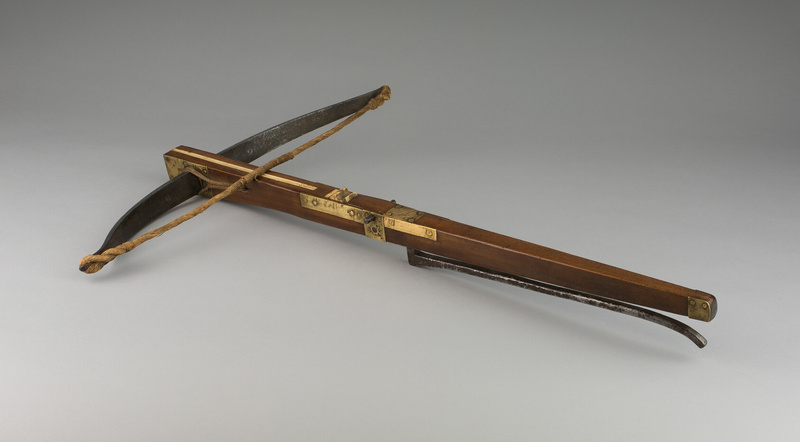
This crossbow has a steel prod with a string made of hemp and binding made of rope. The fruitwood stock is plated with brass columns on the top, along with bone, and side of the stock. The nut is composed of bone and the transverse pin is poking through a square brass plate. The butt stock is also fitted with a brass plate. It has a long iron trigger guard extending to the butt stock and an iron trigger.
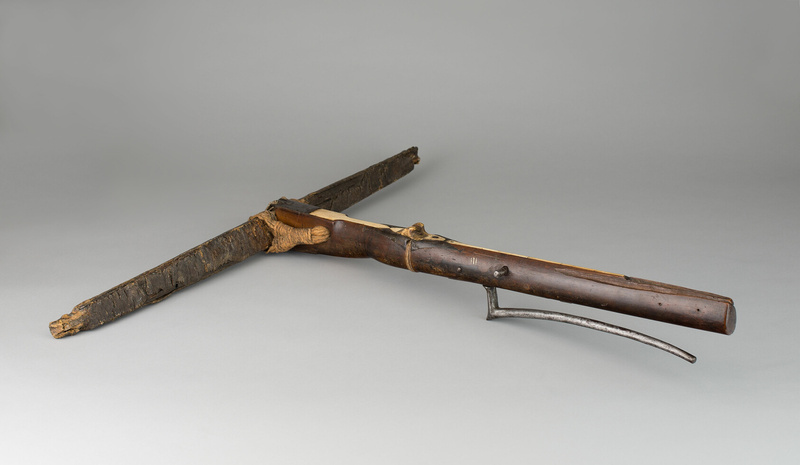
This minimalistic crossbow has a prod which is composed of joined pieces of horn, bone, and sinew bound by glue. It is covered in a painted layer of birch bark and quite damaged. The website states that the steel plate in front it is a later addition for support. The bridle binding is made of hemp while stock is made of cherrywood, appearing to be inlaid with staghorn and bone. The nut binding thread also seems to be made of hemp fibres. The nut is possibly carved from bone while trigger attached below is likely composed of iron.
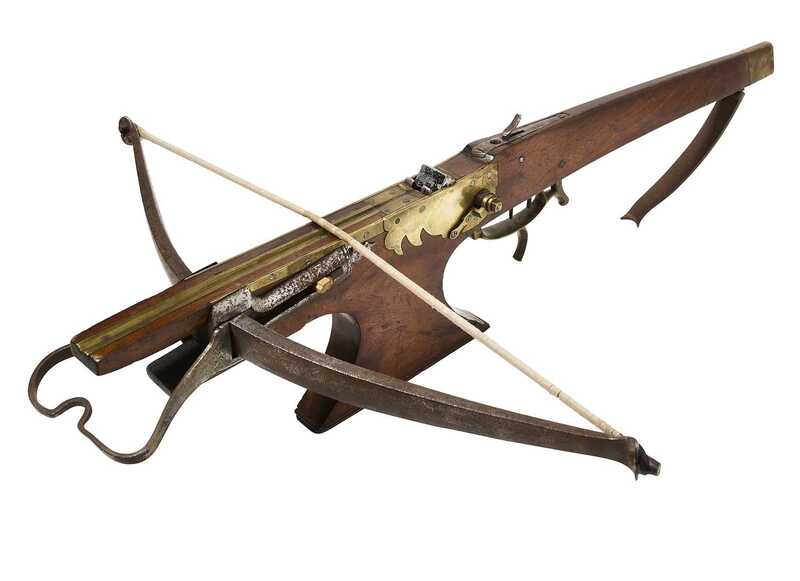
The crossbow has a steel prod retained by a pair of iron ornaments. The bow is stamped with three star-shaped marks on the inside. There is curve in the large iron stirrup which the auction website describes as 'heart-shaped'. The string belongs to a later period and the stock is made of walnut. Large brass panels outline the sides of the nut cavity with steel chords fitted across them. It also has a double trigger set and guard, made of brass. The nut also belongs to a later period. The rear of the stock has an adjustable steel rest attached to it.
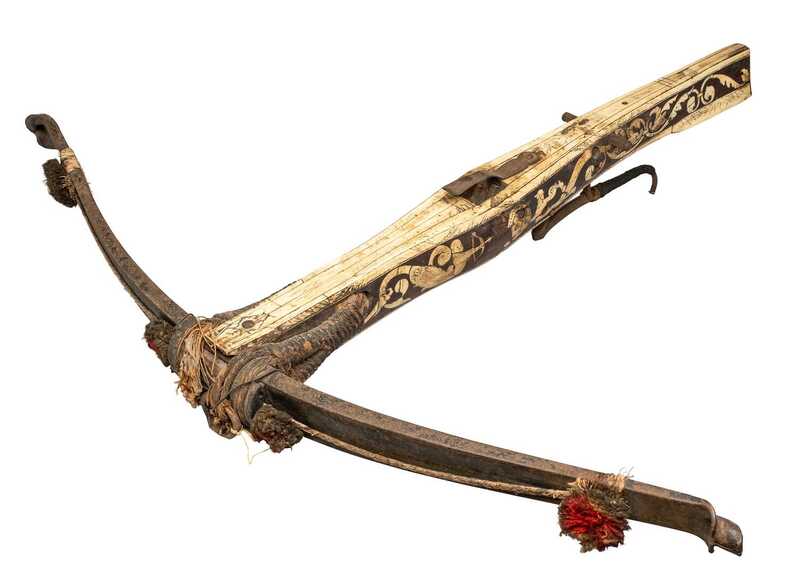
This crossbow has a heavy steel bow, painted black, retained by later chords with red pom poms attached to its edges. The string is missing and the iron stirrup is folded into the frayed chords. The stock is veneered with a staghorn panel engraved with scrolls of foliage. The engravings depict a mermaid shooting an arrow towards a shield held by an armoured merman along with vinal shapes. It has an iron trigger and a pair of iron hooks for a cranequin. It also has an iron transverse pin, bolt clip with the nut missing.
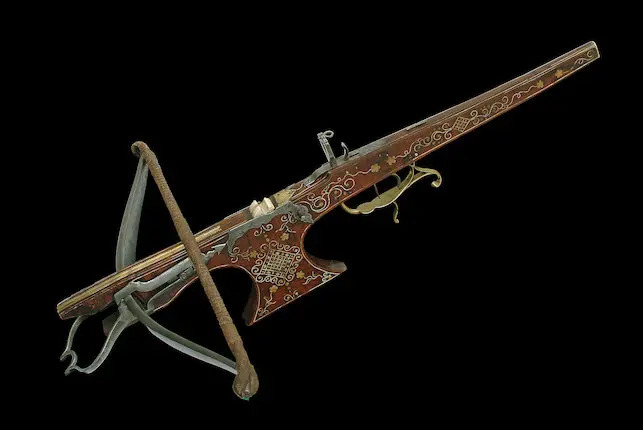
This crossbow has a steel prod retained by iron loops with arrowhead-shaped finial (an ornament) at the end. According to the auction website, the prod is stamped with 'Ozeel' and a bull's head mark underneath each side. The iron stirrup attached to the front of the stock is curved in the middle. The side of the stock is inlaid with white horn scroll-like patterns, a diamond-shaped panel of trellised dots, and flowers. There is another small diamond panel behind the trigger, both containing white horn lines. The nut appears to be made of bone and the iron trigger is mounted behind the adjustable back-sight.
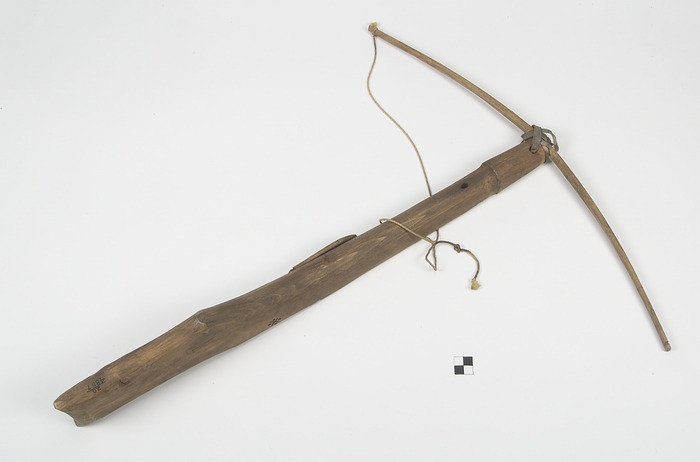
This crossbow model only has a curved wooden stock and a prod with string made of cord wrapped around it. Its aim was most likely to hunt and for fishing.
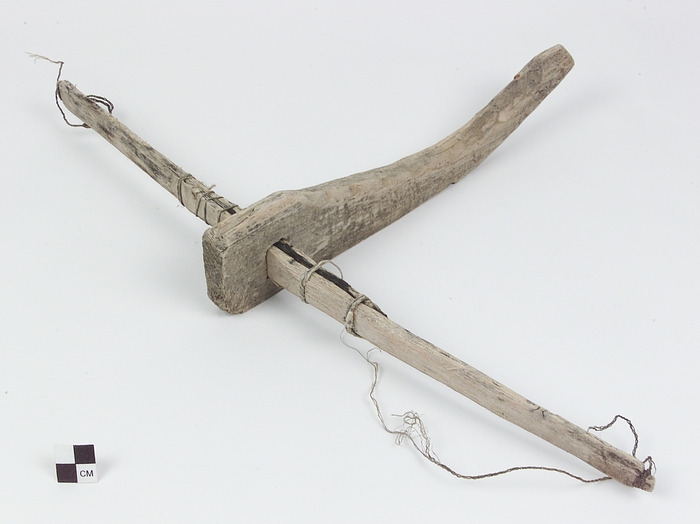
This crossbow has a wooden two part prod where the pieces are held together by separate strapping chords. The stock is a long piece of wood with a rivet at the front along with a thin rope attached to the prod as a string.
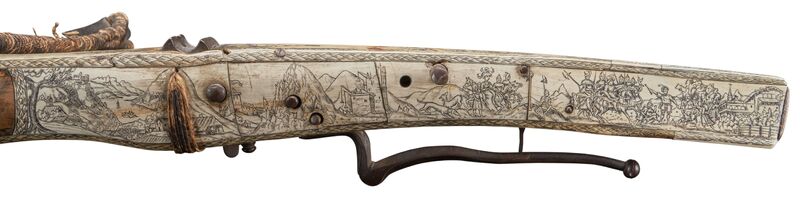
This beautifully decorated crossbow depicts scenes from the life of William Tell, a Swiss folk hero and famous crossbowman.
At the tip of this crossbow, there is a very small suspension ring. There is a thick steel prod which attaches to the stock with bindings. On top of the end of the stock, there is a little wooden bolt rest. The prod has a bowstring which features cockscombing. The bowstring appears to have residue on it, possibly from paint or waterproofing material.
The sides, top, and bottom of the stock are completely covered with bone plates, which are extensively engraved. Panoramas showing the life of Willam Tell as well as the Swiss countryside and mountains decorate the sides of the crossbow.
The edges of the crossbow have a design resembling scales or a laurel wreath.
The crossbow has a rolling nut secured with a nussfaden, or nut thread. The trigger seems to be a metal lever.
The very end of the crossbow butt is bare and shows the wood underneath.
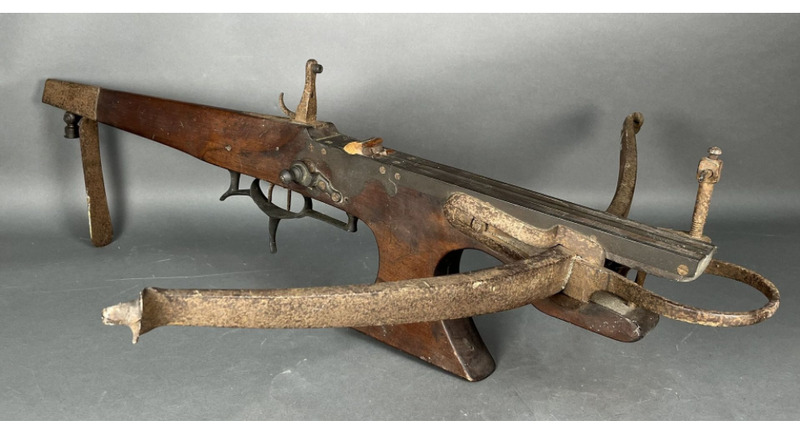
At the tip of this crossbow, there is a large ring made of corroded metal. Corroded bow irons secure the ring and the corroded metal prod to the wooden stock. To one side of the stock, there is a heavily corroded metal sight involving screws which allow the user to adjust it. On the top of the stock, there is a bolt groove made of metal which does not appear corroded. This large metal piece continues down the stock and around the catch area. It is attached with screws. Below the catch area, a wooden support protrudes from the stock. It is made of the same piece of wood as the stock.
The nut appears to be made of bone.
Behind the nut, there is another sight made of heavily corroded metal. This sight has a small, slightly curved metal protrusion behind it, resembling a hair trigger.
The stock has a large transverse pin. Both sides are shaped with ridges and end in a knob.
The trigger system is a double set trigger. There is an elaborate trigger guard protecting it. The trigger guard is not corroded, but the triggers are.
The stock is relatively plain until the butt area, where there is a very large and very corroded metal cap covering the butt. A piece of metal protrudes downward from the butt cap, possibly intended to rest behind the shoulder of the crossbow user.
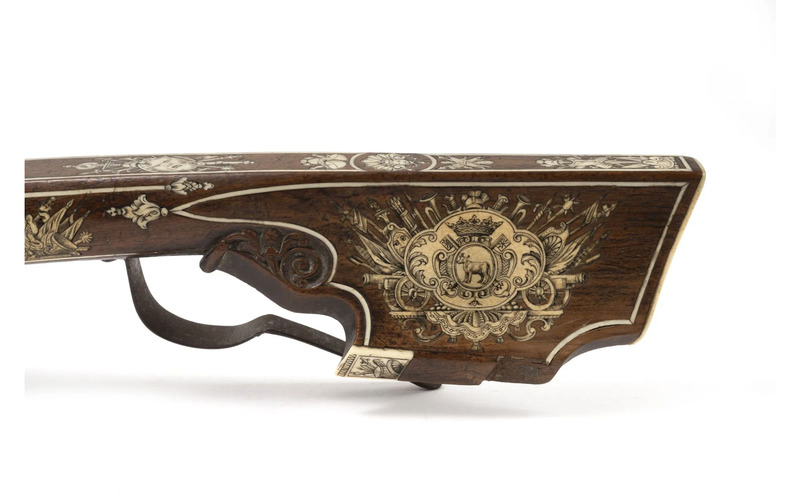
At the tip of this crossbow, there is a suspension ring made of iron. The prod is metal. The bowstring features cockscombing. Bindings secure the prod to the stock. The stock is made of walnut wood and inlaid with bone and deer antler. The inlay features intricate designs. There are motifs of swords, pikes, axes, musical horns, bows, arrows, quivers, armor (such as a feathered helmet and plate armor), chains, spheres (possibly cannonballs), and medallions depicting a man crowned with a laurel wreath like Caesar, evoking an Ancient Roman battle standard.
In general, many of the inlaid designs on this crossbow have borders made of simple lines made of more bone inlaid into the wood of the stock. Sometimes those simple lines end in small flourishes which are difficult to discern.
The cheek rest is slightly concave. There is an elaborate centrepiece design on the cheek rest. The central image is as follows. There is a shield with an ox in the centre. Two crossed keys go behind the shield. There is a crown above all that. Around the edges of that central design, there are cannons, shields, flags, a medallion evoking an Ancient Roman battle standard, quivers, spears, musical horns, swords, and a feathered helmet. All that rests on a platform that has a tasseled cloth over it.
On the underside of the cheek rest, there is a small design engraved into bone inlay. That design involved a drum, a shield, a bow, a spear, and a quiver of arrows. That design is framed with simple lines, with a zigzag design along the upper part of the image.
In the wood of the stock, near the cheek rest, there is some leafy scrollwork, evoking the rinceaux style.
The catch of the crossbow appears to be metal. The number “1725” is carved nearby.
The butt has “no. 2” carved into it. This crossbow was likely spanned with a goat’s-foot lever. La Gazette Drouot states that this crossbow would have been used in the sport of target shooting.