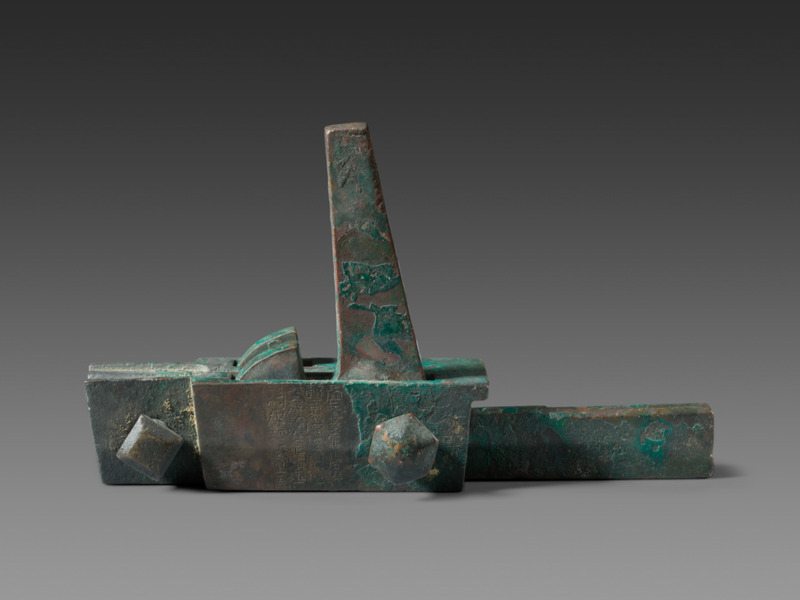
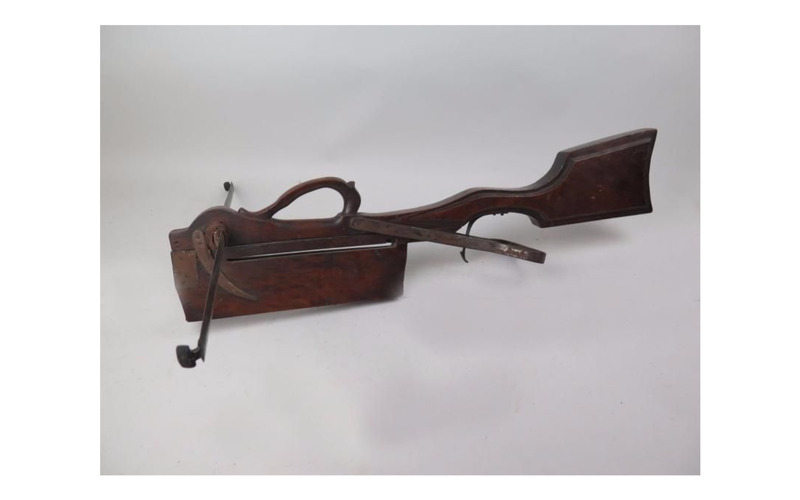
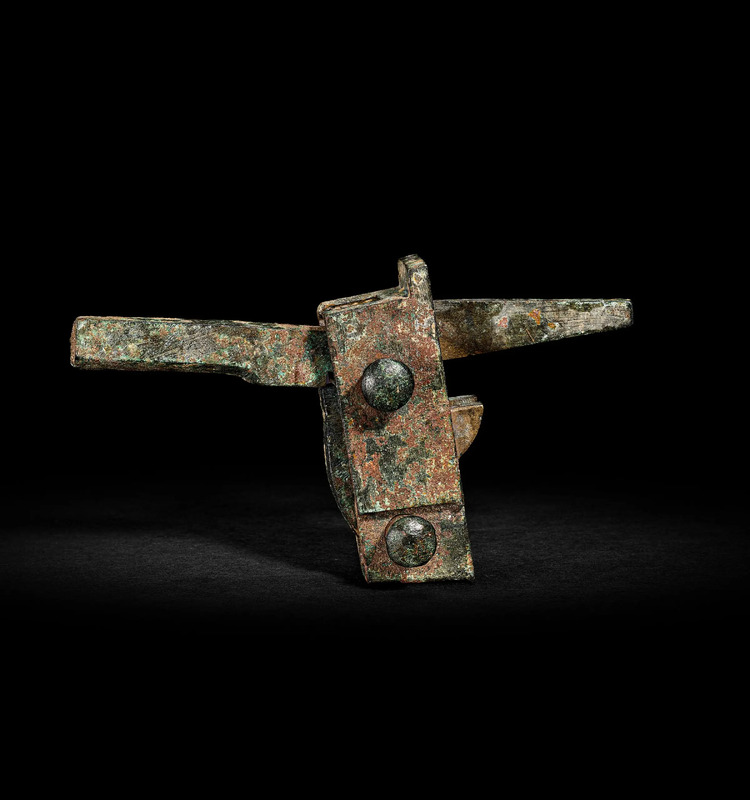
This crossbow mechanism held by the Shanghai museum is dated to 264CE. Its specific location of unearthing is not listed.
The mechanism is made of bronze and it comprises most of the typical parts of a Chinese crossbow mechanism. The long rectangular protrusion at the top of the mechanism is the sight, or wangshan (望山). The two small hooks sticking out in front of the sight are a part of the same component as the wangshan and serve as the nut, or ya (牙). The rectangular handle protruding from the right side of the mechanism is the trigger, or xuandao (悬刀), and within the bronze casing, or guo (郭) there is a sear, or gouxin (钩心) connecting the sight and nut and the trigger. The mechanism is held together by two bronze axle pins. The top surface of the bronze casing has a groove that goes down the middle which would continue onto the wooden stock of the crossbow. This groove would be where the arrow rests during drawing and aiming. The surface of the mechanism has been corroded and oxidised.
There is engraved text on the surface of the casing that tells us about the mechanism’s time of manufacture. The text on the surface dates this mechanism to the first year of the Yuanxing reign title, which corresponds to 264CE.
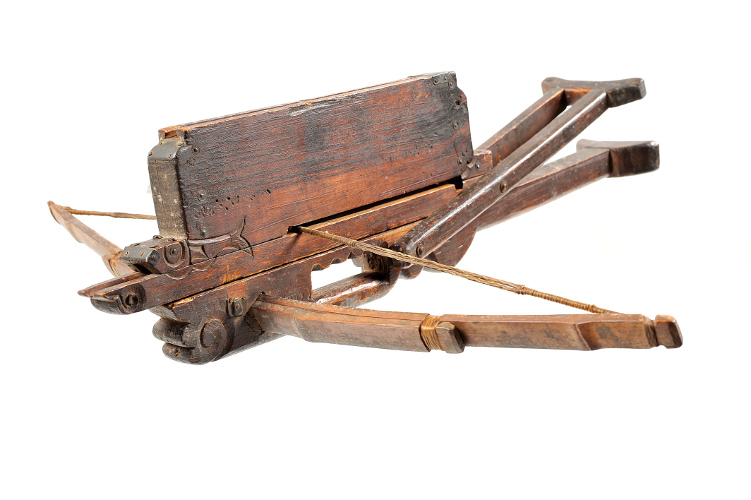
The front of the crossbow is carved with decorative swirls and the image of a wide-eyed fish. The fish carving is positioned such that the bolts exiting the crossbow would appear to fly out of the fish’s mouth. Above the fish’s mouth, there is a metal plate which might reinforce the wood there.
The prod is made of two strips of wood bound together with cord. The prod fits through a hole in the stock. Above the stock, there is the magazine which holds the bolts.
All visible parts of the crossbow seem to be made of wood, except the cord binding the prod, the cord bowstring, the metal fasteners, and the metal plate.
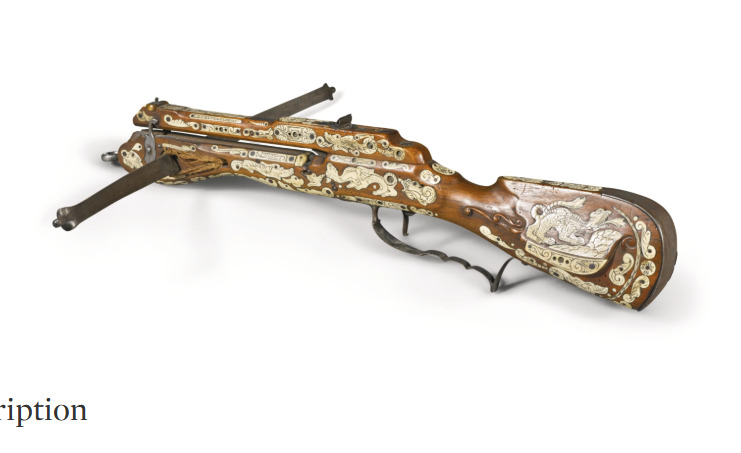
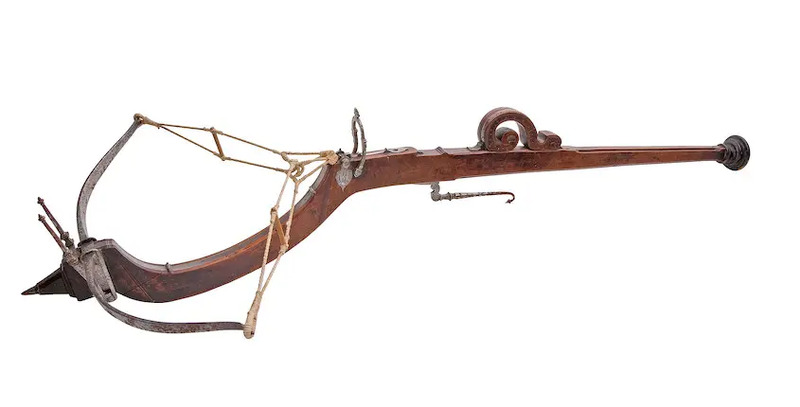
The crossbow has a slender iron bow retained by chords from a later time period with a bolt groove and iron stirrup. According to the source, the upper part of the groove is fitted with a panel inscribed with the maker's name, 'Ian Sander 682' . The wooden stock is richly engraved with staghorn plaques, displaying marine monsters like water dragons and large octopus along with shell-like patterns along with foliage using horn pellets. The butt stock is carved with a raised cheekpiece and a patch box with a sliding cover decorated with the figure of the goddess of hunt, Diana (This is strictly according to the source since the image of this side is not available). There is an iron plate at the base of the butt stock. It has an iron trigger guard and trigger.
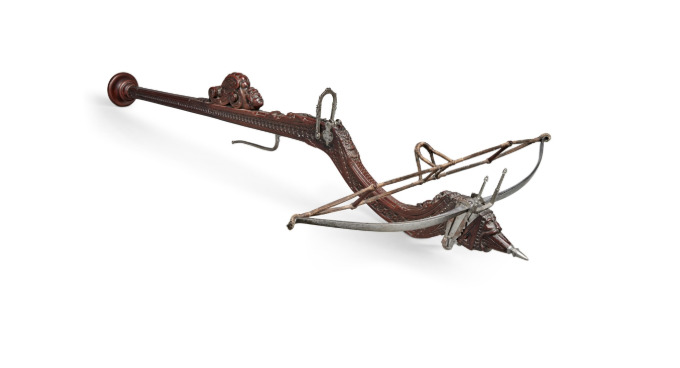
This stonebow has a steel prod, stirrup and steel tip at the front of the weapon. The tip is protruding from the carving of a masked lion's jaw. The prod is clasped to the walnut stock with ridged steel plates. The stock is carved with grotesque masks on top of the curved part of the component. Its whole body is engraved with guilloche mouldings. These refer to precise, intricate, and repetitive patterns as shown in the stock. The decorations are lined with acanthus leaf motifs, a form of style popular in Renaissance era. The ornamental carvings appear to be done in the manner of the Florentine artist, Dionigi Nigetti 's woodworking. The lock mechanism and ovular rear sight appear to be made of steel and there is a mounted wooden carving on top of the stock in the shape of a womanly face, decorated with shell patterns. It also seems to have an iron trigger.
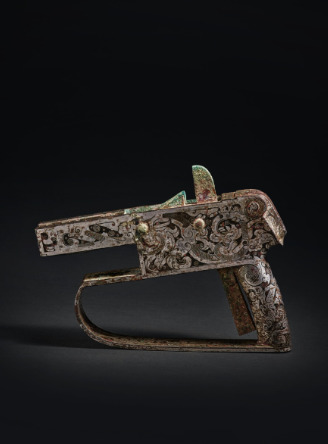
This is a bronze trigger mechanism and a metal casing (guo) covering it to protect the user from the recoil when shooting. It is inlaid with silver and the embellished casing implies that it was crafted for a high-ranking aristocrat or a royal patron exclusively for ceremonial use rather than military practices. The silver inlay display ornate spiral circular, and other geometric patterns. The two extensions decorated with silver on the rear side of the mechanism resemble an abstract animal head. The sear (gouxin) trigger (xuan dao), and axles are covered in bluish-green patina, creating a stark contrast with the silver inlay.
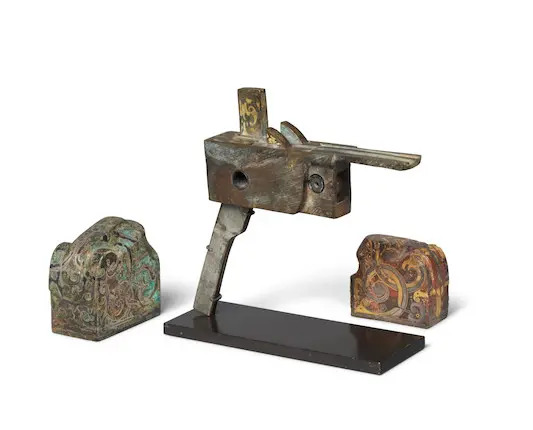
This bronze mechanism has been inlaid with gold foliage with the hook displaying tigers and birds with the lock mechanism depicting leaf-like patterns. Spots of bluish-green patina can be observed on the tumbler and an axle appears to be missing. The crossbow fitting to the right engraved with both silver and gold, showcasing spiral designs. The fitting to the left is almost wholly covered in patina with ornate gold inlay and and curvilinear patterns poking through the rusting bronze.
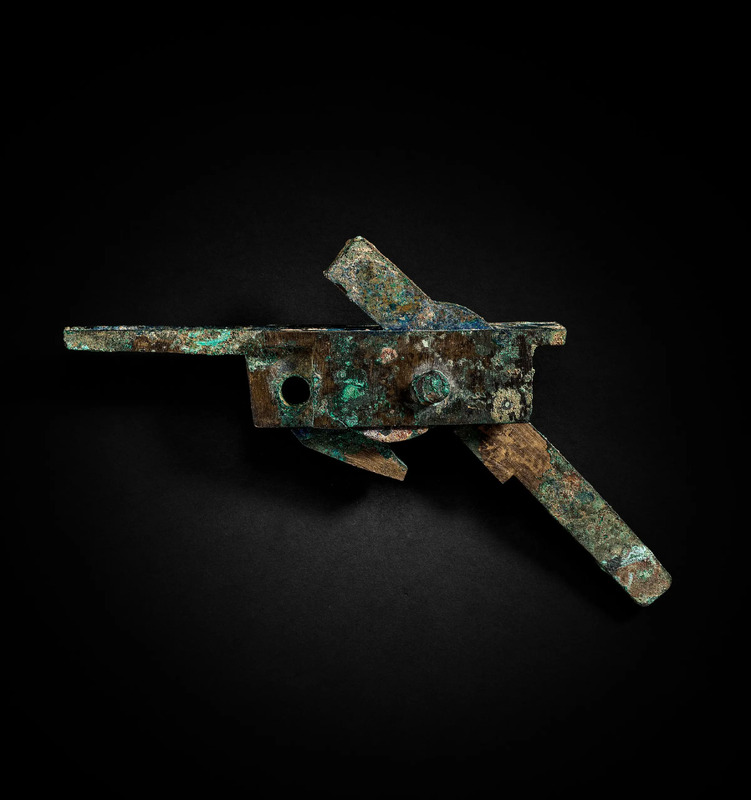
The bronze crossbow mechanism is covered in patina with the partially gilded portion poking through the bronze casting. Flecks of gilt can be seen in the hook mechanism while the gilding on the frame is completely ripped off. The top of the frame retains most its gilding on the patina. The mixture of the patina and the golden gilt on the trigger makes the bluish-green colour sparkle. The bolt groove is also visible and one of the axles is missing.
This bronze crossbow mechanism is partially covered in patina with the axles appearing to be plated with silver. There is a patchwork of shimmering bronze casting on the trigger mechanism and suspension blade, showing the erosion of these components over time. The tumbler is inscribed with the year of manufacturing and the maker's mark, translating to 'the second year of Tianhan, Zhangye supervision, Craftsman Guo Kou (Ming), no. 281', referring the era during the reign of Emperor Wu of the Western Han dynasty. It indicates that the weapon was manufactured as an official military tool in the Zhangye region.
This stonebow has an iron prod retained by rectangular loops and there are two fore-sight pointed pillars with spherical finials at the edge. The front of the fruitwood stock is octagonal and pointed and later strings are attached at the split of the curved neck. There is a folding rear-sight near a decorative foliate plated steel ornament. Behind the rear-sight is a spiral-shaped finial on the stock. The trigger guard is inscribed with small patterns accompanied with a curved trigger ending with a tiny button.
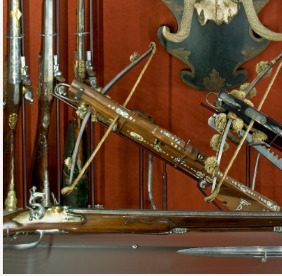
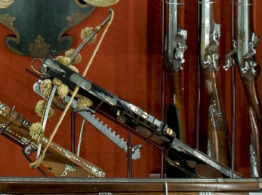
The crossbow has a steel prod bound to the stock with a chord of hemp. The small pom-poms attached to the prod are made of blue and yellow silk yarns. According to the curator's description, the inner side of the prod has the maker's mark which is an arrow. The stock is made of walnut and and lined with horn and the suspension ring affixed at the edge is made of iron. There is also an arrow groove covering the stock and its end is marked by a hog's back. There are decorative panels inlaid with horn at the front and back of the stock which display engraved birds and flowers along with a pierced crown. There is a patch box, as defined in the description, and a plate on the cheek rest, marked with an unknown symbol.
The trigger, trigger guard, and hair trigger lock are made of iron. The nut mechanism is unusual as it is hook-figured iron component that is spring-operated.
The crossbow has a steel prod which has the maker's mark, an arrow, underneath, although it is not clearly visible in the image. The prod is attached to the stock with bridle binding most likely made of twisted hemp along with the string. There are pom-poms attached to the front of the prod and near the binding, which are bleached pink, yellow, white, green, and pink tassels made of silk yarns. There is an iron suspension ring attached at the front. The ebony stocky is carved with an arrow groove, lined with horn. The stock is inlaid with plaques, possibly made of horn, engraved with flowers at the front and back. The cheek rest is inlaid with a crowned C5(subscript) inside a laurel wreath surrounded by heart-shaped carvings, containing tulip-like flowers. The butt stock is plated with silvers but has been chipped off, indicating damage. The steel tumbler and nut is spring-operated and the former is hook shaped. The trigger, hair trigger lock and trigger guard are made of guilt iron.
According to the curator's description, there is an inscription stated as "IVHST HOG ANNO...", however, its placement is not indicated.