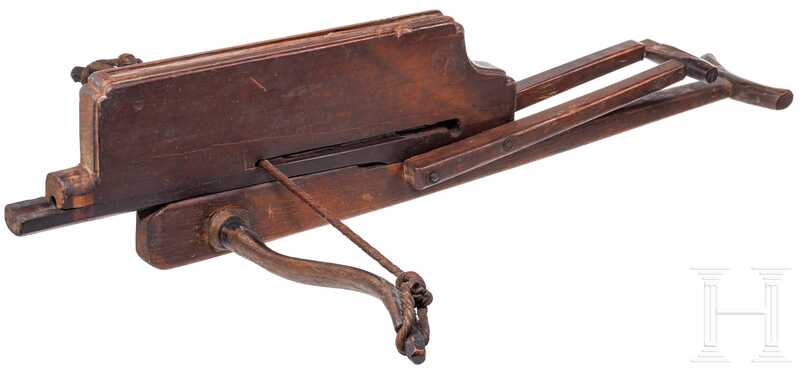
This chinese composite repeating bow is operated by a prod made out of horn, bamboo, and glue-embedded animal sinew, with a fiberstwisted rawhide bowstring strung across. The trimmed edge redwood body features a lever, a bolt box, as well as the T-shaped handle. The bolt box features a bolt guide along the bottom of the box for bolts and a catch for the string. A rail is also along the top, perhaps for sight or attaching attachments.
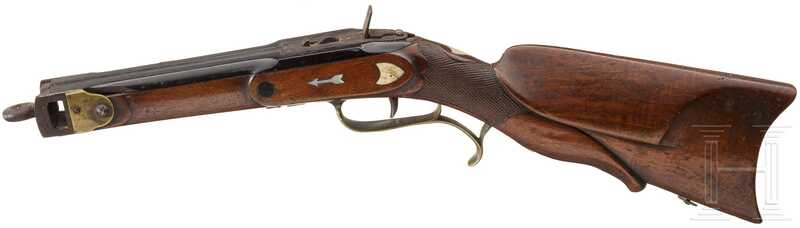
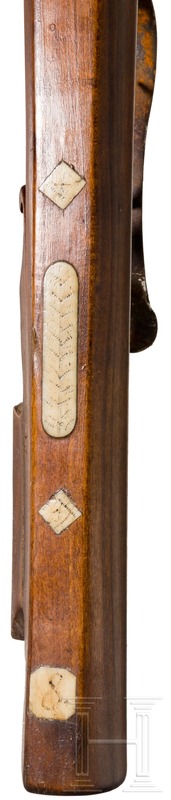
This crossbow features a walnut wood column with an ebony bolt guide. It has a cheekpiece and along the bow small inlays of bone and mother-of-pearl. In where the prod should be is is the prod holder screwed into the stock with a suspension ring. Protected by a brass trigger guard, there is only a trigger and no set trigger.
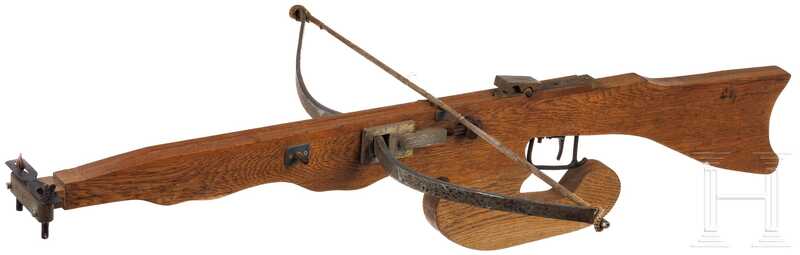
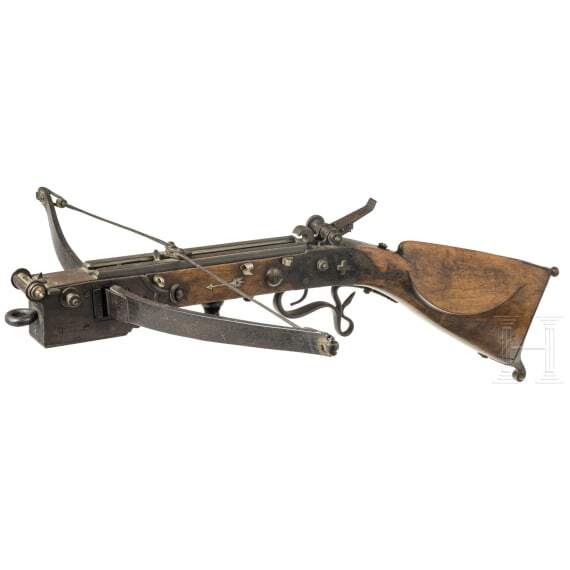
This modern-looking crossbow has many blackened steel parts, such as the prod (which is tightly bowstringed), bolt guide and metal securings. Many of the components are screwed into the wooden column with an intact catch lock with a diopter sight. The stock is unbeveled, with a front grip extended downwards and a very square butt. It is also capped off with a metal L piece, possibly to fit under the arm.
This Saxon bolt crossbow has a blackened steel bow, secured by thick bridles. In the front, blue and red wool pom-poms surround the riveted suspension ring. The fruitwood stock is adorned with sparse inlays of polished and engraved antler. A catch is right above the bow, with a broken-off bolt clip, controlled by the hair and set trigger guarded by a curved trigger guard. A cheek rest also extends out of the right side of the bow.
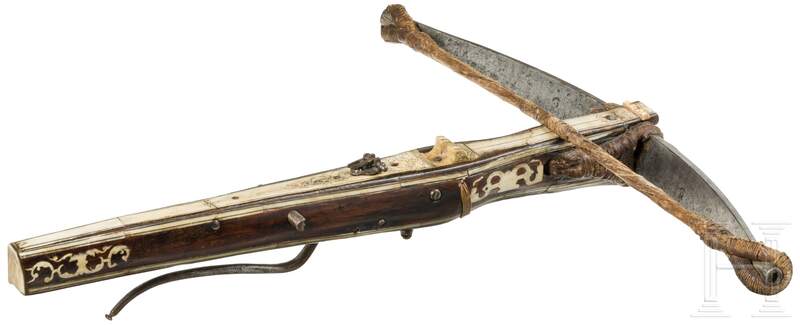
This bolt crossbow is supplemented with a steel prod, and struck on the inside on both sides is a smith mark in the form of a "U", secured onto the stock with thick bridling. The brownwood stock is inlaid of polished stag horn with blackened engravings of scrolling vines and leaves from the Renaissance. The nut made of stag horn and secured with thread (the latter replaced). A multi-axle lock with a single folding trigger secured by an iron trigger guard. A transverse pin is present to engage th a cocking device. A bolt bridge is inserted from the side, with no bolt clip holder attached.
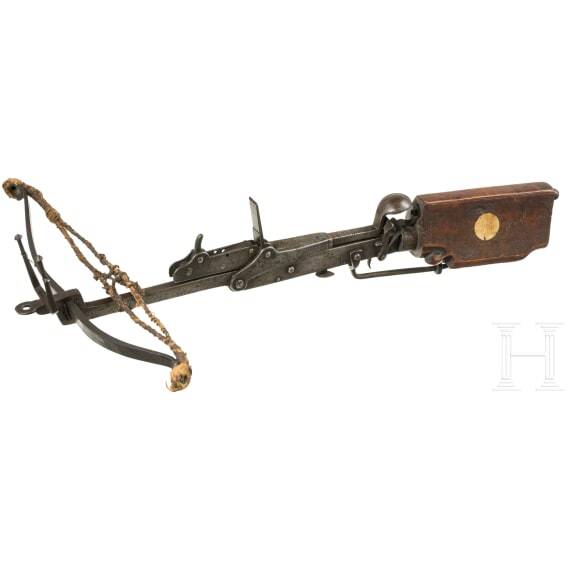
This bullet crossbow has a set of wedged in steel prod, with a pair of inserted sight rods. A loose string is strung across the prod with a bullet pouch in the center. The bow stock is made out of iron, with a hinged cocking lever stamped with the mark of a striding stag. The string is held in with the cocking box, with a single-finger nut connected to the trigger and the cocking lever. Bolted into the stock is an iron trigger guard, and moving down, a lightly decorated wooden buttstock with punch marks, imbedded with a empty bone medallion.
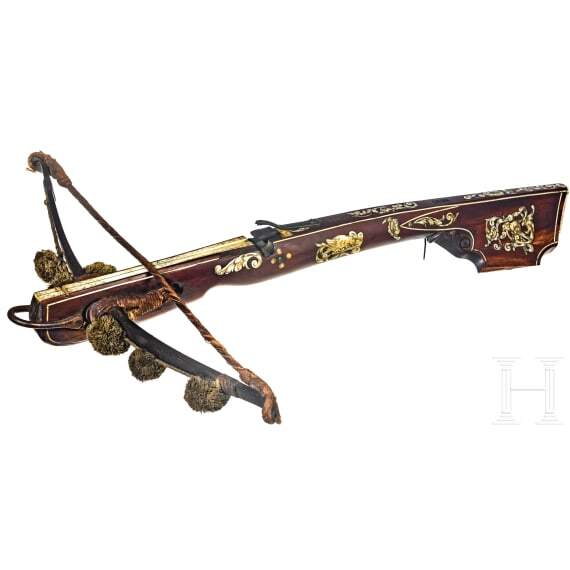
This bolt crossbow features a slender steel bow, with a wheel mark with sunburst struck on the inside of the right prod. It is secured by a bundle of thick bridling, and strung with string, both in different shades. Pom-poms of greenish color can be seen attached to the front, alongside a riveted suspension ring. The fruitwood bow is inlaid with polished, finely engraved antler inlays depicting a parrot and an owl, flowery patterns, interspersed with old brand marks as decorative elements, and at the front, with an engraved maker’s initials "GE" (Georg Escher). The bow is capped off with an antler butt cap, with a downwards catch with double set trigger to catch the string. Moving down along the bow, the trigger guard is completely missing where it should be, as well as parts of the bolt clip.
Hermann Historica notes that this crossbow similar to the courtly weapons of the Dresden armoury, probably commissioned or a gift for the Munich court. In the 18th century, weapons of this kind were used by the aristocracy and the rich for target shooting as a pastime. Citing Cf. H. Richter, Die Kunst der Armbrustmacher in Dresden (tr. The art of crossbow makers in Dresden), Beucha, 2008, p. 18-24, there is evidence that at least one crossbow was dispatched from Dresden to Munich (Richter, page 102, note 109).
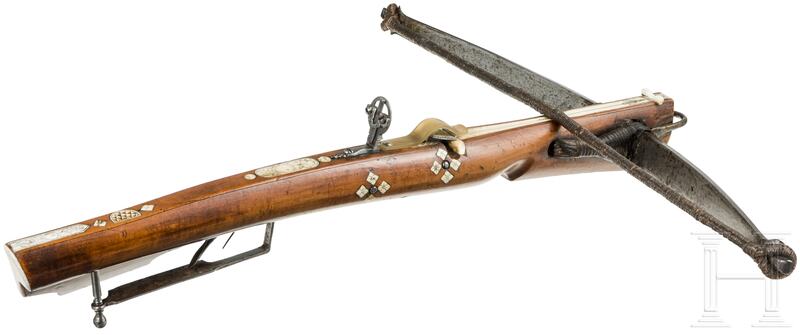
The prod of the steel bow is tightly wrapped by the bridle and metal reinforcements behind the stock, with a stamped trefoil mark for the bowyer on the right inner side. This bolt crossbow has sturdy binding through the elegant fruitwood stock with inlays of polished, finely engraved antler, and an iron ring at the front possibly for the cocking lever. A bone bolt rail and horn bolt holder can be seen from the top, as well as a folding lock with pin catch and square trigger guard.
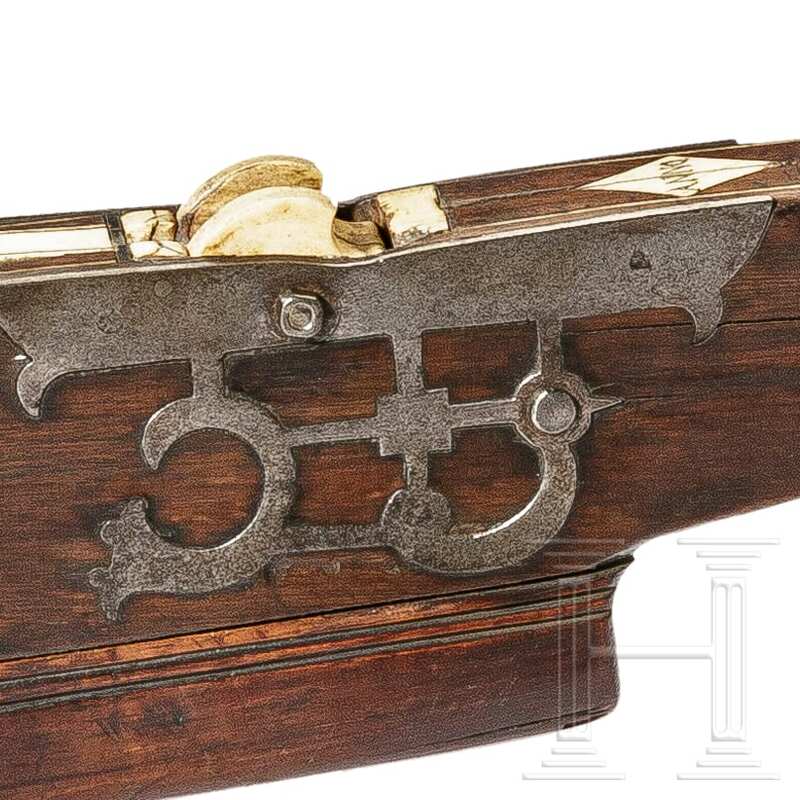
This bolt crossbow has many rivets and flathead screws securing the metal reinforcements onto the walnut stock alongside a suspension ring upfront, and the string is guided in a brass trough through the length of the bow. The prod has spots all along it, presumably from natural wear and tear. Along the sides are many hooks and holes, possibly for bolt storage. A transverse pin is present right behind the goat-eye hook and clip, possibly for the cocking lever. A metal catch can be seen right above and behind that is an adjustable lever possibly as a sight or a bolt clip. Moving down from that , a Swiss cross and the shaped trigger guard can be seen, in a serpentine- like profile. Adjustable front and rear sights can be observed, as well as an iron butt plate, depicting William Tell in brass on one side, a nickel silver arrow on the other, dark wood buttstock ("mushroom").
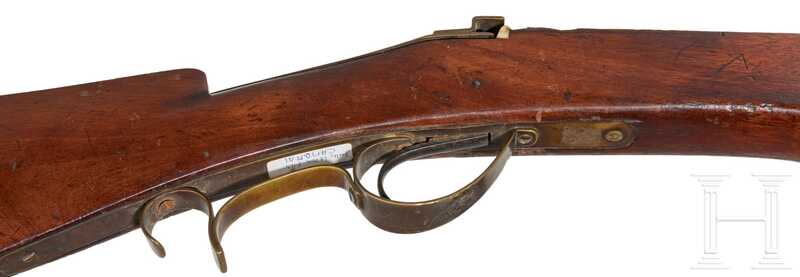
This bolt crossbow has a sturdy, slender steel prod, attached by brass colored plates on both sides. Running across the prod is a tight graying string. The bow stock is dark brown stained and varnished wooden stock with a deep bolt groove along the top, operated with an upward-springing brass flap. The stock is caved in for shoulder support, and the trigger guard is shaped for hand support. A new paper label with the assigned maker's name "Jules Lazon Fils Cambrai" is affixed to the brass trigger guard.
This large bolt crossbow is elegantly curved, with a massive steel prod with bevels along the edges and a heart-shaped mark struck on the inside. A large metal stirrup is at the front, securing the prod with large metal fixtures. A bone bolt groove and fine bone lining on the top of the stock, as well as metal nut reinforcements on the sides. A transverse pin sits right above the curved grooved trigger, presumably for a cranequin to engage with it. The string is loose to the side, detatched from the bow.
Hermann Historica notes that similar crossbows can be seen in the paintings of Jan Brueghel the Elder (Forge of Vulcan).
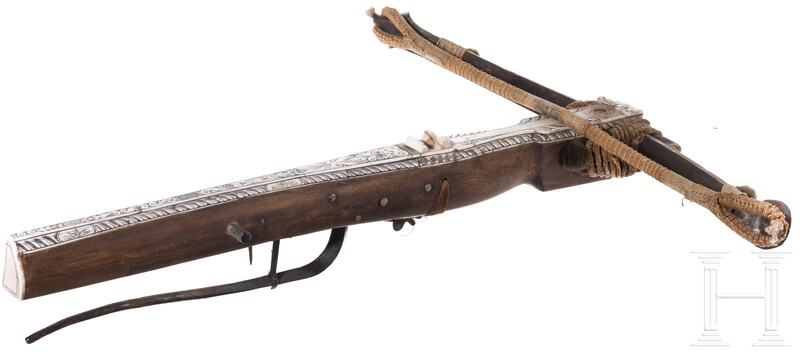
This bolt crossbow features a set of bare steel prods with green wool trim, brown wool pompoms and a safety string wrappings. The bow bridle cradles the suspension iron ring and prod with thick hemp string. The bow stock is made of slightly darkened wood with richly engraved bone inlays on the top and cheek rest, and the butt is capped off with bone. The blackened engravings feature volutes, masks, and foliage in the late Renaissance style. The bone nut is secured and runs smoothly on the nussfaden or nut thread, and the multi-axis, movable lock mechanism has a simple, unspringed folding trigger and a sturdy trigger guard. A transverse pin is also in place possibly for a cranequin, or spanning device to work with.
Hermann Historica notes that it's a very decorative, lovingly crafted crossbow in good condition.