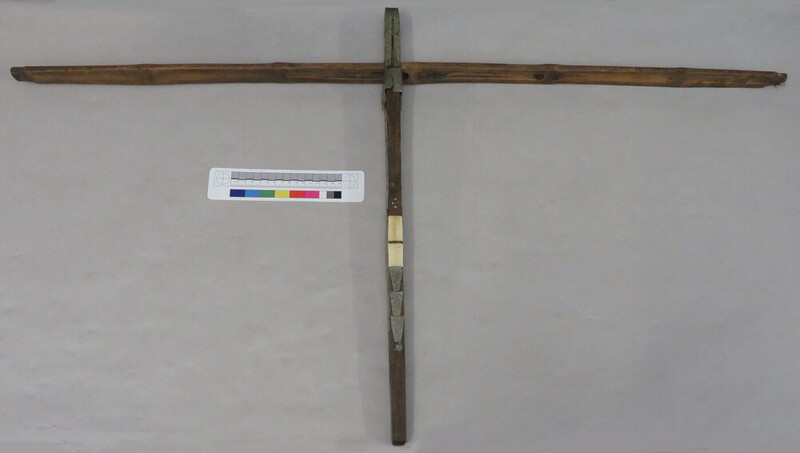
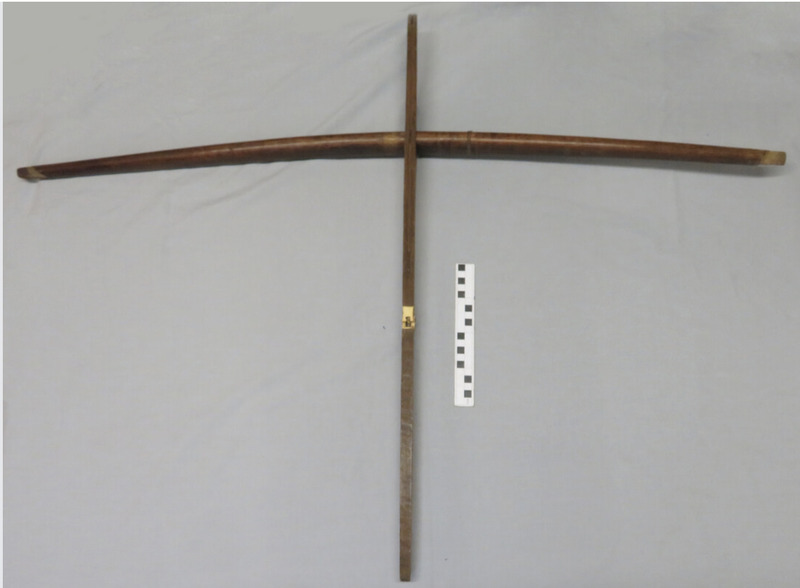
This crossbow originates from India and is dated to have been made likely before 1874. It features a wooden stock that is ornately decorated on its upper surface with a series of metal strips in a trapezoid shape; one of the metal strips has fallen off but is retained with the crossbow. Located on top of the middle section of the stock is an ivory inlay that has an indent to hold the string of the crossbow. Above the inlay, there are what appear to be four dots in a diamond shape. The prod is made of wood and passes through the upper middle portion of the stock.
Measurements: Length: max 1094 mm total, Width: max 625 mm total, Height: max 48 mm total, Length: max 625 mm, Width: max 20 mm, Height: max 48 mm
Materials and processes: Material Wood Plant, Material Metal, Material Animal Ivory Tooth (uncertain), Process Carved, Process Plated
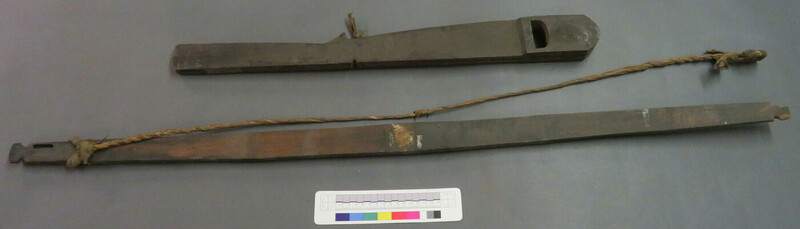
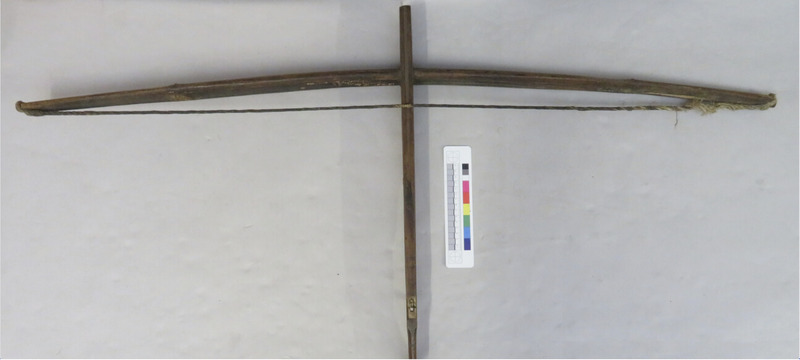
This crossbow originates from the town of Papun in the Bago region of Myanmar, and its use is linked to the Paku Karen (Pakenyo (Sgaw) Kayin) and Karenni ethnic groups. The crossbow possesses a stock made from dark wood, and on its upper surface is a carved-out slot that acts as the bolt channel. The shape of the stock is wider at the rectangular cross-section where the prod would be placed. The front of the stock is rounded, while the end of the stock is tapered. Toward the butt, beginning behind the trigger mechanism, the stock is angled slightly downward. The trigger itself is made of wood and possesses a piece of string tied around it for the purpose of using it with a trap. The prod of the crossbow is made of wood and retains the original string.
Measurements: Depth: max 36 mm, Width: max 64 mm, Length: max 664 mm
Materials and processes: Material Wood Plant, Material Textile, Process Carved, Process Perforated, Process Grooved
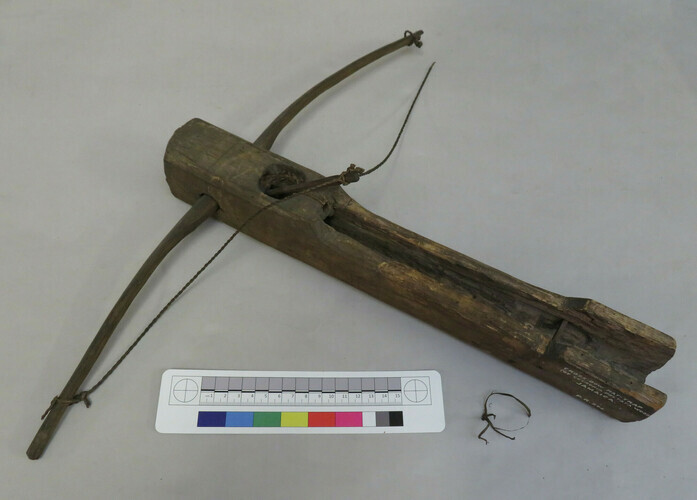
This is a wooden crossbow trap from Jamaica, which is dated to have been made likely before 1874. It features a rectangular wooden stock that has been carved out in the middle. The prod of the crossbow is a carved circular piece of wood that passes through a circular hole in the upper middle of the stock. The original string is intact and consists of a plant material that has been twisted.
Measurements: Length: max 420 mm, Width: max 525 mm, Height: max 110 mm
Materials and processes: Material Wood Plant, Material Plant, Process Carved, Process Twisted, Process Perforated
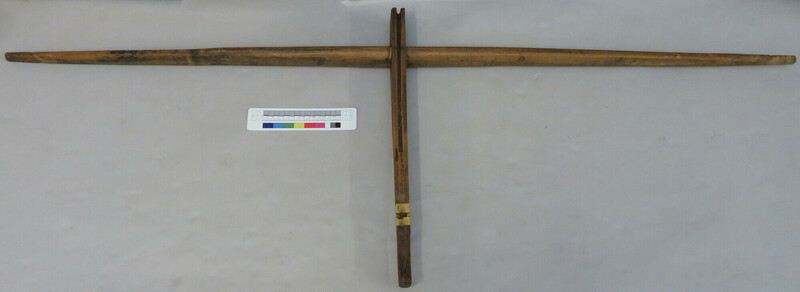
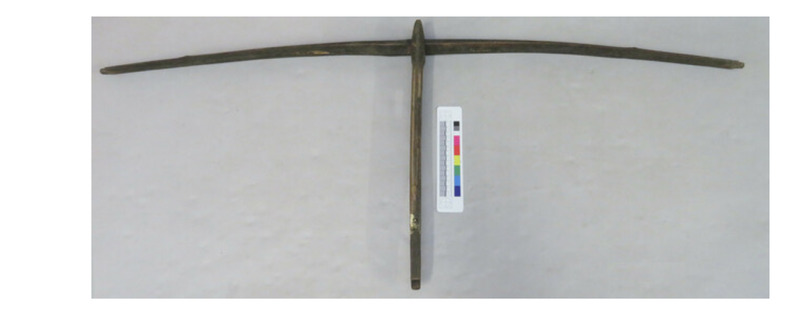
This crossbow originates from the Nagaland region of India, and its creation is dated to before 1924. It features a stock made of wood that tappers toward the butt end. On the upper surface of the stock is a groove that acts as the bolt channel. The trigger is located toward the end of the tapered stock and features a bone trigger. There is an indentation used to hold the string of the crossbow. The prod is made of wood and passes through an oval shaped hole in the upper middle portion of the stock. The original string is missing.
Measurements: Length: max 557 mm, Width: max 27 mm, Width: max 1572 mm total, Height: max 61 mm, Height: max 61 mm total, Length: max 557 mm total
Materials and processes: Material Wood Plant, Material Bone, Material Metal, Process Carved, Process Perforated
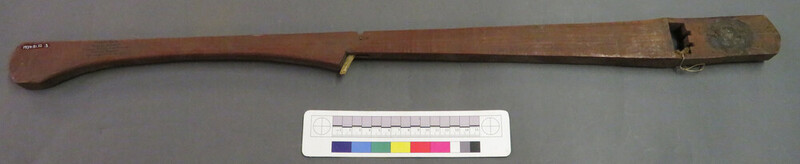
This crossbow stock originates from Myanmar (Burma) in the Karen [Kayin] State region. More specifically, it is from the Dawna Range mountain area that is east of Mawlamyine (Moulmein) city, and its use is linked to the Paku Karen (Pakenyo (Sgaw) Kayin) and Karenni ehtnic groups. The stock is made of wood with a reddish-brown colour that curves at the butt end. From behind the bone trigger to the butt of the stock, the stock’s shape is recessed, curving inwards. The cross section of the stock is rectangular in shape, and there is a hole in the front end where the prod would be slotted, passing through the middle of the stock. Above this hole for the prod is a black circular patch. According to the Pitt Rivers Museum description, the prod for the crossbow is made of wood, although it is not present in the image.
Measurements: Depth: max 18 mm, Width: max 45 mm, Length: max 792 mm
Materials and processes: Material Wood Plant, Material Animal Bone, Process Hollowed, Process Carved
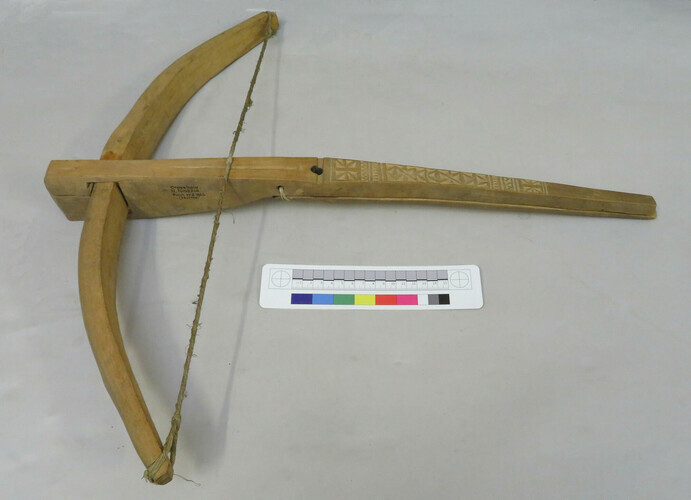
This crossbow originates from Northern Nigeria and is dated to have been made before 1922. The stock is made from wood and curves downward toward the butt. Featured on the upper surface of the stock’s lower half is an engraved geometric design that extends toward the tapered end of the stock. The trigger mechanism is a hinged pin located underneath the stock and is secured with a string made from a plant material. The prod passes through the upper portion of the stock, and the string attached shows minor signs of wear and unraveling.
Measurements: Width: max 590 mm, Length: max 615 mm, Depth: max 66 mm
Materials and processes: Material Wood Plant, Material Plant Fibre, Process Carved, Process Perforated, Process Twisted
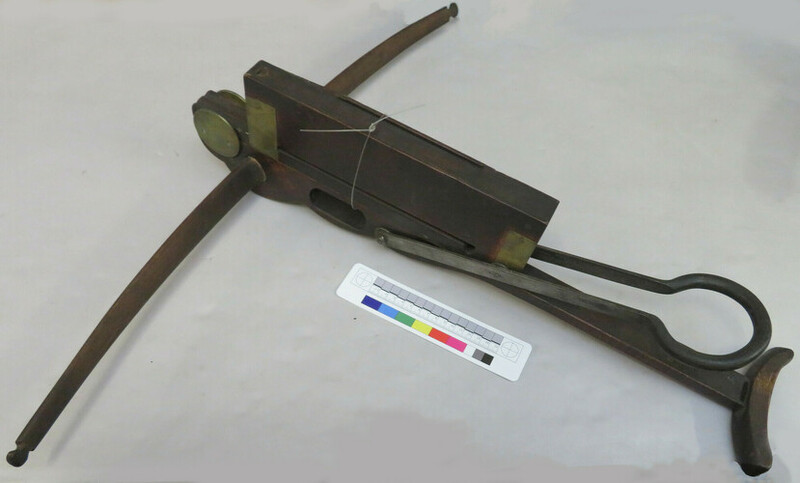
This Chinese repeating crossbow is dated to have been made before 1862. It features a wooden stock fitted with metal plates of copper alloy and a magazine box that is rectangular in shape, attached to its upper surface. Fixed to the middle sides of the stock is a metal lever used to lift up the box, which extends outwards toward the butt. The prod passes through the upper portion of the stock, while the handle at the butt of the stock is a curved wooden piece.
Length: max 674 mm, Width: max 795 mm, Height: max 174 mm
Materials and processes: Material Wood Plant, Material Metal, Material Copper Alloy Metal, Material Brass Metal (uncertain), Material Steel Metal (uncertain), Process Carved, Process Carpentered, Process Forged (Metal), Process Riveted (uncertain)
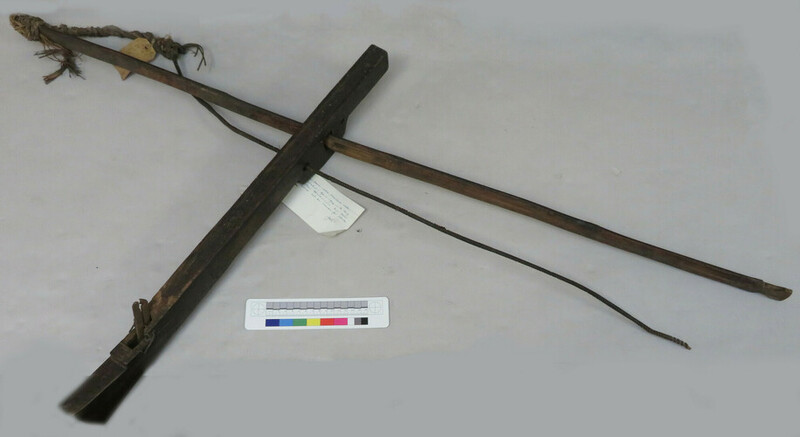
A crossbow from the Nagaland region of India that is used by the Rengma Naga ethnic group. It is dated to have been created before 1930 and consists of a rectangular wooden stock that fans outwards at the butt of the stock. On the upper surface of the stock is a raised line that widens at the intersection of where the prod runs through the stock. The prod, made of a bamboo material, passes through the upper portion of the stock and is secured in a fitted opening within the stock. At the ends of either side of the prod are small cut indentations, and the left side of the prod is wrapped with rope and plant fiber. The original string is made of twisted plant material wrapped with cane and attached to the left side of the prod, but it is severed. The trigger mechanism is located toward the butt of the stock and is made of wood.
Measurements: Length: max 1330 mm, Height: max 93 mm, Width: max 707 mm
Materials and Processes: Material Wood Plant, Material Bamboo Plant, Material Cane Plant, Material Plant Fibre, Process Carved, Process Perforated, Process Bound, Process Twisted
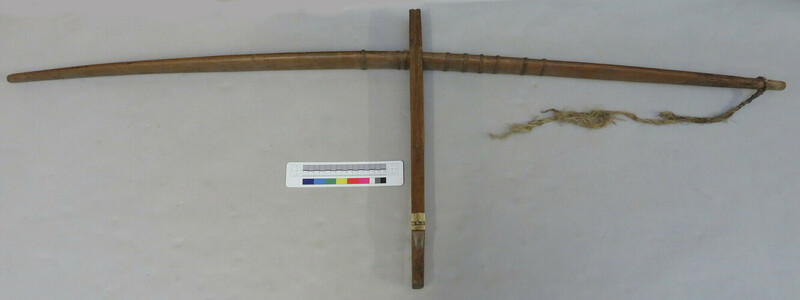
This crossbow originates from the Nagaland region in India, linked specifically to Laruri village. The crossbow is used by the Pochuri and Khiamniungan Naga ethnic groups and is dated to have been made before 1922. The crossbow stock is made of carved wood that curves downwards at the fore end and butt ends of the stock. The prod is made of curved wood and is slotted into the stock, passing through the upper middle portion of the stock. Wrapped around the length of the prod is a series of nine pieces of plaited string bands made of a cane plant material. The original string of the crossbow, made of twisted plant fiber, is attached to the right side of the prod but is torn. There is a bone trigger and notch at the butt end of the stock.
Measurements: Width: max 1455 mm, Length: max 528 mm, Height: max 57 mm
Materials and Processes: Material Wood Plant, Material Cane Plant, Material Plant Fibre, Process Carved, Process Plaited, Process Bound, Process Twisted
This crossbow, dated to before 1947, originates from the Arunachal Pradesh region of India and is used by the Nyishi ethnic group. It features a slender wooden stock that narrows and rounds at the butt end of the stock. The prod is slotted into the middle of the upper end of the stock and is made from a split bamboo material. The original bow string is intact and made of some kind of twisted plant fiber. At the butt of the stock is a trigger mechanism made of bone.
Dimensions Height: max 77 mm, Length: max 1280 mm, Width: max 620 mm
Materials and processes: Material Wood Plant, Material Cane Plant, Material Bone, Material Animal Sinew (uncertain), Material Plant Fibre (uncertain), Process Carved, Process Perforated, Process Wound, Process Twisted
A wooden crossbow from Nagaland, India, dated to before 1897. It features a wooden stock that narrows toward the butt end of the stock with a small curve. The prod is made of a split cane plant fiber and passes through the upper portion of the stock that is fitted within a socket. The original string of the crossbow is missing, and the trigger is made of bone.
Measurements: Height: max 58 mm, Width: max 522 mm, Length: max 1278 mm
Materials: Material Wood Plant, Material Cane Plant, Material Bone, Process Carved, Process Perforated
This crossbow originates from Nagaland, India, and its creation is dated to sometime before 1898. The crossbow’s rectangular stock is made entirely of wood and extends outward in a curved shape at the butt of the stock. The prod passes through the upper section of the stock and possesses a band on it made of plant fiber that is plaited. The trigger mechanism of the crossbow is made of bone and the string is missing.
Width: max 794 mm, Depth: max 63 mm, Length: max 1112 mm
Material Wood Plant, Material Bone, Material Plant Fibre, Process Carved, Process Plaited