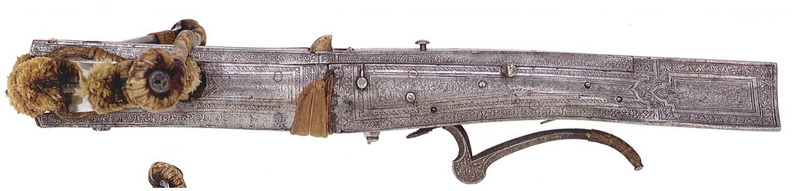
There is a small ring at the tip of the crossbow. The steel prod is covered with parchment. The prod is attached to the stock with bindings, which are decorated with pom-poms. The bowstring has cockscombing. The stock is made of wood covered with thin sheets of steel. The crossbow is etched with patterns of scrollwork and braiding. The prod bears a mark in the shape of a quartered circle surrounded by jagged points. This crossbow was possibly made by Franz Kaphan; the book “Die Armbrust: Schrecken und Schönheit” contains detailed related research.
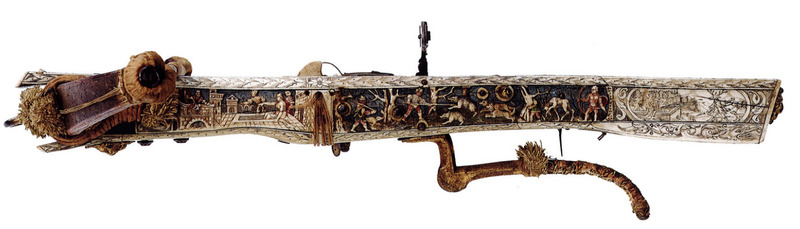
At the tip of the crossbow, there is a small gilded suspension ring. The steel prod is covered in leather which is painted with hunting scenes. It has a safety cord which serves to prevent the pieces of the prod from flying off and injuring someone in the event that the prod breaks. The prod also bears its bowstring, which features cockscombing. The prod connects to the stock with bindings made of hemp cord. There are pom-poms attached to the bindings. Nearby, on the topside of the stock, there is a bolt rest. The number “1567” is engraved into the stock in front of it. In the same area on the underside of the crossbow, there is the number “1656.”
The surface of the wooden stock is covered with plates made of deer antler. These plates are finely engraved and most areas are painted colorfully. These decorations will be described in more detail in a section below.
This crossbow has a four-axle lock system. The nut is held in place by a “nussfaden” or nut thread. The trigger appears to be a hair trigger. The trigger guard is wrapped in cord and has a pom-pom on it.
On the butt of the crossbow, there is a gilded lion’s head.
In terms of decoration, the crossbow depicts many engraved and/or painted scenes from the Bible and from classical mythology. On the right side, nearer the prod, there is a scene from the Wedding at Cana (figures seated around a table, and a figure refilling large jars). Farther down the stock, there is a hunting scene in a forest (hunting dogs, a standing figure with a spear, and a figure on horseback with a spear, and a bear). On the left side, nearer the prod, there is a scene from the Old Testament - King David watching Bathsheba bathe. Farther down the stock, there is a hunting scene in a forest with two people, two hogs, and hunting dogs. A person spears one of the hogs. Farther down, there is another hunting scene. A stag nudges a figure behind a tree while an archer looks on. The final scene is from classical mythology. It shows the goddess Diana and some nymphs bathing. Diana is turning the voyeuristic Actaeon into a stag. This scene covers the part of the stock which becomes the cheek rest.
The lengthwise edges of the stock are covered with unpainted engraved strips of antler or bone, depicting a pattern reminiscent of scales or leaves.
Although not visible in the photos, the sources describe the top and bottom of the stock.
The topside of the stock depicts masks, fruits, and flowers, as well as a scene from the Old Testament (Adam and Eve by the Tree of Knowledge of Good and Evil), as well as a scene with a female figure and foliage. The underside of the stock depicts birds, flowers, tendrils, and scrollwork.
The book “Die Armbrust” mentions an inventory book which indicates that the crossbow was repaired by someone from the Hänisch family in the 19th century, and they added or replaced the bindings, string (the bowstring or the safety cord is not specified), and the lion’s head on the butt.
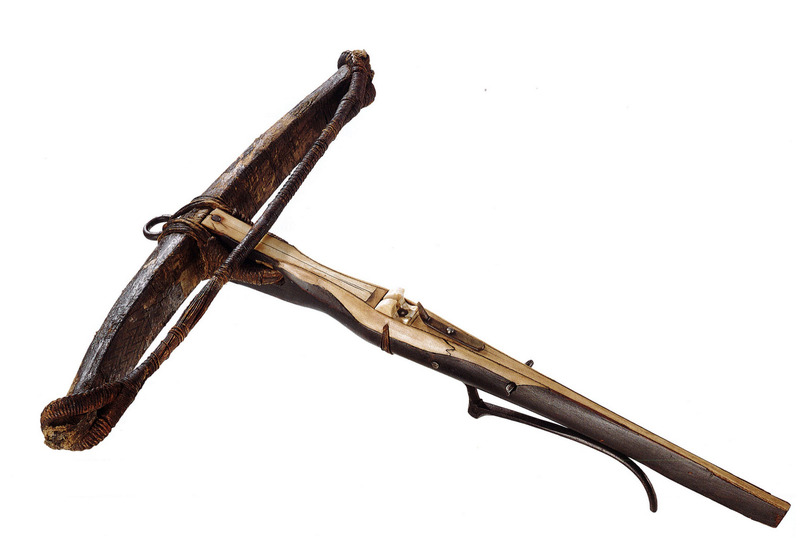
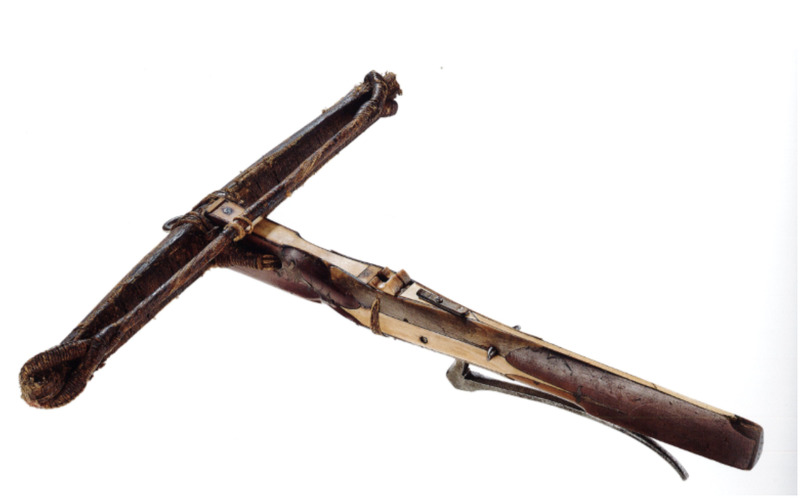
At the tip of the crossbow, there is a small suspension ring. The composite prod is covered with birchbark, likely for waterproofing. It has been stamped with the design of a vertical zigzag pattern made of small dots. Bindings secure the prod to the fruitwood stock. The stock has thin plates of bone on the top and around the lock area. The nut, which appears to be bone, is secured with a nussfaden or nut thread. Just past the nut, there is a broken bolt clip made of dark horn. The crossbow has a single-axle lock mechanism. The trigger lever has a stamp of unknown significance on its corner. The stock has a transverse cranequin pin or lug, to help with spanning the crossbow. The end of the stock is straight and plain.
This crossbow lacks a suspension ring or stirrup.
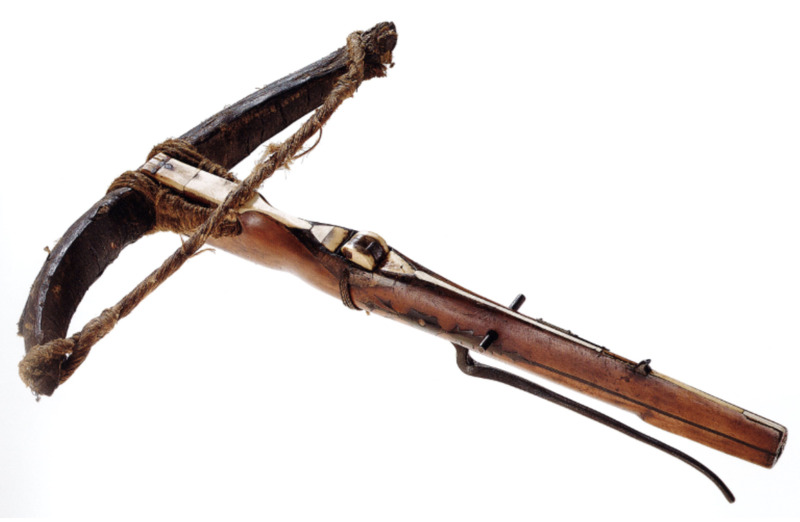
The composite prod has some birchbark left on it. There are traces of decorative patterns on the birchbark. Notably for a crossbow of its age, the prod has its original bowstring. Hemp bindings attach the prod to the wooden stock. The stock has thin plates of bone along the top. Around the nut area, there are also strips of dark horn. The nut is held in place with a nussfaden, or nut thread. The crossbow has a single axle lock mechanism and a trigger lever. The stock has a transverse cranequin pin or lug. The left side of the stock has a partially obscured decorative pattern.
The end of the stock appears to be cracked.
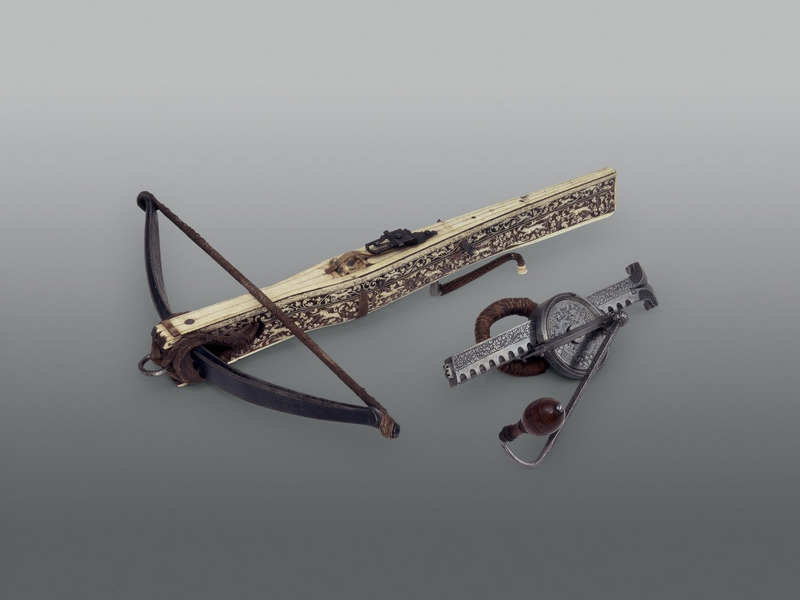
The steel prod passes through the front of the stock secured by a bridle. A circular metal suspension ring is also secured by this bridle at the top of the stock. The bowstring is made of darkened twisted cord. There is a bolt rest at the front of the stock. The wooden stock is inlaid with bone with simple line etchings on the top and elaborate foliage designs and hunting scenes on the side. There is a folding rear sight made of metal. The underside of the stock shows St. Magdalene, a Christian woman with a skull and the year 1565 at the front and Lucretia, a figure from Roman mythology, at the back.
The lock mechanism is a multi-axle rolling nut. The nussfaden is seen under the nut. There is a bolt clip made of horn. The trigger is a simple lever with a cap at the end of possibly bone and a cord winding at the top. There a transverse pin that pierces the stock to anchor the cranequin.
The crossbow is accompanied by a cranequin with foliage motif and dog etchings on the saw and case with a lever and wooden handle. It is missing the belt hook.
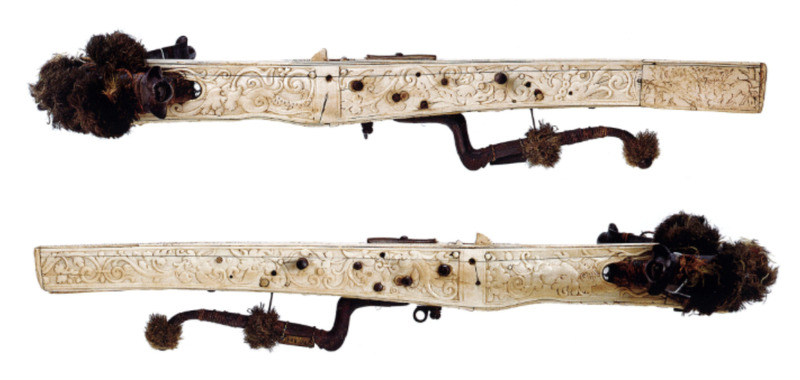
At the tip of the crossbow, there is a small suspension ring obscured by pom-poms. The steel prod has traces of green paint and an unidentified circular stamp. The safety cord has pom-poms attached to it. The prod is lacking its bowstring. Hemp bindings secure the prod to the stock. The stock is covered in bone plates with decorations that are described in a section below.
On the stock, past the nut, there is a bolt clip which has partially broken off. The crossbow has a four-axle lock mechanism. The trigger guard has cord wrappd around it and has two pom-poms. The stock also features a transverse cranequin lug or pin.
In terms of decoration, there are relief carvings on the sides and back of the stock and engravings on its topside. The sides depict chimeras, vines, geometric patterns, flowers and foliage. Farther down the stock, there is a cheek rest at a slight angle. It is decorated with a scene of a man on horseback stabbing a deer with his sword.
On the topside of the stock, the engravings are heavily worn. Nevertheless, it seems that the engravings on the top were added later. The underside of the crossbow features the number “1537.” There is even decoration on the butt of the crossbow. The butt cap depicts a figure in relief.
Though not visible in the photo, sources describe this crossbow as having a suspension ring at its tip. The steel prod is crudely made and still has its bowstring. Bindings made of hemp secure the prod to the fruitwood stock. The topside and underside of the stock are covered with bone plates. The sides feature bone inlay in an elongated diamond-like shape.
The crossbow has a two-axle lock system and a trigger lever. In the stock, there is a transverse cranequin pin. The underside of the stock is engraved with hatching.
Towards the end of the stock, there is a slight cheek rest on the left side.
The butt has some damage.
It is likely that this crossbow would originally have had a composite prod, and the steel prod now present is a replacement from a later point in its period of use.
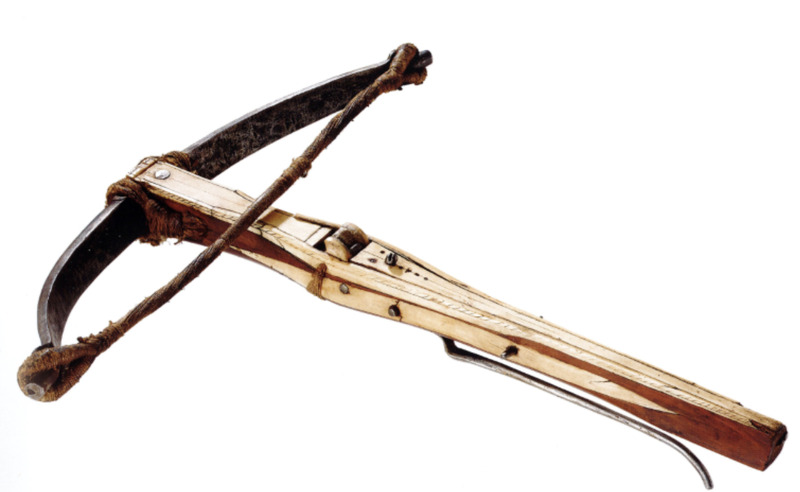
At the tip of the crossbow there is a small suspension ring. The prod is composite. There are fragments of birchbark remaining on the surface of the prod. There are also traces of paint on the prod. The prod has a bowstring that has remnants of waterproofing on it. Hemp bindings secure the prod to the stock. There are remnants of waterproofing on the bindings. The stock is made of fruitwood. It has been carved into a complex sinuous shape.
The top of the stock is covered with bone plating. The nut, made of antler, is secured to the stock with a nussfaden or nut thread. Behind the nut, there is a partially broken bolt clip.
There are elongated plates of bone inlay on the sides and underside of the crossbow. They end in sharp tapers which point towards the prod end and butt end.
The book “Die Armbrust” refers to thin strips of horn around the nut socket and strips of horn on the underside of the crossbow, but these are not visible in the photo. It also refers to delicate leaf designs in dark horn on the underside of the stock, which are not shown in the photo.
The crossbow has a single-axle lock mechanism and a trigger lever.
There is some damage by the butt of the crossbow.