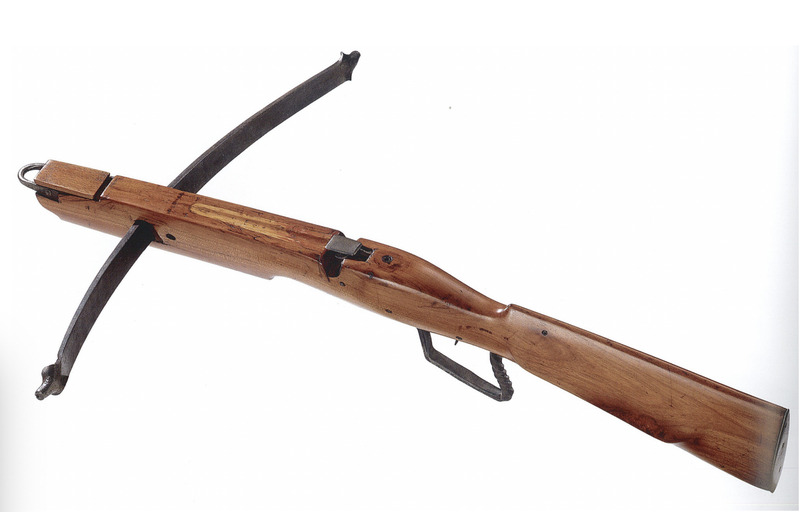
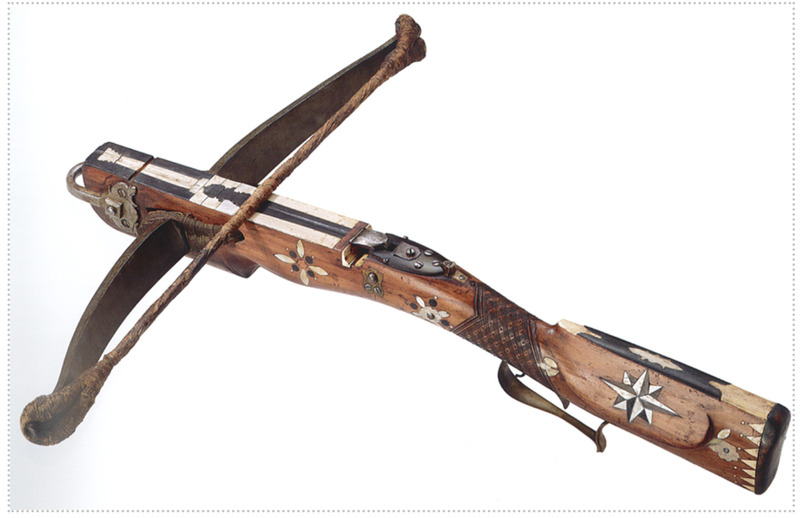
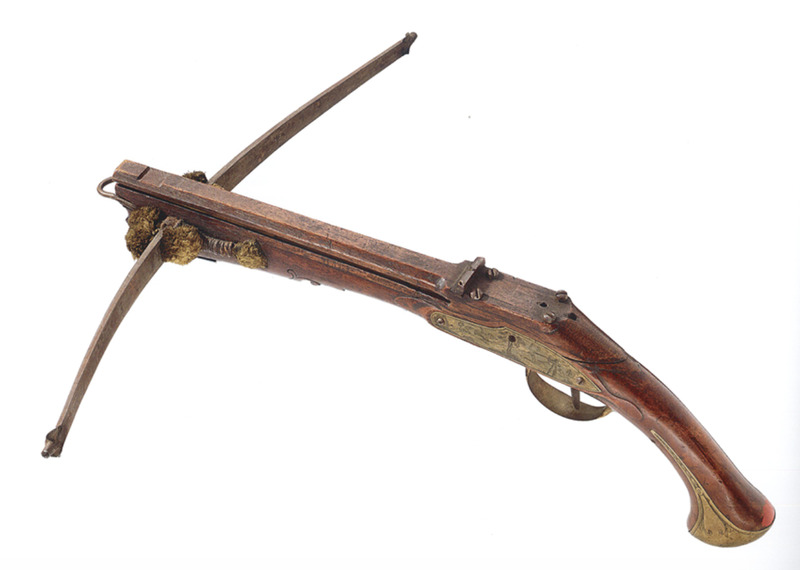
At the tip of the crossbow, there is a small suspension ring. The prod has a very slight curve and lacks a bowstring. It is simply wedged through a hole in the stock. The stock is wooden, possibly made of plum wood. The catch is a keylock. This crossbow has an unusually large trigger guard, which may be a later modification. The stock ends in a butt reminiscent of a rifle, with a left-hand cheek rest protruding only slightly. The very end of the butt has a steel cap on it. The Schnepper seems to lack decorative elements beyond slight shaping of the stock and the steel butt cap.
At the very tip of the crossbow, there is a suspension ring (or anchor point for spanning device). It forms the head of a large screw which enters the tip of the stock. The tip of the stock appears to be made of, or encased in, a steel complex. The prod goes through a hole in this steel complex. The prod is held in place by the pressure of the aforementioned screw, whose blunt tip pushes against the prod.
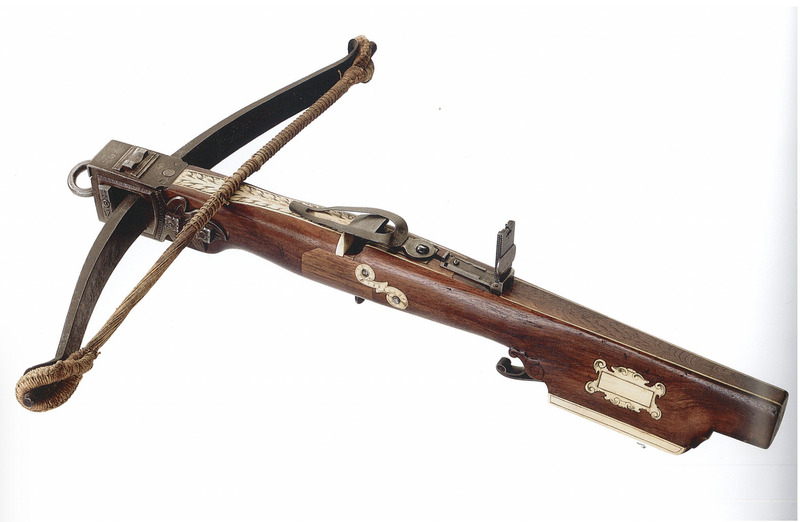
The prod still has its original hemp bowstring. The ends of the bowstring form loops, which are knotted according to the traditional ring hitch “cockscomb” pattern. On the top of the steel tip of the stock, there is a laterally adjustable steel bolt rest. The steel complex has small oak-leaf-shaped panels protruding on the sides, which provide a place for nails or screws to be placed, to secure the steel complex to the rest of the stock. The rest of the stock is made of walnut wood.
There is decorative bone inlay on the top and side of the stock, as well as on the cheekplate. The top of the stock has a plant motif, the side has a curlicue, and the cheekplate has a plaque with some scrollwork (but no writing visible).
The top of the stock has a bolt rest and folding sight, which appear to be made of steel. On the rear sight, the number “5.44” has been stamped. On the base plate of the folding sight, the number “2.44” has been stamped. The flap lock connects to a set trigger. On the sides of the stock, near the lock, there seems to be a repair to the wood, with new wood added.
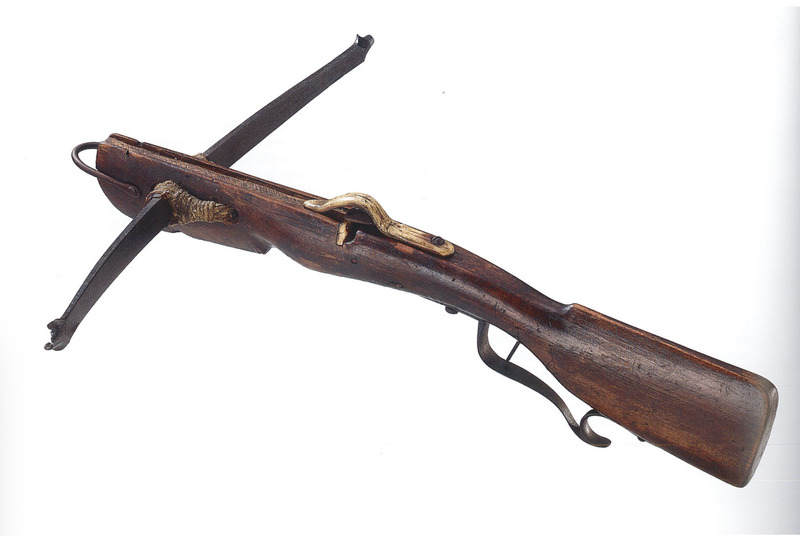
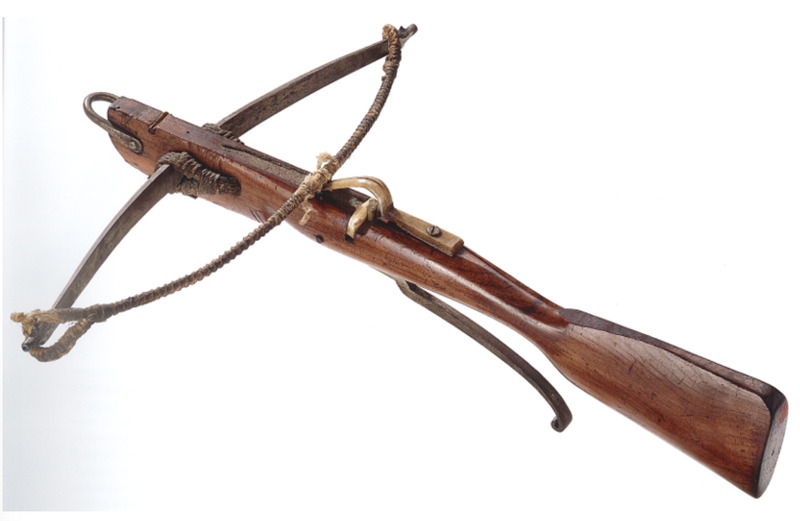
At the tip of the crossbow, there is a small suspension ring. The steel prod is attached to the stock with bindings. The bowstring is missing; other important pieces, such as the bolt rest, are also missing. The bolt clip is still present and intact. It has a groove in the top, which likely served as a sight. There is a keylock catch. The trigger is likely a hair trigger, and there is a trigger guard.
In terms of decoration, the trigger guard has some decorative curliness. The stock has also been shaped. The wood of the stock was likely stained to look darker than it naturally is, since in areas with wear, you can see the lighter wood underneath.
In terms of damage, the wood has dents and scratches and has been worm-eaten. Notable metal parts, such as the suspension ring, keylock, and prod, are corroded.
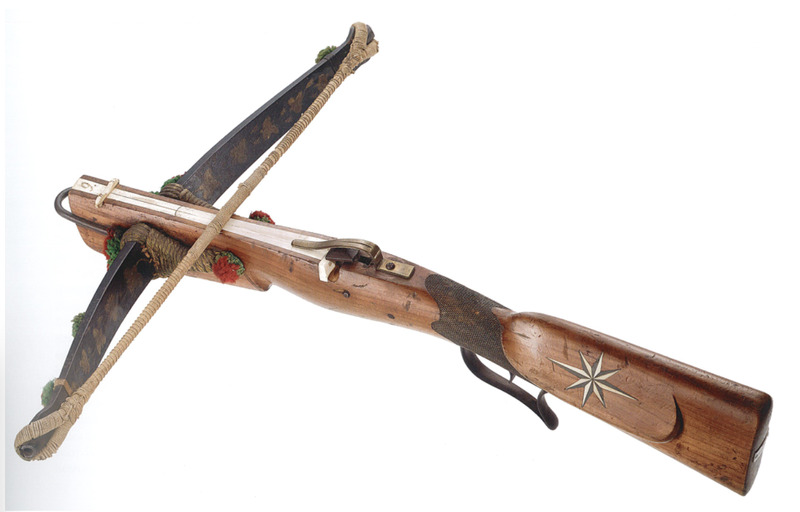
At the tip of the crossbow, there is a small suspension ring. On the stock, the bolt rest and associated bonework is still there. The number 9 is etched in the bonework near the bolt rest. Painted designs of leaves and tendrils decorate the prod. The prod connects to the walnut wood stock with bindings. On the prod and bindings, there are small green and red pom-poms. The bowstring is a restoration.
Further down the stock, there is a brass bolt clip with a groove in the top which serves as a sight. The lock system is a flap lock. The crossbow has a trigger guard protecting its trigger.
Farther down, metal covers a part of the stock which is sometimes called the neck. The metal is decorated with a very fine grid pattern.
The crossbow has a lightly concave cheek rest on the left side. It protrudes slightly from the rifle-like butt of the crossbow. It is decorated with a nautical star made of inlay in bone as well as either ebony or dark horn.
In terms of damage, there is a crack in the wood by the front of the crossbow. Reinforcing rivets are visible. The lack of damage to the bonework above the cracked wood implies that the bonework was replaced at some point.
At the tip of the crossbow, there is a suspension ring - it may also be an anchor point for a spanning device. The sides of the ring widen to form plates which are screwed into the stock. The stock is made of fruitwood, possibly cherry or apple wood. The prod, likely of steel, connects to the stock with bindings. Its bowstring is original, made in the typical ring hitch and ”cockscomb” style.
On the top of the stock, there are bone and ebony inlays which resemble a columnar monument, such as the Belgian “perron.” On the sides of the stock, there are inlays of ebony and mother-of-pearl which form stylized flower shapes. Farther down on the stock, there is a black pattern which may have been etched or woodburned. It resembles plaid and incorporates dots, which the museum describes as a “fisk-skin” pattern incorporating small decorative nails.
There is a cheek rest on the left side of the crossbow. It is decorated with a nautical star like that of a compass rose, made of mother-of-pearl and ebony. The crossbow ends in a rifle-like butt, the end of which is ringed in triangle-shaped bone inlay and capped in dark horn. This crossbow has a set trigger made of steel and a trigger guard made of brass. Most of the crossbow’s metalwork is steel.
On the tip of the crossbow, there is a small suspension ring. The prod has a slight curve to it. The museum notes that the bow displays signs of poor workmanship, which could indicate that it was a later addition. The bowstring is loose, appearing to have been stretched out over time. The prod connects to the stock with hemp bindings. The stock is made of fruitwood. Its bolt rest is missing, but the horn bolt clip is present and intact. The bolt clip has a groove on the top which likely served as a sight. The catch is a mortise lock. The trigger is a lever. The stock ends in a butt like a rifle’s. Aside from the shape of the stock and slight curl on the end of the trigger, there appears to be no decoration on this crossbow.
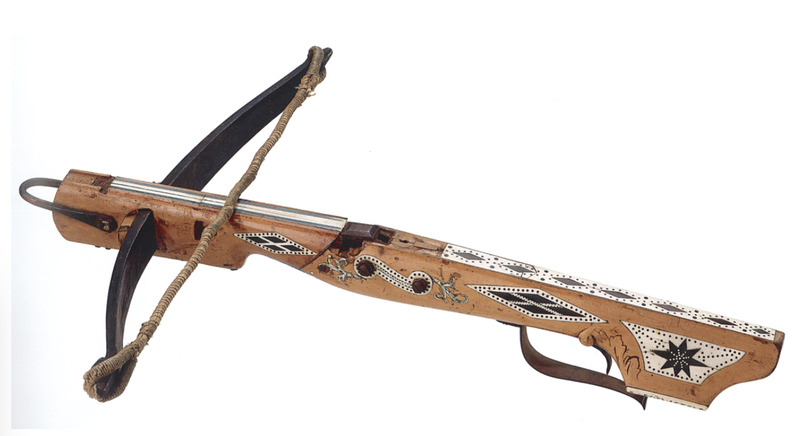
At the tip of the crossbow, there is a suspension ring. The blackened steel prod is wedged into a hole in the stock. A piece of wood is also wedged in beside it to increase pressure and secure the prod. The bolt rest is missing. There is some bonework lining the groove, though some of it is missing. The stock is made of a fine-grained light brown wood, now blemished with scratches and pressure marks. The stock is made of two pieces of wood. A diagonal glued joint is visible near the lock. On the underside, a steel plate, screws, and a bolt support the joint, but despite this, age has weakened it. The lock is a keylock. The trigger is protected with a trigger guard.
The stock is extensively decorated with bone inlay, which is sometimes darkened with linseed oil to create contrasts of black and white. The motifs include diamonds, checker patterns, dots, and some scrollwork. For example, S-shaped scrollwork curls around the lock axles. On the cheek rest, a trapezoidal piece of bone is inlaid. An eight-pointed star of bone darkened with linseed oil is also inlaid.
The angle of the photo obscures the following features. On the lower part of the cheek rest, there is a bone plate inscribed with “H. M. 1778.” Also on the cheek rest, there is the outline of a snail with foliage.
Despite the number on the inscription, the crossbow is dated to a later period, implying that the crossbow is meant to commemorate a historical event or possibly that the numbers do not represent a year.
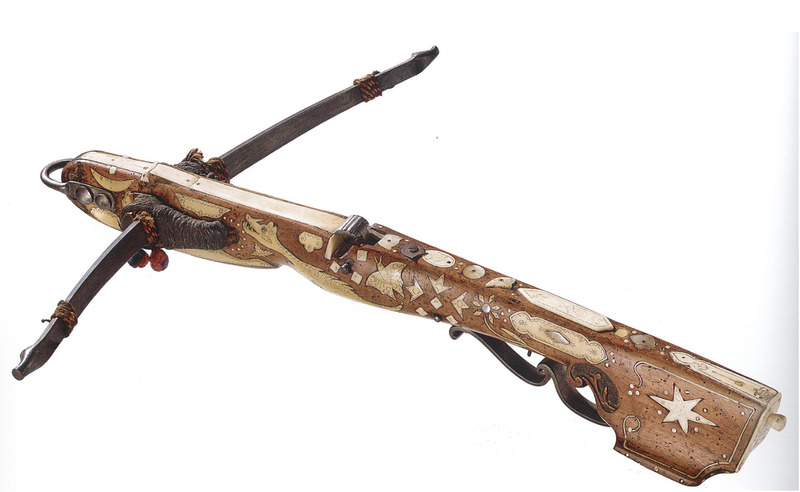
At the tip of the crossbow, there is a suspension ring. The steel prod is secured to the wooden stock with bindings. There is some decorative wool yarn on the prod. The bowstring is missing. There is cracking on the stock near the prod. On top of the stock, bone covers the area between the lock and the prod. The lock is a keylock. Behind the lock, a piece of a steel bolt holder remains. The trigger guard curls decoratively underneath the set trigger.
There are decorative inlay designs in bone and mother-of-pearl on the rest of the stock. Each side has a crescent moon, flower, leaves, dragon, butterfly, and geometric designs including dots and lines. The top of the stock has rather more simple decorative bone plates with worn engravings. The museum notes that the engravings and bonework bear signs of poor workmanship. On the cheek rest, there is a six-pointed star inlay as the centrepiece. The butt of the crossbow has a bone cap with a knob protruding.
At the tip of the crossbow, there is a suspension ring. The prod is steel and it connects to the stock with bindings. Those bindings are decorated with yellowish-greenish tufts of wool. The bowstring is missing.
The stock is made of walnut wood. The bottom of the bullet’s (or pellet’s) path is a bone-covered groove cut into the stock, whereas the top is covered by a screwed-on wooden attachment. The lock is set into the stock, so it is not visible. The trigger is protected by a brass trigger guard, which is engraved. It says “P.S. No: 4.” and depicts a vase.
On both sides of the stock, there is a brass plaque engraved with a hunting scene. On the right side, a hunter shoots at two rabbits. He is accompanied by his dog. The left side shows a hunter shooting at birds. The figures are wearing tricorn hats and long coats, typical of 18th century menswear.
The butt of the crossbow is capped with brass plating.
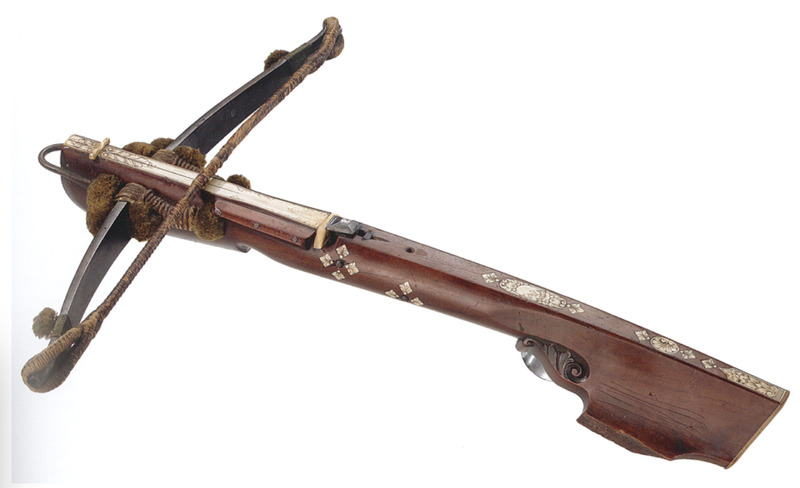
This crossbow has a steel prod bound with bridle pinding and light-colored piece of leather. It bears a mark in the shape of a quartered circle surrounded by five jagged points. The frayed string is made of hemp with knotted loops. Olive-green woollen pompoms are attached to the binding and the braid. The stock is made of reddish-brown fruitwood. The top of the stock is completely inlaid with bone between the lock mechanism and the prod. At the front is an adjustable bolt rest and engraved scrollwork
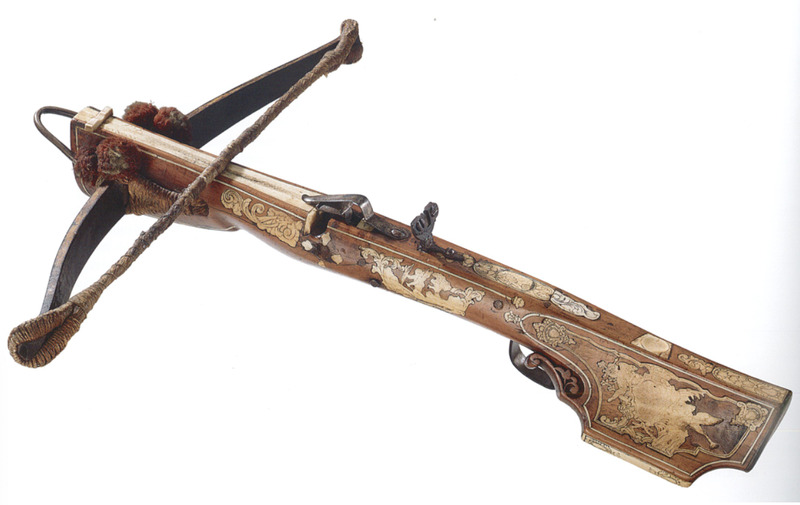
The light brown Schnepper's stock is made of European walnut with a German cheek piece. The wood has numerous dents and scratches, as well as worm-eaten in places and broken off around the lock axles. Between the lock and the prod, the stock is fully covered in bone at the top and provided with a flat-cut bolt groove; a laterally adjustable bone bolt rest is inserted at the front. Worn engravings are visible. On both sides of the stock are various tendrils and landscape depictions with hunting angels. Inlaid blossoms adorn the lock axles. The cheek piece tapers to the front. The cheek piece surface is bordered at the front and back with rocailles. The center shows a crowned shield flanked by two musical angels. The inlays vary in color from white to light yellow. All engravings are partially worn beyond recognition; the shield in particular is almost completely rubbed off. Above the right binding, the name SCHUMANN is written on the stock in black ink in flowing cursive script. A butt cap made of dark horn closes the stock at the back. All steel parts of the key lock and German set trigger are blackened. The bolt holder is bent from sheet metal and attached behind the key lock with a screw. Behind it is a laterally adjustable, semicircular folding sight. The blackened stirrup is riveted to the front of the stock. A binding made of dark brown hemp holds the prod and the binding block firmly to the stock. Red-olive-green tufts are attached here, some of which only hang loosely. The prod, also blackened shows remnants of gold plating. It has a ground mark on the left belly in the shape of a hunting horn or a quartered circle surrounded by five jagged points. The string with knotted loops hangs loosely on the pod; it is frayed in places, and dried-out remnants of dark water-proofing are visible in some places.
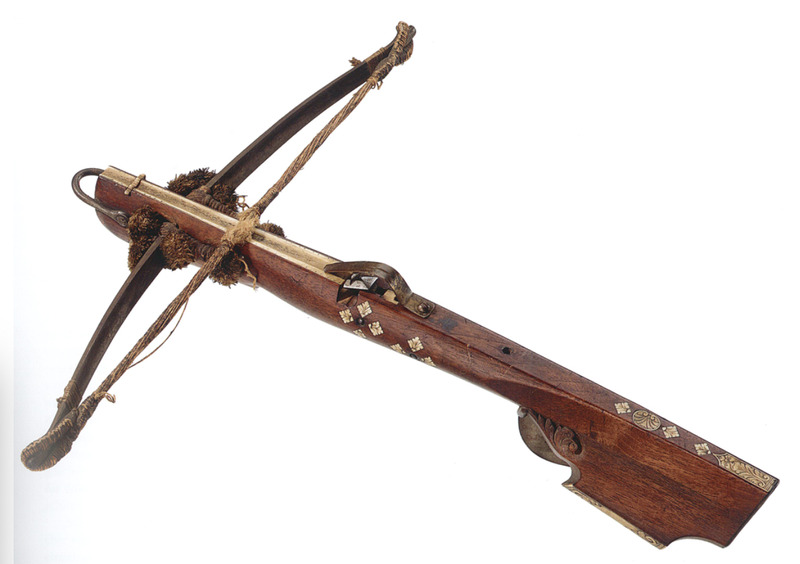
The Schnepper stock is made of dark brown walnut and has a glued-on cheek piece made of the same wood. At the front, the cheek piece is bordered by scroll carved in high relief. In the area between the lock and the prod, the stock is completely covered in bone. The stock has a laterally adjustable bolt rest embedded at the front near the prod. A deep bolt groove is cut in front of the lock; the cancelous bone structure is visible at the base of the groove. The groove is flanked by engravings, which are heavily worn. A key lock with a German set trigger is embedded in the stock. The guard extends far into the space beneath the stock; its attachment lugs are shaped like leaves. A steel stirrup is attached to the front of the stock; like all its steel parts, it is bright and pitted. A bolt holder made of brass is screwed onto the top of the stock. The prod was bound to the stock with a piece of leather. Its binding was painted with gold, of which only remnants remain. Remnants of original blackening are visible in some places on the steel prod. Beige and olive-green pom poms are attached to both the binding and the prod. The hemp string has knotted loops and remnants of dark, dried-out water-proofing, has frayed in places.