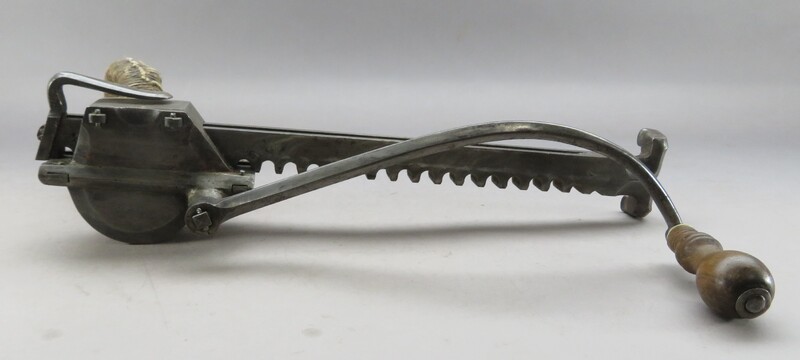
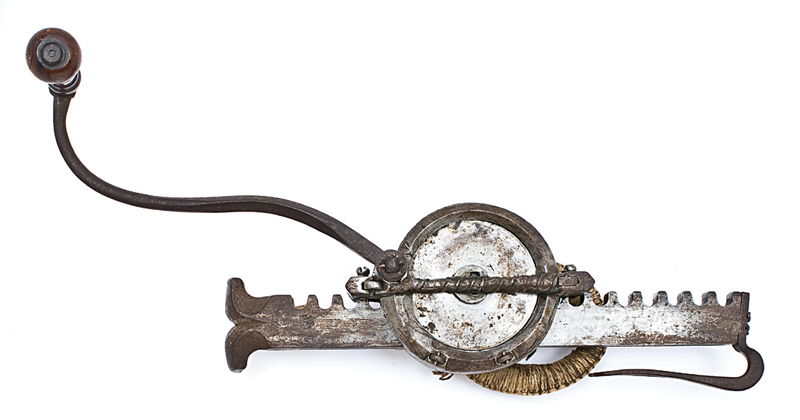
plain ratchet bar formed with a claw mount, rounded gear box with a mark on the underside and a loop for suspension, curved faceted winding bar and turned wooden grip 41.5 cm; 16 3/8 in Property from the McEwen Collection of archery and associated items Estimate: £150-200 Sale Data: 30.06.2021 Hammer Price: €350
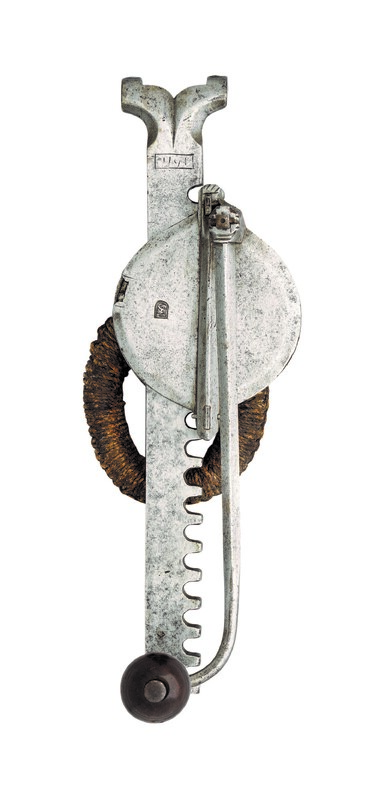
PROBABLY AUGSBURG with circular gearbox stamped with the maker's mark (Neue Støckel 1808) on the cover, ratchet bar engraved with the date in a rectangular frame at the top, faceted winder with turned wooden handle (belt hook missing), and the inside fitted with a cord loop 34.0 cm; 13 3/8 in overall Støckel records this maker circa 1572-87, probably in Augsburg. Estimate: £800-1000 Sale Data: 30.07.2020 Hammer Price: €650
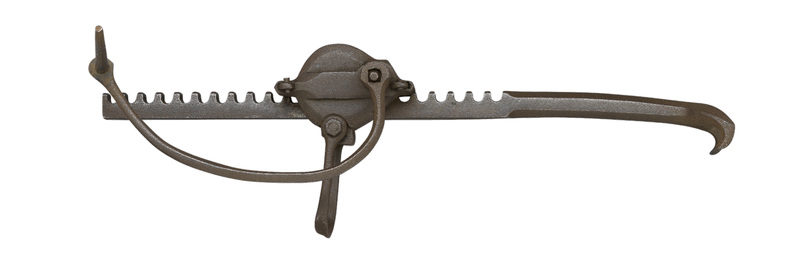
PROBABLY GERMAN 16TH CENTURY comprising ratchet bar with claw terminal, gear-box fitted with a loop on the right for attaching to the tiller, and curved handle bar (grip missing, pitted) 42cm; 16 1/2in Estimate: £600-800 Sale Data: 07.12.2011 Hammer Price: €700
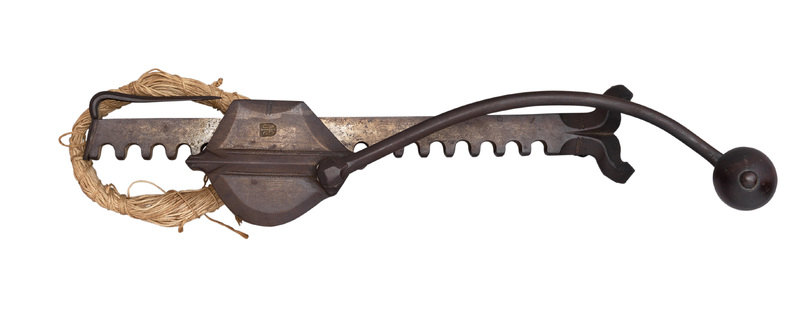
PROBABLY AUGSBURG with circular gearbox stamped with the maker's mark (Neue Støckel 1808) on the cover and pierced with a tracery rondel on one side, ratchet bar engraved with the date and the maker's initials 'AB' at the top behind the claw terminal (belt-hook missing), and faceted winder with turned wooden handle, and the inside fitted with a later cord loop 42.5 cm; 16 3/4 in Another cranequin by this maker (recorded by Støckel circa 1572-87, probably in Augsburg) was sold in this room 30th July 2020, lot 209. Estimate: £800-1000 Sale Data: 02.12.2020 Hammer Price: €900
shaped gearbox fitted with chamfered cover, decorated with slender ropework patterns and stamped with a brass-lined maker's mark (Neue Støckel 5424), ratchet bar with claw terminal en suite with the gearbox cover, scrolling winder with turned wooden handle with bone ferrule, belt hook and later cord loop 32.5cm; 12 7/8in Another cranequin by this maker is preserved in the Museum für Deutsche Geschichte, Berlin. Estimate: £1000-1500 Sale Data: 29.06.2011 Hammer Price: €1200
circular gearbox engraved with the initials 'LFH' on one side and stamped with the maker's mark (perhaps Neue Støckel 3168) beneath, the ratchet bar engraved with the letter 'H' at the top, scrolling winder with turned wooden handle, pierced belt hook, and the inside fitted with a cord loop 35.5cm; 14in Estimate: £700-900 Sale Data: 10.12.2008 Hammer Price: €1800
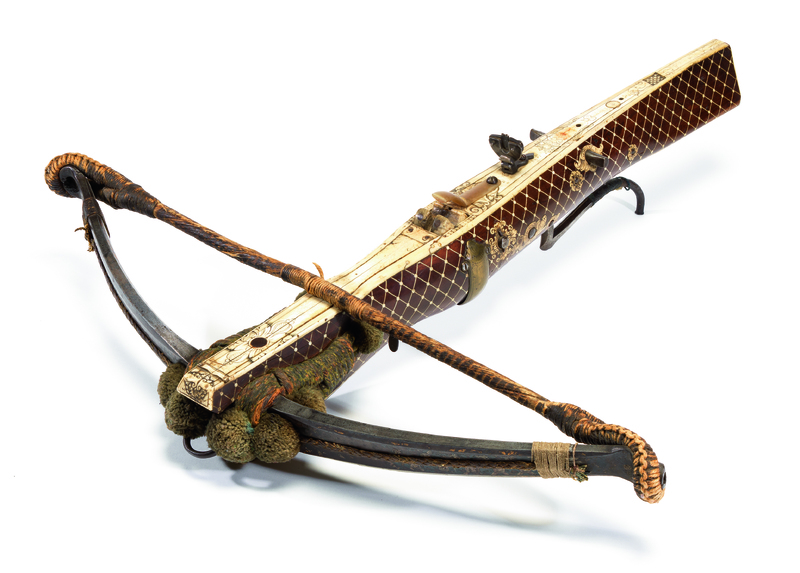
POSSIBLY BOHEMIAN with heavy steel bow struck with a mark (Neue Støckel 6451) on the belly to the right of the tiller, retained by later cords with green pom poms (loose), small iron stirrup and fitted with a portion of an early string of twisted cord and sinew, strongly formed tiller veneered over its full length with a framework of scrolls and bouquets of fruit, inlaid with engraved staghorn panels on each side comprising two differing coats of arms at the top, three pairs of half-length portrait figures in contemporary dress, a further portrait on the left and the figure of Ceres on the right, all on a ground of minute staghorn pellets framed by tightly scrolling staghorn tendrils carrying ball flowers left natural and enriched with green stain, framed top and bottom by a slender ropework frame, the top veneered in engraved staghorn decorated with scrolls, bouquets of fruit and a herm, fitted with bolt-rest, bone nut, and later iron bolt-clip, a pair of lugs for a cranequin, the underside veneered over its full surface and decorated with the standing figure of Venus on her scallop shell, a bouquet of fruit centring around an aperture for the cocking rod, a mannerist mask, further bouquets of fruit and an amorous couple above a heart (the tiller with small cracks and repairs, some inlays perhaps replaced in early working life), iron trigger-guard, and folding trigger 73.0 cm; 28 3/4 in tiller The arms are perhaps those of Berka z Dubé and Zajícové z Hazmburka. The style of inlay is reminiscent of firearms from Thuringia and Saxony from the last quarter of the 16th century though the overall scheme of design and its execution is more subdued. The head dress on many of the figures is related to illustrations of 17th century Burghers of Silesia and Bohemia, a fact that is reinforced by the two coats-of-arms, almost certainly for man and wife that would appear to be from those lands. The manufacture and decoration of crossbows was often subject to conservative design as evident in this example, clearly echoing the richly decorated examples of neighbouring Saxony. The tradition of crossbow shooting lasted many centuries and continues to this day in many parts of Europe, notably in Saxony. See Breiding 2013, p. 15. Estimate: £6000-8000 Sale Data: 30.07.2020 Hammer Price: €13000
heavy steel bow painted on the belly and back with an elaborate trellis design (small areas of wear and losses), retained by early cords with green pom-poms, small iron stirrup and fitted with an early string of twisted cord, tiller inlaid on each side with a matching trellis design in staghorn and enriched with engraved staghorn washers and scrolling marine monster plaques, the top veneered in engraved staghorn decorated with symmetrical panels of scrollwork, foliage, bouquets of fruit, and engraved with the owners initial, 'JZ?' and the date, perhaps 1766 (rubbed, the tiller with a small repair on the left of the nut), fitted at the front with bolt rest, bone nut, horn bolt-clip (the front portion missing), folding adjustable iron sight, a pair of lugs for a cranequin and chequered thumb-rest, the underside inlaid with engraved staghorn plaques with further scrolls, including a central monsterhead with a pierced mouth for inserting a cocking rod, iron trigger-guard, and folding trigger 77.0 cm; 30 3/8 in tiller Provenance The Lord Astor of Hever, sold Sotheby's, London, 5th May 1983, lot 84 The trellis design on the bow and the tiller is reminiscent of contemporary hunt enclosures. The marine monsters are reminiscent of the inlay on earlier Saxon pistols. Estimate: £3000-5000 Sale Data: 30.07.2020 Hammer Price: €8500
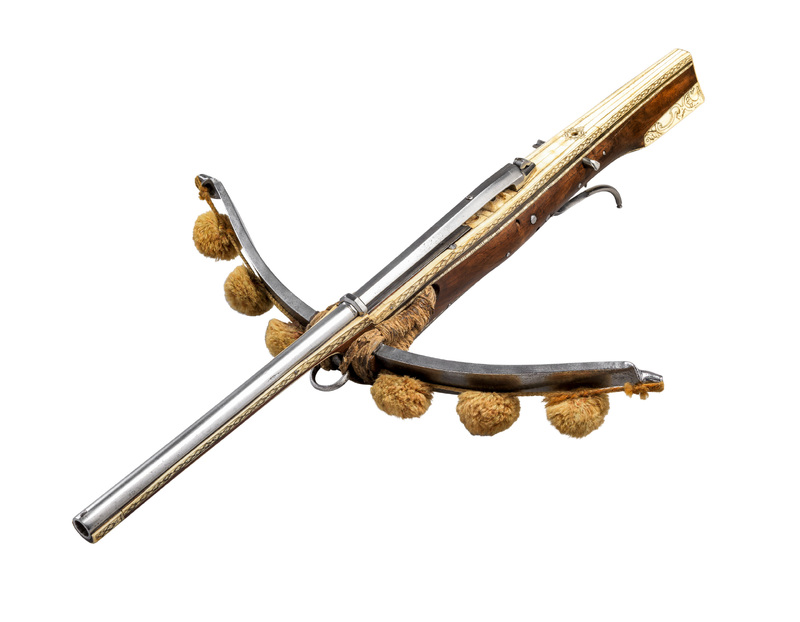
robust steel bow struck with a mark, a horn (Neue Støckel 5217 for similar), bound with cords over a wooden saddle with suspension ring and retaining six of its original decorative woollen pom-poms, fruitwood tiller, the greater part of conventional form, swelling about the release mechanism and shaped for the cheek, the forward section faceted, extending in the manner of a pistol fore-end and seating an iron two-stage barrel , the forward half with polygroove rifled bore, retained by a pair of screws entering from beneath, a raised faceted band behind the bow and a short tang, the octagonal rear half of the barrel open at both sides, extending over the nut and the tang fitted with pivoted back-sight, the tiller with tubular bullet-magazine running forwards from a horn bullet-feed immediately ahead of the nut, the feed-block rising on a spring through an aperture in the underside of the tiller and released by a sliding catch, the magazine filled from a port beneath the bow closed by a horn sliding cover, with iron bullet-channel laid over the chase, iron lugs for a spanning-lever, folding trigger, two-stage trigger-guard and pivot safety-catch, the tiller veneered in white horn finely engraved with German baroque ornament over its upper and lower surfaces, decorated with acanthus borders, an acanthus rollwerk cartouche enclosing the lower aperture of the bullet-feed, a similar cartouche about the aperture for a rod inserted to set the action and a more elaborate engraved cartouche framing the base of the trigger-guard, inlaid over the sides with engraved beaded horn lines along its full length behind the bow, and the remaining forward section decorated with further white horn inlays including a pair of engraved plaques impaled by the barrel screws, and the border panels and the terminal cap all engraved with acanthus ornament (the bow-string and the pivot cords for the nut missing) 92 cm; 36¼ in 61 cm; 24 in bow Barrelled crossbows were intended to discharge a bullet seated in the cupped head of a small iron rod known in France as a chasse de fer. A repeating magazine system, as in this rare instance, would still necessitate each bullet to be seated on a rod. The present bow has provision for probably up to eight bullets to be held in its magazine; another German example, probably unique, is said to have held 24: see Blackmore 1971, pp. 202, 207. For an account of the development and use of barrelled crossbows see Paterson 1990, pp.88-91. Estimate: £4500-6000 Sale Data: 03.12.2014 Hammer Price: €4200
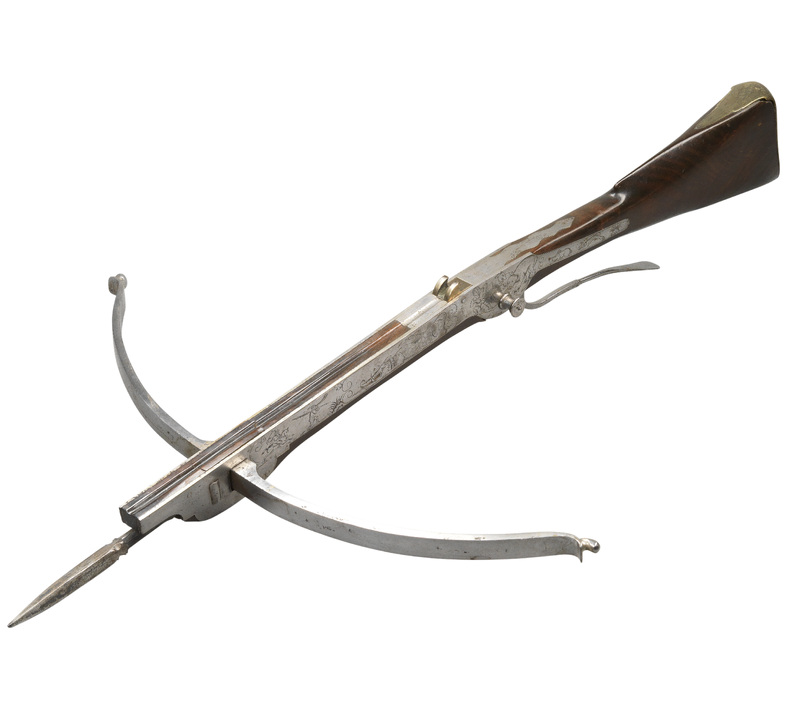
robust steel bow stamped with two marks, a castellated tower and a crescent, on either side of the tiller, retained by a pair of long burnished steel side-plates, the left engraved with hunting scenes involving a huntsman and a mounted figure, a marine monster, and a hound in pursuit of a rabbit, all within scrolling linear frames, and a boar hunting vignette above the date 1631, the right with further framed scenes including a dragon and a boar set upon by hounds above the maker's initials 'W.H.', figured walnut tiller of gun-stock form, fitted with a steel spike at the front, short steel bolt channel ahead of a brass nut, a pair of burnished steel moulded lugs for a winding device, long trigger, and engraved brass butt-plate 80.5cm; 31 3/4in tiller Estimate: £1500-2500 Sale Data: 07.12.2011 Hammer Price: €1500
BY H.W.MORTIMER & SON, 89 FLEET STREET, GUNMAKERS TO HIS MAJESTY, CIRCA 1806-12 with slender steel bow fitted with later expertly constructed string, highly figured tiller incorporating steel gaffle, fitted with folding forward sight engraved with a stonebowman in contemporary dress beneath, the forward portion of the tiller inlaid with iron plaques engraved with scrolls and foliage, a pair of flush-fitting scrolling side-plates signed on scrolls carried by conventional foliage and flowers, folding back-sight with four sighting apertures and engraved with trophies-of-arms on the bed, engraved lever button decorated with a flowerhead, engraved trigger-guard decorated with a trophy-of-arms on the bow and with pineapple finial, and engraved butt-cap (the iron parts with areas of light pitting) 72.5 cm; 28 ½ in tiller Estimate: £2500-3000 Sale Data: 04.12.2019 Hammer Price: €2200 Mortimer
blued steel bow decorated with a gilt band top and bottom at each side, fitted with an early string, retained by gilt cords and with its green pom-poms, fruitwood tiller fitted with an additional bar above and with bone bolt channel (very light worm damage), engraved with the date ahead of the string-release, inlaid with engraved staghorn segmental lines and plaques including panels of rococo foliage inhabited by hounds on each side of the mechanism, a doe and a stag pursued by a hound in a rococo landscape on the left of the cheek-piece and further decorated panels on top including a scalloped hollow for the thumb, steel string-release, double set trigger, steel trigger-guard, and bone butt-plate engraved with the number '1', 'I. G. E.' and 'Ertell' 67.0 cm; 27⅜ in This was converted for use as a slurbow in its early working life. Two gunmakers of this name, a father and son, are recorded circa 1700-63 and 1728-94 respectively. A number of firearms by them are preserved in the former Electoral gewehrkammer, Dresden, though neither is recorded as a crossbow maker. It is likely that this is the work of the father as the son is recorded in Amsterdam as both Burgher and Master the year the present bow was manufactured. See Schaal 1975. Estimate: £2000-2500 Sale Data: 29.06.2016 Hammer Price: €1800 Erttel