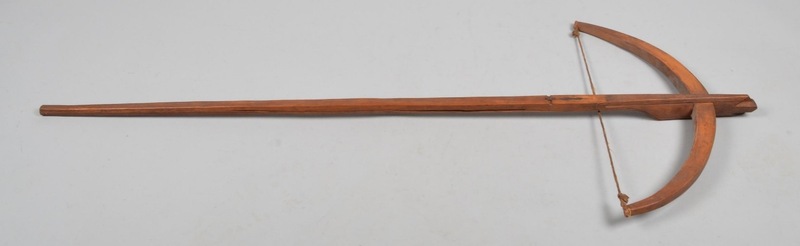
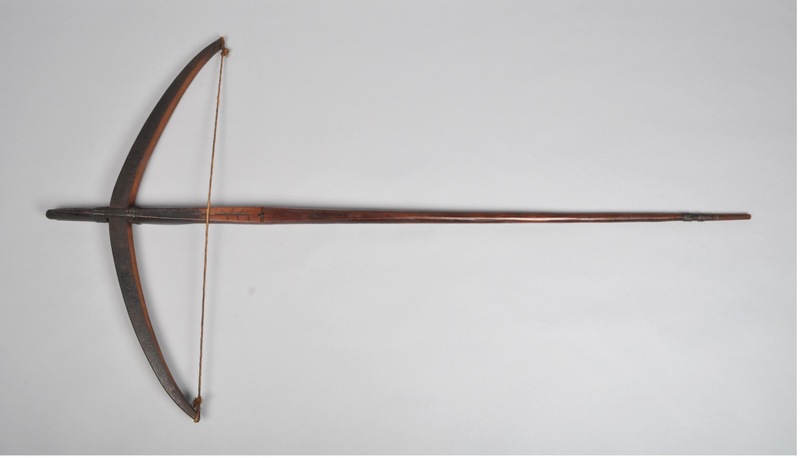
This crossbow is made of wood with a twisted hide bowstring. The stock and prod are both wooden, forming a thin and narrow structure. The trigger lever is hinged beneath the stock and secured with an iron pin.
Materials/Media Wood, skin, beeswax
Dimensions/Measurements Height: Height: 7 centimetres
Width: Width: 60 centimetres
Depth: Depth: 124 centimetres
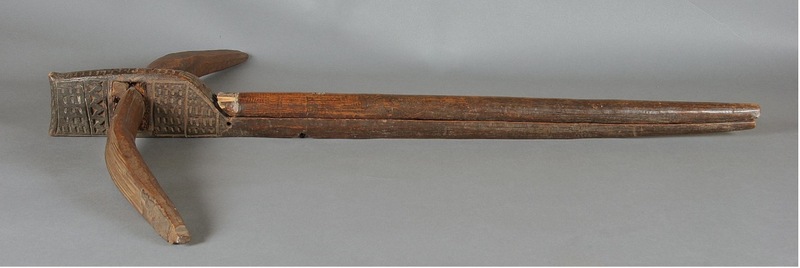
This crossbow features a thick wooden stock composed of two layers, with an additional piece of wood affixed to the main body. A hole is visible on top of the lower stock layer to connect both pieces together. The stock tapers toward the butt end and broadens at the front, where carved decorative shapes are present. A thick wooden prod, which narrows toward the ends, is inserted through a hole in the front section of the stock. The bowstring is missing.
Materials/Media Wood
Dimensions/Measurements Height: Height: 8.40 centimetres
Width: Width: 66 centimetres
Depth: Depth: 82 centimetres
Other notes Donated by: Mrs Ethel Maclear
Donated through: Mrs Eileen M Bickford
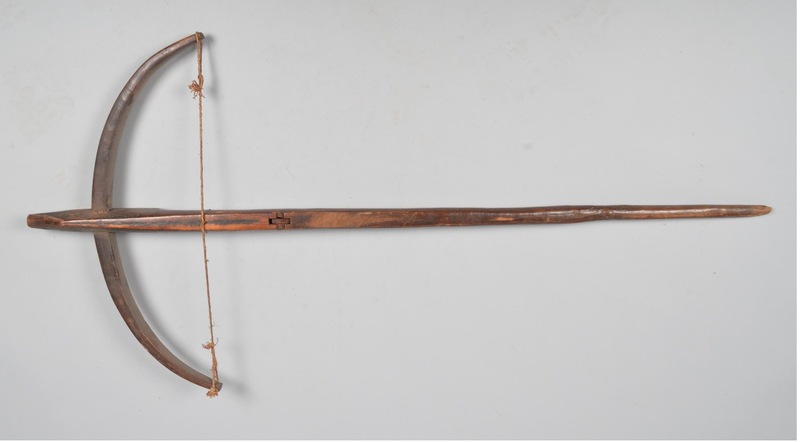
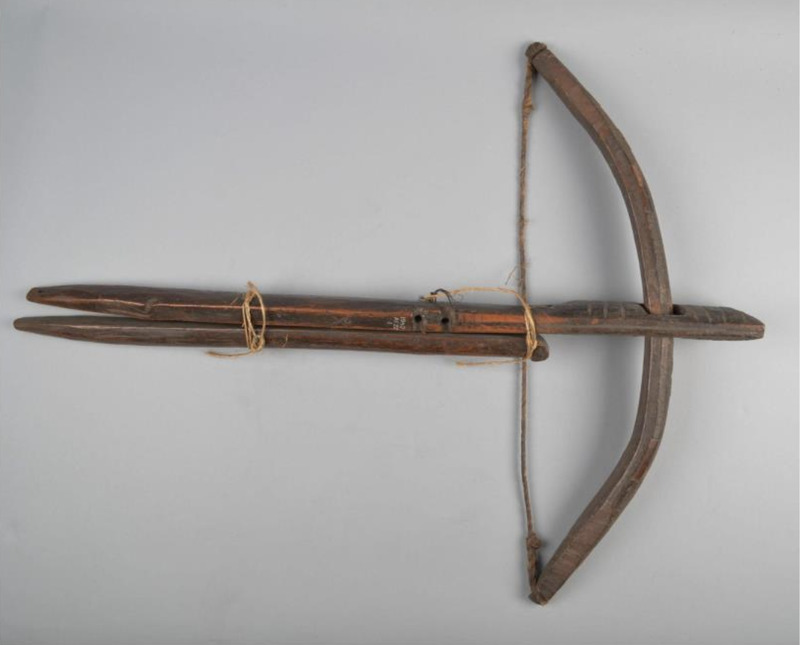
This crossbow, made by the Ijebu Yoruba or Bini, features a thin, straight wooden stock and a matching wooden prod. The prod is fitted through a rectangular hole near the front of the stock. A thin fiber string is tied to the ends of the prod. The stock has two carved dips along its length, each containing a hole that passes through the wood.
Materials/Media Wood, fibre
Dimensions/Measurements Height: Height: 73.50 centimetres
Width: Width: 57.30 centimetres
Depth: Depth: 8.50 centimetres
Other notes In 1940, Mrs. Ethel Maclear donated Af1940,22.1 through her daughter, Mrs. Eileen M. Bickford. The items had been collected in Nigeria by her late husband, Lt.-Col. Percy Maclear of the West African Frontier Force (1875–1914), and were believed to have been brought back to England in 1906.
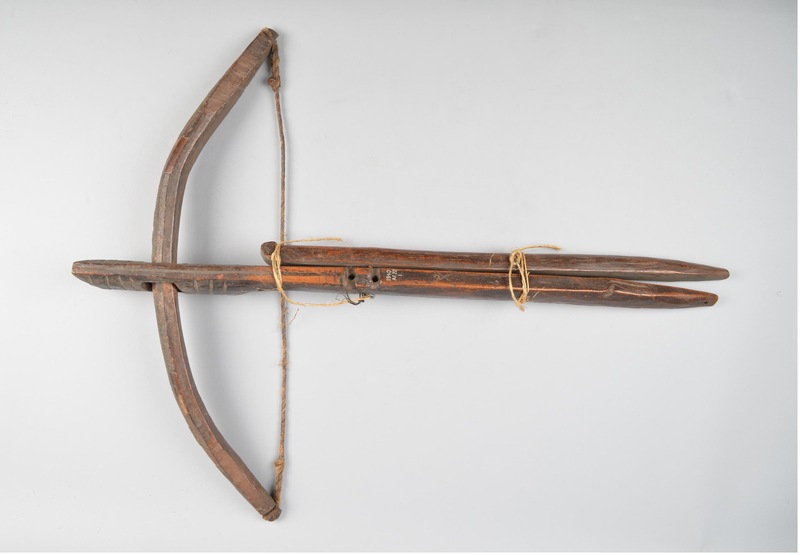
This crossbow features a long, thin wooden stock that tapers toward the butt end. A trigger or axle mechanism is located near the front section of the stock, just behind the bowstring. The front end of the stock is thicker and decorated with carved lines. The prod is thick and block-like at the center, tapering toward its ends. The bowstring appears to be made of twisted fibre.
Materials/Media Wood
Dimensions/Measurements Height: Height: 122 centimetres
Width: Width: 49.90 centimetres
Depth: Depth: 4.80 centimetres
Other notes Donated by: Major P H G Powell-Cotton
This thin wooden crossbow is constructed from wood and iron, featuring a 'split shaft' trigger release mechanism. Binding near the bridle is made of iron.
Materials/Media Wood, iron
Dimensions/Measurements Height: Height: 133 centimetres
Width: Width: 49.20 centimetres
Depth: Depth: 4.50 centimetres
Other notes Donated by Major P H G Powell-Cotton
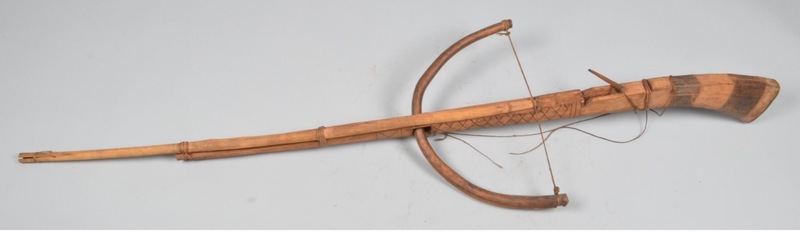
A wooden crossbow shaped to resemble a musket. The thick stock ends in a rifle-style butt and extends into a long, rounded barrel. A wooden prod, shaped in a semi-circle, is fitted horizontally through a rectangular hole in the middle of the stock. A thin wooden rod runs along the top length of the stock, secured in place with fiber bindings. A simple wooden trigger is mounted beneath the stock, while a lever mechanism is positioned on top near the rear. The sides of the stock also feature incised geometric decoration.
Materials/Media Wood
Dimensions/Measurements Height: Height: 12 centimetres
Width: Width: 39 centimetres
Depth: Depth: 145.50 centimetres
Other notes Donated by: Colonial Government of Nigeria (Chief Secretary)
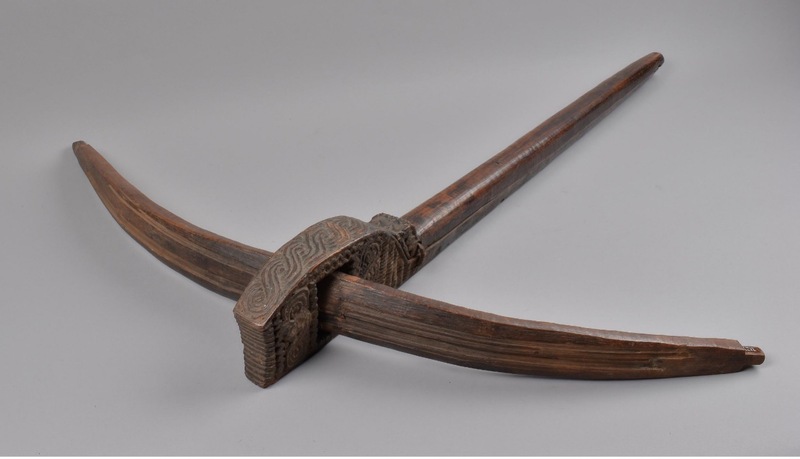
This crossbow is constructed with a wooden stock and prod. The stock is thick near the front end and tapers into a pointed form toward the butt end. Carved patterns decorate the front portion of the stock, which also features a square hole through which the prod is inserted. The wooden prod is slightly curved, broad at the center, and tapers to points at either end. Lines are carved along the length of the prod. The bowstring is missing.
Materials/Media Wood
Dimensions/Measurements Height: Height: 9.50 centimetres (a+b)(a+b)
Height: Height: 9.50 centimetres (a)(a)
Height: Height: 6 centimetres (b)(b)
Width: Width: 69.50 centimetres (a+b)(a+b)
Width: Width: 4.90 centimetres (a)(a)
Width: Width: 69.80 centimetres (b)(b)
Depth: Depth: 75.50 centimetres (a+b)(a+b)
Depth: Depth: 75.50 centimetres (a)(a)
Depth: Depth: 16.60 centimetres (b: max)(b: max)
Depth: Depth: 3 centimetres (b: min)(b: min)
Other notes Purchased from: Arthur Harold Unwin
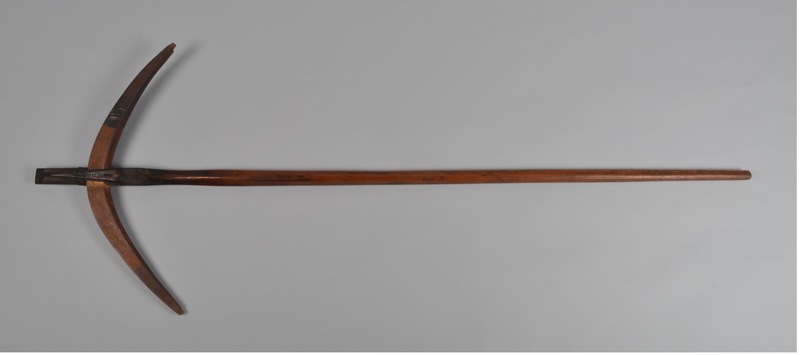
This crossbow is crafted from heavy, darkened wood with a thin and streamlined form. The bowstring is missing. It was made by the Fang ethnic group.
Materials/Media Wood
Dimensions/Measurements Length: Length: 139.50 centimetres
Width: Width: 68.10 centimetres
Depth: Depth: 4.60 centimetres
Other notes Donated by Wellcome Institute for the History of Medicine
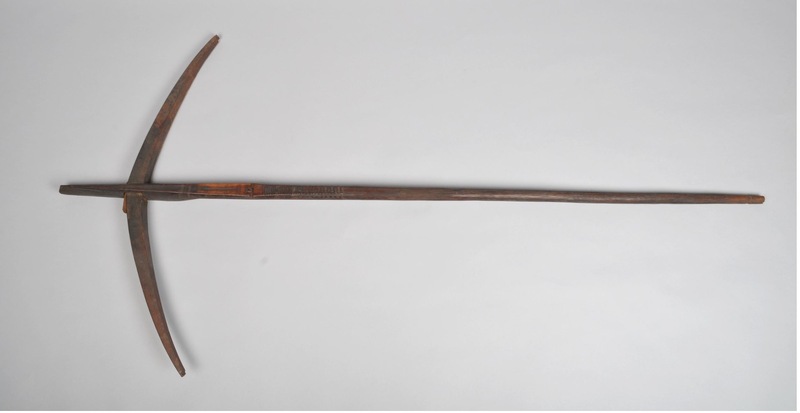
This crossbow is made of heavy darkened wood and fitted with a bowstring of twisted fibre. Binding near the bridle appears to be made of iron. A small groove is carved into the top of the stock, most likely containing some sort of an axle mechanism. Another small and shallow groove runs lengthwise along the stock, likely for positioning the arrow before shooting.
Materials/Media Wood, fibre, iron
Dimensions/Measurements Length: Length: 125 centimetres
Width: Width: 68 centimetres
Depth: Depth: 4.60 centimetres
Other notes Donated by Sir Augustus Wollaston Franks
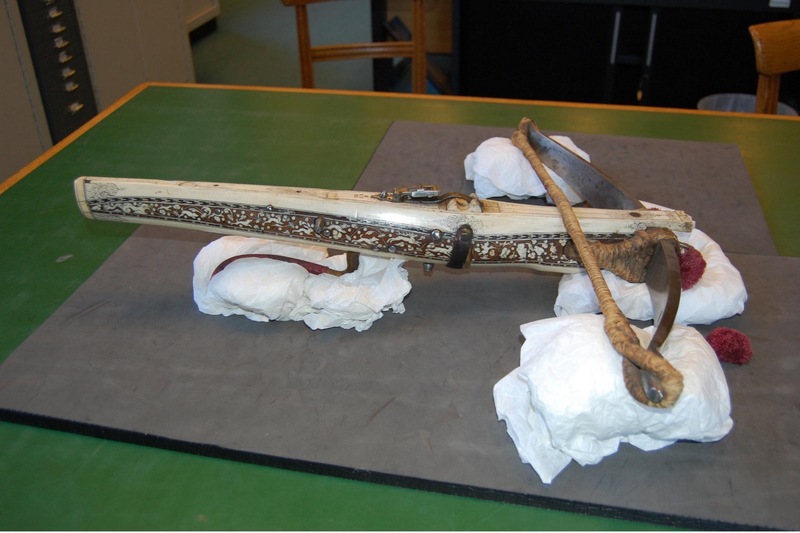
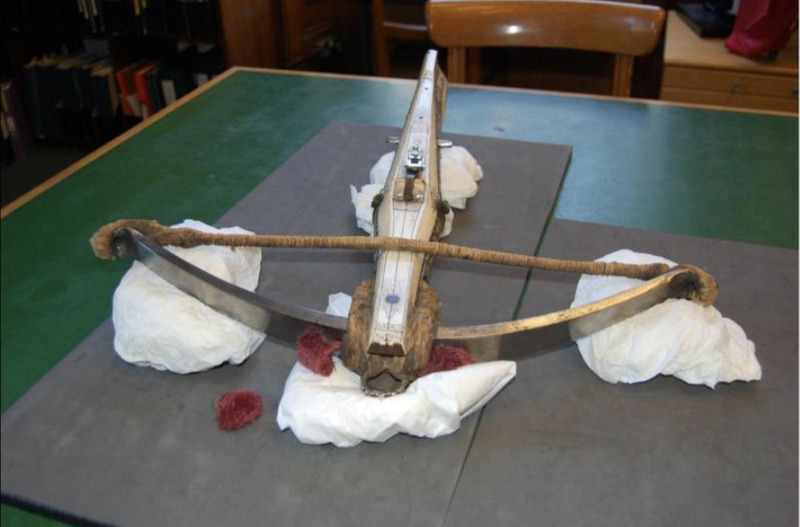
This crossbow features a straight wooden stock that tapers toward the butt end. It is elaborately inlaid with engraved ivory panels featuring decorative hunting scenes, including scrolling foliage and figural scenes, such as a standing nobleman in 16th- or 17th-century attire. The prod is made of steel and is bound to the stock with a thick, twisted rope bridle. The rope is looped through metal rings or fixtures on either side of the stock and secured tightly around the prod, with red wool pom poms placed at the binding points likely for decoration. The bowstring is made of coarse twisted fiber, looped at each end around the tips of the prod. It runs across the front of the stock and sits in place near the nut mechanism. This crossbow is fitted with a multi-axle lock mechanism partially enclosed in an engraved metal plate at the top of the stock. The trigger is located beneath the stock and enclosed by a decorative metal trigger guard that is covered in a red material. Lugs are visible along the sides of the stock, a ring is attach at the top of the stock possibly for hanging or carrying the weapon, and the weapon is marked with a maker’s stamp in the form of a bunch of grapes.
Materials/Media Steel, wood, cotton (?)
Dimensions/Measurements Length: Length: 64 centimetres
Weight: Weight: 3950 grammes
Width: Width: 59.50 centimetres
Other notes Bequeathed by William Burges, acquired in 1881
This West African crossbow (Nigerian) was most likel made by whether the Yoruba or Edo ethnic group. Besides the bow string, the crossbow is almost entirely made from wood including the bow. Its previous owner was Lieutenant Colonel Percy Maclear of the West Africa Frontier Force who brought his colleciton to England from Nigeria in 1906 and it was then donated to the museum and registered in 1940 by his wofe and daughter Mrs Percy Maclear and Mrs Eileen M. Bickford. This crossbow does not contain any decorative imagery but does include carvings near the front of the stock of lines going downwards as well as a carving of an X in its stock.
Materials/Media Wood, Fiber
Dimensions/Measurements Height: 73.50 centimetres Width: 57.30 centimetres Depth: 8.50 centimetres
Other notes Donated by Donated by: Mrs Ethel Maclear
This crossbow was most likely meant for hunting. It has a steel bow and wooden stock. It is both inlaid and overlaid with ivory decorated with images of a hunting scene feautring lanimals leaping entwined in a vine. It it also features a stamp of a bunch of grapes in the inside of the steel bow. The bow is decorated with red pompoms presumably made from cotton and this crossbow also features a thick bow string. It was donated by William Burges in 1881 and is on display at the british Museum with the display code G46/dc5.
Materials/Media Steel, wood, cotton
Dimensions/Measurements Length: 64 centimetres, Weight: 3.950 kilograms Width: 59.50 centimetres
Other notes Donated by William Burges