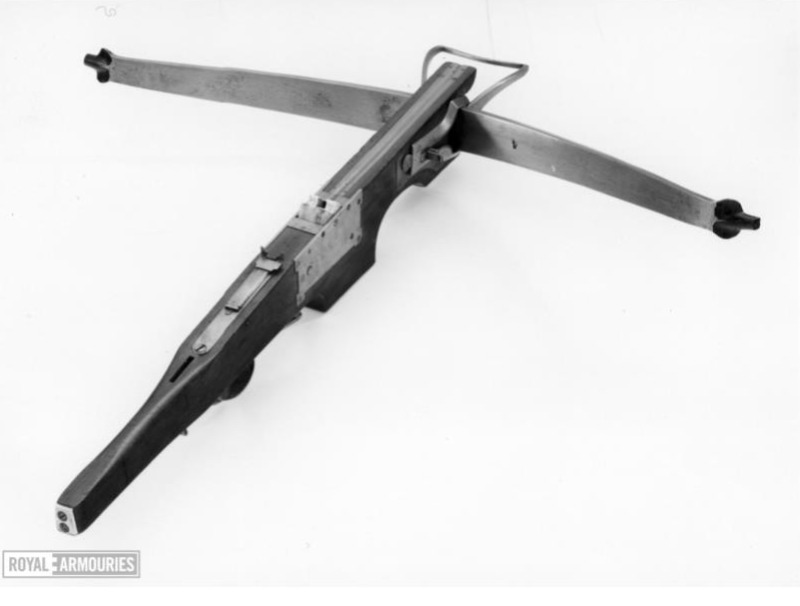
This crossbow contains a bull’s head marked into the fore-end of the stock. A steel bridle attaches the stock to the fore-end and also holds a stir-up in place. The stock is wooden and is fitted with brass plates which hold the nut in place. Beneath the cocking mechanism is an engraving of four circles formed in the shape of a square with a small space in the centre. This crossbow is for the use of a left-handed person demonstrated by its left-hand grip and is meant to be used along with a windlass which is a type of cranequin
Materials/Media Steel, brass, wood
Dimensions/Measurements Overall Length: 1029mm
Other notes It was a part of the Ex Renkin collection and acquired by the Royal Armouries in 1967
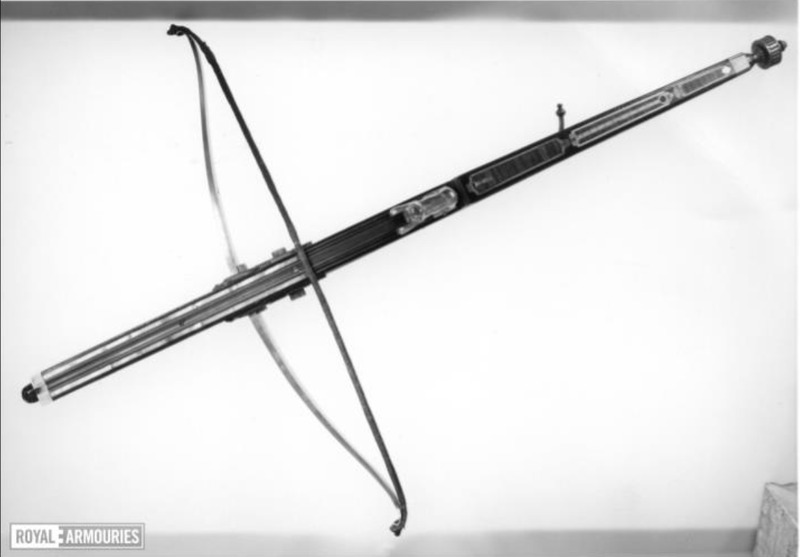
This steel bow has an unusual construction as the stock is secured in place by brass cheeks. Its shape features components in the shape of a crocodile and lion with the fore-end being in the shape of a crocodile and the lion’s paws acting as a bending mechanism and lock action that keeps the bow drawn back and engaged. When the trigger is pulled the paws of the lion lift and the cord is released, firing the arrow. It is also inlaid with ivory and mother of pearl with an acorn ornament engraved in the inlay. This piece is incredibly decorated and shaped
implying that this crossbow was used either ceremonially, for hunting, or sport.
Materials/Media Steel, iron copper, and brass, mother of pearl, ivory
Other notes Displayed in the exhibit “Over and by Arches.”
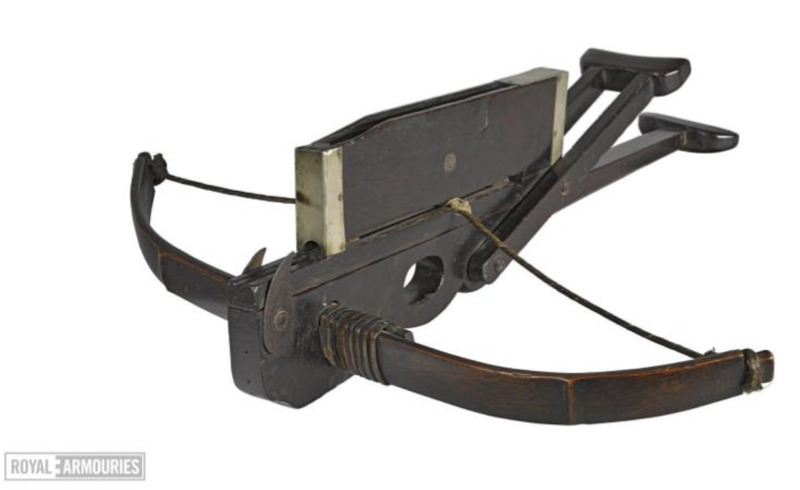
The bow is made from bamboo wood most likely due to the flexibility and pliability. The rest of the stock is made from a darker wood. The magazine is also made from this darker wood with two silver pieces on each end. The magazine is loaded into the top of the bow which allows for repeating ammunition to be fired. The rivets are made from iron and are decorative, being in the shape of a lotus flower. Two iron projections are also perched onto the end of the crossbow to act as a lug for the magazine.
To use this weapon several bolts are fed into the magazine. The pull lever is then pushed forward to relax the bowstring and drop a bolt into the firing position. The pull lever is then pulled back to engage, tighten the bowstring, and move the magazine back downwards towards the stock to release a button and fire the weapon.
Materials/Media Bamboo, Silver, Iron, Wood
Dimensions/Measurements Height: 164 millimeters, Length: 670 millimeters, Weight: 1670 grams, Width: 55 millimeters
Other notes Acquired by England before 1859
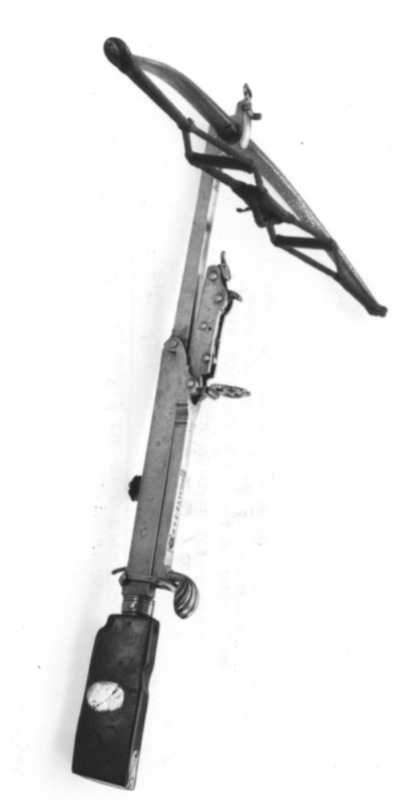
This crossbow is primarily made from steel but includes a cheek stock made from wood. The functional aspects of this bow are ornamental with the bending lever being in the shape of a shell, the action button being in the shape of a rosette, and the sight being in the shape of a mermaid. Its inlay also includes decorative pieces made from bone and mother-of-pearl. It includes a stamp that
reads “Moritz Sam” as well as an engraving that states Heinrich Mabat which may be indicative of both the maker and the owner/user of the crossbow. It is likely that Mortiz is the maker of the crossbow as other crossbows have been found with the same stamp including some that are found at the Metropolitan Museum in New York and at the Hermitage Museum in St Petersburg.
Materials/Media Steel, wood, bone, and mother-of-pearl
Dimensions/Measurements Length: 692 millimeters
Other notes Also referred to as “Bullet Crossbow by Mortiz Sam”
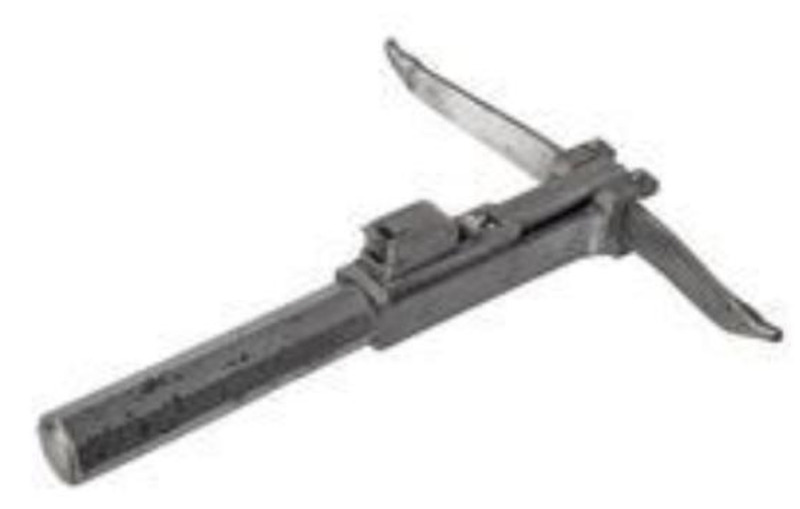
This crossbow is fully made from steel. Its faceted handle contains the coking mechanism where the string is pulled back into position and the bolt is released by a small thumb-operated trigger release on the top of the crossbow. Its small size may suggest that it was a personal item used for self-defense or for inconspicuousness. Its other name of reference the “ “All-steel “Assassin’s Crossbow” further suggests this crossbow’s inconspicuous usage. Only 15 of these small crossbows are known and it is recorded in documents
that if caught carrying this weapon in 16th century Vienna while concealing your identity was a crime.
Materials/Media Steel
Dimensions/Measurements Length: 178 millimeters Width: 165 millimeters Weight: 368 grams
Other notes Also referred to as the “All-steel “Assassin’s Crossbow”