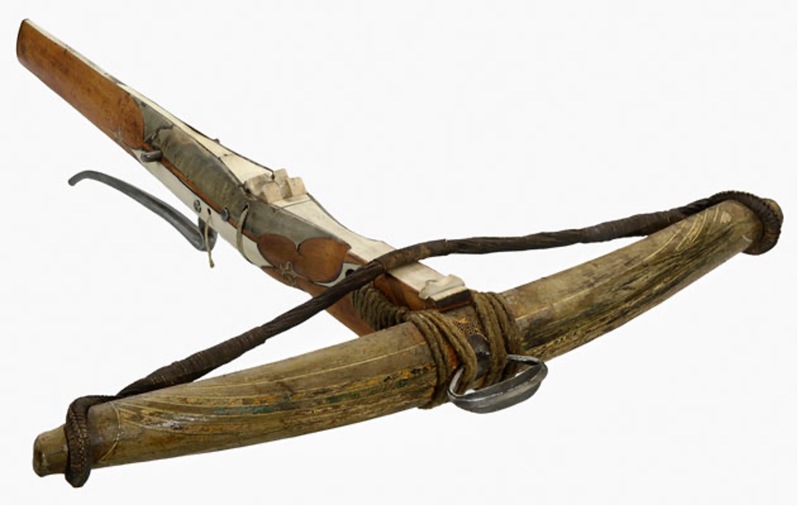
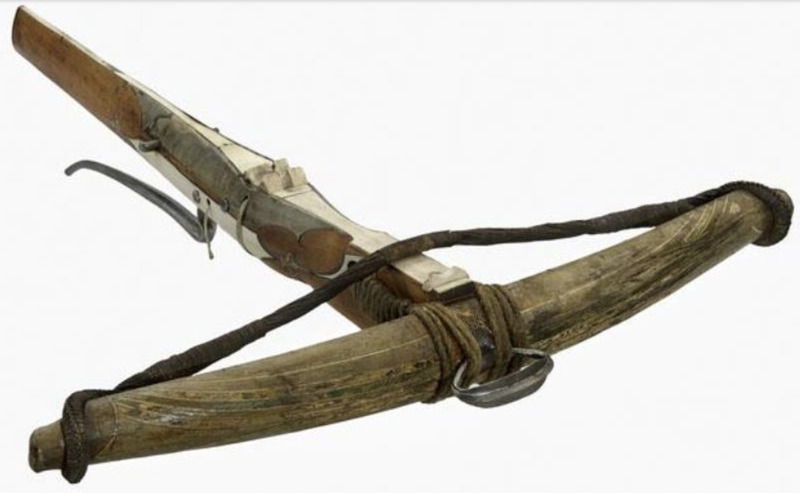
This crossbow features a thick curved composite prod secured to the stock by a rope bridle. A brass suspension ring at the top of the stock is also secured by the bridle but appears to be a later addition. There is a bolt rest made of bone set into the front of the stock with black lines possibly from etchings of bone or buckhorn. The thick stock is made of poplar wood with bone inlays. The lock mechanism is a single-axle rolling nut secured by a nusfaden made of hemp cord that passes through a small hole. It has a long metal lever trigger. The stock is reinforced with a long iron rivet that goes through it and an additional iron pin seen behind the prod to prevent cracking.
This composite crossbow features a wooden stock that tapers towards the butt with a cheek rest. The prod made of composite wood and likely covered with birch bark or parchment for waterproofing is secured to the front of the stock with a bridle. A circular metal suspension ring is also secured to the top of the stock by this bridle. The bowstring is composed of darkened twisted cords possibly hemp. The lock mechanism is a double-axle rolling nut secured by a nusfaden possibly made of hemp cord that passes through a small hole. The trigger is a simple metal lever. The sides of the stock have decorative inlays in geometric patterns with the part near the nut appearing a darker colour possibly made from animal horn and the lower side and the top appearing lighter possibly made from bone. The lateral lugs of metal are used to attach a spanning device.
This bow is a composite bow made from both animal horn and wood. The wood on this particular bow is yew and either wrapped are varnished in birch. The animal used to make this crossbow was most likely cattle horn and baleen from a seal. Baleen are the horn-like structures found in the mouths of whales and other aquatic animals that were used for composite bow construction. In this particular bow the birch varnish or finishing was painted to potentially resemble snake skin.
Although the composite bow was popular in the 13th century and was slowly phased out by the steel crossbow, composite bows like this one were still being used and constructed in the 15th century possibly because the wood made the bow less likely to break in the cold while hunting in the winter. A stag bone is also featured in the inlay of this crossbow which may have a decorative purpose.
Other notes Collection: R L Scott Collection
Materials/Media iron, sinew, wood, bone, ivory