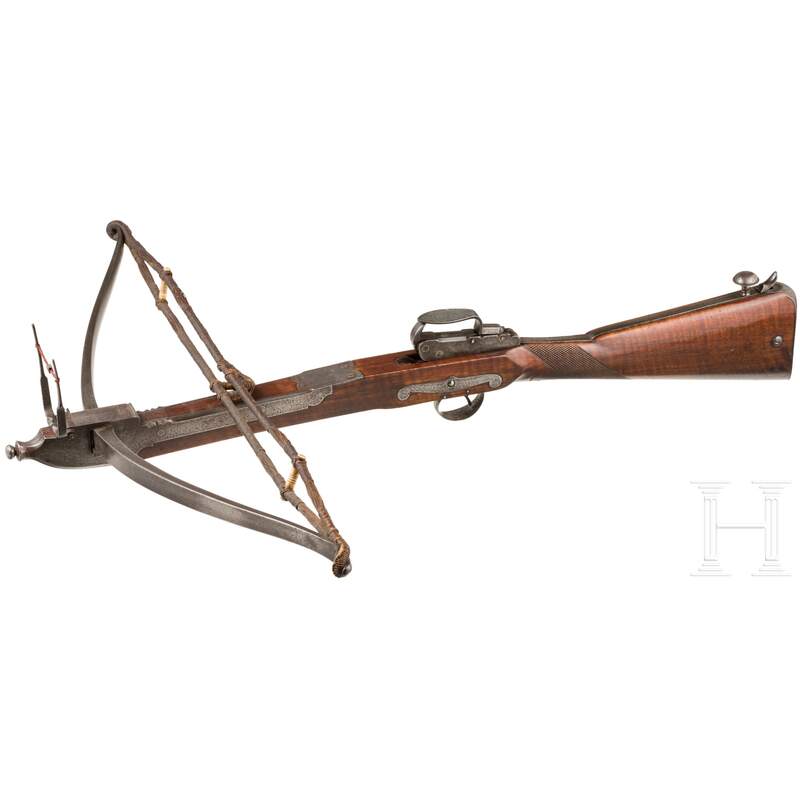
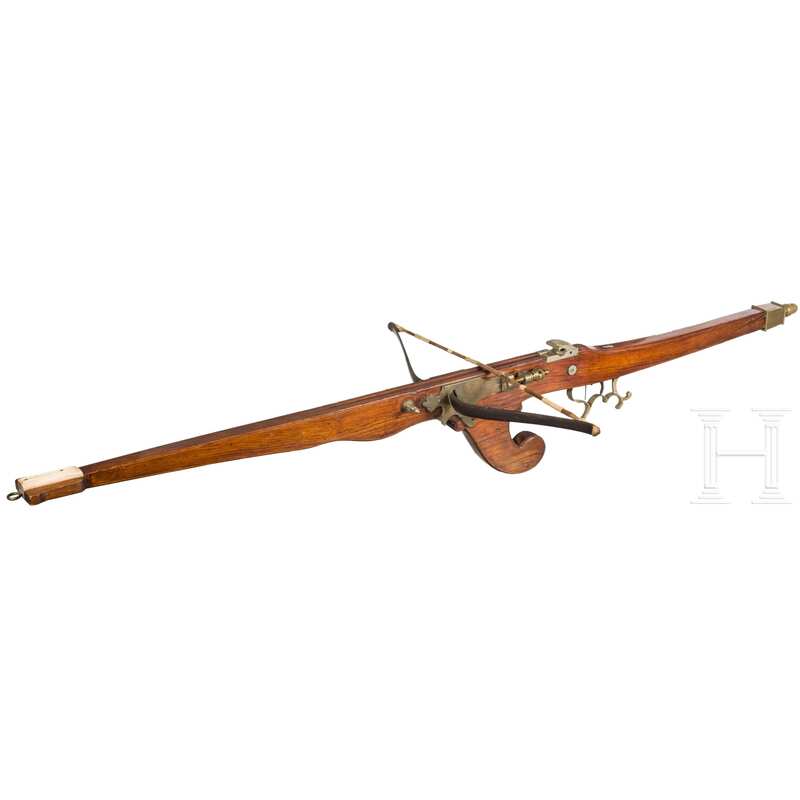
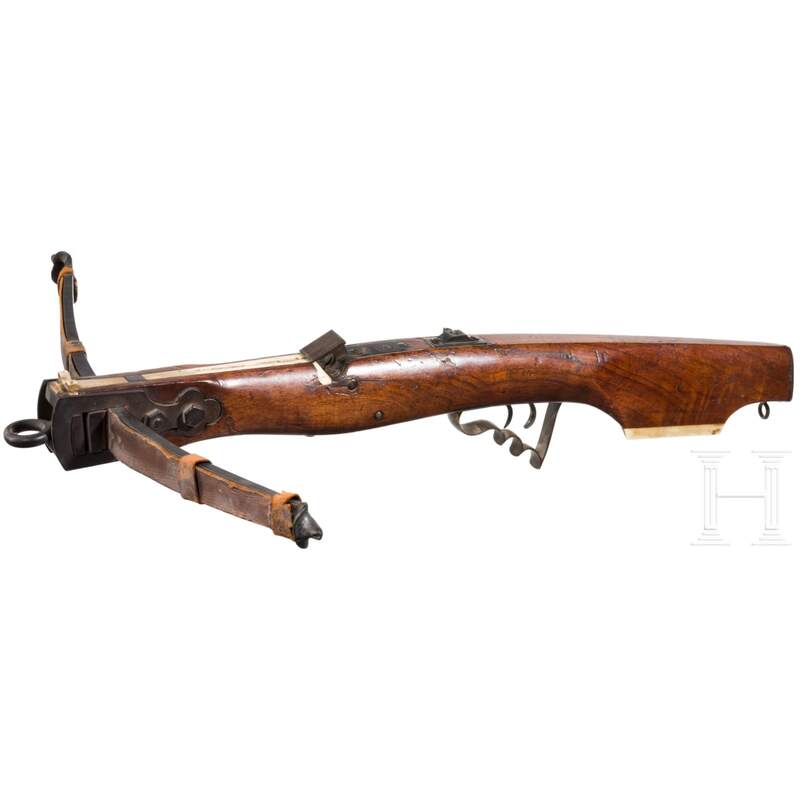
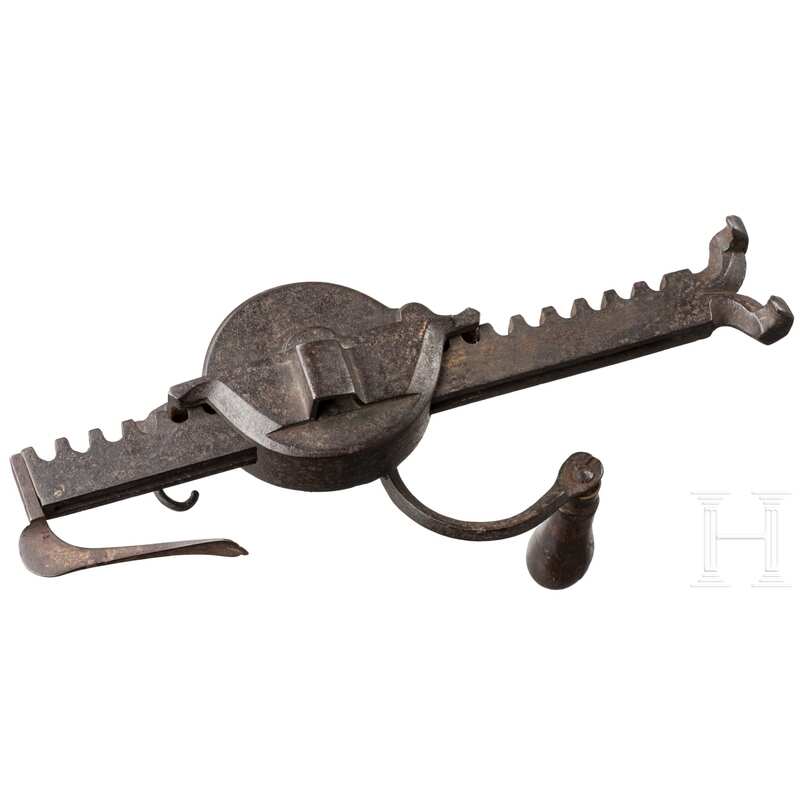
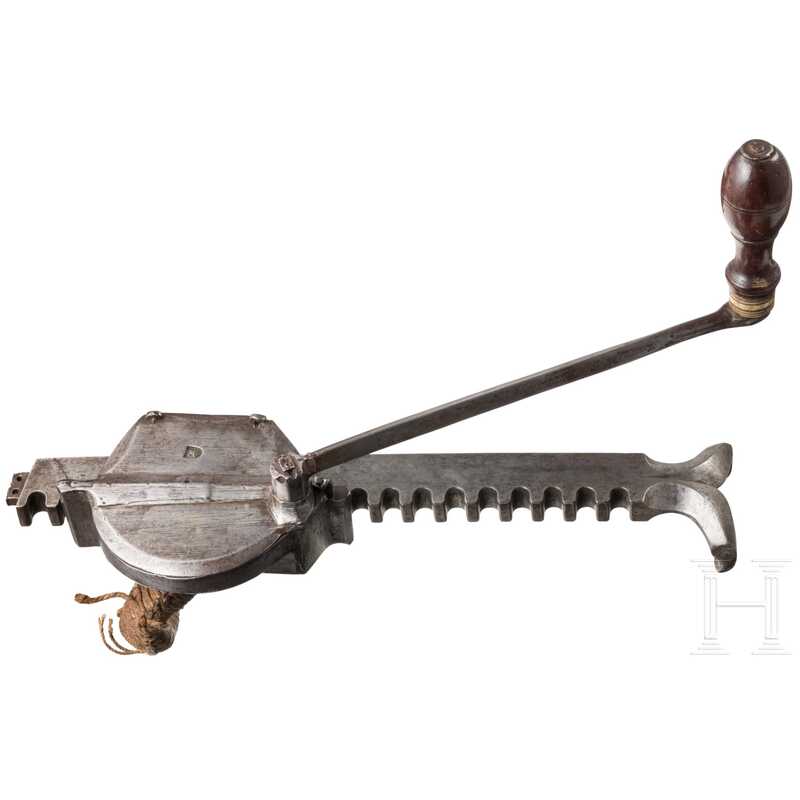
This crossbow has a stock made of polished walnut decorated with ornate iron plates and a prod made of steel. The prod is complete with an original bowstring which has two bone spacers. The iron cocking lever and folding sight are both visible which features five diopter holes and the maker's mark reading "Harcourt Ipswich."
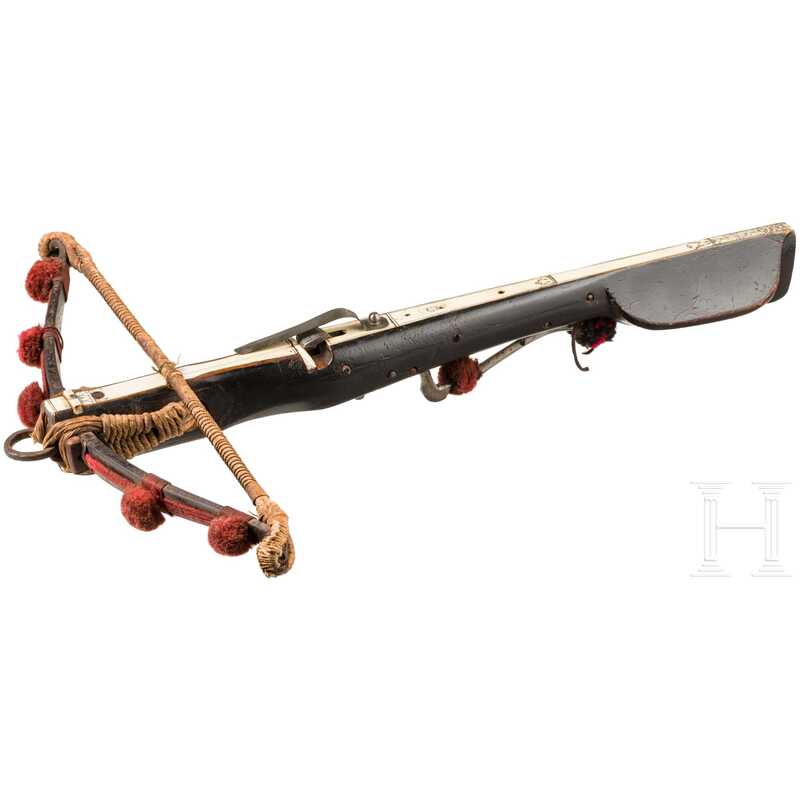
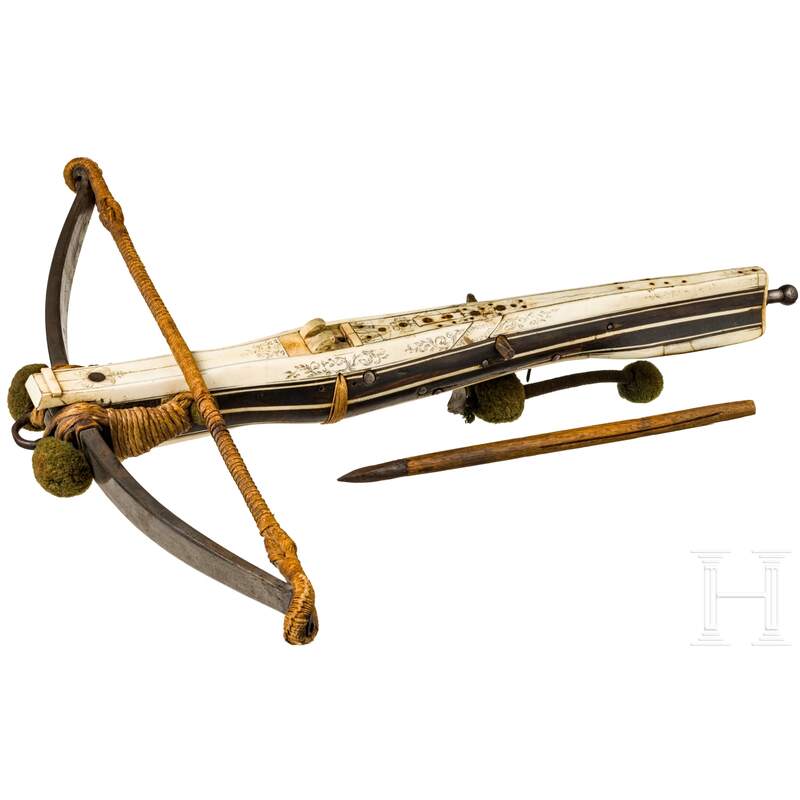
This crossbow features a blackened steel prod, which has been stamped with a wheel shape on the inside. The prod is decorated with red woolen pom poms of which one is missing. The bowstring is original hemp cord. The stock is crafted of ebonized wood and shows evidence of wear through small dents. The top and bottom of the stock are inlaid with antler which has been sparsely engraved with floral motifs. The iron bolt holder is visible as well as multi-axle lock. The sight has been noted as missing.
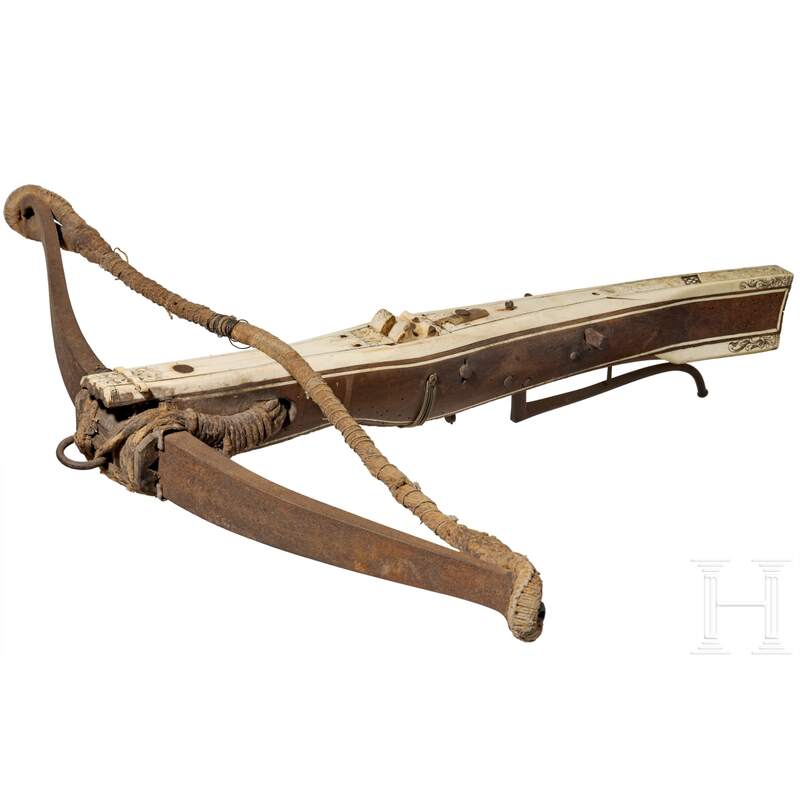
This crossbow features a steel prod marked with the initials "AB", presumed to be the maker's mark. The stock is crafted of wood which shows evidence of worm damage. The stock features the original bindings and bowstring. The stock has been minimally decorated with strips of polished antler which are engraved with ornamental foliage. The stock is missing the butt cap and the underside is more heavily damaged. The nut, multi-axle lock and folding trigger are original to the weapon.
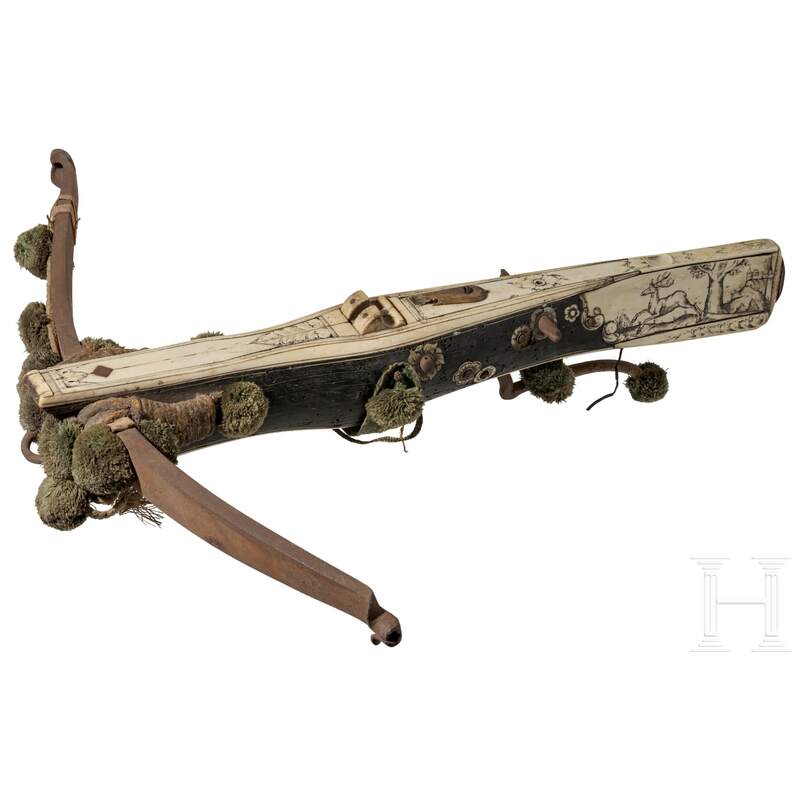
This crossbow found in Saxony, features a heavy steel prod with remnants of gilding, and the mark of a wheel with a sun burst stamped on the inside of the prod on the right. The stock is finished with gilt cord anchors, and decorative pom poms of green wool. The stock is made of finely grained brown wood covered with approximately 2 mm of ebony veneer which shows evidence of worm damage. The stock is also inlaid with polished antler with blackened engravings. The cheek rest is engraved with representational images including foliage, a large leaping stag, and a castle in the background, closest to the butt end of the stock. The original nut is made of antler and secured with thread. The mechanism is a multi-axle lock with a folding trigger and iron trigger guard. The butt end of the stock has been capped with an iron applique. A fragment of the old horn bolt channel is visible behind the nut. Overall the crossbow is incomplete, damaged, shows evidence of old repairs, and the iron components are rusted.
This crossbow features a polished steel prod which has been stamped with the mark of a wheel with a sun burst on the inside on the right. The binding and bowstring are original knotted hemp. The green woollen pompoms can be seen on the front of the prod as well as on the trigger guard. The stock is crafted of ebonised wood and engraved with blackened bone inlays. The original nut made of antler is secured with thread, which appears to be of similar material to the binding. The mechanism is a multi-axle lock, with a folding, adjustable trigger shoe, covered by an iron trigger guard. Remnants of decorative gilt etching can still be seen on the cranequin lug and the underside of the lock components. One may note the iron ball that has been added to the butt cap of the stock. The crossbow does show signs of ware given the missing rear sight and bolt channel as well as the subtle damage on various parts of the stock.The bolt channel and back sight have been lost. The images also include a medieval crossbow bolt with an oak shaft, measuring 37 cm, though the fletches are missing.
Condition: II -"
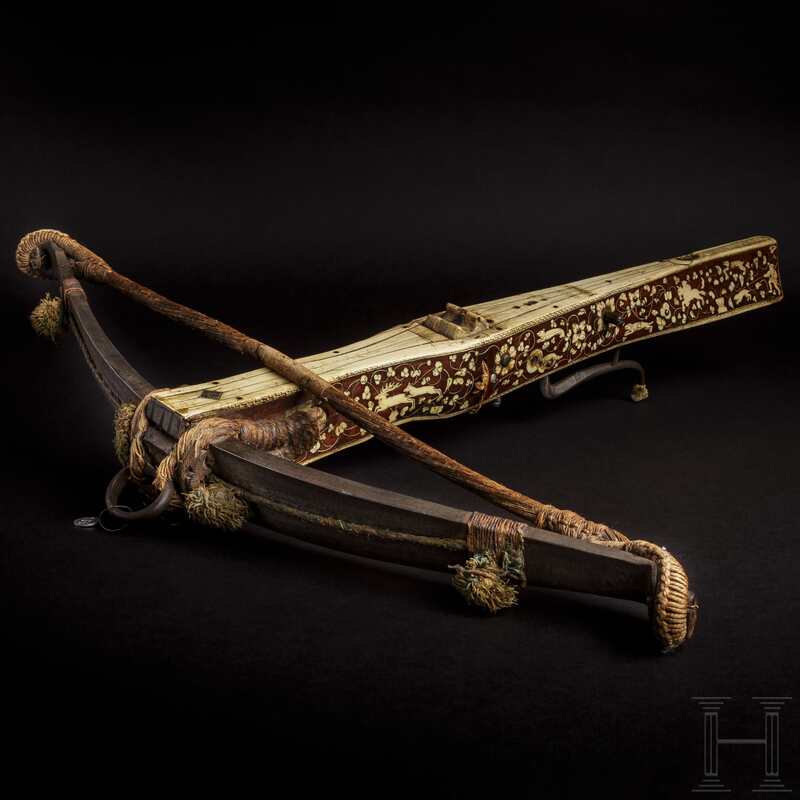
This crossbow is composed of an iron prod and features the original green woollen pompoms. The inner side of the prod a features a stamp which resembles a 5 fingered hand. The safety cord, and binding are crafted of braided hemp bowstring, which was also used to attach the suspension ring to the front of the prod. The stock is made of walnut, and the top and bottom are entirely veneered in bone. The front top of the stock is 2 cm shorter than the rest of the stock. The sides of the stock are inlaid with bone and depict hunters pursuing various animals including large game. The figures are positioned amongst vines and floral motifs. The underside of the stock is finely engraved with further floral motifs. The underside, butt end of the stock depicts an engraved standing Adam and Eve and towards the prod is another human figure believed to be the icon of Fortuna. The nut is also made of bone and secured with a thread. This crossbow's mechanism is a multi-axle lock and folding trigger. The butt end of the stock has a thumb depression and evidence of mounting holes indicating that a rear sight used to be attached.
Provenance: From the Schulthess collection (CH).
Condition: II -"
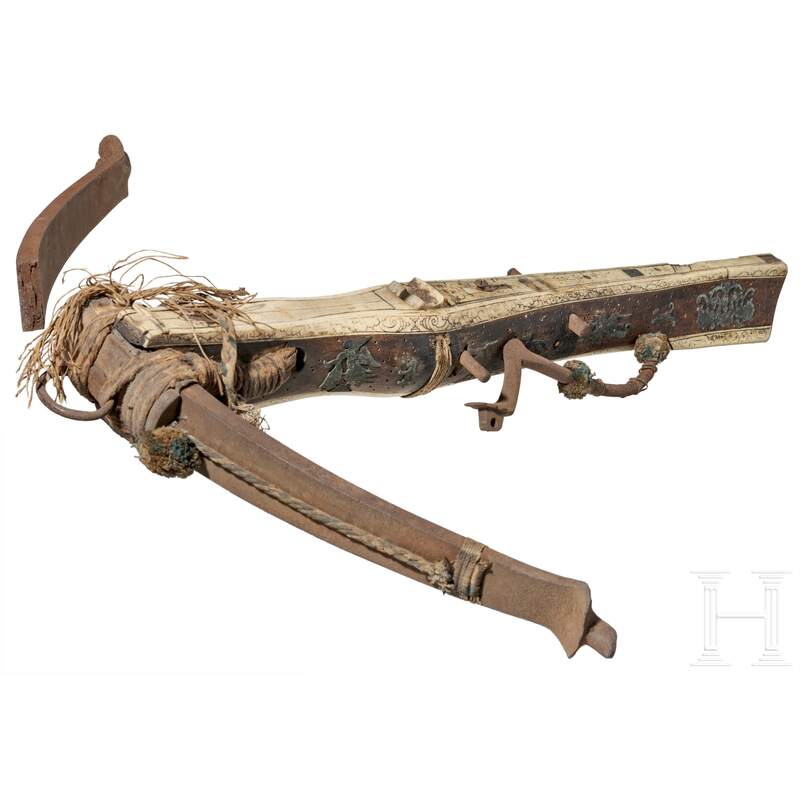
Found in an attic in Saxony, this crossbow features a broken composite prod and remnants of its original binding and blue and yellow pom pom decorations. The fine grained wood of the stock is covered on the top and bottom with engraved antler. Along the sides of the stock are eroded pewter inlays which have been attached to the side with glue. The butt of the stock has been engraved with a pentagram and additional ornamental designs, described by the original source as a coat of arms. Though the crossbow is damaged, its iron parts are rusty and has had old repairs, much of the original mechanisms including the multi-axle lock and trigger remain. Given its blue and yellow decoration, scholars speculate this crossbow may have originated in the Leipzig Crossbowmen's guild.
Original Description:
"erer Stahlbogen (mittig gebrochen) aus Schweißverbundstahl, originaler, fester Einbund, gelb-blauer Aufputz aus zopfförmiger Fangschnur und Wollpompons, gebauchte Säule aus feinmaserigem Holz (Wurmlöcher), oben und unten belegt mit Bändern aus poliertem Geweih mit geschwärzten Gravuren. An den Seitenflächen eingeleimte figürliche Intarsien aus Zinn (korrodiert). Beinerne Kolbenkappe mit eingestochenem Adelswappen (Pentagramm unter Bügelhelm). Mehrachsiges Schloss (alle Teile vorhanden), Abzugsbügel (ohne Stift) separat. Fadenstecher mit Klappabzug. Unvollständig, beschädigt, Altreparaturen, Eisenteile rostig, alles im Fundzustand. Bogenweite 69 cm, Gesamtlänge 69 cm.
Aufputz in den Leipziger Stadtfarben, evtl. aus der Armbrustschützengesellschaft Leipzig stammend.
Provenance: Dachbodenfund aus Sachsen.
Condition: IV"
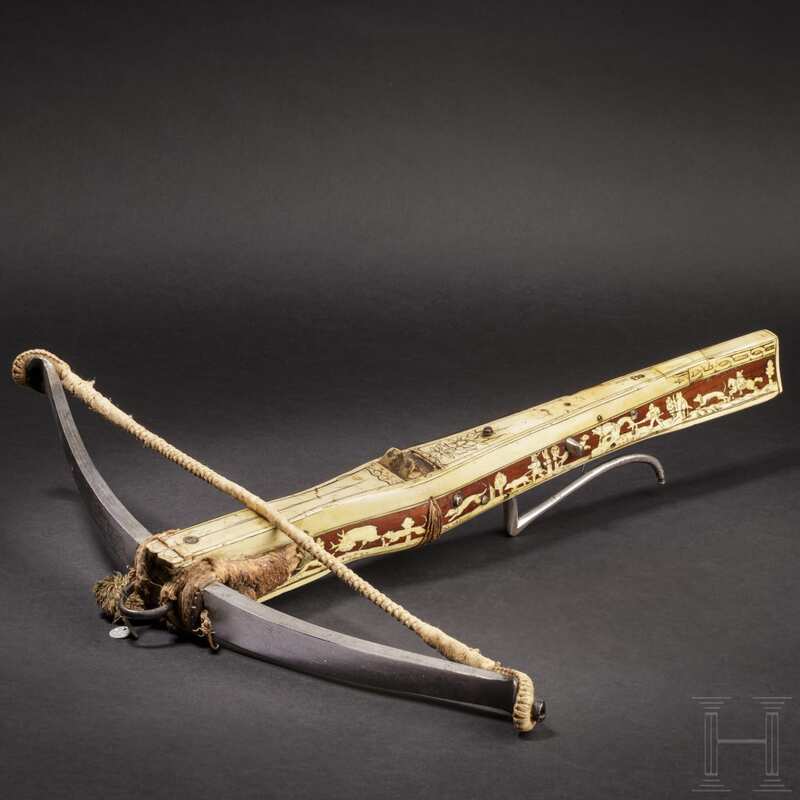
This crossbow features a steel prod and a stock made of fruit wood inlaid with engraved bone. The prod has been stamped on the inside with a circular form and holds a braided hemp bowstring. The front of the prod is finished with an iron ring, cord anchors and remnants of green woolen pom poms. The bone inlays along the sides of the stock depict hunting scenes with various hunters pursuing a wild boar and a stag. The bone inlay on the butt of the stock is believed to be a replacement, but the crossbow maintains its multi-axle lock and trigger. On the bottom of the stock, the letters "MCVI" are engraved in bone and remain clearly visible.
Condition: II -"
This crossbow consists of a steel prod with a hemp string, and has been attached to the wooden stock with brass plates and screws. The sparsely decorated stock features its maintained bolt groove, lock mechanism, trigger and later added bone guide. The trigger guard, lock cover and cross pin are made of nickel silver, otherwise known as German silver. To shoot this crossbow, the stock would have been tested on the shoulder, however the shoulder rest and rear sight are missing.
This Crossbow features its original steel prod with a leather strap on the outer surface. The stock is varnished walnut, with subtle bone inlays and cracks due to age. The bolt holder and rear sight have been noted as missing and this weapon is believed to have had older repairs completed. The lock mechanism, trigger, and trigger guard remain intact. According to the original source, this style of crossbow would have been used by Bavarian shooting clubs such as those in Nuremberg and Munich up until the 1920s.
This 1625 German Crossbow winch features a gear mechanism that fits over the rack and is housed by flat, round metal plates. The winch still has its riveted belt hook and iron crank arm with the original wooden handle, which has been cracked. What is believed to be a manufacturer's mark, of a male figure and the letters "TK" in a shield has been identified on the side near the rack. The date 1625 has also been inscribed on the underside of the rack near the claw.
This German cranequin is crafted of iron and most likely dates to the 2nd half of the 16th century. It is believed to be from Nuremburg, but scholars are not certain. The gear mechanism itself is encased by a circular iron plate described to have a subtly raised surface texture. The plate has two visible pins, suggesting it has been hammered onto the other parts of the mechanism. One may notice the plate has also been stamped with a crescent moon and two stars. The crank arm features an original turned wooden handle with a base crafted from animal bone. The belt hook, that would have been attached is missing. The device also features an original knotted cord loop.