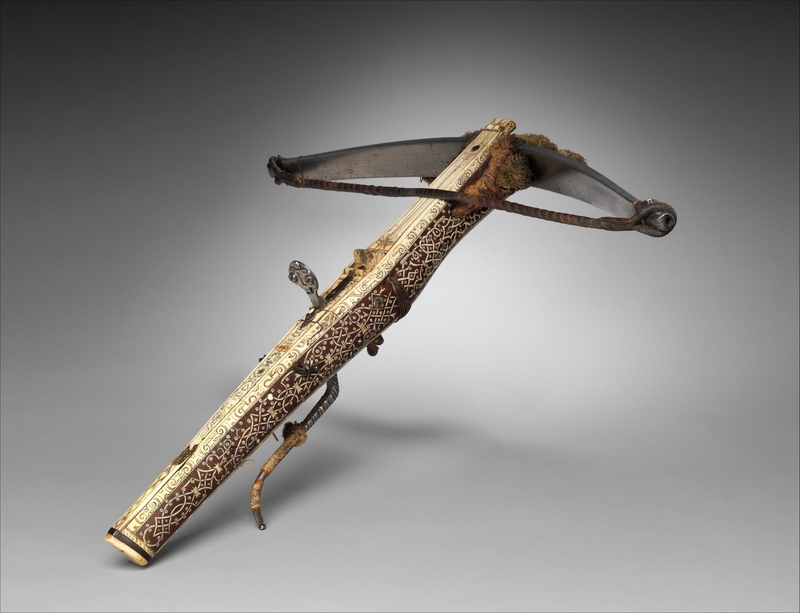
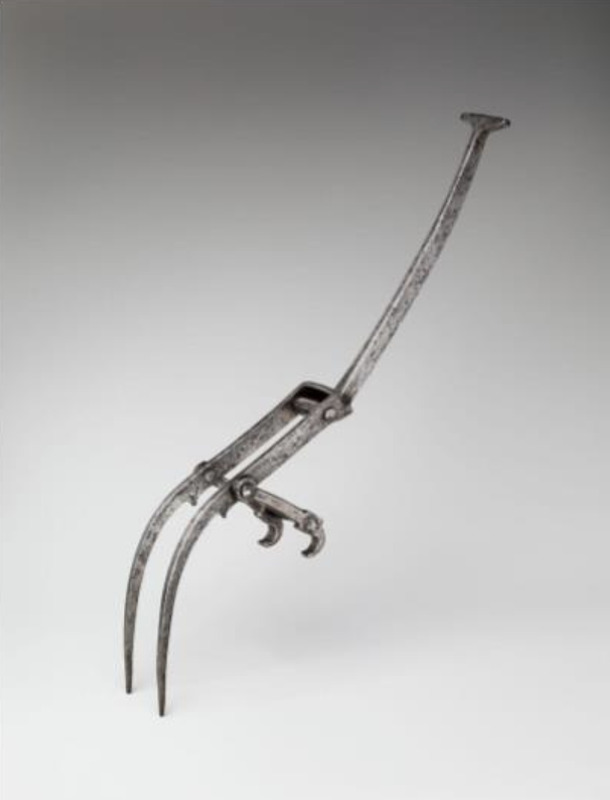
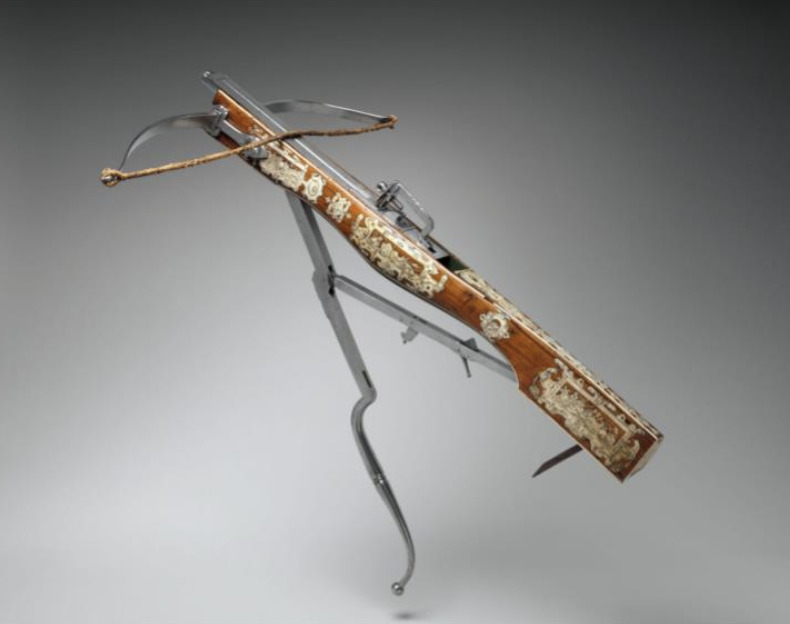
This crossbow, held by the Metropolitan Museum of Art, is dated between 1575 and 1650. The crossbow is accompanied by a cranequin dated from 1562. The bow and cranequin are most likely to have their origins in Saxony, Germany.
The walnut stock is decorated with patterns in inlaid antler or bone; the top and bottom of the stock are veneered with antler or bone, and engraved with patterns. The rolling nut is set in the top of the stock, and includes an iron reinforcement set in the middle of the nut. Behind the nut is the remnant of a bolt clip, likely made from cow horn. Just behind the clip there is a folding rear sight made from iron, which is adjustable vertically and horizontally. Farther back, a transverse pin is set horizontally through the stock, which serves as an anchor point for the cranequin spanning mechanism. Towards the rear, a thumb rest in brass is set in the top of the stock. The lock is likely a four-axle mechanism with a “hair” trigger, protected by a long L-shaped trigger guard. A swiveling safety latch is located on the underside directly in front of the trigger guard. The nut is secured by a hemp thread bound around the stock. The steel bow is bound to the front of the stock by hemp cords, which also hold a suspension ring. Pompoms of green wool decorate the bow.
Dimensions/Measurements Crossbow, Length: 63 cm, Width, 59.5 cm, Weight: 3775g Cranequin, Length: 34.8cm, Width: 10.4cm, Weight 2567g
Other notes: Gift of William H. Riggs, 1913
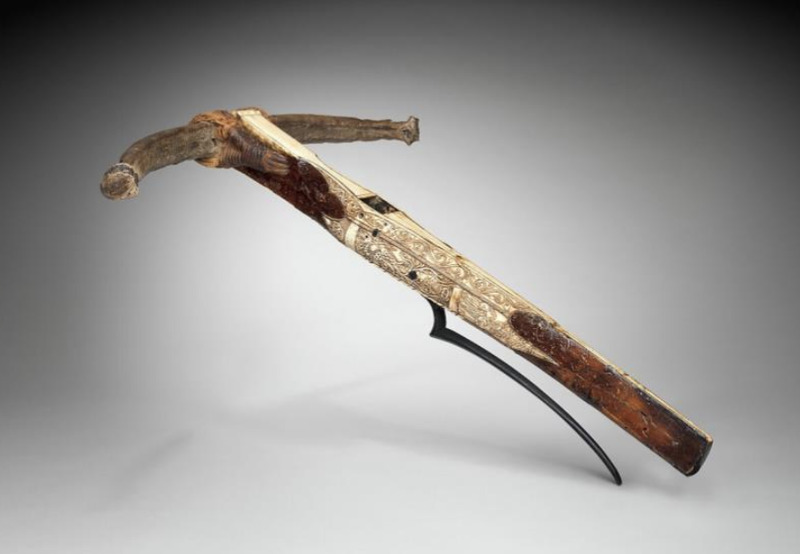
This crossbow, on display at the Metropolitan Museum of Art, is dated back to 1489 and was created for Mattias Cornivus, the king of Hungary and Bohemia which is indicated by Cornivus’s personal Coat of Arms and the Coat of Arms of his Kingdom being visible in its decoration. This crossbow is significant due not only to its detailed ornamentation but also its complex firing mechanism. Due to the complex firing mechanism and decoration, this crossbow was most likely used for hunting or ceremonial purposes rather than warfare.3 Its construction is placed in possibly Vienna Austria due to King Mattias Cronivus’s residence there. It is made from Wood, horn, animal sinew, staghorn, and iron alloy.
Materials/Media Wood, horn, animal sinew, staghorn, birch bark, iron alloy
Dimensions/Measurements Length: 73.7cm Width: 60.9cm, Weight: 2284g
Other notes Rogers Fund, 1925
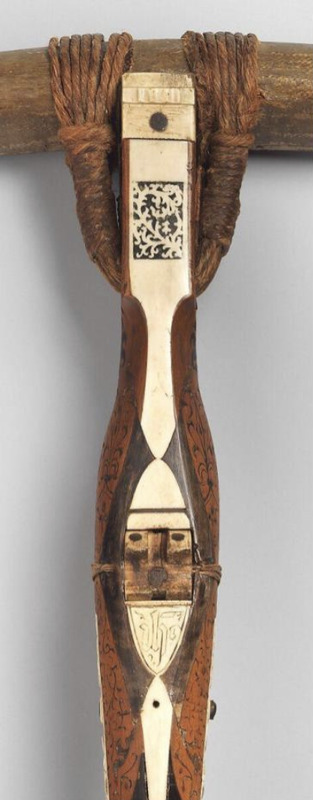
This crossbow, on display at the Metropolitan Museum of Art, is dated back to 1460 indicated by the carved staghorn decoration. It is the oldest dated crossbow in existence and belonged to Count Ulrich V of Württemberg of what is now Stuttgart Germany indicated by his family’s Coat of Arms carved into the staghorn. It is also decorated with Hebrew inscriptions which is rare considering the owner of the crossbow was a Christian. It is a composite bow made from wood, animal horn, animal sinew, staghorn, and copper alloy for the lever. The construction of the now is accredited to Heinrich Heid von Winterthur which is suggested by the employment records referring to Heinrich Heid von Winterthur as either “crossbow maker” or “crossbowman” as well as the lack of documented crossbow makers in the area at the time.
Materials/Media Wood (European hornbeam), horn, animal sinew, staghorn, birch bark, iron alloy, copper alloy, pigment
Dimensions/Measurements Length: 71.2 cm Width: 65 cm Weight: 2972 g
Other notes Rogers Fund, 1904
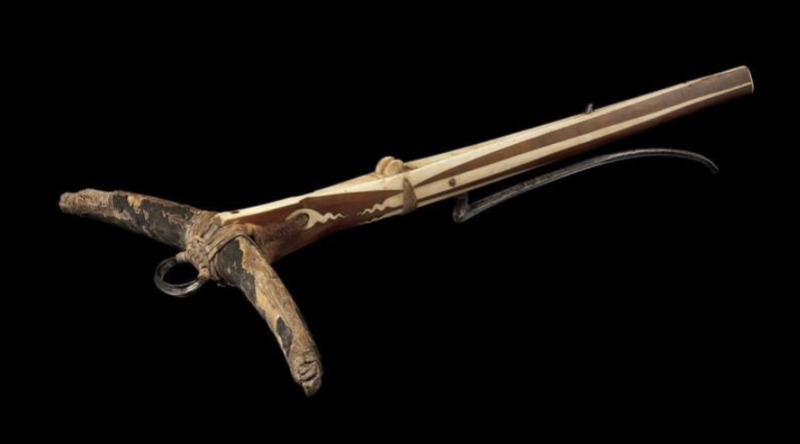
This crossbow, on display at the Metropolitan Museum of Art, dates back to approximately 1425-1475 which is indicated by its long stock and long release lever. It is a composite crossbow made primarily from wood, animal horn, and animal sinew. The rope and string were made from hemp and the lever from iron alloy. The inlaid body of the crossbow, decorated with flame-like carvings, indicates that this crossbow along with a group of others has its origins in Austria. A group of similar shapes and decorated crossbows which are believed to be from the same workshop can be found in Slovakia and Austria.
Materials/Media Wood (European hornbeam), horn, animal sinew, animal glue, birch bark, staghorn, iron alloy, hemp, leather
Dimensions/Measurements Length: 95.6cm, Width: 75.5cm Weight: 3989g
Other notes Bashford Dean Memorial Collection, Funds from various donors, 1929
This slender crossbow is not on display but is held by the Metropolitan Museum of Art. It does not feature any extensive artwork in the inlay however it features four stamps of a forward walking lion with its head turned to face the viewer which is encased in a circle of dots. This stamp may be the insignia of the crossbowmaker. The spanning lever feature of the crossbow is removable.
Materials/Media Steel, holly oak wood, staghorn, copper alloy, hemp, leather
Dimensions/Measurements Crossbow: length: 82.9 centimetres, Width: 54.6 centimetres, Weight: 2,726 grams Spanning Lever: Length: 46.6 centimetres, Width: 6.7 centimetres, Weight: 548 grams
Other notes Gift of Archer M. Huntington, 1927
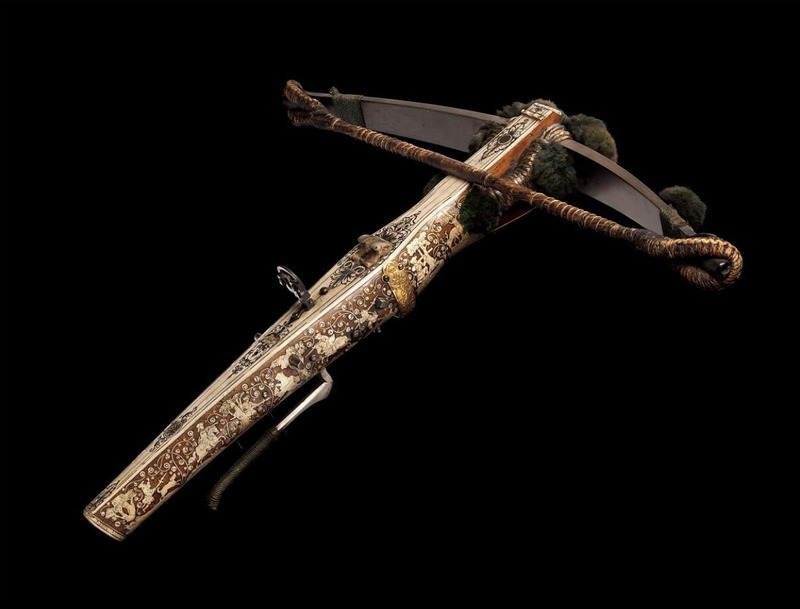
This crossbow from central Europe is on display in Gallery 375 of the Metropolitan Museum of Art and is known for it wheel lock gun mechanism which allows for the crossbow to shoot both arrow-like projectiles as well as pellets. It is known for its inlay of carved staghorn featuring artwork based on the published works of Jacob Floris. These decorations depict designs of other arms such as spears and crossbows. It includes a metal lever and its steel bow was a later replacement.
This type of crossbow was popular as a sporting weapon for target shooting and especially for hunting, because of its precision, quiet discharge, and projectiles which could range up to four hundred yards, depending on the size. The engravings on this crossbow show demonic mask carvings and small game hunting which further reinforce the purpose of this crossbow as a sporting or hunting tool.
Classification: Archery Equipment-Crossbows Credit Line: Bashford Dean Memorial Collection, Funds from various donors, 1929
Materials/Media Steel, wood (walnut), staghorn, copper alloy, hemp, leather, silk, gold, iron alloy, wool
Dimensions/Measurements crossbow: L. 26 15/16 in. (68.4 cm); W. 29 7/8 in. (75.8 cm); Wt. 13 lb. 15 oz. (6329 g); winder: L. 14 in. (35.5 cm); W. 4 1/8 in. (10.4 cm); Wt. 5 lb. 3 oz. (2341 g)
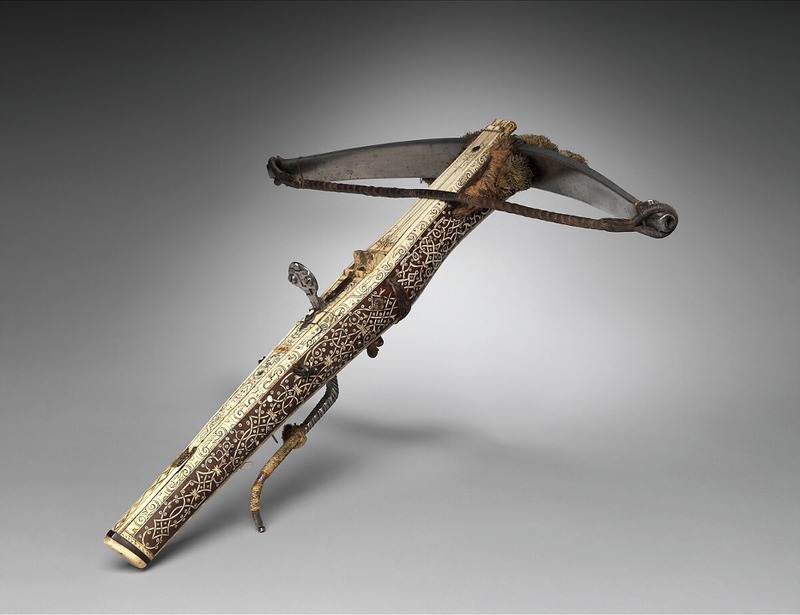
This 16th - 17th Century crossbow contains a straight walnut stock that is inlaid with staghorn in an interlaced pattern. Towards the back is a transverse peg, which acts as the rest for the winder and a hand-width from the butt end is an brass thumb rest. Directly in front of the trigger is a safety swivel and the release nut is secured by eight strands of hemp bound around the stock. The steel bow is lashed to the forked forward end of the stock by heavy hemp cords, which also hold a suspension ring. Green wool pompoms are attached as decoration.
Steel, wood (fruitwood, probably cherry and plum), staghorn, copper alloy, hemp, wool
crossbow, L. 24 3/16 in. (63 cm); W. 23 7/16 in. (59.5 cm); Wt. 8 lb. 7 oz. (3,775 g); cranequin, L. 13 3/4 in. (34.8 cm); W. 4 1/8 in. (10.4 cm); Wt. 5 lb. 11 oz. (2,567 g).