At the tip of this crossbow, there is a U-shaped suspension ring
The iron prod is secured to the wooden stock with bindings. There are yellow pom-poms attached to the bindings. The iron prod has a bowstring.
The top of the stock, from the tip to the nut area, is covered with bone plates. There is a missing piece where the bolt rest likely used to be.
There are bone inlays on the stock.
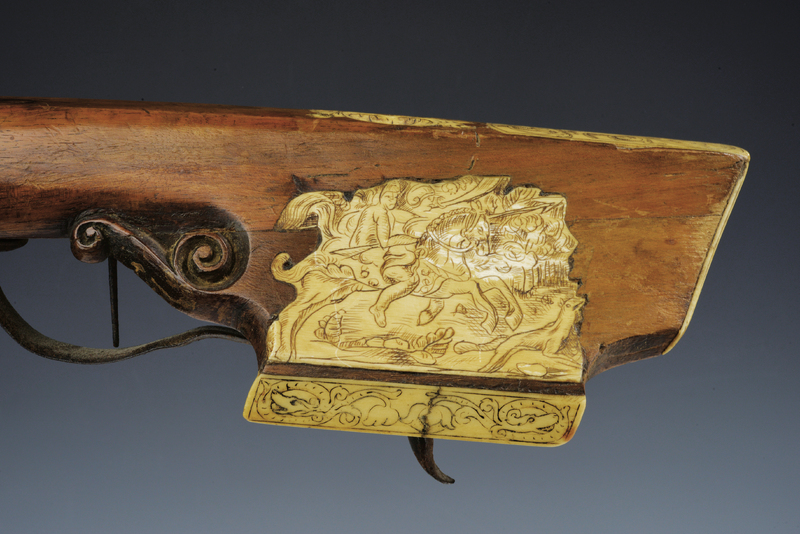
On the left side of the stock, there are three small circles with floral designs and zigzags. There are two inlays depicting dragons or dragon-like creatures. Then there is an inlay showing an ambiguous mammalian creature with bits of foliage near it. This leads us to the trigger area. Between the trigger and the cheek rest, there is scrollwork - two swirls - carved into the stock. On the cheek rest, there is a large and beautiful centerpiece inlay. This inlay depicts a hunter on horseback, carrying a spear, chasing after a mammal. With a long body and long tail, the mammal looks like a mink, weasel, ferret, or otter. However, it could also be a fox or some other creature. At the bottom, on the underside of the cheek rest, there is a broken plate of bone depicting two fantastical creatures and some flowers. The creatures are biting their own tails. There is a flower growing out of the end of each tail.
On the topside of the stock, right after the catch area, there is a bone inlay of a fantastical dragon or dragon-like creature biting its tail, reminiscent of the design on the bottom of the cheek rest. Near the end of the crossbow, there is an inlay with a strange curling design which is so stylized as to be indecipherable. The last bone inlay on the topside shows the head of a grotesque figure, reminiscent of a demon with goat-like horns and a long tongue. It is made of only a head and a tail, like some of the dragon-like creatures previously described. Also like them, its tail has a flower growing out of the end.
On the right side of the crossbow, on the opposite side of the cheekpiece, there is an inlay showing three creatures running. The creatures are ambiguous.
On the backside of the cheek rest, there are the letters “ISR” carved.
The trigger guard is iron. The crossbow has a set trigger.
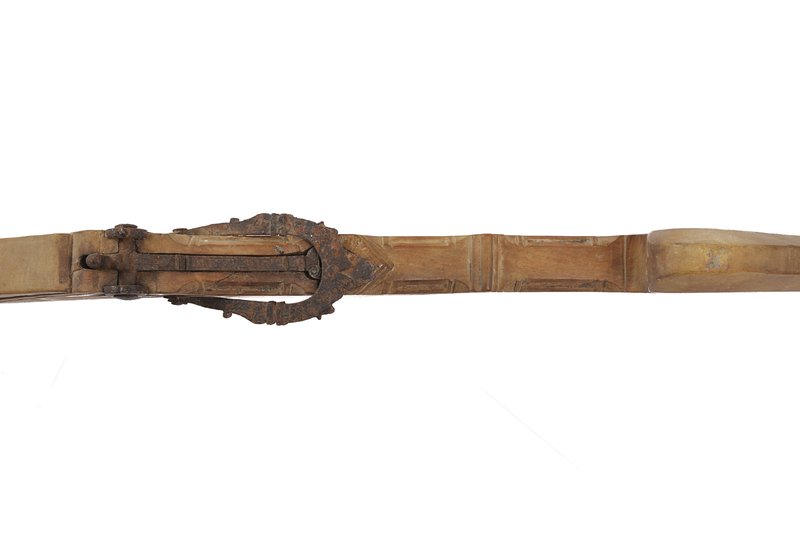
The tip of this crossbow lacks the pyramidal spike typical of Italian pellet crossbows. It has a forked sight made of iron. The iron prod lacks a bowstring. The prod is secured to the wooden stock with bow irons.
There is a sort of metal collar around the stock at this point.
The stock then curves in a concave shape, down and then up again into a straight form. This part of an Italian pellet crossbow is usually curved rather smoothly like half a circle, but this area on this crossbow appears somewhat flatter, likely due to its great length.
At the end of the curve, there is a hook meant to secure the bowstring. This hook is on an axle which is secured to the stock with two metal pieces, one on each side. These metal pieces have decorative elements of scrollwork and an oval, reminiscent of some other Italian pellet crossbows.
After that, there are some decorative ridges carved into the stock. After that, there is a large hump-like protrusion and a smaller round one, possibly meant to be later carved into a piece of scrollwork. The rest of the stock is relatively plain, until the butt, which is a rounded pommel or knob with rings carved into it.
The metalwork on this crossbow shows signs of rust.
The extreme length of the crossbow is unusual. Typically, a large pellet crossbow will not exceed approximately 100 cm.
At the tip of the crossbow, there is a pyramidal spike formed from the same wood as the stock. It may have a metal tip, though the photo is not conclusive.
The crossbow has a forked sight with an unusual form - the two vertical metal sticks have curly ends (like the antennae often seen among the Auplopus genus of spider wasps, for example). They have also been pushed together until they meet in the middle.
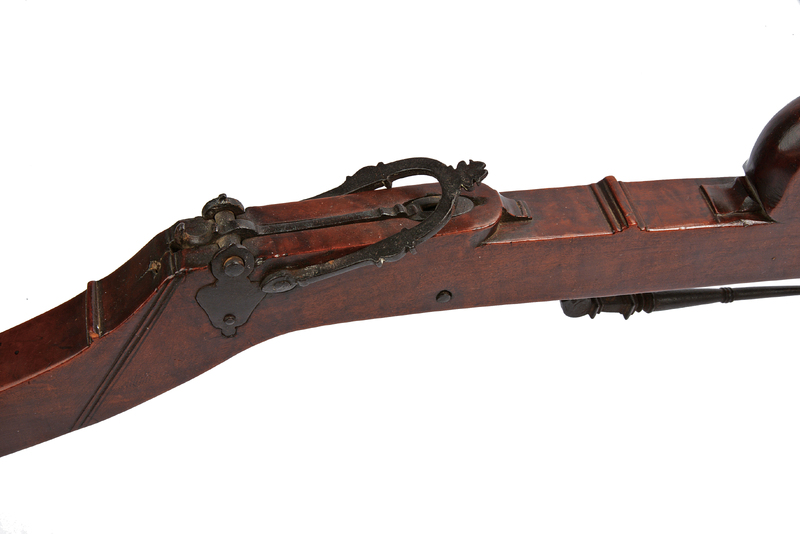
The iron prod is secured to the stock with bow irons. A ring descends from the underside of this area on the crossbow. The prod has a bowstring, which is a restoration. After the prod, the stock bends downward in a concave shape before curving upward and returning to a straight form. At this point, there is a hook which is meant to hold the bowstring. In the same area, there is a foldable sight in the shape of an arch. Further down the top of the stock, there is a large scrollwork carving protruding prominently. The rest of the stock is plain until the butt, where there is a rounded pommel or knob. There is a met
The metalwork of the trigger lever is decorated with ridges.
On the tip of the crossbow, there is a string loop which goes through the stock. This may have been used to hang up the crossbow. It is not clear whether it is original or a later addition.
There is also a unique iron sight in the shape of a square that is attached to the tip of the stock.
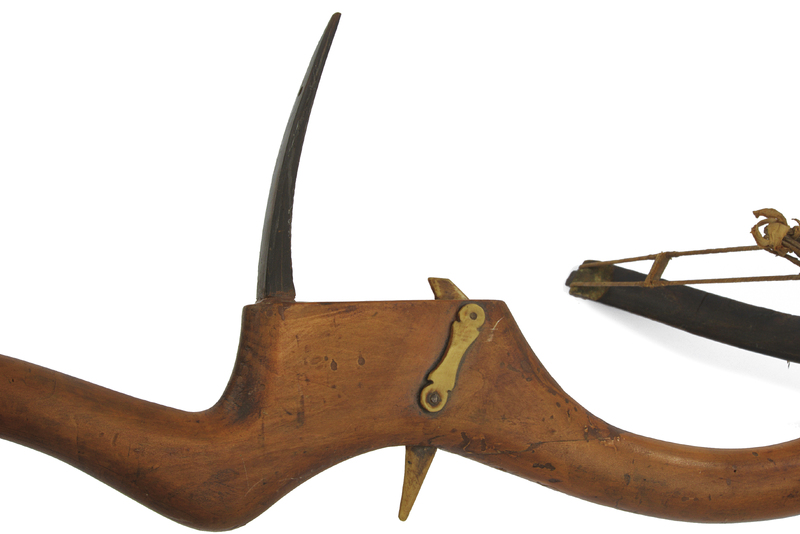
The prod is made of horn and goes through a hole in the stock. The prod has its original bowstring. The bowstring has some additional string in the middle, likely forming a pouch. The string forming the pouch appears to be strips of leather.
The general shape of the stock is curvy and rounded off. After the prod, the stock curves in a concave shape, down and then up again. The nut appears to be made of bone. There is a bone overlay below the nut. The trigger appears to be made of bone as well. Behind the nut, a large horn protrudes upward from the stock, serving as a sight. The rest of the stock has a lightly convex shape.
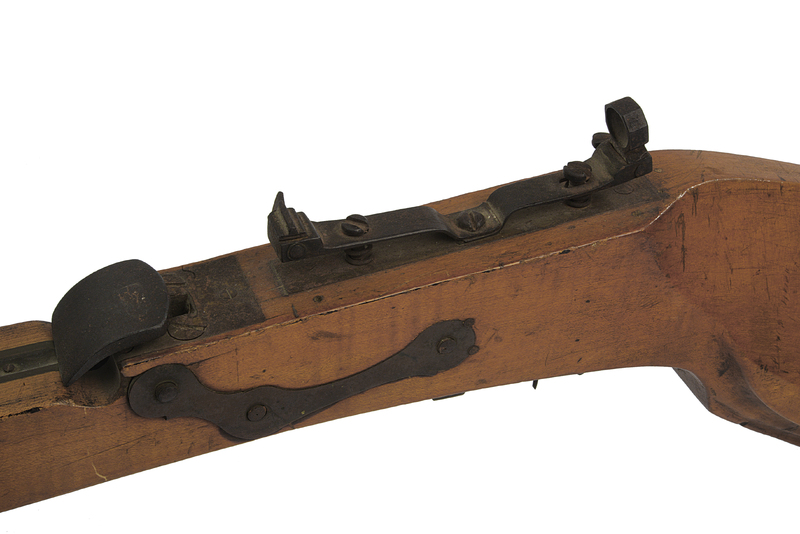
At the tip of the crossbow, there is a U-shaped suspension ring. The iron prod is set into the stock with unique bow irons. The prod has its bowstring. The wooden stock has a metal bolt groove running from its tip to the lock area. The crossbow has a catch lock. It also has a sight.
The butt of the crossbow is in the shape of a rifle’s, and it is set at an angle to the stock.
On the right side of the crossbow, there is a thumb rest in the form of a very smooth groove in the stock. It resembles the shape of a bird.
The crossbow has a double set trigger.
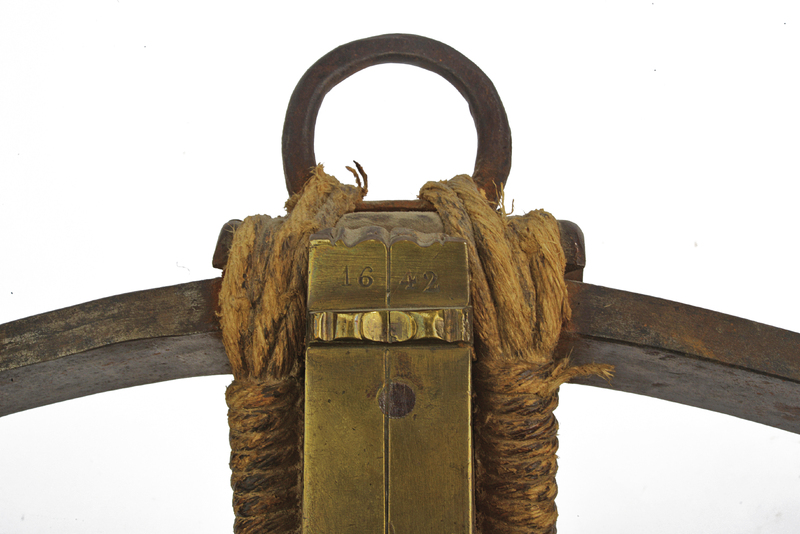
This German crossbow is classified as a “Halberüstung” or “half-bow” and is dated to 1642. It possesses a wooden stock with intricate carvings of brass and pearl on the upper and bottom surfaces of the crossbow. The crossbow also features bone plates along the stock and brass plates along its upper surface. The trigger of the crossbow is a rolling nut made of brass metal and is dated to the year 1642. The prod of the crossbow is made of iron with a twisted string made of plant fiber. Mounted on the fore end of the stock is an iron stirrup used to help span the crossbow. The trigger guard, screws, and pins are all made of iron. The prod is fixed onto the stock with a rope bridle. The overall condition of the crossbow is good with only minor damage and small missing pieces.
Measurements: Length 68cm
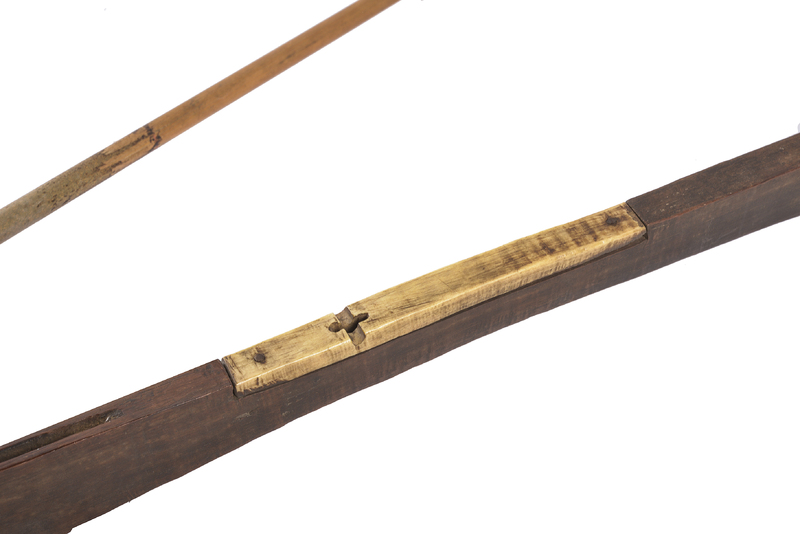
This 20th-century crossbow features a short wooden stock that is recessed in the middle, curving in on itself. The stock is wider in the front where it meets the prod at the cross section and tapers at the butt. Along the upper surface of the stock is a carved-out bolt groove. Toward the end of the stock’s upper surface is a bone inlay where the trigger is missing. The straight wooden prod passes through the upper portion of the stock and is longer in length than the stock. The crossbow comes with a wooden bolt with an iron tip, and the bow string is missing.
Length 61cm
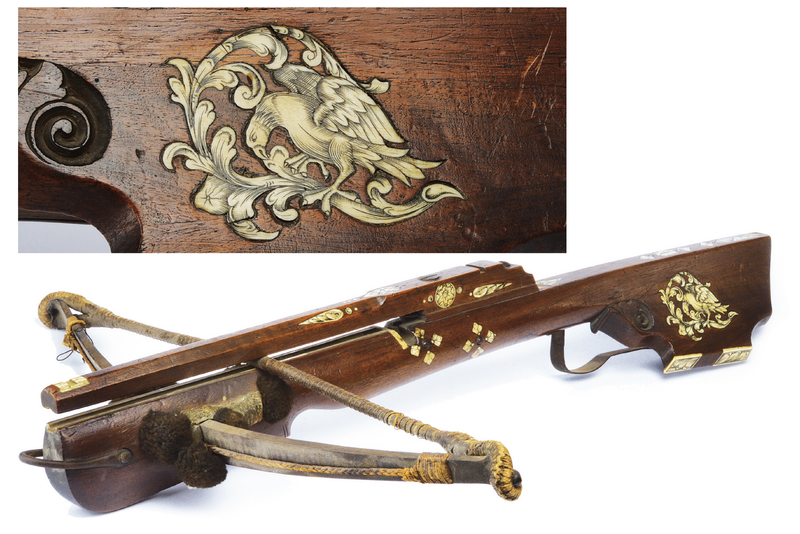
This crossbow originates from Germany in the early 18th century. The crossbow consists of a wooden stock that is rounded at the front end and features a concave cheek rest at the butt of the stock. At the top of the stock is a wooden cover. Across the surface of the stock and its wooden cover are small bone inlays that showcase floral imagery, while the cheek rest features a bone inlay depicting floral decorations alongside a hawk. On the upper surface of the crossbow is a bolt groove with bone inlay. The crossbow also consists of an iron prod passing through the stock and an iron stirrup mounted to the front of the stock. Around the prod and stock are eight woollen pompoms. The trigger features a trigger guard made of iron and a Schnepper or “snap lock” trigger mechanism. The string is still attached.
Measurements: Length 72cm
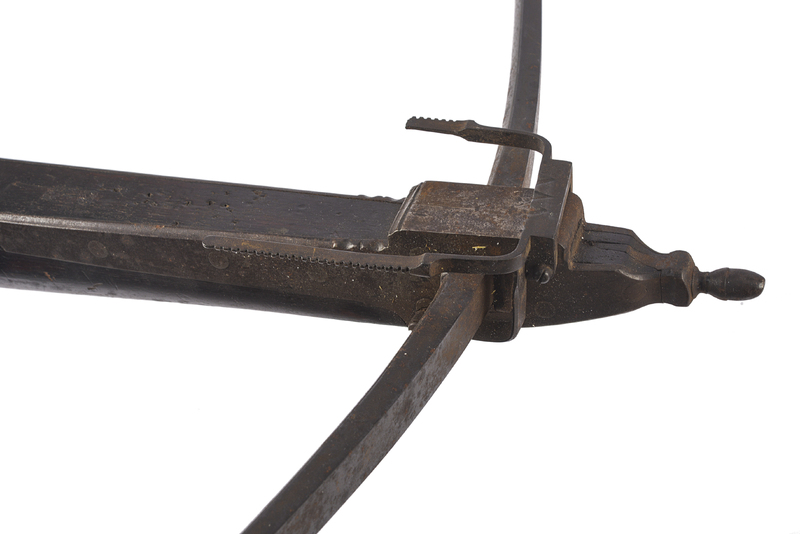
This 19th-century crossbow originates from England. It consists of a rectangular wooden stock that tapers toward the front in a carved and pointed turret (or castle) style end. Toward the butt, the stock narrows and flares out into the shape of a rifle butt. The trigger guard and the nut trigger are made of iron. The sides of the stock are fixed with iron plates. The prod is also made of metal and passes through the stock. Above the prod is a U-shaped sight that is broken on the right handle. The butt of the stock features the phrase “N. 920” on a metal plate. The crossbow is in good condition with minor damage and wear over time.
Length 81cm
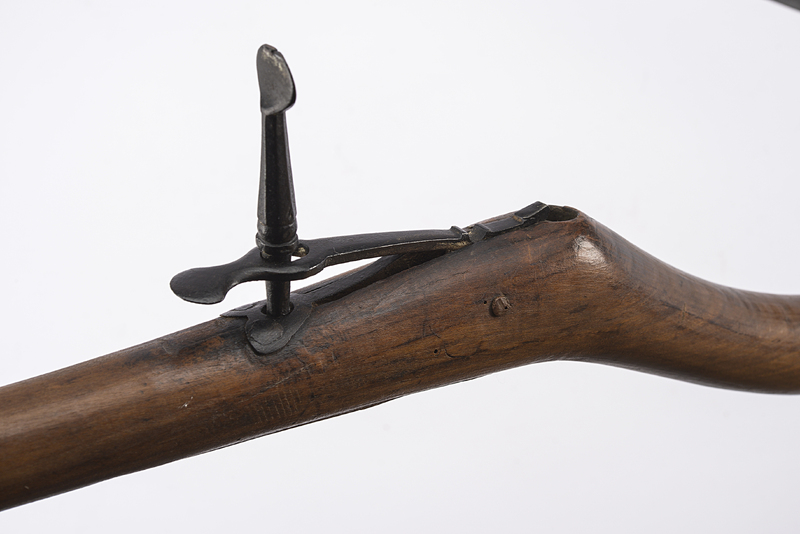
A pellet crossbow from the 18th or 19th century. It consists of a wooden stock. The shape of the stock curves downwards in the front portion and straightens in the middle before flaring into the shape of a rifle butt. At the fore end of the stock is the carved shape of a human figure’s head. On top of the stock’s front end is a U-shaped sight. The rest of the trigger mechanism is made of metal. The prod of the stock is made of steel and passes through the middle. The bow string is missing.
Measurements: Length 97cm
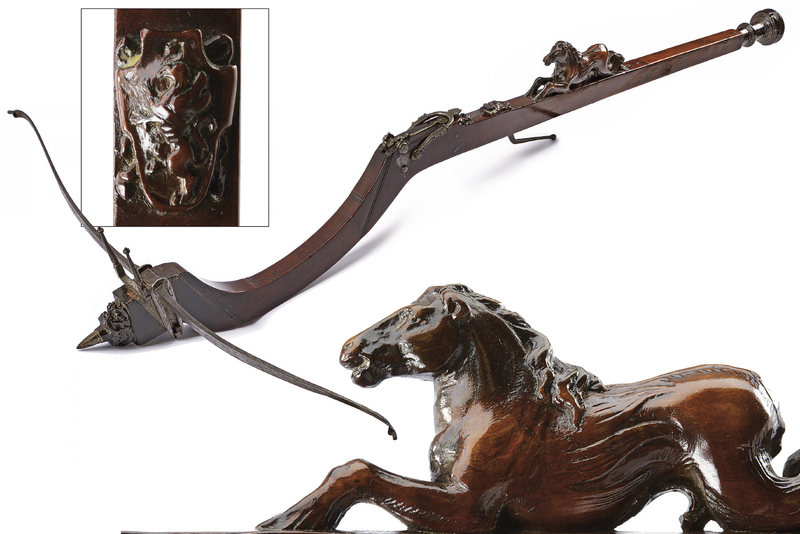
This 16th-century pellet crossbow originates from Tuscany, Italy. It features a stock made from walnut wood that dips in the front portion of the stock. The stock straightens in length toward the butt of the stock, with the exception of a carved creature with a horse’s body, but a dragon’s tail resting on it. There is a carved decoration in front of the creature, but behind the nut, that depicts a figure’s face. The trigger system is made of metal with an iron nut and an iron trigger lever. The stock turns into a sharp, pointed end at the front end, taking on a turreted shape. The butt of the stock is in an intricate, rounded knob. The prod is fixed onto the front of the stock, and above it is a U-shaped sight. The original string is missing.
Note: Elegant and light shape. Similar examples in the Spitzer collection, see "La Collection Spitzer", Tome Sixieme, plate XLIII and in the Wallace Collection, see "Wallace Collection - European Arms & Armour", Vol. II, plate 161, A 1044 and A 1046.
Length 113cm
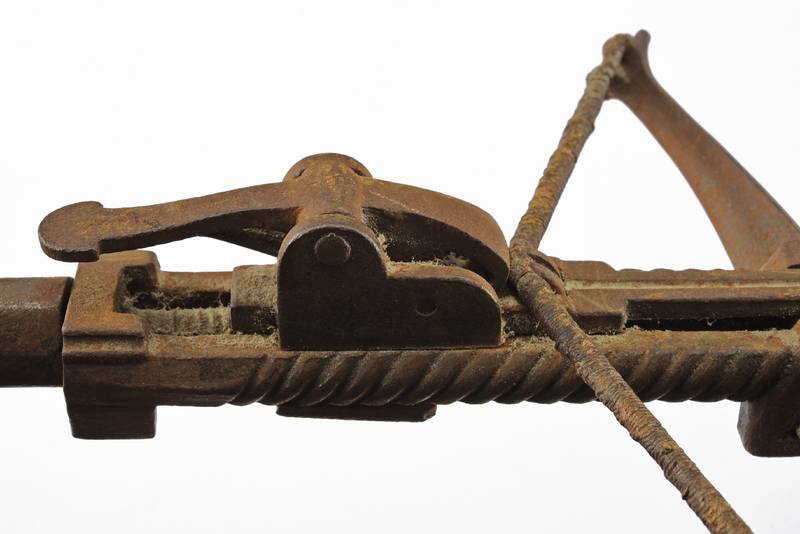
This 19th-century miniature crossbow features a cylindrical iron stock that tapers toward the front. Along the narrow front portion is a bolt groove. At the sides of the stock are iron rods that twist, possibly to give the impression of rope. On the upper surface of the crossbow is a lever mechanism for releasing the bowstring. The prod of the crossbow is made of iron and stringed with an old rope of plant fiber.
Measurements: Length 29,5cm