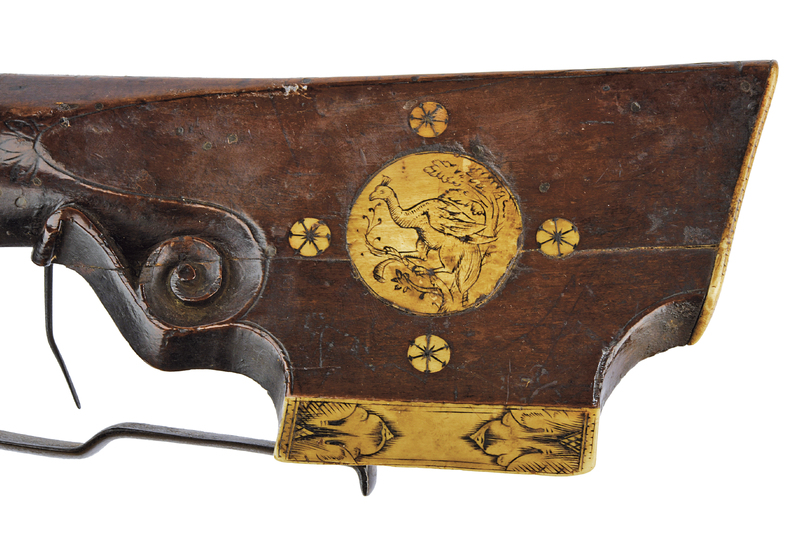
The thick wooden stock is decorated with a bone plate on top. There are bone inlays of floral motifs on the side of the stock with a medallion of a bird perched on a tree on the cheek rest. The sturdy iron prod passes through the stock and is secured by hemp cord. The bowstring is original and is composed of blackened hemp cord. A rounded suspension ring is riveted to the front of the stock. The lock mechanism is a set trigger with a simple slightly curved trigger guard. There is a metal bolt clip.
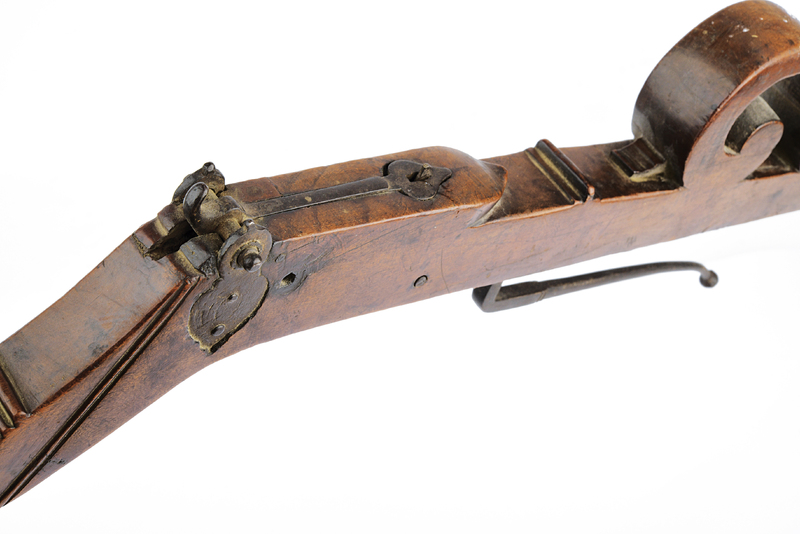
This pellet crossbow features a long wooden stock curved at the front. At the end of the stock is a simple spiral volute. The thin curved prod passes through the front of the stock and is secured with bow irons. The bowstring of twisted cord is frayed. There is a metal front sight fork but the folding rear sight is missing. There is a small spike at the front of the stock most likely used for support when spanning. The butt is rounded like a disc-shaped pommel. Simple lever trigger made of metal.
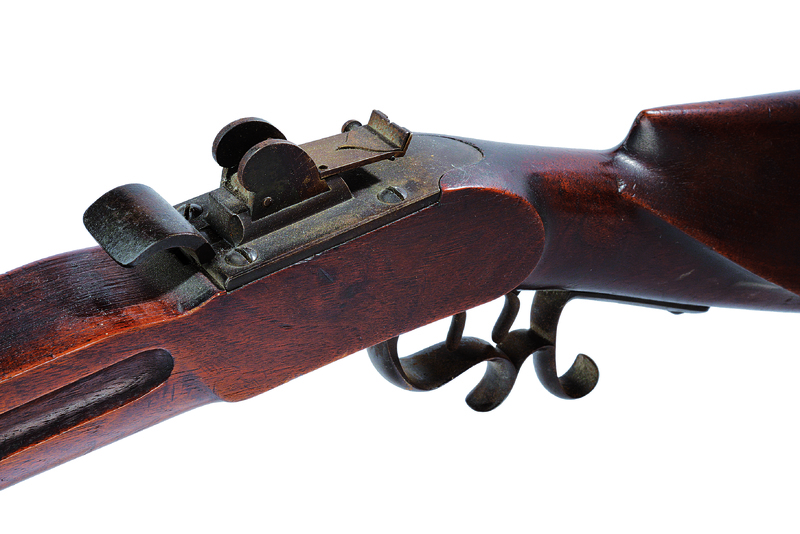
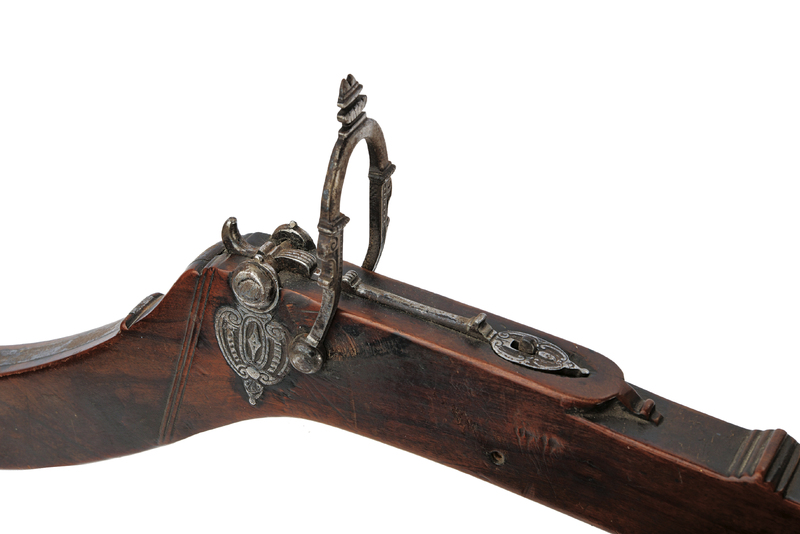
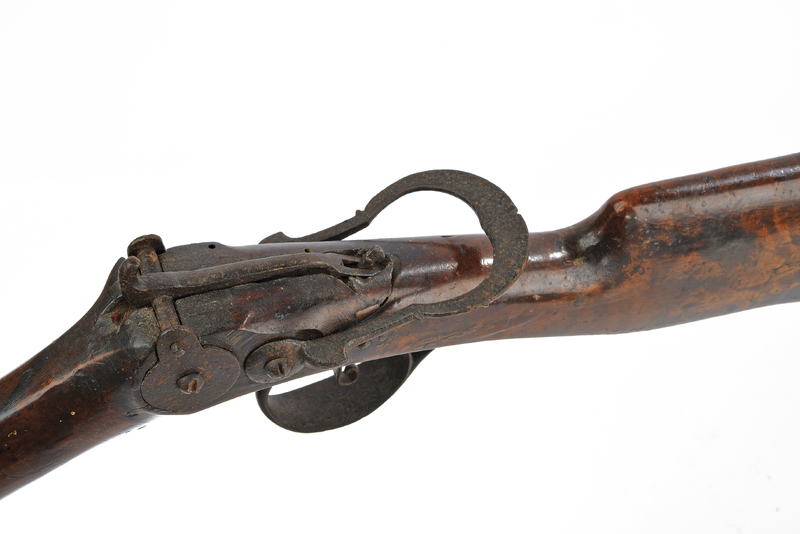
The wooden stock is square in cross-section and curves downwards at the neck of the gun-shaped butt. The iron prod is wedged into the front of the stock with a small circle suspension ring attached by screws to the top. There is a carved groove at the front of the stock for the bolt rest. There is a foldable metal rear sight. The lock mechanism is a set trigger with a harp-shaped trigger guard. On the underside of the stock at the front there is a wooden inlay with a marking of “J. BRECHTBUHL THUN” engraved. The bowstring is missing.
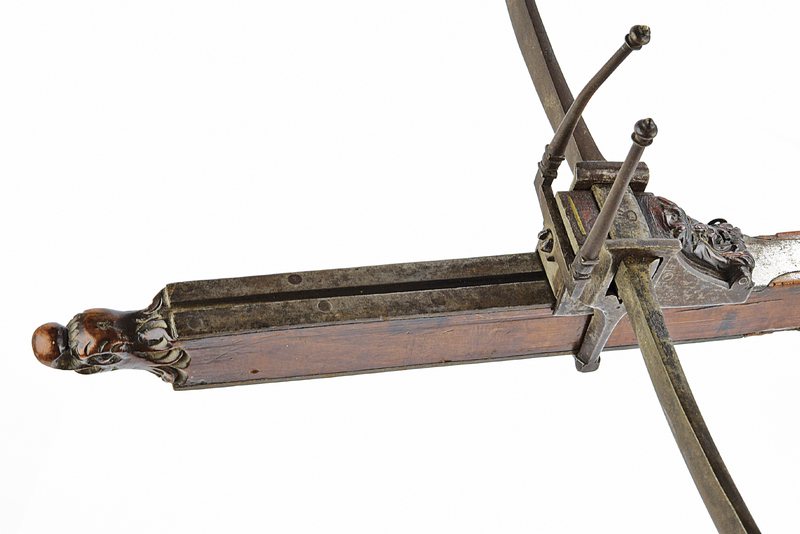
This pellet crossbow features a long wooden stock. Unlike most Italian pellet crossbows the front of the stock is straight rather than curved. The tip of the stock is the carving of a bird's head. The long curved prod secured with bow irons passes through an iron mount which is movable and adjustable on the front section of the prod. The screw for the iron mount block is missing. Behind the prod is a long mask in relief. There is a front sight fork that is slightly bent as well as a folding arched rear sight. Behind the rear sight is an iron inlay ending with a brass fleur-de-lis. Below this is the simple curved metal trigger guard. The bowstring is missing. The butt of the stock is rounded and carved into a disc-shaped pommel. The nut is made of iron. On the underside is an intricate carving of the center piece curled.
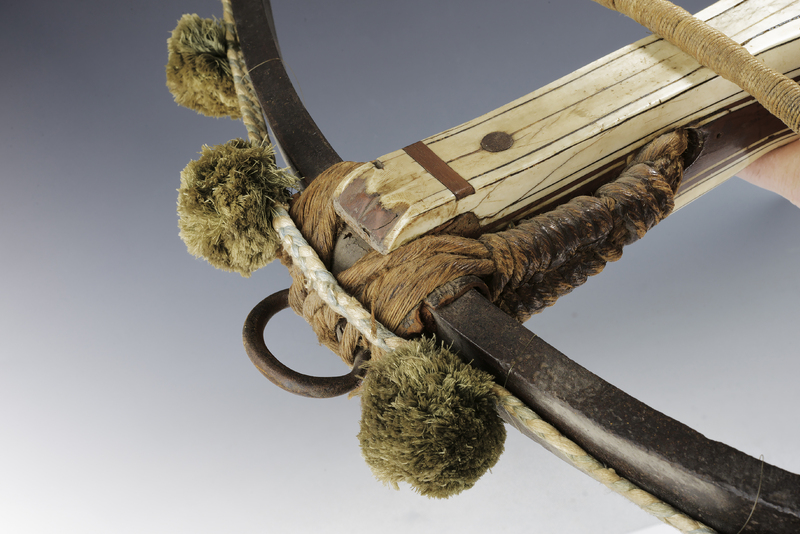
The steel prod is secured to the front of the stock with hemp string. It is corded with a yellow and green braided string that has come loose with six green pom poms on the outside of the prod. There is a circular metal suspension ring also secure to the front of the stock by hemp cord. The bowstring is made of twisted hemp cord. There is a bolt rest at the front of the stock. The wooden stock is veneered in bone on top and on the underside with simple line decorations leaving a small section of wood uncovered. The lock mechanism is a rolling nut with a nut made of bone. The end of the stock has lateral lugs to stop the cord of the cranequin. It has a simple metal trigger guard lever.
It is accompanied by an iron cranequin which has a lever with a wooden handle.
This pellet crossbow features a wooden stock curved at the front. The curved metal prod passes through the front of the stock and is secured by bow irons. The bowstring is missing. There is a front sight fork shaped with balusters and an arched decorated folding rear sight. Below the rear side is decorative metal inlays. Behind the sight on the top of the stock is a simple volute. The butt is rounded shaped like a pommel. There is a small pyramidal spike at the front of the stock most likely used for support when spanning. The trigger guard is of the lever type shaped with balusters and curved at the end.
This pellet crossbow features a wooden stock curved at the front with a gun-shaped butt. A thin curved iron bow passes through the front of the stock and is secured by bow irons. There is a bowstring with cradle made of hemp cord. The front sight fork and arched folding rear sight are made of metal. The trigger guard is rounded. A large pyramidal spike is at the front of the stock which was most likely used for support while spanning.
At the tip of the crossbow, the stock protrudes and has been carved into the shape of a dragon’s head. Then there is a forked sight, a sight made of two vertical metal sticks joined at the bottom by a horizontal metal stick which has been set into a notch in the stock. The sight appears to be made of iron.
The iron prod still has its original bowstring. As is typical for pellet crossbow bowstrings, it has wooden supports which help keep the shape or position of the complicated bowstring such that it is easier to load a pellet. The prod joins to the stock with bow irons. There is some damage to the stock right above the bow irons.
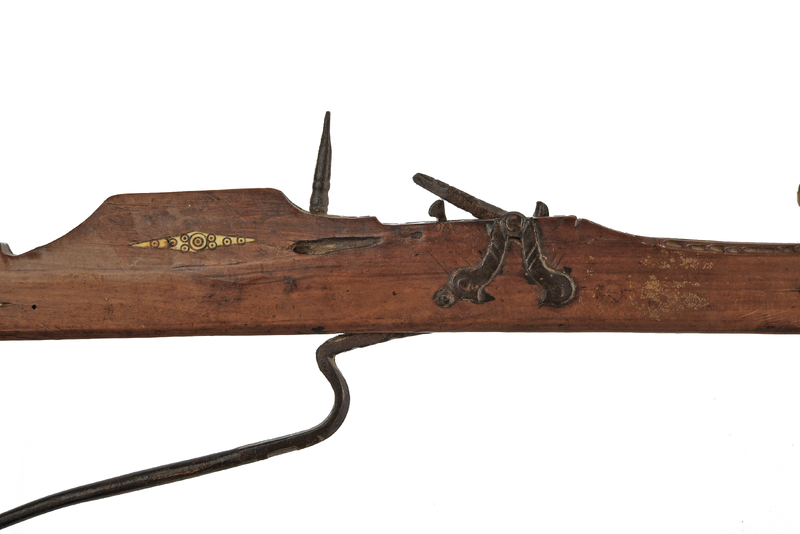
The stock is made of walnut wood. It has strips of bone inlay that have been decorated (possibly burn-marked) with designs of dark concentric circles and dots. There are small decorative carved indentations in lengthwise lines down the stock.
The stock has a slight concave curve on its topside in the area between the prod and the foldable sight.
There is a metal attachment which appears to be a foldable sight which can fold down into a little cavity in the stock. It appears to have some decorative elements in the metalwork. However, it might be the remains of a hook for the bowstring. If so, it is heavily damaged.
Just past this, there appears to be a non-foldable sight which stands up from the stock. Then, the topside of the stock shapes into a lengthwise ridge which ends in some slight carved scrollwork, after which the stock returns to a normal straight shape. This area of the stock also has bone inlays and carved indentations as previously described. The butt of the stock is in the shape of a knob or pommel.
This crossbow is rather unique. There are a set of typical traits which characterize Italian pellet crossbows as a category. This crossbow has versions of these traits which are so slight as to be remarkable. The slight concave depression in the otherwise straight stock stands in contrast to the deep half-circle curve of the typical Italian pellet crossbow. Often, this curve is so pronounced that it had to be made of a different piece of wood that had to be joined to the rest of the stock.
The carved dragon’s head at the tip of this crossbow completely diverges from the pyramidal spike typically seen on Italian pellet crossbows.
The ridge and scrollwork carved into the stock are in the place on the stock where there is typically an elaborate carving. If not elaborate, the typical carving at least protrudes prominently from the stock. The example on this crossbow is neither elaborate nor prominent.
One explanation of how minimal these traits are is that the crossbow was made by someone unfamiliar with the category of Italian pellet crossbow.
Another explanation, perhaps more likely, is that this crossbow was made by an inexperienced crossbow maker. This idea is supported by other signs of crudeness in the workmanship, for example, the circle designs on the bone inlay are often off-center and asymmetrical, the bone inlays themselves are small and sometimes imperfectly shaped, and the carved indentations also have variations. The dragon’s head at the tip of the crossbow is also quite crudely carved.
Another explanation is that the crossbow was made early in the formation of the style category of Italian pellet crossbow, such that the signature traits had not much emerged yet, nor developed to the intensity seen in other examples of the category.
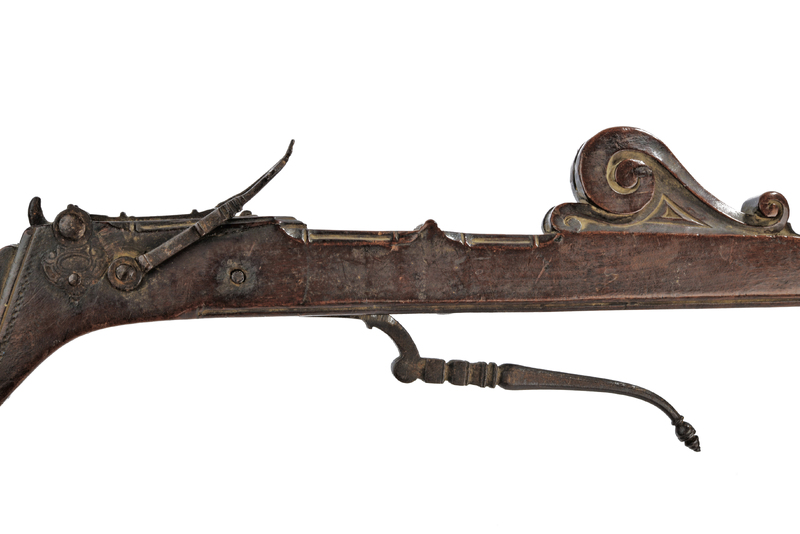
At the tip of this crossbow, there is a large pyramidal spike carved out of the wood of the stock. The iron prod connects to the wooden stock with bow irons. There is a forked sight, also probably in iron. There is a strong concave curve in the stock before it returns to a straight form. There is a foldable sight in the shape of an arch. It is probably iron. It has slight decorative elements in the metalwork. Further down the top of the stock, there is a large scrollwork carving. The rest of the stock is relatively plain and straight, and ends in a narrower shape.
Along the corners of the stock, which has a cross-section shape of a square, there are chamfers cut into the wood.
The trigger lever has square ridges around its body and ends in a knob.
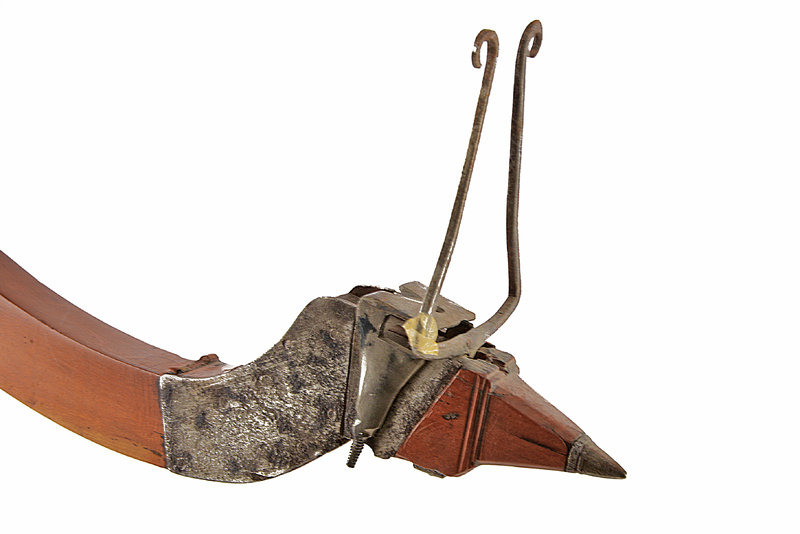
At the tip of this crossbow, there is a pyramidal wooden spike tipped with a metal cap.
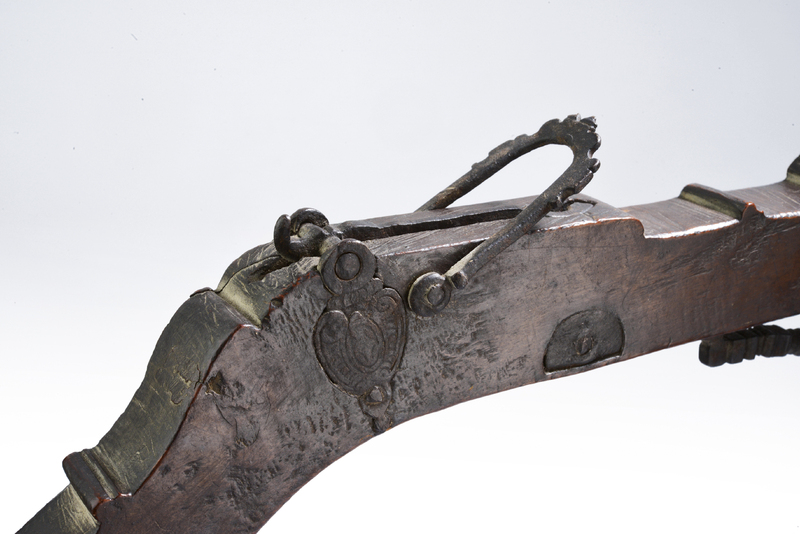
There is a forked sight with an unusual form - the two vertical metal sticks have curly ends (like the antennae often seen among the Auplopus genus of spider wasps, for example). There is a sort of metal collar around the stock here - it may be reinforcing the wood. The wooden stock then bends into a concave curve, before coming back up and returning to a straight form. At this point, there is a metal hook which folds back into the stock. It is probably the mechanism which would hold the bowstring. It is on an axle which connects to two small metal pieces. The metal pieces attach to the stock on either side. The two metal pieces have beautiful decorative elements, including their general shape and the filigree-style engravings on the surface. The metal piece on the right side of the stock is damaged. There is a foldable sight in the shape of an arch. Farther down the top of the stock, there is a large, prominent scrollwork carving protruding upwards. The rest of the stock is relatively plain, except for the butt which is in the shape of a circular knob or pommel.
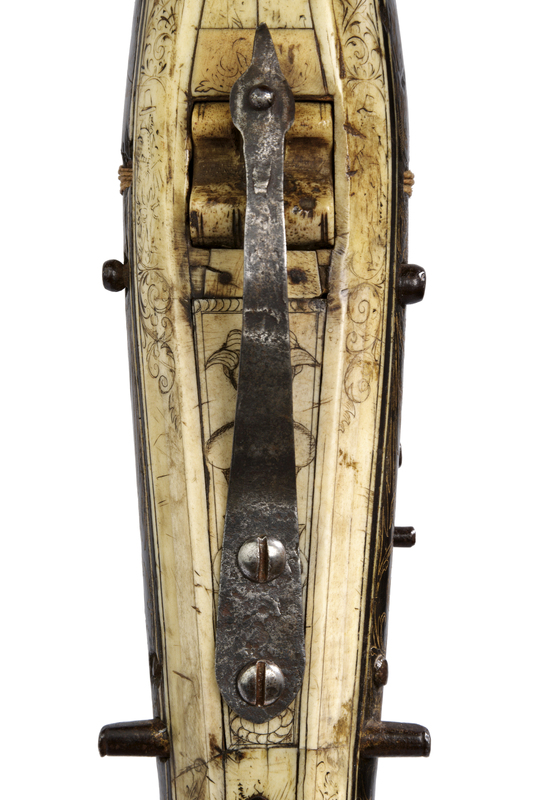
The thick iron bow is attached to the ebony stock with bindings. The topside and underside of the stock are completely plated with bone. The bone nut is held in place with a nussfaden or nut thread. Behind this, there is an iron bolt clip. After that, there are five holes in a line down the stock, which probably were used to attach a sight or two, now missing.
The auction house notes that the rope work is from a later period than the crossbow.
The ebony of the stock, exposed at the sides, has been decorated with engraving and gilding. Down the sides of the stock, there is the image of a crown and an eagle. The crown has a closed design. The design is such that the two sides could be interpreted as showing the two halves of the double-headed eagle. There are also floral designs reminiscent of the rinceaux style. There is a hunting dog and possibly other small motifs within the floral design.
On the topside of the crossbow, engraved into the bone plate, there is a grotesque or bestial figure. This figure is obscured because the bolt clip is directly on top of it. Along the edges of the bone plates which cover the top and bottom of the stock, there are designs of curling vines and foliage in the rinceaux style.
At the tip of the crossbow, there is a small blunt protrusion.
There is also a forked sight made of two vertical metal sticks. The metal prod is secured to the wooden stock with bow irons.
The stock has the downward curve typical of Italian pellet crossbows. Past this curve, on the top of the stock, there is a foldable sight in the shape of an arch. On the sides of the stock, there are plaques which likely depict an emblem, but which are worn. Further down the topside of the stock, there is some carved wooden scrollwork protruding from the top of the stock. The wooden butt is notable for its shape, which is like a fish’s tail.
On the underside of the stock, there is a decorated iron lever trigger.